
|
시장보고서
상품코드
2114701
하대정맥 필터 : 시장 점유율 분석, 업계 동향 및 통계, 성장 예측(2026-2031년)Inferior Vena Cava Filter - Market Share Analysis, Industry Trends & Statistics, Growth Forecasts (2026 - 2031) |
||||||
 Mordor Intelligence
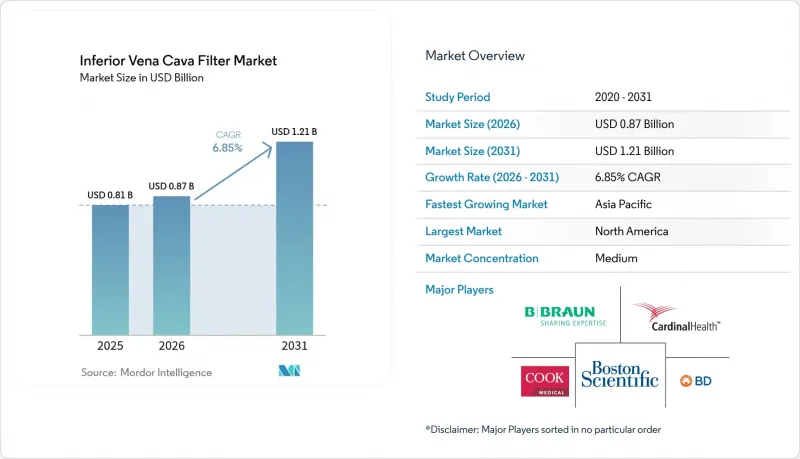
Mordor Intelligence에 의하면, 하대정맥 필터 시장은 2025년에 8억 1,000만 달러 규모로 평가되었습니다. 2026년 8억 7,000만 달러에서 2031년까지 12억 1,000만 달러에 이를 것으로 예상되며, 예측 기간(2026-2031년) CAGR은 6.85%를 나타낼 전망입니다.
본 보고서는 제품 유형(회수형 필터, 영구형 필터), 용도(정맥혈전색전증 치료, 폐색전증 예방), 최종 사용자(병원, 외래수술센터(ASC), 전문 클리닉, 기타), 지역(북미, 유럽, 아시아태평양, 중동 및 아프리카, 남미)별로 분류되어 있습니다. 시장 전망은 금액(달러) 기준으로 제시되어 있습니다.
세계의 하대정맥 필터 시장 동향 및 인사이트
정맥 혈전색전증 및 폐색전증 유병률 증가
암 관련 혈전증으로 인해, 항응고 요법이 최적화되어 있는 경우에도 폐색전증 재발률은 22.5%에 달하고 있어, 기계적 보호에 대한 지속적인 수요가 발생하고 있습니다. 고령화가 진행됨에 따라, 허약함이나 동반 질환으로 인해 약물 요법의 지속성이 제한되기 때문에 이러한 수요는 더욱 증가하고 있습니다. 다중 검출기 CT 및 듀플렉스 초음파를 통한 질환의 조기 발견으로 인해, 임상적으로 무증상인 혈전이 더 많이 검출됨에 따라 고위험군에서 하대정맥 필터 시장은 예외적인 사용에서 일상적인 사용으로 전환되고 있습니다. 인공지능(AI)은 진단 감도를 더욱 높여주며, 딥러닝 모델을 통해 이전에는 간과되었던 미세한 분절성 색전을 식별할 수 있게 되었습니다. 이러한 요인들이 복합적으로 작용하여, 일반 인구에서의 전반적인 이용률은 감소하고 있음에도 불구하고, 종양 센터에서는 두 자릿수의 시술 건수 증가세가 지속되고 있습니다.
영구형 설계에 비해 회수 가능한 필터의 채택이 증가하고 있습니다.
의사들은 이론적으로 혈전 형성 기간이 끝나면 회수가 가능하다는 이유로 회수 가능한 필터를 자주 선택하고 있습니다. 전국 데이터베이스에 따르면, 실제로 회수되는 것은 이식된 기기의 고작 15%에 불과함에도 불구하고 이러한 행동 경향이 확인되고 있습니다. 합병증 등록 데이터에서는 유해 사건의 86.8%가 회수 가능한 제품에서 기인한 것으로 나타나지만, 병원 측은 수술 전후의 유연성을 중시하여 이를 선호하여 채택하고 있습니다. 적극적인 회수 기술의 성공률은 현재 94.7%에 달하지만, 시술의 복잡성이 높아짐에 따라 수술 전후 합병증 위험은 5.3%로 상승하고 있습니다. 전자 차트에 통합된 예측 알고리즘은 회수를 위해 재방문할 가능성이 낮은 환자를 식별하는 데 도움이 되며, 의사 결정권자를 영구형 또는 생체 전환형 솔루션으로 유도하고 있습니다. 그 결과, 수요 곡선은 양극화된 경향을 보이고 있으며, 이로 인해 두 기기 분류 모두 상업적으로 중요한 위치를 유지하고 있어 하대정맥 필터 시장에 활기가 지속되고 있습니다.
의료기기와 관련된 합병증 및 제조물 책임 소송
벡톤 디킨슨(Becton Dickinson)은 진행 중인 필터 관련 소송에 대해 17억 달러의 충당금을 계상했습니다. 이는 특정 의료기기에 대한 제품 책임 충당금으로는 사상 최고액입니다. 현재도 1만 1,000건 이상의 소송이 계류 중이며, 그 내용은 이탈, 파손, 장기 천공 등 다양하지만, 이 모든 것은 삽입 기간이 길어짐에 따라 발생 위험이 높아집니다. FDA가 의무화한 시판 후 분석 결과, 이식 기간이 90일을 초과하면 천공률이 20% 이상의 것으로 밝혀져, 제거 프로그램의 개선이 시급한 과제가 되고 있습니다. 법적 리스크로 인해 제조업체는 연구개발(R&D)에서 합의금으로 자본을 전환할 수밖에 없게 되었으며, 이로 인해 제품 파이프라인의 다각화가 둔화되고, 하대정맥 필터 시장 전체의 성장 전망도 억제되고 있습니다.
부문별 분석
영구형 기기는 수익 기반은 작지만, 경제적 근거가 주목을 받으면서 2031년까지 7.55%라는 가장 높은 연평균 성장률(CAGR)을 보일 것으로 전망됩니다. 회수형 필터는 2025년에 80.65%의 시장 점유율을 차지했습니다. 영구형 하대정맥 필터 시장 규모는 평균 수명 주기 비용 2,070달러로 5.41 QALY(질 조정 생존년)를 창출하는 반면, 회수 가능한 모델은 5.33 QALY, 4,650달러인 점을 고려할 때, 시장 규모가 크게 확대될 것으로 예측됩니다. 그럼에도 불구하고, 회수형 시스템은 뿌리 깊은 임상적 선호도와 유리한 보험 급여 코드로 인해 2025년에도 지배적인 점유율을 유지하고 있습니다.
현재, 의사를 대상으로 한 교육 프로그램에서는 국내 제거율이 낮고 유해 사건 발생 빈도가 높아지고 있다는 점이 강조되고 있으며, 이에 따라 위험 관리 위원회에 기기 선정 프로토콜의 재평가를 촉구하고 있습니다. 전자 차트에 통합된 예측 점수 산정 도구는 추적 관찰을 소홀히 할 가능성이 높은 환자를 식별하여, 임상의에게 영구형 또는 생체 변환 가능한 임플란트의 채택을 권장하고 있습니다. 혈전 예방 기간이 지난 후 용해되는 초기 단계의 폴리머 기반 필터는 두 유형의 장점을 결합하여 하대정맥 필터 시장에 새로운 활력을 불어넣을 가능성이 있습니다.
지역별 분석
북미는 종합적인 보험 환급 제도와 첨단 영상 진단 인프라 덕분에 2025년 매출의 41.78%를 차지했습니다. 그러나 메디케어 청구 데이터에 따르면, 필터 삽입 건수는 2013년 4만 4,680건에서 2021년 1만 9,501건으로 급격히 감소했으며, 이는 전문가 지침의 개정과 혈전 제거술의 대체 수단 확대를 반영한 것입니다. 소송 비용은 혁신 예산을 압박하고 있지만, AI를 활용한 영상 진단 및 레지스트리와 연계된 성과 추적을 통해 중증도가 높은 종양 센터에서는 성장의 조짐이 보입니다.
아시아태평양은 연평균 성장률(CAGR) 7.9%를 기록하며 가장 빠르게 성장하고 있는 지역입니다. 중국에서는 보험 제도 개혁과 혈관 내 치료 기술에 관한 대규모 의사 연수 프로그램을 통해 수술 건수를 견인하고 있습니다. 정맥혈전색전증(VTE)의 기초 발병률은 유럽 및 미국 환자 집단보다 낮은 수준을 유지하고 있지만, 복잡한 수술 및 외상 치료의 급속한 증가로 인해 견조한 수요가 유지되고 있습니다. 일본과 한국에서는 국가의 의료비 억제 정책이 약물 예방을 중시하고 있어 시장 성숙도가 비교적 완만하지만, 그럼에도 뛰어난 안전성을 자랑하는 AI 가이드형 회수 플랫폼의 도입은 진행되고 있습니다.
유럽에서는 균형 잡힌 추세가 관찰됩니다. 독일과 영국은 통합 외상 의료 시스템을 통해 이용을 주도하는 반면, 프랑스는 종양학 분야의 적용을 우선시하고 있습니다. 중동 걸프 국가들은 의료 관광객을 위한 필터 수술에 적합한 완전 디지털화된 카테터실 확충에 투자하고 있습니다. 아프리카 시장 점유율은 아직 초기 단계에 있으며, 인프라 및 보험 급여 부족으로 인해 제약을 받고 있지만, 남아프리카공화국의 민간 부문 프로젝트가 하대정맥 필터 시장에 향후 진출하기 위한 기반을 마련하고 있습니다.
기타 혜택 :
- 엑셀 형식 시장 예측(ME) 시트
- 3개월간의 애널리스트 지원
자주 묻는 질문
목차
제1장 서론
제2장 조사 방법
제3장 주요 요약
제4장 시장 구도
제5장 시장 규모 및 성장 예측
제6장 경쟁 구도
제7장 시장 기회 및 향후 전망
KTH 26.08.28According to Mordor Intelligence, the inferior vena cava filter was valued at USD 0.81 billion in 2025 and estimated to grow from USD 0.87 billion in 2026 to reach USD 1.21 billion by 2031, at a CAGR of 6.85% during the forecast period (2026-2031). This report is Segmented by Product Type (Retrievable Filters, Permanent Filters), Application (Treatment of Venous Thrombo-Embolism, Prevention of Pulmonary Embolism), End-User (Hospitals, Ambulatory Surgical Centers, Specialty Clinics, Others), and Geography (North America, Europe, Asia-Pacific, Middle East and Africa, South America). The Market Forecasts are Provided in Terms of Value (USD).
Global Inferior Vena Cava Filter Market Trends and Insights
Rising Prevalence of Venous Thrombo-embolism & Pulmonary Embolism
Cancer-associated thrombosis drives recurrent PE rates of 22.5% even under optimized anticoagulation, creating a continual need for mechanical protection . Aging populations amplify this demand because frailty and comorbidities limit drug therapy durability. Earlier disease detection through multidetector CT and duplex ultrasound means more clinically silent clots are captured, pushing the Inferior Vena Cava Filter market toward routine rather than exceptional use in high-risk cohorts . Artificial intelligence further elevates diagnostic sensitivity, with deep-learning models identifying small, segmental emboli that were previously overlooked. Combined, these factors sustain double-digit procedural growth in oncology centers despite overall utilization decline in the general population.
Growing Adoption of Retrievable Filters Over Permanent Designs
Physicians frequently select retrievable filters because they can, in theory, be extracted once the clotting window closes. National databases confirm this behavioral bias even though only 15% of implanted devices are eventually retrieved. Complication registries attribute 86.8% of adverse events to retrievable products, yet hospitals prefer them for immediate peri-operative flexibility. Aggressive retrieval techniques now reach 94.7% success, but the higher procedural complexity elevates peri-operative complication risk to 5.3%. Predictive algorithms embedded in electronic records help identify patients unlikely to return for extraction, nudging decision-makers toward permanent or bioconvertible solutions. The net result is a mixed demand curve that keeps both device classes commercially relevant and maintains vibrancy in the Inferior Vena Cava Filter market .
Device-related Complications & Product Liability Litigation
Becton Dickinson accrued USD 1.7 billion in reserves for ongoing filter lawsuits, the highest product-specific medical-device liability provision on record. More than 11,000 cases remain active and reference migration, fracture, and organ perforation, all of which scale with indwelling time. FDA-mandated post-market analysis revealed penetrations exceeding 20% when dwell exceeded 90 days, adding urgency to improved retrieval programs. Legal exposure compels manufacturers to redirect capital from R&D to settlement funds, slowing pipeline diversification and tempering growth prospects for the wider Inferior Vena Cava Filter market.
Other drivers and restraints analyzed in the detailed report include:
- Increasing Prophylactic Use in Bariatric & Major Orthopedic Surgeries
- AI-enabled Imaging Improving Placement & Retrieval Accuracy
- Rapid Uptake of Pharmacomechanical Thrombectomy as an Alternative
For complete list of drivers and restraints, kindly check the Table Of Contents.
Segment Analysis
Permanent devices contributed a smaller revenue base but delivered the swiftest 7.55% CAGR to 2031 as economic evidence gains traction. Retreivable filters generated 80.65% market share in 2025. The Inferior Vena Cava Filter market size for permanent designs is projected to widen materially because they generate 5.41 quality-adjusted life-years at an average lifetime expenditure of USD 2,070, compared with 5.33 QALYs and USD 4,650 for retrievable models. Nonetheless, retrievable systems retain dominant 2025 share owing to deeply ingrained clinical preference and favorable reimbursement coding.
Physician education programs now highlight low national extraction rates and heightened adverse-event frequency, encouraging risk committees to reassess device selection protocols. Predictive scoring tools embedded within electronic medical records identify patients who will likely default on follow-up, directing clinicians toward permanent or bioconvertible implants. Early-phase polymer-based filters that dissolve after thrombo-protective windows may merge the advantages of both archetypes and inject fresh momentum into the Inferior Vena Cava Filter market.
Complete Report Scope:
- By Product Type
- Retrievable Filters
- Permanent Filters
- By Application
- Treatment of Venous Thrombo-embolism
- Prevention of Pulmonary Embolism
- By End-User
- Hospitals
- Ambulatory Surgical Centers
- Specialty Clinics
- Others
- By Geography
- North America
- United States
- Canada
- Mexico
- Europe
- Germany
- United Kingdom
- France
- Italy
- Spain
- Rest of Europe
- Asia-Pacific
- China
- Japan
- India
- Australia
- South Korea
- Rest of Asia-Pacific
- Middle East and Africa
- GCC
- South Africa
- Rest of Middle East and Africa
- South America
- Brazil
- Argentina
- Rest of South America
- North America
Geography Analysis
North America accounted for 41.78% of 2025 revenue because of comprehensive reimbursement coverage and advanced imaging infrastructure. Medicare claims nevertheless show a steep decline in filter placements from 44,680 in 2013 to 19,501 in 2021, reflecting revised professional guidance and expanding thrombectomy alternatives. Litigation costs stifle innovation budgets, but AI-enabled imaging and registry-linked performance tracking nurture pockets of growth in high-acuity oncology centers.
Asia-Pacific is the fastest-growing territory with an 7.9% CAGR. China drives volume via insurance reform and large-scale physician-training programs in endovascular techniques. Baseline VTE incidence remains lower than Western cohorts; nonetheless, rapid growth in complex surgeries and trauma care sustains healthy demand. Japan and South Korea mature more slowly because national cost-containment policies emphasize pharmacological prophylaxis, yet they still adopt AI-guided retrieval platforms that showcase superior safety.
Europe exhibits balanced dynamics. Germany and the United Kingdom lead utilization through integrated trauma systems, while France prioritizes oncology indications. Middle Eastern Gulf states invest in fully digital cath-lab expansions that favor filter procedures for medical tourists. Africa's share is embryonic, limited by infrastructure and reimbursement shortfalls, but private-sector projects in South Africa lay groundwork for future participation in the Inferior Vena Cava Filter market.
- Becton, Dickinson & Co. (C. R. Bard)
- Cook Group
- Boston Scientific
- B. Braun
- Cardinal Health
- Argon Medical Devices
- ALN Implants
- Adient Medical
- Braile Biomedica
- Philips IGT Devices (Volcano)
- Lifetech Scientific
- Terumo Corp.
- Merit Medical Systems
- MicroPort
- Nipro Medical
- Artivion (formerly CryoLife)
- Kaneka Medix
- Shanghai Kindly Medical
- Q3 Medical Devices
- Venus Medtech
Additional Benefits:
- The market estimate (ME) sheet in Excel format
- 3 months of analyst support
TABLE OF CONTENTS
1 Introduction
- 1.1 Study Assumptions & Market Definition
- 1.2 Scope of the Study
2 Research Methodology
3 Executive Summary
4 Market Landscape
- 4.1 Market Overview
- 4.2 Market Drivers
- 4.2.1 Rising prevalence of venous thrombo-embolism (VTE) & pulmonary embolism (PE)
- 4.2.2 Growing adoption of retrievable filters over permanent designs
- 4.2.3 Increasing prophylactic use in bariatric & major orthopedic surgeries
- 4.2.4 Biodegradable polymer-based filters entering clinical pipelines
- 4.2.5 AI-enabled imaging improving placement & retrieval accuracy
- 4.2.6 Higher PE recurrence in oncology patients driving filter usage
- 4.3 Market Restraints
- 4.3.1 Device-related complications & product liability litigation
- 4.3.2 Restrictive professional-society guidelines lowering prophylactic indications
- 4.3.3 Rapid uptake of pharmacomechanical thrombectomy as an alternative
- 4.3.4 Limited reimbursement for filter retrieval in many health systems
- 4.4 Value / Supply-Chain Analysis
- 4.5 Regulatory Landscape
- 4.6 Technological Outlook
- 4.7 Porters Five Forces Analysis
- 4.7.1 Threat of New Entrants
- 4.7.2 Bargaining Power of Buyers
- 4.7.3 Bargaining Power of Suppliers
- 4.7.4 Threat of Substitute Products
- 4.7.5 Intensity of Competitive Rivalry
5 Market Size & Growth Forecasts (Value, USD)
- 5.1 By Product Type
- 5.1.1 Retrievable Filters
- 5.1.2 Permanent Filters
- 5.2 By Application
- 5.2.1 Treatment of Venous Thrombo-embolism
- 5.2.2 Prevention of Pulmonary Embolism
- 5.3 By End-User
- 5.3.1 Hospitals
- 5.3.2 Ambulatory Surgical Centers
- 5.3.3 Specialty Clinics
- 5.3.4 Others
- 5.4 By Geography
- 5.4.1 North America
- 5.4.1.1 United States
- 5.4.1.2 Canada
- 5.4.1.3 Mexico
- 5.4.2 Europe
- 5.4.2.1 Germany
- 5.4.2.2 United Kingdom
- 5.4.2.3 France
- 5.4.2.4 Italy
- 5.4.2.5 Spain
- 5.4.2.6 Rest of Europe
- 5.4.3 Asia-Pacific
- 5.4.3.1 China
- 5.4.3.2 Japan
- 5.4.3.3 India
- 5.4.3.4 Australia
- 5.4.3.5 South Korea
- 5.4.3.6 Rest of Asia-Pacific
- 5.4.4 Middle East and Africa
- 5.4.4.1 GCC
- 5.4.4.2 South Africa
- 5.4.4.3 Rest of Middle East and Africa
- 5.4.5 South America
- 5.4.5.1 Brazil
- 5.4.5.2 Argentina
- 5.4.5.3 Rest of South America
- 5.4.1 North America
6 Competitive Landscape
- 6.1 Market Concentration
- 6.2 Market Share Analysis
- 6.3 Company Profiles (includes Global level Overview, Market level overview, Core Segments, Financials as available, Strategic Information, Market Rank/Share for key companies, Products & Services, and Recent Developments)
- 6.3.1 Becton, Dickinson & Co. (C. R. Bard)
- 6.3.2 Cook Medical
- 6.3.3 Boston Scientific Corp.
- 6.3.4 B. Braun Melsungen AG
- 6.3.5 Cordis (Cardinal Health)
- 6.3.6 Argon Medical Devices
- 6.3.7 ALN Implants
- 6.3.8 Adient Medical
- 6.3.9 Braile Biomedica
- 6.3.10 Philips IGT Devices (Volcano)
- 6.3.11 Lifetech Scientific
- 6.3.12 Terumo Corp.
- 6.3.13 Merit Medical Systems
- 6.3.14 MicroPort Scientific
- 6.3.15 Nipro Medical
- 6.3.16 Artivion (formerly CryoLife)
- 6.3.17 Kaneka Medix
- 6.3.18 Shanghai Kindly Medical
- 6.3.19 Q3 Medical Devices
- 6.3.20 Venus Medtech
7 Market Opportunities & Future Outlook
- 7.1 White-space & Unmet-Need Assessment