

|
시장보고서
상품코드
2114710
뇌척수액(CSF) 관리 시장 : 시장 점유율 분석, 업계 동향 및 통계, 성장 예측(2026-2031년)Cerebrospinal Fluid Management - Market Share Analysis, Industry Trends & Statistics, Growth Forecasts (2026 - 2031) |
||||||
 Mordor Intelligence
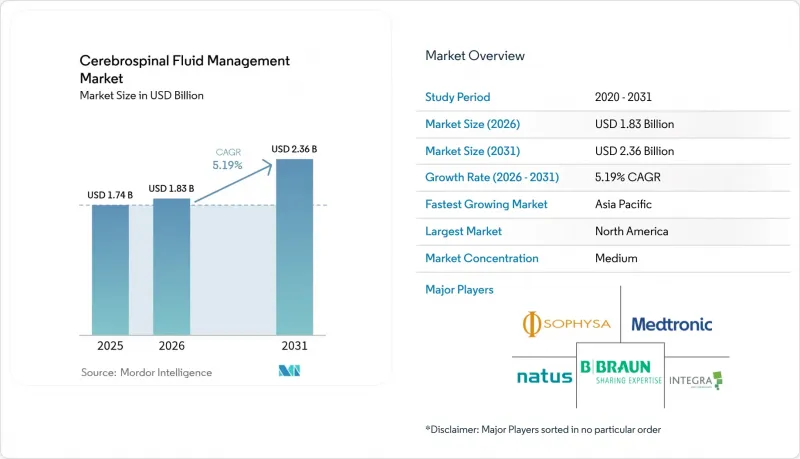
Mordor Intelligence에 의하면, 뇌척수액(CSF) 관리 시장 규모는 2025년에 17억 4,000만 달러로 평가되었고 2026년 18억 3,000만 달러에서 2031년까지 23억 6,000만 달러에 이를 것으로 예측되며, 예측 기간(2026년-2031년) CAGR은 5.19%를 나타낼 전망입니다.
본 보고서는 제품별(션트, 외부 뇌실 배액 시스템, 두개내압 모니터링 장치, 부속품·소모품), 환자 연령대별(소아 : 0-17세, 성인 : 18-64세, 고령자 : 65세 이상), 최종 사용자별(병원 등), 지역별(북미, 유럽, 아시아태평양 등)로 분류되어 있습니다. 시장 예측은 금액(달러) 기준으로 제시되어 있습니다.
세계의 뇌척수액(CSF) 관리 시장 동향 및 인사이트
수두증 및 두개내압 상승증의 부담 증가
세계적으로 볼 때, 70세 인구의 1.5%가 정상압 수두증을 앓고 있으며, 이는 중재 대상이 될 수 있는 미진단 환자가 다수 존재함을 나타냅니다. 이 질환은 현재 글림파틱 계통의 조절 장애 및 정맥 유출 장애도 포함하게 되었으며, 임상의들은 다각적인 모니터링 접근법을 채택하고 있습니다. 저·중소득 지역에서는 소아 사례의 10.7%가 여전히 감염 후 요인에 기인하고 있어, 지역 특유의 제품 수요를 창출하고 있습니다. 션트 감염으로 인한 1건당 비용은 중앙값 기준 2만 8,686달러에 달하기 때문에 보험사들은 재수술 위험을 줄여주는 기술을 점점 더 지지하고 있습니다. 의료 시스템에서는 선별 검사 및 다학제적 협력 클리닉이 확충되고 있지만, 여전히 충족되지 않은 수요가 크며, 이로 인해 뇌척수액(CSF) 관리 시장은 꾸준히 확대되고 있습니다.
저침습 신경내시경술 및 션트 없는 ETV/CPC의 도입 확대
맥락막 소작을 동반한 내시경 하 제3뇌실 개창술은 다기관 코호트 연구에서 6개월 시점의 성공률이 76%로 나타났습니다. 션트 수술에 비해 감염률이 현저히 낮아지며, 평생 의료기기에 의존해야 하는 문제도 해소됩니다. 태아기 이후의 척수막류 교정술에서 ETV/CPC의 실패율은 17%인 반면, 뇌실-복강 션트의 경우 86%이며, 실패까지의 기간 중앙값은 17.5개월로 연장되었습니다. 현재 외과의사들은 고해상도 내시경과 유연한 기구를 활용하여 적응증에 해당하는 연령 범위를 넓히고 있지만, 치료 성과는 여전히 시술자의 훈련 수준에 좌우됩니다. 보험사가 재수술률이 낮다는 점을 높이 평가하게 됨에 따라, 뇌척수액(CSF) 관리 시장에서 내시경적 치료법에 대한 수요가 증가하고 있습니다.
기존 션트 시스템의 높은 재수술률과 실패율
12개월 이내의 실패율은 40%에 육박하며, 그 주된 원인은 폐색, 감염 또는 단선입니다. 한 소아 의료 센터에서는 총 실패율이 31.2%로 보고되었으며, 재수술을 통한 션트 치료 결과는 초회 수술보다 열악합니다. 감염 1건당 비용은 2만 8,686달러에 달하며, 환자는 평생 평균 10회의 재수술을 받습니다. 현재 항생제 함침 카테터를 통해 감염률은 4.0%에서 1.2%로 감소했으나, 기계적 폐색은 여전히 주요 문제로 남아 있습니다. ReFlow 플러싱 카테터는 초기 코호트에서 4년 동안 재수술 건수를 14건에서 1건으로 감소시켜 어느 정도 개선을 가져왔습니다.
부문 분석
2025년에는 션트가 매출의 65.25%를 차지했으며, 뇌척수액 분류에서 그 확고한 역할이 부각되었습니다. 수요 면에서는 뇌실-복강 션트가 주도적이지만, 임상의들이 비수술적 압력 조절을 선호하는 경향이 있어 조절 가능한 밸브가 장착된 모델이 가장 빠르게 성장하고 있습니다. 두개내압 모니터링 장치는 연평균 성장률(CAGR) 6.78%로 성장하고 있으며, 프로그래밍 가능한 밸브와 세트로 판매되는 이점을 누리고 있어 뇌척수액(CSF) 관리 시장 전체를 확대되고 있습니다. 외측 뇌실 배액은 외상이나 감염 후의 사례에서 여전히 중요한 도구로 자리 잡고 있으며, 항생제 코팅 카테터용 액세서리 사업의 안정적인 수요를 뒷받침하고 있습니다.
CereVasc사가 주도하는 혈관 내 션트 개념은 입원 기간 단축과 외래 환자에서의 이식을 목표로 하고 있으나, 대규모 도입 여부는 주요 임상시험 결과에 달려 있습니다. 플러싱 어댑터와 같은 부속품은 예방적 유지보수라는 틈새 시장을 창출하고 있으며, 기기의 수명을 연장할 가능성이 있습니다. 션트용 소모품 분야의 뇌척수액(CSF) 관리 시장 규모는 도입 대수와 연동될 것으로 예상되며, 차세대 솔루션이 등장하더라도 지속적인 수익을 가져다줄 것으로 전망됩니다.
지역별 분석
북미는 선진적인 보험 환급 체계, 치밀한 신경외과 네트워크, 그리고 텔레메트리 밸브의 조기 도입을 배경으로 2025년 매출의 37.28%를 차지했습니다. 미국에서는 여러 FDA 브레이크스루 프로젝트가 진행 중이며, 차세대 임플란트의 도입이 가속화되면서 뇌척수액(CSF) 관리 시장에서 지역적 리더십을 확고히 하고 있습니다. 캐나다는 션트 교체 수술 비용을 지원하는 국민건강보험 제도의 혜택을 받고 있지만, AI 진단 도입 면에서는 뒤처져 있습니다.
유럽은 2위를 차지하고 있으며, 독일에서는 정상압 수두증 진단 건수가 48% 증가했으나, 이는 발병률의 변화라기보다는 검출 능력의 향상을 시사합니다. 각국의 의료 제도는 프로그래밍 가능한 밸브에 대한 자금 지원을 폭넓게 실시하고 있지만, 조달 주기는 다년 계약을 선호하는 경향이 있어, 이로 인해 제품 업데이트 속도가 늦어질 가능성이 있습니다. 영국의 의료 기관에서는 외래 환자 대상 ETV(경비강 판막 교체술) 클리닉의 시범 운영이 진행되고 있으며, 이는 유럽 대륙 전체에서 최소 침습 치료에 대한 선호도를 높이고 있습니다.
아시아태평양은 중국의 병원 확충과 일본의 급속한 고령화에 힘입어 연평균 성장률(CAGR) 7.02%로 가장 빠르게 성장하고 있는 지역입니다. 남아시아 및 동남아시아에서는 여전히 감염 후 뇌수종 문제가 과제로 남아 있어, 저비용 뇌실-복강 션트에 대한 수요가 유지되고 있습니다. 동시에, 한국과 같은 고소득 하위 지역에서는 텔레메트리 밸브 도입이 진행되고 있어, 해당 지역의 뇌척수액(CSF) 관리 시장이 확대되고 있습니다. 펠로우십 연수를 지원하는 정부의 역량 개발 프로그램 덕분에 외과 의사 부족 현상은 서서히 해소되고 있습니다.
라틴아메리카에서는 브라질의 3차 의료기관이 항균 카테터를 도입하는 등 완만한 진전이 나타나고 있으나, 보험 급여 제도의 불균형으로 인해 기술의 균일한 보급이 제한되고 있습니다. 중동 및 아프리카는 심각한 인력 부족에 직면해 있으며, 중앙아프리카의 경우 인구 220만 명당 평균 1명의 뇌신경외과 의사만 있습니다. 의료 접근성을 확대하기 위해서는 국제 원조 활동, 민관 파트너십, 그리고 저비용 의료기기의 혁신이 필수적입니다. 이러한 공동 노력을 통해 치료 격차가 줄어들고 시장의 점진적인 성장이 촉진될 것으로 기대됩니다.
기타 혜택 :
- 엑셀 형식 시장 예측(ME) 시트
- 3개월간의 애널리스트 지원
자주 묻는 질문
목차
제1장 서론
제2장 조사 방법
제3장 주요 요약
제4장 시장 구도
제5장 시장 규모 및 성장 예측
제6장 경쟁 구도
제7장 시장 기회 및 향후 전망
AJY 26.08.26According to Mordor Intelligence, the cerebrospinal fluid management market size was valued at USD 1.74 billion in 2025 and estimated to grow from USD 1.83 billion in 2026 to reach USD 2.36 billion by 2031, at a CAGR of 5.19% during the forecast period (2026-2031).
This report is Segmented by Product (Shunts, External Ventricular Drainage Systems, Intracranial Pressure Monitoring Devices, Accessories & Consumables), Patient Age Group (Pediatric 0-17 Yrs, Adult 18-64 Yrs, Geriatric 65+ Yrs), End User (Hospitals, and More), and Geography (North America, Europe, Asia-Pacific, and More). The Market Forecasts are Provided in Terms of Value (USD).
Global Cerebrospinal Fluid Management Market Trends and Insights
Increasing Burden of Hydrocephalus & Intracranial Hypertension
Globally, normal pressure hydrocephalus affects 1.5% of people aged 70 years, underscoring a large pool of undiagnosed candidates for intervention. The disease now encompasses glymphatic dysregulation and venous outflow disturbances, pushing clinicians toward multimodal monitoring approaches. In low- and middle-income regions, post-infectious etiologies still account for 10.7% of pediatric cases, creating region-specific product demand. Shunt infections cost a median USD 28,686 per episode, so payers increasingly endorse technologies that cut revision risk. Health systems have expanded screening and multidisciplinary clinics, yet unmet need remains significant, enabling steady expansion of the cerebrospinal fluid management market.
Growing Adoption of Minimally Invasive Neuro-Endoscopy & Shuntless ETV/CPC
Endoscopic third ventriculostomy with choroid plexus cauterization shows 76% 6-month success in multi-center cohorts. Infection rates drop markedly compared with shunting, and dependence on lifelong hardware is eliminated. In post-fetal myelomeningocele repair, ETV/CPC records 17% failure versus 86% for ventriculoperitoneal shunts, extending median time to failure to 17.5 months. Surgeons now leverage HD endoscopes and flexible instruments that broaden the eligible age window, though outcomes still hinge on operator training. With payers rewarding lower revision incidence, demand for endoscopic solutions is rising in the cerebrospinal fluid management market.
High Revision and Failure Rates of Traditional Shunt Systems
Failure approaches 40% within 12 months, largely due to blockage, infection, or disconnection. One pediatric center reported 31.2% total failures, with revision shunts faring worse than initial procedures. Each infection episode costs USD 28,686, and patients undergo an average of 10 lifetime revisions. Antibiotic-impregnated catheters now cut infection from 4.0% to 1.2%, yet mechanical occlusion persists as a dominant issue. ReFlow flushing catheters reduced revisions from 14 down to 1 over 4 years in early cohorts, offering partial relief.
Other drivers and restraints analyzed in the detailed report include:
- Advances in Smart Programmable Shunts with Telemetric ICP Monitoring
- Rising Geriatric Population Susceptible to Normal Pressure Hydrocephalus
- Lack of Neurosurgical Capacity in Low-Income Regions
For complete list of drivers and restraints, kindly check the Table Of Contents.
Segment Analysis
Shunts generated 65.25% of revenue in 2025, underscoring their entrenched role in cerebrospinal fluid diversion. Ventriculoperitoneal models lead volume demand, though adjustable valves are expanding quickest as clinicians prioritize non-surgical pressure tweaks. Intracranial pressure monitoring devices, growing at a 6.78% CAGR, are benefitting from bundled sales with programmable valves, thereby enlarging the overall cerebrospinal fluid management market. External ventricular drains continue as critical tools in trauma and post-infectious cases, supporting a steady accessories business for antibiotic-coated catheters.
Endovascular shunting concepts led by CereVasc aim to shorten hospital stays and enable outpatient implantation, but large-scale adoption hinges on pivotal trial outcomes. Accessories such as flushing adapters are creating preventive maintenance niches and could lengthen device lifecycles. The cerebrospinal fluid management market size for shunt consumables is expected to track the installed base, providing recurring revenue even as next-generation solutions emerge.
Complete Report Scope:
- By Product
- Shunts
- By Valve
- Adjustable Valve Shunts
- Monopressure / Fixed Valve Shunts
- By Type
- Ventriculoperitoneal (VP) Shunts
- Ventriculoatrial (VA) Shunts
- Lumboperitoneal (LP) Shunts
- Ventriculopleural (VPL) Shunts
- By Valve
- External Ventricular Drainage (EVD) Systems
- Intracranial Pressure (ICP) Monitoring Devices
- Accessories & Consumables
- Shunts
- By Patient Age Group
- Pediatric (0-17 yrs)
- Adult (18-64 yrs)
- Geriatric (65+ yrs)
- By End User
- Hospitals
- Ambulatory Surgical Centers
- Specialty Clinics & Neurology Centers
- By Geography
- North America
- United States
- Canada
- Mexico
- Europe
- Germany
- United Kingdom
- France
- Italy
- Spain
- Rest of Europe
- Asia-Pacific
- China
- Japan
- India
- Australia
- South Korea
- Rest of Asia-Pacific
- Middle East & Africa
- GCC
- South Africa
- Rest of Middle East & Africa
- South America
- Brazil
- Argentina
- Rest of South America
- North America
Geography Analysis
North America held 37.28% of 2025 revenue on the back of advanced reimbursement frameworks, dense neurosurgical networks, and early uptake of telemetric valves. The United States hosts multiple FDA breakthrough projects, accelerating introduction of next-generation implants and consolidating regional leadership in the cerebrospinal fluid management market. Canada benefits from universal coverage that funds shunt replacements but lags in AI diagnostic adoption.
Europe ranks second, with Germany exhibiting a 48% rise in normal pressure hydrocephalus diagnoses, signaling improved detection rather than incidence shift. National health systems finance programmable valves extensively, though procurement cycles favor multi-year tenders that can slow product refresh rates. United Kingdom centers are piloting outpatient ETV clinics, reinforcing the continent's tilt toward minimally invasive care.
Asia-Pacific is the fastest-growing region at 7.02% CAGR, driven by China's hospital expansion and Japan's rapid aging. Post-infectious hydrocephalus still burdens South and South-East Asia, sustaining demand for low-cost ventriculoperitoneal shunts. Simultaneously, high-income subregions like South Korea procure telemetric valves, broadening the regional cerebrospinal fluid management market. Government capacity-building programs that sponsor fellowship training are gradually reducing surgeon shortages.
Latin America shows moderate progress as Brazilian tertiary centers adopt antibiotic catheters, yet heterogeneous reimbursement limits uniform technology diffusion. Middle East and Africa face acute workforce scarcity, with Central Africa averaging one neurosurgeon per 2.2 million people. International aid missions, public-private partnerships, and low-cost device innovations are vital to expand access. Collective efforts are expected to narrow the treatment gap and spur incremental market growth.
- Medtronic
- B. Braun
- Integra LifeSciences Holdings Corp.
- Sophysa SA
- Natus Medical
- Aesculap Inc. (B. Braun)
- Spiegelberg
- Miethke GmbH & Co. KG
- Fuji Systems Corp.
- Moller Medical GmbH
- CereVasc Inc.
- Adeor Medical
- G. SURGIWEAR Ltd
- Phoenix Medical Systems
- DePuy Synthes
- Codman Neuro (Integra)
- Dispomedica GmbH
- Raumedic
- Tokibo Co., Ltd.
- Mindray Bio-Medical Electronics
Additional Benefits:
- The market estimate (ME) sheet in Excel format
- 3 months of analyst support
TABLE OF CONTENTS
1 Introduction
- 1.1 Study Assumptions & Market Definition
- 1.2 Scope of the Study
2 Research Methodology
3 Executive Summary
4 Market Landscape
- 4.1 Market Overview
- 4.2 Market Drivers
- 4.2.1 Increasing Burden of Hydrocephalus & Intracranial Hypertension
- 4.2.2 Growing Adoption of Minimally Invasive Neuro-Endoscopy & Shuntless ETV/CPC
- 4.2.3 Advances in Smart Programmable Shunts with Telemetric ICP Monitoring
- 4.2.4 Rising Geriatric Population Susceptible to Normal-Pressure Hydrocephalus
- 4.2.5 Expanding Reimbursement for CSF Diversion Procedures in Emerging Markets
- 4.2.6 Emerging Endovascular eShunt & Reflow Devices Reducing Revision Surgeries
- 4.3 Market Restraints
- 4.3.1 High Revision and Failure Rates of Traditional Shunt Systems
- 4.3.2 Lack of Neurosurgical Capacity in Low-Income Regions
- 4.3.3 Infection Risk Associated with External Ventricular Drainage
- 4.3.4 Supply-Chain Dependency on Silicone & Rare-Earth Magnets for Valve Assemblies
- 4.4 Porter's Five Forces Analysis
- 4.4.1 Threat of New Entrants
- 4.4.2 Bargaining Power of Buyers
- 4.4.3 Bargaining Power of Suppliers
- 4.4.4 Threat of Substitutes
- 4.4.5 Intensity of Competitive Rivalry
5 Market Size & Growth Forecasts (Value in USD)
- 5.1 By Product
- 5.1.1 Shunts
- 5.1.1.1 By Valve
- 5.1.1.1.1 Adjustable Valve Shunts
- 5.1.1.1.2 Monopressure / Fixed Valve Shunts
- 5.1.1.2 By Type
- 5.1.1.2.1 Ventriculoperitoneal (VP) Shunts
- 5.1.1.2.2 Ventriculoatrial (VA) Shunts
- 5.1.1.2.3 Lumboperitoneal (LP) Shunts
- 5.1.1.2.4 Ventriculopleural (VPL) Shunts
- 5.1.1.1 By Valve
- 5.1.2 External Ventricular Drainage (EVD) Systems
- 5.1.3 Intracranial Pressure (ICP) Monitoring Devices
- 5.1.4 Accessories & Consumables
- 5.1.1 Shunts
- 5.2 By Patient Age Group
- 5.2.1 Pediatric (0-17 yrs)
- 5.2.2 Adult (18-64 yrs)
- 5.2.3 Geriatric (65+ yrs)
- 5.3 By End User
- 5.3.1 Hospitals
- 5.3.2 Ambulatory Surgical Centers
- 5.3.3 Specialty Clinics & Neurology Centers
- 5.4 By Geography
- 5.4.1 North America
- 5.4.1.1 United States
- 5.4.1.2 Canada
- 5.4.1.3 Mexico
- 5.4.2 Europe
- 5.4.2.1 Germany
- 5.4.2.2 United Kingdom
- 5.4.2.3 France
- 5.4.2.4 Italy
- 5.4.2.5 Spain
- 5.4.2.6 Rest of Europe
- 5.4.3 Asia-Pacific
- 5.4.3.1 China
- 5.4.3.2 Japan
- 5.4.3.3 India
- 5.4.3.4 Australia
- 5.4.3.5 South Korea
- 5.4.3.6 Rest of Asia-Pacific
- 5.4.4 Middle East & Africa
- 5.4.4.1 GCC
- 5.4.4.2 South Africa
- 5.4.4.3 Rest of Middle East & Africa
- 5.4.5 South America
- 5.4.5.1 Brazil
- 5.4.5.2 Argentina
- 5.4.5.3 Rest of South America
- 5.4.1 North America
6 Competitive Landscape
- 6.1 Market Concentration
- 6.2 Market Share Analysis
- 6.3 Company Profiles (includes Global level Overview, Market level overview, Core Segments, Financials as available, Strategic Information, Market Rank/Share for key companies, Products & Services, and Recent Developments)
- 6.3.1 Medtronic
- 6.3.2 B. Braun Melsungen AG
- 6.3.3 Integra LifeSciences Holdings Corp.
- 6.3.4 Sophysa SA
- 6.3.5 Natus Medical Inc.
- 6.3.6 Aesculap Inc. (B. Braun)
- 6.3.7 Spiegelberg GmbH & Co. KG
- 6.3.8 Miethke GmbH & Co. KG
- 6.3.9 Fuji Systems Corp.
- 6.3.10 Moller Medical GmbH
- 6.3.11 CereVasc Inc.
- 6.3.12 Adeor Medical AG
- 6.3.13 G. SURGIWEAR Ltd
- 6.3.14 Phoenix Medical Systems Pvt Ltd
- 6.3.15 DePuy Synthes
- 6.3.16 Codman Neuro (Integra)
- 6.3.17 Dispomedica GmbH
- 6.3.18 Raumedic AG
- 6.3.19 Tokibo Co., Ltd.
- 6.3.20 Mindray Bio-Medical Electronics
7 Market Opportunities & Future Outlook
- 7.1 White-space & Unmet-need Assessment


