

|
시장보고서
상품코드
2114713
바이오 분석 시험 서비스 시장 : 시장 점유율 분석, 업계 동향 및 통계, 성장 예측(2026-2031년)Bioanalytical Testing Services - Market Share Analysis, Industry Trends & Statistics, Growth Forecasts (2026 - 2031) |
||||||
 Mordor Intelligence
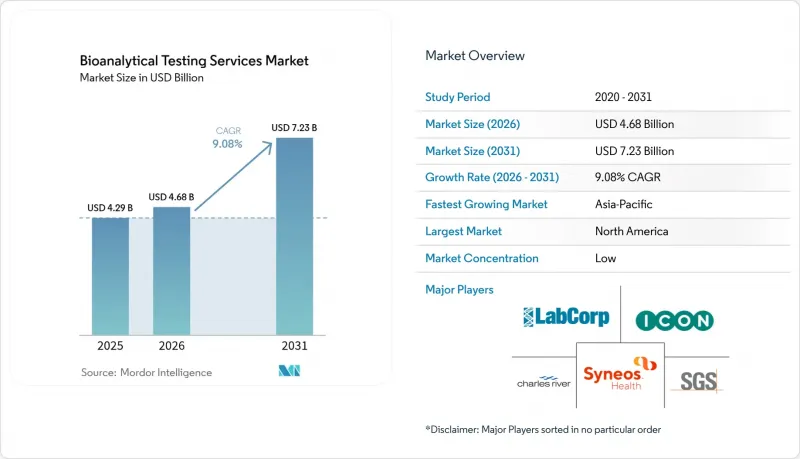
Mordor Intelligence에 의하면, 2026년 바이오 분석 시험 서비스 시장 규모는 46억 8,000만 달러로 추정되고, 2025년 42억 9,000만 달러에서 확대해, 2031년에는 72억 3,000만 달러에 이를 것으로 예측됩니다.
2026-2031년 연평균 성장률(CAGR)은 9.08%를 나타낼 것으로 전망됩니다.
본 보고서는 분자 유형별(저분자, 고분자), 시험 유형별(생체이용률 및 생물학적 동등성, 약동학 등), 최종 사용자별(제약사, 바이오의약품·바이오기술 기업 등), 지역별(북미, 유럽,아시아태평양, 중동 및 아프리카, 남미)로 세분화되어 있습니다. 시장 예측은 금액(달러) 기준으로 제시되어 있습니다.
세계의 바이오 분석 시험 서비스 시장 동향 및 인사이트
분석 시험 아웃소싱 증가
제약 기업들은 고정된 자사 연구소에서 유연하고 기술을 활용한 파트너십으로 자본을 재분배하고 있으며, 이로 인해 아웃소싱 보급률은 전례 없는 수준으로 높아지고 있습니다. ppm 미만의 불순물 검출이나 다중 리간드 결합 분석을 필요로 하는 바이오의약품 워크플로는 현재 거의 전적으로 CRO에 맡겨지고 있습니다. 팬데믹에 따른 규제로 인해 사내 연구소가 폐쇄되는 반면, CRO 네트워크는 재해 복구 프로토콜을 통해 운영을 유지했기 때문에 이러한 전환 추세는 더욱 가속화되었습니다. 대당 50만 달러에 달하는 고분해능 질량 분석기나 자동 시료 전처리 로봇에 대한 접근성은 신속한 데이터 확보를 필요로 하는 중소 바이오기술 기업들에게 여전히 결정적인 요인으로 작용하고 있습니다.
바이오의약품 및 바이오시밀러 파이프라인의 확대
2025년 FDA 승인 건수의 46%를 고분자 의약품이 차지했는데, 이는 효능, 당사슬 변형 및 숙주 세포 단백질 함량을 평가하기 위해 직교 분석이 필요한 단일 클론 항체, 융합 단백질 및 항체-약물 복합체(ADC)에 의해 주도된 결과입니다. 240건 이상의 바이오시밀러가 활발하게 개발되고 있으며, 고비용의 효능 시험보다는 분자의 유사성에 초점을 맞춘 비교 분석에 대한 수요가 높아지고 있습니다. 영국의 MHRA를 비롯한 규제 당국은 분석적 증거가 설득력 있는 경우 특정 유효성 시험을 면제할 의향이 있음을 밝혔으며, 이로 인해 첨단 생물물리학적 기법과 다변량 통계의 도입이 가속화되고 있습니다.
복잡하고 급속히 진화하는 세계 규제 환경
지역별 기대치의 차이로 인해 여러 프로토콜에 걸친 검증 계획이 계속해서 필요하며, 개발 예산은 15-20% 증가하고 있습니다. FDA의 실험실 개발 검사(LDT)에 대한 감독 가능성이 높아짐에 따라, 임상 실험실은 의약품과 동일한 GMP 시스템에 임베디드될 것이며, 문서 관리, 변경 관리, 데이터 무결성 아키텍처에 대한 설비 투자가 요구됩니다. 전담 규제 대응 팀을 갖추지 않은 소규모 제공업체는 규정 준수 비용이 증가함에 따라 경쟁상의 역풍에 직면하게 될 것입니다.
부문 분석
2025년에도 저분자 화합물이 바이오 분석 시험 서비스 시장의 63.62%를 계속 차지했으며, 고분자 화합물은 급속한 성장세를 보였습니다. 고분자 부문은 리간드 결합 분석, 세포 기반 효능 시험 및 면역원성 평가가 필요한 단일 클론 항체, 융합 단백질, 펩타이드 치료제로 인해 연평균 성장률(CAGR) 11.12%로 확대되고 있습니다. 이러한 수요로 인해 검사 기관들은 고처리량의 Gyrolab 면역 분석 플랫폼과 몇 분 이내에 구조 변이를 식별할 수 있는 다중 속성 질량 분석 워크플로우를 도입할 수밖에 없게 되었습니다.
투자 집중도는 계속해서 높아지고 있습니다. 예를 들어, WuXi AppTec사는 고체상 합성 반응기를 통해 펩타이드 생산 능력을 32,000 L로 확대하여 바이오시밀러 개발사들의 비교 분석 의뢰 급증에 대응하고 있습니다. 각 스폰서사는 장기적인 유효성 시험보다 분석적 유사성 패키지를 선호하는 경향이 있어, 이에 따라 고도의 직교 기법이 일상 업무에 정착되고 있습니다. 파이프라인의 다양화에 따라, 바이오 분석 시험 서비스 시장은 증가하는 복잡성에 대응하기 위해 생화학, 통계학, 자동화에 걸친 학제간 기술에 크게 의존하게 될 것입니다.
지역별 분석
북미는 2025년 전 세계 매출의 41.92%를 차지했습니다. 이는 제약 기업의 본사가 집중되어 있고, FDA와의 근접성, 그리고 탄탄한 GLP 인프라에 힘입은 결과입니다. Labcorp 등 주요 제공업체들은 베스트셀러 의약품 프로그램을 뒷받침하는 국내 연구소에 1만 4,000명 이상의 직원을 배치하고 있습니다. 그러나 인력 부족과 인건비 급등이 이익률을 압박하고 있어, 저비용 지역으로의 선택적 아웃소싱이 진행되고 있습니다. 캐나다의 시설은 이중언어 신청 처리를 통해 미국의 처리 능력을 보완하고 있는 반면, 멕시코에서의 니어쇼어링 추세는 미국 수입 규정을 준수하는 GLP 시설에 대한 새로운 투자를 촉진하고 있습니다.
유럽은 EMA(유럽의약품청)의 일관된 프레임워크와 바이오시밀러 분야의 리더십 덕분에 2위를 차지하고 있습니다. 독일, 프랑스, 영국에는 학술 거점과 연계된 CRO 및 CDMO 시설 클러스터가 존재하며, 유로핀 사이언티픽(Eurofins Scientific) 한 회사만 해도 유럽에서 900개 이상의 연구소를 운영하며 연간 4억 5,000만 건의 검사를 실시했습니다. 브렉시트 이후, 영국은 경쟁력을 유지하기 위해 바이오시밀러 승인 절차를 신속화하고 유연한 규제 태도를 보이고 있으며, 이는 계속해서 바이오의약품 분석 업무를 유치하고 있습니다. 바이오의약품 제조 허브에 대한 EU의 투자와 ‘호라이즌 유럽(Horizon Europe)’의 연구개발 보조금 덕분에 수요는 견조한 추세를 보일 전망입니다. 아시아태평양은 임상시험 이전, 제조 능력 확대, 그리고 정부의 지원책에 힘입어 연평균 성장률(CAGR) 11.74%로 가장 빠르게 성장하는 지역이 되었습니다. 중국의 현지 CRO가 역량을 확대함에 따라, 중국은 시료 처리량에서 1위를 차지하고 있으며, 한편 일본은 세계 3위의 의약품 시장인 만큼, 이중 언어 문서가 필요한 복잡한 신청 건이 꾸준히 유입되고 있습니다. 한국과 대만은 세액 공제 및 심사 신속화 조치를 활용하여, 효율적인 피험자 모집과 비용 관리를 추구하는 다국적 기업들을 유치하고 있습니다. 인도의 GLP 준수를 위한 국가적 노력과 호주의 생명공학 클러스터는 해당 지역의 역량을 다각화하고 있습니다. 그 결과, 생물학적 분석 시험 서비스 시장에서 향후 10년 후반에는 아시아태평양의 매출이 유럽 및 미국의 수준에 근접할 것으로 전망됩니다.
기타 혜택 :
- 엑셀 형식 시장 예측(ME) 시트
- 3개월간의 애널리스트 지원
자주 묻는 질문
목차
제1장 서론
제2장 조사 방법
제3장 주요 요약
제4장 시장 구도
제5장 시장 규모 및 성장 예측
제6장 경쟁 구도
제7장 시장 기회 및 향후 전망
AJY 26.08.26According to Mordor Intelligence, bioanalytical testing services market size in 2026 is estimated at USD 4.68 billion, growing from 2025 value of USD 4.29 billion with 2031 projections showing USD 7.23 billion, growing at 9.08% CAGR over 2026-2031.
This report is Segmented by Molecule Type (Small Molecules, Large Molecules), Test Type (Bioavailability & Bioequivalence, Pharmacokinetics, and More), End User (Pharmaceutical Companies, Biopharmaceutical & Biotech Firms, and More), and Geography (North America, Europe, Asia-Pacific, Middle East & Africa, South America). The Market Forecasts are Provided in Terms of Value (USD).
Global Bioanalytical Testing Services Market Trends and Insights
Rising outsourcing of analytical testing
Pharmaceutical sponsors are reallocating capital from fixed laboratories to flexible, tech-enabled partnerships, lifting outsourcing penetration to unprecedented levels. Biologics workflows requiring sub-ppm impurity detection and multiplex ligand-binding assays now sit almost entirely with CROs. Pandemic restrictions intensified the shift as in-house labs shut down while CRO networks stayed operational through disaster-recovery protocols. Access to high-resolution mass spectrometers costing USD 500,000 per unit and automated sample-preparation robots remains a decisive factor for smaller biotech firms seeking rapid data readouts.
Expansion of biologics & biosimilars pipeline
Large-molecule approvals comprised 46% of FDA clearances in 2025, propelled by monoclonal antibodies, fusion proteins, and antibody-drug conjugates that require orthogonal assays to evaluate potency, glycosylation, and host-cell-protein content. Over 240 biosimilars are in active development, reinforcing demand for comparative analytics that focus on molecular similarity rather than expensive efficacy trials. Regulators such as the UK MHRA signal readiness to waive certain efficacy studies when analytical evidence is compelling, accelerating uptake of advanced biophysical techniques and multivariate statistics.
Complex & rapidly-evolving global regulations
Differing regional expectations continue to generate multi-protocol validation plans, inflating development budgets by 15-20%. Potential FDA oversight of laboratory-developed tests (LDTs) will pull clinical labs into drug-style GMP systems, demanding capital upgrades in documentation, change control, and data-integrity architecture. Smaller providers lacking embedded regulatory teams face competitive headwinds as compliance overhead rises.
Other drivers and restraints analyzed in the detailed report include:
- Growing global clinical-trial volumes
- Stringent PK/PD & BE regulatory mandates
- Shortage of skilled bioanalytical scientists
For complete list of drivers and restraints, kindly check the Table Of Contents.
Segment Analysis
Large molecules generated rapid momentum, even though small molecules still held 63.62% of the bioanalytical testing services market share in 2025. The large-molecule segment is expanding at an 11.12% CAGR due to monoclonal antibodies, fusion proteins, and peptide therapeutics that necessitate ligand-binding assays, cell-based potency tests, and immunogenicity evaluations. This demand compels laboratories to install high-throughput Gyrolab immunoassay platforms and multi-attribute-method mass-spectrometry workflows that identify structural variants within minutes.
Investment intensity continues to rise. WuXi AppTec, for example, lifted peptide-manufacturing capacity to 32,000 L of solid-phase synthesis reactors, underpinning a surge in comparative analytical requests from biosimilar developers. Sponsors favor analytical similarity packages over long efficacy studies, pushing advanced orthogonal techniques into routine service. As the pipeline diversifies, the bioanalytical testing services market will rely heavily on cross-disciplinary skillsets spanning biochemistry, statistics, and automation to match rising complexity.
Complete Report Scope:
- By Molecule Type
- Small Molecules
- Large Molecules
- By Test Type
- Bioavailability & Bioequivalence
- Pharmacokinetics
- Pharmacodynamics
- Absorption-Distribution-Metabolism-Excretion
- Immunogenicity & Neutralizing-Antibody Assays
- Biomarker & Omics-Based Assays
- Other Tests
- By End User
- Pharmaceutical Companies
- Biopharmaceutical & Biotech Firms
- Contract Development & Manufacturing Organizations
- Academic & Government Institutes
- By Geography
- North America
- United States
- Canada
- Mexico
- Europe
- Germany
- United Kingdom
- France
- Italy
- Spain
- Rest of Europe
- Asia-Pacific
- China
- Japan
- India
- Australia
- South Korea
- Rest of Asia-Pacific
- Middle East & Africa
- GCC
- South Africa
- Rest of Middle East & Africa
- South America
- Brazil
- Argentina
- Rest of South America
- North America
Geography Analysis
North America generated 41.92% of global revenue in 2025, underpinned by concentrated pharmaceutical headquarters, FDA proximity, and extensive GLP infrastructure. Major providers such as Labcorp deploy more than 14,000 employees across domestic labs that underpin top-selling drug programs. Yet, talent shortages and elevated labor costs pressure margins and drive selective outsourcing to lower-cost regions. Canadian facilities complement US capacity with bilingual submissions, while Mexico's near-shoring momentum is prompting fresh investment in GLP sites aligned with US import rules.
Europe ranks second due to cohesive EMA frameworks and leadership in biosimilars. Germany, France, and the United Kingdom host clusters of CRO and CDMO facilities that collaborate with academic hubs, and Eurofins Scientific alone runs over 900 European laboratories performing 450 million tests annually. Post-Brexit, the UK fast-tracked biosimilar pathways to sustain competitiveness, demonstrating a flexible regulatory posture that continues to attract biopharma analytical work. EU investments in biopharmaceutical manufacturing hubs and Horizon Europe R&D grants will keep demand buoyant. Asia-Pacific represents the fastest-growing zone at 11.74% CAGR, driven by clinical-trial migration, expanding manufacturing capacity, and supportive government incentives. China leads sample volumes as local CROs scale capacity, while Japan's status as the third-largest pharmaceutical market ensures a steady flow of complex submissions requiring bilingual documentation. South Korea and Taiwan leverage tax credits and expedited reviews, luring multinationals searching for efficient enrollment and cost controls. India's national push for GLP compliance and Australia's biotechnology cluster diversify regional capabilities. As a result, the bioanalytical testing services market will see APAC revenue converge with Western levels during the second half of the decade.
- LabCorp
- Charles River
- Thermo Fisher - PPD
- Eurofins
- ICON
- Syneos Health
- SGS
- Intertek Group
- WuXi App Tec
- Medpace Holdings
- BioAgilytix Labs
- Frontage Labs
- Toxikon Corp.
- Covance-Monogram
- Altasciences
- SGS Vitrology
- Eurofin-Advinus
- Analytical Bio-Clear
Additional Benefits:
- The market estimate (ME) sheet in Excel format
- 3 months of analyst support
TABLE OF CONTENTS
1 Introduction
- 1.1 Study Assumptions & Market Definition
- 1.2 Scope of the Study
2 Research Methodology
3 Executive Summary
4 Market Landscape
- 4.1 Market Overview
- 4.2 Market Drivers
- 4.2.1 Rising Outsourcing of Analytical Testing
- 4.2.2 Expansion of Biologics & Biosimilars Pipeline
- 4.2.3 Growing Global Clinical-Trial Volumes
- 4.2.4 Stringent PK/PD & BE Regulatory Mandates
- 4.2.5 Adoption of Microsampling & DBS in Decentralized Trials
- 4.2.6 AI-Driven Analytics Cutting Assay Turnaround Time
- 4.3 Market Restraints
- 4.3.1 Complex & Rapidly-Evolving Global Regulations
- 4.3.2 Shortage of Skilled Bioanalytical Scientists
- 4.3.3 High Capex for HR-Mass-Spectrometry Platforms
- 4.3.4 Sample-Integrity Risks in At-Home Collections
- 4.4 Porter's Five Forces Analysis
- 4.4.1 Threat of New Entrants
- 4.4.2 Bargaining Power of Buyers
- 4.4.3 Bargaining Power of Suppliers
- 4.4.4 Threat of Substitutes
- 4.4.5 Intensity of Competitive Rivalry
5 Market Size & Growth Forecasts (Value in USD)
- 5.1 By Molecule Type
- 5.1.1 Small Molecules
- 5.1.2 Large Molecules
- 5.2 By Test Type
- 5.2.1 Bioavailability & Bioequivalence
- 5.2.2 Pharmacokinetics
- 5.2.3 Pharmacodynamics
- 5.2.4 Absorption-Distribution-Metabolism-Excretion
- 5.2.5 Immunogenicity & Neutralizing-Antibody Assays
- 5.2.6 Biomarker & Omics-Based Assays
- 5.2.7 Other Tests
- 5.3 By End User
- 5.3.1 Pharmaceutical Companies
- 5.3.2 Biopharmaceutical & Biotech Firms
- 5.3.3 Contract Development & Manufacturing Organizations
- 5.3.4 Academic & Government Institutes
- 5.4 By Geography
- 5.4.1 North America
- 5.4.1.1 United States
- 5.4.1.2 Canada
- 5.4.1.3 Mexico
- 5.4.2 Europe
- 5.4.2.1 Germany
- 5.4.2.2 United Kingdom
- 5.4.2.3 France
- 5.4.2.4 Italy
- 5.4.2.5 Spain
- 5.4.2.6 Rest of Europe
- 5.4.3 Asia-Pacific
- 5.4.3.1 China
- 5.4.3.2 Japan
- 5.4.3.3 India
- 5.4.3.4 Australia
- 5.4.3.5 South Korea
- 5.4.3.6 Rest of Asia-Pacific
- 5.4.4 Middle East & Africa
- 5.4.4.1 GCC
- 5.4.4.2 South Africa
- 5.4.4.3 Rest of Middle East & Africa
- 5.4.5 South America
- 5.4.5.1 Brazil
- 5.4.5.2 Argentina
- 5.4.5.3 Rest of South America
- 5.4.1 North America
6 Competitive Landscape
- 6.1 Market Concentration
- 6.2 Market Share Analysis
- 6.3 Company Profiles (includes Global level Overview, Market level overview, Core Segments, Financials as available, Strategic Information, Market Rank/Share for key companies, Products & Services, and Recent Developments)
- 6.3.1 Labcorp Drug Development (Covance)
- 6.3.2 Charles River Laboratories
- 6.3.3 Thermo Fisher - PPD
- 6.3.4 Eurofins Scientific
- 6.3.5 ICON plc
- 6.3.6 Syneos Health
- 6.3.7 SGS SA
- 6.3.8 Intertek Group plc
- 6.3.9 WuXi AppTec
- 6.3.10 Medpace Holdings
- 6.3.11 BioAgilytix Labs
- 6.3.12 Frontage Labs
- 6.3.13 Toxikon Corp.
- 6.3.14 Covance-Monogram
- 6.3.15 Altasciences
- 6.3.16 SGS Vitrology
- 6.3.17 Eurofin-Advinus
- 6.3.18 Analytical Bio-Clear
7 Market Opportunities & Future Outlook
- 7.1 White-Space & Unmet-Need Assessment


