

|
시장보고서
상품코드
2114739
조영 증강 초음파 : 시장 점유율 분석, 업계 동향 및 통계, 성장 예측(2026-2031년)Contrast Enhanced Ultrasound - Market Share Analysis, Industry Trends & Statistics, Growth Forecasts (2026 - 2031) |
||||||
 Mordor Intelligence
Mordor Intelligence에 의하면, 조영 증강 초음파 시장 2026년 시장 규모는 23억 4,000만 달러로 추정되고 2025년 22억 2,000만 달러에서 확대해, 2031년에는 30억 3,000만 달러에 이를 것으로 예측됩니다.
2026년부터 2031년까지 연평균 성장률(CAGR) 5.31%로 성장할 것으로 전망됩니다.
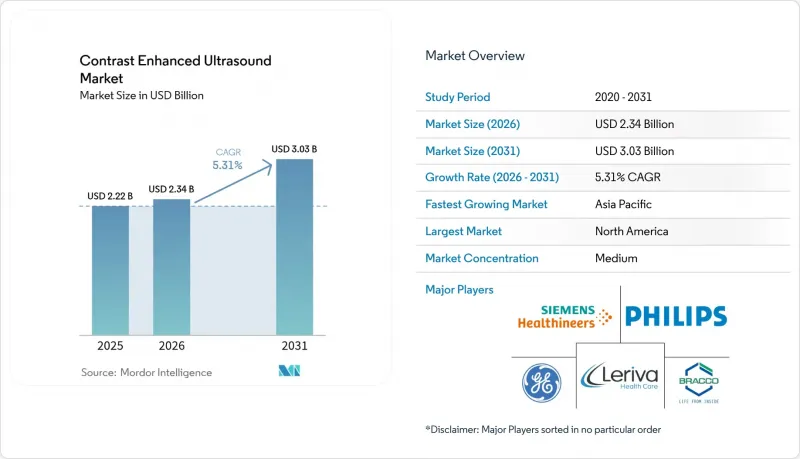
본 보고서는 제품 유형(장비, 조영제), 기술(비표적 CEUS, 표적 CEUS), 용도(심혈관 영상, 간·담도 영상, 기타), 최종 사용자(병원, 영상 센터, 기타),지역(북미, 유럽, 아시아태평양, 중동 및 아프리카, 남미)별로 분류되어 있습니다. 시장 예측은 금액(달러) 기준으로 제시되어 있습니다.
세계의 조영 증강 초음파 시장 동향 및 인사이트
실시간 관류 영상 검사가 필요한 만성 심혈관 질환 및 간 질환의 부담 증가
심장 및 간 질환이 꾸준히 증가함에 따라, 동적 관류 평가에 대한 수요가 높아지고 있습니다. CEUS는 기존 B-모드 초음파로는 포착할 수 없는 미세혈관의 흐름을 실시간으로 시각화하며, 다기관 공동 연구에서 악성 및 양성 간 병변을 감별할 때 86%의 민감도와 91.3%의 특이도를 달성했습니다. 이러한 성능 향상으로 인해 2차 영상 검사가 줄어들고 조기 개입이 가능해짐에 따라, 북미와 유럽의 3차 의료 기관에서 이 검사법의 도입이 확산되고 있습니다.
소아 및 임산부를 대상으로 한 방사선 피폭이 없는 영상 검사로의 전환
이온화 방사선에 대한 우려로 인해 임상의들은 계속해서 초음파 검사를 중시하는 경향을 보이고 있습니다. CEUS는 CT나 MRI에 필적하는 진단 성능을 제공함과 동시에 방사선 피폭 및 신독성의 위험을 배제합니다. 클리블랜드 클리닉(Cleveland Clinic)에 따르면, 심각한 부작용이 발생하는 경우는 시행 건수의 0.01% 이하입니다. 유럽의 정책 지침과 미국의 소아 가이드라인 개정은 이러한 전환을 더욱 뒷받침하고 있으며, 병원이 일상적인 소아 간 및 신장 검사 과정에 CEUS를 포함하도록 장려하고 있습니다.
CEUS 교육을 이수한 초음파 검사사 부족
2024년 『Journal of Diagnostic Medical Sonography』지의 조사에 따르면, 전문가의 42%가 CEUS 도입의 가장 큰 장애물로 “부족한 교육”을 꼽았습니다. 기술자 부족은 특히 체계적인 지도 체제가 갖춰지지 않은 소규모 병원에서 검사 예약 대기 기간을 길게 만들고, 이용률을 저하시키고 있습니다. 주요 벤더들은 현재 콘솔 구매 시 e-러닝 모듈을 세트로 판매하고 있지만, 신흥국에서의 도입은 더딘 편이며, 방사선 피폭이 없는 영상 진단의 혜택을 가장 많이 누릴 수 있어야 할 지역에서 검사 건수 증가세가 억제되고 있습니다.
부문별 분석
2025년, 조영 증강 초음파 시장의 매출 중 61.42%는 기기 부문이 차지했습니다. 병원에서는 복부, 심장, 산과 영상 진단에 폭넓게 대응할 수 있는 범용성이 높은 프리미엄 콘솔이 중시되고 있습니다. 북미와 유럽의 장비 교체 주기에 따라 조영 증강 초음파 시장 내 장비 부문 시장 규모는 꾸준히 확대될 것으로 예측됩니다. 한편, 조영제 시장은 검사 건수 증가와 더 안전한 육불화황 마이크로버블의 승인으로 인해 연평균 성장률(CAGR) 10.74%로 확대되고 있습니다. 브라코(Bracco)사의 헥사곤 공장은 기존 공급 병목 현상을 해소하여 아시아와 라틴아메리카 전역에서 두 자릿수 출하 성장률을 뒷받침할 것입니다. 혁신의 기세가 가장 강한 분야는 분자 영상화를 가능하게 하는 표적형 조영제 부문이며, 이 부문에서는 생명공학 기업과 스캐너 OEM 업체 간의 공동 연구 개발이 활발해지고 있습니다.
수요 측면에서의 시너지 효과는 분명합니다. 초음파 장비 설치 대수가 1대 증가할 때마다 소모품의 지속적인 매출이 촉진되는 한편, 새로운 조영제의 도입은 벤더 간의 차별화로 이어지는 소프트웨어 업그레이드를 유발합니다. 트랜스듀서 보증과 조영제 구매 계약을 결합한 번들형 서비스 계약을 통해 고객과의 유대감이 강화되고 있습니다. 그러나 신흥국에서는 여전히 가성비가 뛰어난 중급 기종과 제네릭 마이크로버블의 조합이 선호되고 있으며, 이는 단일 가격에 기반한 세계 전략에 과제를 안겨주는 양극화된 구매 동향을 시사합니다.
2025년에는 광범위한 규제 당국의 승인과 확립된 임상 프로토콜에 힘입어 비표적 CEUS가 매출의 88.07%를 차지했습니다. 비표적 검사용 조영 증강 초음파 시장 규모는 심장 및 복부 영상 검사 건수 증가에 힘입어 지속적으로 확대되고 있습니다. 그러나 학술 기관들이 종양학 및 염증 치료용 리간드 특이적 마이크로버블의 유효성을 검증함에 따라 표적 CEUS도 탄력을 받고 있습니다.
2031년까지 이 부문의 연평균 성장률(CAGR) 14.02%는 VEGF, 인테그린, 면역 체크포인트를 표적으로 하는 약물 파이프라인을 반영한 것입니다. 유럽의 초기 도입 기관들로부터 약물 반응 모니터링에 관한 유망한 결과가 발표되면서, 보험 급여에 관한 논의가 시작되고 있습니다. 여전히 과제는 남아 있습니다. 규제 당국의 심사 기간 장기화와 영상 분석의 복잡성으로 인해, 방사선과 의사와 임상의 간의 보다 긴밀한 협력이 요구되고 있습니다. 표적 영상 진단은 정밀 의학의 동향과 부합하며, 종양학 임상시험 및 면역요법 모니터링 분야에서 이 모달리티가 매우 많은 사례를 대상으로 할 가능성이 높아지고 있습니다.
지역별 분석
북미는 FDA의 조기 승인 및 견고한 보험 급여에 힘입어 2025년 매출의 36.88%를 차지했습니다. 수많은 교육 병원이 CEUS 지침 제정을 주도하고 있어, 지역 의료 현장에 대한 신속한 보급이 보장되고 있습니다. 캐나다가 CEUS를 간세포암의 전국 치료 경로에 포함시킨 것은 해당 국가의 주도적 입지를 더욱 공고히 하고 있습니다. 유럽은 2위를 차지하고 있으며, 독일과 영국에서는 방사선 피폭량 감소를 중시하고 있습니다. 유럽 초음파 의학회 연합(EFSUMB)이 2024년에 갱신한 지침은 모범 사례를 규정하여 회원국 전체의 품질 균일화를 촉진하고 있습니다.
아시아는 연평균 성장률(CAGR) 9.41%로 가장 높은 성장률을 보이고 있습니다. 중국의 ‘건강 중국 2030’ 계획에서는 첨단 영상 진단이 우선순위로 지정되어 있으며, CEUS를 도입하는 성립 병원에 보조금이 지원되고 있습니다. 일본에서는 급속한 고령화가 진행되며 심혈관 및 종양학 분야의 영상 진단 수요가 증가하고 있어, 현지 공급업체들이 클리닉 사용에 적합한 소형 스캐너를 출시하고 있습니다. 인도는 아직 도입 단계이지만, 인지도가 높아지고 있으며 현지 유통업체이 경쟁력 있는 가격의 콘솔을 판매하고 있어 큰 잠재력을 지니고 있습니다.
라틴아메리카와 중동 및 아프리카는 자금적 제약과 의료 종사자의 연수 기회가 제한적이어서 도입 진척도가 전반적으로 더딘 임베디드니다. 다자간 개발은행이 선정된 시범 사이트에 자금을 지원하고 있어, 점차 보급이 확대될 조짐이 보입니다. 주요 공급업체와의 정부 협력을 통해 장비와 교육을 결합한 패키지가 도입 장벽을 낮춘다면, 그 추세를 가속화할 수 있을 것으로 보입니다.
기타 혜택
- 엑셀 형식 시장 예측(ME) 시트
- 3개월간의 애널리스트 지원
자주 묻는 질문
목차
제1장 서론
제2장 조사 방법
제3장 주요 요약
제4장 시장 구도
제5장 시장 규모 및 성장 예측
제6장 경쟁 구도
제7장 시장 기회 및 향후 전망
KTH 26.08.28According to Mordor Intelligence, contrast enhanced ultrasound market size in 2026 is estimated at USD 2.34 billion, growing from 2025 value of USD 2.22 billion with 2031 projections showing USD 3.03 billion, growing at 5.31% CAGR over 2026-2031.
This report is Segmented by Product Type (Equipment, Contrast Agents), Technology (Non-Targeted and Targeted), Application (Cardiovascular Imaging, Hepatic & Biliary Imaging, and More), End User (Hospitals, Diagnostic Imaging Centers, and More), and Geography (North America, Europe, Asia-Pacific, Middle East & Africa, South America). The Market Forecasts are Provided in Terms of Value (USD).
Global Contrast Enhanced Ultrasound Market Trends and Insights
Rising Burden of Chronic Cardiovascular & Hepatic Diseases Necessitating Real-Time Perfusion Imaging
Steady growth in cardiac and liver pathologies heightens demand for dynamic perfusion assessment. CEUS delivers real-time visualization of microvascular flow that conventional B-mode ultrasound misses, achieving 86% sensitivity and 91.3% specificity for differentiating malignant from benign liver lesions in multi-center trials. These performance gains reduce secondary imaging and support earlier interventions, promoting wider procedural adoption across tertiary centers in North America and Europe.
Shift Toward Radiation-Free Imaging for Pediatric & Pregnant Populations
Concerns over ionizing radiation continue to steer clinicians toward ultrasound. CEUS provides diagnostic performance comparable with CT or MRI while eliminating radiation and nephrotoxicity risks. Severe adverse reactions occur in fewer than 0.01% of administrations, according to the Cleveland Clinic. Policy directives in Europe and updated pediatric guidelines in the United States further reinforce this transition, encouraging hospitals to embed CEUS pathways in routine pediatric liver and renal work-ups.
Limited Availability of CEUS-Trained Sonographers
A 2024 Journal of Diagnostic Medical Sonography survey found 42% of professionals cite inadequate training as the chief obstacle to CEUS deployment. Skill shortages lengthen exam scheduling and curb utilization, especially in smaller hospitals lacking structured mentorship. Large vendors now bundle e-learning modules with console purchases, yet adoption in emerging economies lags, constraining volume growth in regions that would benefit most from radiation-free imaging.
Other drivers and restraints analyzed in the detailed report include:
- Expansion of Point-of-Care Ultrasound Platforms in Emergency & Critical Care
- Growing Investments by Government and Private Organizations
- Stringent & Lengthy Regulatory Pathways for Novel Contrast Agents
For complete list of drivers and restraints, kindly check the Table Of Contents.
Segment Analysis
In 2025, equipment generated 61.42% of revenue within the contrast enhanced ultrasound market. Hospitals prize multi-purpose premium consoles for their versatility across abdominal, cardiac, and obstetric imaging. The contrast enhanced ultrasound market size for equipment is projected to climb steadily alongside replacement cycles in North America and Europe. Meanwhile, contrast agents are expanding at 10.74% CAGR thanks to broader procedure counts and the approval of safer sulfur-hexafluoride microbubbles. Bracco's Hexagon plant will remove historical supply bottlenecks and underpin double-digit shipment growth across Asia and Latin America. Innovation momentum is strongest in targeted agents that enable molecular imaging, an area attracting collaborative R&D between biotech firms and scanner OEMs.
Demand synergies are evident: every incremental console installation spurs recurring consumable sales, while new agents trigger software upgrades that differentiate vendors. Bundled service contracts that combine transducer warranties and agent purchasing agreements are creating stickier customer relationships. Emerging economies, however, still favor cost-effective mid-tier machines paired with generic microbubbles, hinting at a bifurcated purchasing landscape that challenges single-price global strategies.
Non-targeted CEUS held 88.07% of revenue in 2025, anchored by broad regulatory clearance and established clinical protocols. The contrast enhanced ultrasound market size for non-targeted exams continues to rise, driven by cardiology and abdominal imaging volumes. Yet targeted CEUS is gaining traction as academic centers validate ligand-specific microbubbles for oncology and inflammation.
The segment's 14.02% CAGR to 2031 reflects a pipeline of agents aimed at VEGF, integrins, and immune checkpoints. Early adopters in Europe are publishing encouraging results on drug-response monitoring, opening reimbursement discussions. Obstacles remain: longer regulatory reviews and interpretive complexity require tighter radiologist-clinician collaboration. Still, targeted imaging aligns with precision medicine trends, positioning the modality for outsized sampling in oncology trials and immune-therapy monitoring.
Complete Report Scope:
- By Product Type
- Equipment
- Contrast Agents
- By Technology
- Non-targeted CEUS
- Targeted CEUS
- By Application
- Cardiovascular Imaging
- Hepatic & Biliary Imaging
- Renal & Urological Imaging
- Obstetrics & Gynecology
- Oncology & Tumor Characterisation
- Others
- By End User
- Hospitals
- Diagnostic Imaging Centers
- Ambulatory Surgical Centers
- Academic & Research Institutes
- By Geography
- North America
- United States
- Canada
- Mexico
- Europe
- Germany
- United Kingdom
- France
- Italy
- Spain
- Rest of Europe
- Asia-Pacific
- China
- Japan
- India
- Australia
- South Korea
- Rest of Asia-Pacific
- Middle East & Africa
- GCC
- South Africa
- Rest of Middle East & Africa
- South America
- Brazil
- Argentina
- Rest of South America
- North America
Geography Analysis
North America commanded 36.88% revenue in 2025, supported by early FDA approvals and robust reimbursement. Numerous teaching hospitals lead CEUS guideline formulation, ensuring rapid diffusion into community practice. Canada's inclusion of CEUS in national hepatocellular carcinoma pathways further cements leadership. Europe ranks second, with Germany and the United Kingdom emphasizing radiation-dose mitigation; the European Federation of Societies for Ultrasound in Medicine and Biology's updated 2024 guidelines codify best practices and foster uniform quality across member states.
Asia delivers the highest growth at 9.41% CAGR. China's Healthy China 2030 plan prioritizes advanced imaging, funneling subsidies toward provincial hospitals that adopt CEUS. Japan's rapidly aging population drives cardiovascular and oncologic imaging, and local vendors introduce compact scanners tailored to clinic use. India remains nascent but exhibits strong potential as awareness grows and local distributors market competitively priced consoles.
Latin America and the Middle East & Africa trail in aggregate adoption, weighed by capital constraints and limited practitioner training. Multilateral development banks fund select pilot sites, hinting at gradual diffusion. Government partnerships with leading vendors could quicken momentum if bundled equipment-training packages lower entry barriers.
- Bracco
- Lantheus
- GE HealthCare Technologies Inc.
- Siemens Healthineers
- Koninklijke Philips
- Daiichi-Sankyo Co. Ltd.
- Canon
- Samsung Medison Co. Ltd.
- Esaote S.p.A.
- Mindray
- Hitachi Healthcare (Fujifilm)
- Guerbet SA
- Trivitron Healthcare
- Chison Medical Imaging Co. Ltd.
- Terason
- Sonoscape Medical Corp.
- Supersonic Imagine SA (Hologic)
- FUJIFILM VisualSonics Inc.
- Leriva Group
Additional Benefits:
- The market estimate (ME) sheet in Excel format
- 3 months of analyst support
TABLE OF CONTENTS
1 Introduction
- 1.1 Study Assumptions & Market Definition
- 1.2 Scope of the Study
2 Research Methodology
3 Executive Summary
4 Market Landscape
- 4.1 Market Overview
- 4.2 Market Drivers
- 4.2.1 Rising Burden of Chronic Cardiovascular & Hepatic Diseases Necessitating Real-Time Perfusion Imaging
- 4.2.2 Shift Toward Radiation-Free Imaging for Pediatric & Pregnant Populations
- 4.2.3 Expansion of Point-of-Care Ultrasound Platforms in Emergency & Critical Care
- 4.2.4 Growing Investments by Government and Private Organization
- 4.2.5 Rising Demand for Minimally Invasive Diagnostic Procedures
- 4.2.6 Technological Advancements in Microbubble Contrast Agents
- 4.3 Market Restraints
- 4.3.1 Limited Availability of CEUS-Trained Sonographers
- 4.3.2 Stringent & Lengthy Regulatory Pathways for Novel Contrast Agents
- 4.3.3 High Capital Costs of Premium CEUS-Enabled Ultrasound Systems
- 4.3.4 Adverse Reactions & Safety Concerns with Contrast Agents
- 4.4 Technological Outlook
- 4.5 Porter's Five Forces Analysis
- 4.5.1 Threat of New Entrants
- 4.5.2 Bargaining Power of Buyers
- 4.5.3 Bargaining Power of Suppliers
- 4.5.4 Threat of Substitutes
- 4.5.5 Intensity of Competitive Rivalry
5 Market Size & Growth Forecasts (Value in USD)
- 5.1 By Product Type
- 5.1.1 Equipment
- 5.1.2 Contrast Agents
- 5.2 By Technology
- 5.2.1 Non-targeted CEUS
- 5.2.2 Targeted CEUS
- 5.3 By Application
- 5.3.1 Cardiovascular Imaging
- 5.3.2 Hepatic & Biliary Imaging
- 5.3.3 Renal & Urological Imaging
- 5.3.4 Obstetrics & Gynecology
- 5.3.5 Oncology & Tumor Characterisation
- 5.3.6 Others
- 5.4 By End User
- 5.4.1 Hospitals
- 5.4.2 Diagnostic Imaging Centers
- 5.4.3 Ambulatory Surgical Centers
- 5.4.4 Academic & Research Institutes
- 5.5 By Geography
- 5.5.1 North America
- 5.5.1.1 United States
- 5.5.1.2 Canada
- 5.5.1.3 Mexico
- 5.5.2 Europe
- 5.5.2.1 Germany
- 5.5.2.2 United Kingdom
- 5.5.2.3 France
- 5.5.2.4 Italy
- 5.5.2.5 Spain
- 5.5.2.6 Rest of Europe
- 5.5.3 Asia-Pacific
- 5.5.3.1 China
- 5.5.3.2 Japan
- 5.5.3.3 India
- 5.5.3.4 Australia
- 5.5.3.5 South Korea
- 5.5.3.6 Rest of Asia-Pacific
- 5.5.4 Middle East & Africa
- 5.5.4.1 GCC
- 5.5.4.2 South Africa
- 5.5.4.3 Rest of Middle East & Africa
- 5.5.5 South America
- 5.5.5.1 Brazil
- 5.5.5.2 Argentina
- 5.5.5.3 Rest of South America
- 5.5.1 North America
6 Competitive Landscape
- 6.1 Market Concentration
- 6.2 Market Share Analysis
- 6.3 Company Profiles (includes Global level Overview, Market level overview, Core Segments, Financials as available, Strategic Information, Market Rank/Share for key companies, Products & Services, and Recent Developments)
- 6.3.1 Bracco Diagnostics Inc.
- 6.3.2 Lantheus Medical Imaging Inc.
- 6.3.3 GE HealthCare Technologies Inc.
- 6.3.4 Siemens Healthineers AG
- 6.3.5 Koninklijke Philips N.V.
- 6.3.6 Daiichi-Sankyo Co. Ltd.
- 6.3.7 Canon Medical Systems Corp.
- 6.3.8 Samsung Medison Co. Ltd.
- 6.3.9 Esaote S.p.A.
- 6.3.10 Shenzhen Mindray Bio-Medical Electronics Co. Ltd.
- 6.3.11 Hitachi Healthcare (Fujifilm)
- 6.3.12 Guerbet SA
- 6.3.13 Trivitron Healthcare Pvt. Ltd.
- 6.3.14 Chison Medical Imaging Co. Ltd.
- 6.3.15 Terason
- 6.3.16 Sonoscape Medical Corp.
- 6.3.17 Supersonic Imagine SA (Hologic)
- 6.3.18 FUJIFILM VisualSonics Inc.
- 6.3.19 Leriva Group
7 Market Opportunities & Future Outlook
- 7.1 White-space & Unmet-Need Assessment


