

|
시장보고서
상품코드
2114748
관상막 : 시장 점유율 분석, 업계 동향 및 통계, 성장 예측(2026-2031년)Tubular Membrane - Market Share Analysis, Industry Trends & Statistics, Growth Forecasts (2026 - 2031) |
||||||
 Mordor Intelligence
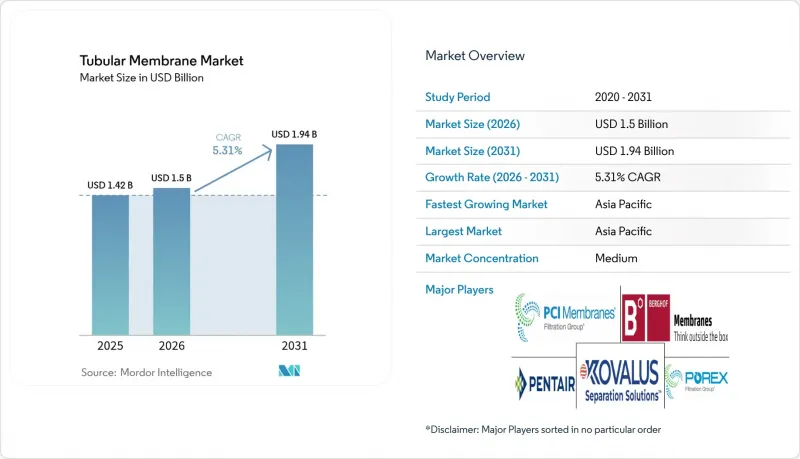
Mordor Intelligence에 의하면, 2026년 관상막 시장 규모는 15억 달러로 추정되고 2025년 14억 2,000만 달러에서 확대해, 2031년에는 19억 4,000만 달러에 이를 것으로 예측됩니다.
2026년부터 2031년까지 연평균 성장률(CAGR) 5.31%로 성장할 것으로 전망됩니다.
본 보고서는 용도별(막 생물 반응기(MBR), 역삼투(RO) 전처리, 기타), 최종 사용자 산업별(식음료, 화학제품 및 석유화학제품, 기타), 막 소재별(PVDF, 설폰계, PTFE, 기타), 지역별(아시아태평양, 북미, 유럽, 남미, 중동 및 아프리카)로 분류되어 있습니다. 시장 예측은 금액(달러) 기준으로 제시되어 있습니다.
세계의 관상막 시장 동향 및 인사이트
막 생물 반응기(MBR) 도입 확대
각 도시에서는 규제 준수 및 음용수 재이용 목표 달성을 위한 ‘일석이조’의 해결책으로서 MBR 도입이 점점 더 주목받고 있습니다. 캘리포니아주 실리콘밸리 클린워터(Silicon Valley Clean Water)사의 ‘순 에너지 플러스(net energy positive)’ 단계식 혐기성 유동층 MBR은 바이오 고형물 발생량을 90% 줄이고 에너지 자급자족을 입증하여, 미국 상수도 유틸리티자들의 조달 결정의 기반이 되고 있습니다. 싱가포르, 베이징, 밀라노에서 실시된 유사한 실증 실험에서는 혼합액 내 부유 고형물 농도가 높은 조건에서도 병원체를 확실하게 제거할 수 있음이 입증되어, 전 세계적인 보급을 뒷받침하고 있습니다. 컴팩트한 설치 면적으로 인해 인구 밀도가 높은 대도시권에 설치하기 쉬울 뿐만 아니라, 높은 고형물 내성 덕분에 처리 시설은 부지를 확장하지 않고도 처리 능력을 강화할 수 있습니다. 그 결과, 북미와 동아시아의 자본 투자 계획에서 신규 건설 및 대규모 개보수 시 관형 MBR이 표준 사양으로 채택되면서, 관상막 시장의 성장을 더욱 촉진하고 있습니다.
고강도 폐수 처리에 대한 산업 수요
순환수 전략으로 전환되고 있는 화학 플랜트에서는 플레이트형 막이나 중공사형 막에 비해 용매의 급격한 농도 상승, 높은 염분, 연마성 미립자에 대한 내성이 뛰어나기 때문에 관상막이 선호되고 있습니다. 최근 실시된 염분 농도 20g/L의 MBR 검사에서는 COD 97% 감축과 BOD의 거의 완전한 제거가 보고되어, 염수 및 생산수 환경에서의 성능이 입증되었습니다. 연속 처리로 전환하는 제약 업체에서는 고농도의 폐수가 발생하기 때문에 높은 막 투과 압력 하에서 24시간 365일 가동 가능한 기계적 강도가 뛰어난 모듈이 요구되고 있습니다. 광업 부문에서는 세라믹 관상막 유닛이 산성 광산 폐수 처리에서 장시간 가동을 실현하여 약품 투입량과 가동 중단 시간을 줄이고 있습니다. 이러한 이용 사례가 맞물려 관상막 시장의 소비 확대를 뒷받침하고 있습니다.
중공사, 플레이트 막 및 기타 대체 기술과의 경쟁
중공사형 MBR은 더 높은 충전 밀도와 1제곱미터당 낮은 설치 비용을 실현하고 있어, 부지 여유가 있는 지역에서는 가격에 민감한 지자체 입찰에서 이러한 설계가 선택되기 쉽습니다. 플레이트형 카세트는 육안 검사가 용이하다는 장점이 있어, 고도의 유지보수 도구를 보유하고 있지 않은 운영자에게 중요한 이점이 됩니다. 6-66 L cm?² MPa?¹의 투수성을 자랑하는 산화 그래핀 적층재는 에너지 성능 면에서 모든 폴리머계 시스템을 능가할 가능성이 있습니다. 한편, 개발 중인 광촉매식 자가 세정 코팅은 기존 관형 모듈이 누려왔던 오염 저항성의 우위를 좁힐 가능성이 있습니다. 이러한 역풍으로 인해 고고형분 내성이 중요하지 않은 부문에서는 도입이 억제될 가능성이 있습니다.
부문별 분석
2025년, 막 생물 반응기(MBR)는 2차 침전 공정 없이 고농도 혼합액을 처리할 수 있는 능력에 힘입어 관상막 시장의 44.92%를 차지했습니다. 이러한 우위는 생물학적 산화와 물리적 분리를 통합함으로써 얻는 이점을 반영하며, 플랜트 전체의 설치 면적을 줄이고 기존 침전조 내에서 신속한 개조를 가능하게 합니다. 이 부문에서는 유량 증가에 따른 확장을 용이하게 하는 모듈식 스키드 레이아웃이 채택되고 있으며, 이는 인구 증가와 산업 단지에 대한 급수 연결에 직면한 수도 유틸리티자에게 중요한 요소입니다. 미세 기포 폭기 및 간헐적 운전이 보급됨에 따라 에너지 소비량은 지속적으로 감소하고 있으며, 이는 관상막 시장 전체에서 MBR 도입의 사업적 타당성을 더욱 공고히 하고 있습니다.
역삼투(RO) 전처리는 규모는 작지만, 탈염 사업자들이 고압 RO 단계를 오염으로부터 보호하기 위해 다층 배리어 플로우 시트를 채택하고 있기 때문에 2031년까지 연평균 성장률(CAGR) 5.82%를 나타낼 것으로 예측됩니다. 관상막은 마이크로 샌드 필터로는 처리할 수 없는 기름, 그리스, 생체 고분자가 혼입된 탁한 원수를 처리할 수 있는 능력을 갖추고 있어, 견고한 1차 스크린으로서의 입지를 확립하고 있습니다. 유제품 부문의 CIP(정지 세척) 회수, 침출수 정제, 매립지 응축수 관리는 여전히 틈새 시장이지만 안정적인 수요원입니다. 이는 관상막의 기계적 강도와 화학 세척의 용이성이라는 장점을 활용하고 있습니다. 이러한 다양한 용도가 결합되어 수익원을 확대하고, 관상막 시장의 경기 변동 영향을 완화하고 있습니다.
지역별 분석
아시아태평양은 중국의 대규모 지자체 도입과 인도의 벌크 화학제품 및 섬유 산업에 대한 ‘폐수 무방류’ 규제의 뒷받침을 받아, 2025년에는 매출 점유율 42.60%를 차지하며 관상막 시장을 주도했습니다. 중국의 ‘양쯔강 보호법’은 수천 곳의 산업 클러스터에서 고도 처리 설비로의 개조를 추진하고 있으며, 한편 각 성의 보조금 제도는 MBR(막 생물 반응기) 개조에 대한 투자 회수를 가속화하고 있습니다. 인도의 2025년 재이용 목표에 따라, BOD 10mg/L 이하의 안정적인 투과수를 보장하는 통합형 막 처리 라인의 신속한 도입이 요구되고 있습니다. 일본공급업체들은 수십 년에 걸친 정화조를 통한 분산형 처리 전문 지식을 활용하여 컨테이너형 관상막 패키지를 동남아시아 전역에 수출하고 있으며, 한국의 제약 산업 확대로 인해 초순수 시스템에 대한 수요가 증가하고 있습니다.
북미는 성숙한 교체 주기와 규제 강화에 힘입어 세계 2위의 지역 블록을 형성하고 있습니다. 미국의 ‘인프라 투자 및 고용법’에서는 납제 급수관 교체 및 고도 처리 설비 업그레이드에 수십억이 배정되어 있으며, 많은 유틸리티자는 영양염 규제치를 충족하기 위해 이러한 프로그램과 병행하여 MBR로의 전환을 추진하고 있습니다. 캐나다의 각 주에서는 원주민 거주 지역의 분산형 처리 시스템에 기후 변화 대응 기금을 투입하고 있으며, 소형 MBR이나 관형 오염 저항 스키드가 선호되고 있습니다. 멕시코의 멕시코만 연안에 위치한 산업 지역에서는 급속히 확장되는 석유화학 복합 시설에서 하류 RO(역삼투) 장치의 오염을 최소화하기 위해 관형 전처리 기술이 채택되고 있습니다.
유럽에서는 재료 규정 준수 측면에서 중요한 전환기를 맞이하고 있습니다. REACH에 따른 PFAS 규제로 인해 세라믹 재료의 채택이 가속화되고 있으며, 신규 입찰에서는 설폰, 폴리에테르이미드, 개질 PP계 재료가 우대받고 있습니다. 독일의 ‘탄소 중립 워터(Carbon Neutral Water)’ 이니셔티브는 하이브리드형 막·오존 처리 플랜트의 시범 사업에 자금을 지원하고 있으며, 한편 이베리아 반도에서는 가뭄 대책 자금이 관형 한외여과를 핵심으로 하는 물 재이용 계획에 투입되고 있습니다. 북유럽의 유틸리티자들은 그린 수소 생산자의 지원을 받은 저에너지형 FO-MBR 하이브리드 기술을 선도적으로 도입하고 있으며, 이는 부문 간 통합이 해당 지역의 관상막 시장 수요 점진적 증가를 어떻게 뒷받침하고 있는지를 보여줍니다.
기타 혜택
- 엑셀 형식 시장 예측(ME) 시트
- 3개월간의 애널리스트 지원
자주 묻는 질문
목차
제1장 서론
제2장 조사 방법
제3장 주요 요약
제4장 시장 구도
제5장 시장 규모 및 성장 예측
제6장 경쟁 구도
제7장 시장 기회 및 향후 전망
KTH 26.08.28According to Mordor Intelligence, tubular membrane market size in 2026 is estimated at USD 1.5 billion, growing from 2025 value of USD 1.42 billion with 2031 projections showing USD 1.94 billion, growing at 5.31% CAGR over 2026-2031.
This report is Segmented by Application (Membrane Bioreactors, Reverse Osmosis Pretreatment, and More), End-User Industry (Food and Beverage, Chemical and Petrochemicals, and More), Membrane Material (PVDF, Sulfone-Based, PTFE, and More), and Geography (Asia-Pacific, North America, Europe, South America, and Middle-East and Africa). The Market Forecasts are Provided in Terms of Value (USD).
Global Tubular Membrane Market Trends and Insights
Rising Adoption of Membrane Bioreactors
Cities increasingly view MBRs as a dual answer to regulatory compliance and potable-reuse ambitions. California's net-energy-positive staged anaerobic fluidized bed-MBR at Silicon Valley Clean Water cuts biosolids production by 90% and demonstrates energy self-sufficiency, anchoring procurement decisions among U.S. utilities. Similar pilots in Singapore, Beijing and Milan validate robust pathogen removal under high mixed-liquor suspended solids, underpinning global uptake. The compact footprint eases siting in dense metros, while high solids tolerance allows treatment plants to intensify capacity without land expansion. Consequently, capital programs in North America and East Asia now incorporate tubular MBRs as default for new works or major retrofits, reinforcing growth in the tubular membrane market.
Industrial Demand for High-Strength Effluent Treatment
Chemical facilities moving toward circular-water strategies favor tubular membranes because they withstand solvent spikes, high salinity and abrasive particulates better than flat-sheet or hollow-fiber analogs. Recent 20 g/L-salinity MBR trials reported 97% COD abatement and near-complete BOD removal, validating performance in brine and produced-water settings. Pharmaceutical formulators shifting to continuous processing generate concentrated wastes that demand mechanically robust modules capable of 24/7 operation at elevated trans-membrane pressures. In mining, ceramic tubular units deliver long runtimes in acid mine drainage service, cutting chemical dosing and downtime. These industrial use cases collectively fuel incremental consumption within the tubular membrane market.
Competition from Hollow-Fiber, Flat-Sheet and Other Alternatives
Hollow-fiber MBRs deliver higher packing density and lower installed costs per square meter, steering price-sensitive municipal tenders toward these designs in regions with ample land. Flat-sheet cassettes provide easy access for visual inspection, a key benefit for operators lacking advanced maintenance tooling. Graphene-oxide laminates boasting 6-66 L cm-2 MPa-1 water permeability threaten to leapfrog all polymeric systems on energy performance. Meanwhile, photocatalytic self-cleaning coatings under development could narrow the fouling-resistance advantage historically enjoyed by tubular modules. These headwinds temper adoption in segments where high-solids resilience is not critical.
Other drivers and restraints analyzed in the detailed report include:
- Stricter Global Discharge and Water-Reuse Regulations
- Tubular Forward-Osmosis Modules Enable Low-Energy Concentration
- High CAPEX for Small and Decentralized Facilities
For complete list of drivers and restraints, kindly check the Table Of Contents.
Segment Analysis
Membrane bioreactors controlled 44.92% of the tubular membrane market in 2025, underpinned by their capacity to treat high mixed-liquor concentrations without secondary clarification. This dominance reflects the integration benefits of merging biological oxidation with physical separation, lowering overall plant footprints and enabling fast retrofits within existing clarifier basins. The segment leverages modular skid layouts that simplify expansion as flows rise, a consideration for utilities facing population growth and industrial-park hookups. Energy intensity continues to decline as fine-bubble aeration and intermittent operation routines gain traction, further cementing the business case for MBR installations across the tubular membrane market.
Reverse-osmosis pretreatment, while smaller, is projected to post a 5.82% CAGR to 2031 as desalination operators adopt multi-barrier flowsheets to protect high-pressure RO stages from fouling. Tubular membranes' ability to handle turbid feed waters laced with oil, grease and biopolymers that overwhelm micro-sand filters positions them as a resilient first-stage screen. Dairy clean-in-place recovery, leachate polishing and landfill condensate management remain niche but steady outlets, benefitting from the tubes' mechanical strength and ease of chemical cleaning. Together, these diversified applications broaden revenue streams and mitigate cyclicality within the tubular membrane market.
Complete Report Scope:
- By Application
- Membrane Bioreactors (MBR)
- Reverse Osmosis (RO) Pretreatment
- Other Applications (Dairy CIP, Leachate, etc.)
- By Membrane Material
- Polyvinylidene Fluoride (PVDF)
- Sulfone-based (Polyether sulfone (PES) / Polysulfone (PSU))
- Polytetrafluoroethylene (PTFE) / Expanded PTFE
- Polypropylene
- Ceramic
- Other Membrane Materials (Polyacrylonitrile (PAN), etc.)
- By End-user Industry
- Food and Beverage
- Chemical and Petrochemicals
- Pharmaceutical
- Energy and Power
- Other Industries (Mining, Pulp and Paper, etc.)
- By Geography
- Asia-Pacific
- China
- Japan
- India
- South Korea
- ASEAN Countries
- Rest of Asia-Pacific
- North America
- United States
- Canada
- Mexico
- Europe
- Germany
- United Kingdom
- France
- Italy
- Spain
- Russia
- NORDIC Countries
- Rest of Europe
- South America
- Brazil
- Argentina
- Rest of South America
- Middle East and Africa
- Saudi Arabia
- South Africa
- Rest of Middle East and Africa
- Asia-Pacific
Geography Analysis
Asia-Pacific dominated the tubular membrane market with 42.60% revenue share in 2025, buoyed by large-scale municipal rollouts in China and India's zero-liquid-discharge mandates for bulk chemicals and textiles. China's Yangtze River protection law pushes advanced treatment retrofits at thousands of industrial clusters, while provincial subsidies accelerate capital recovery for MBR retrofits. India's 2025 reuse targets compel overnight adoption of integrated membrane trains that guarantee consistent permeate below 10 mg/L BOD. Japanese vendors leverage decades of Johkasou decentralized expertise to export containerized tubular packages across Southeast Asia, and South Korean pharma expansions add demand for ultrapure-water systems.
North America forms the second-largest regional bloc, underpinned by mature replacement cycles and regulatory tightening. The U.S. Infrastructure Investment and Jobs Act allocates billions for lead-service-line replacements and advanced treatment upgrades, and many utilities piggy-back these programs with MBR conversions to meet nutrient caps. Canadian provinces channel climate-resilience funds toward decentralized schemes in indigenous territories, favoring small MBRs and tubular fouling-resistant skids. Mexico's industrial corridor along the Gulf coast embraces tubular pretreatment to minimize downstream RO fouling at its rapidly expanding petrochemical complexes.
Europe faces a pivotal material-compliance shift. PFAS curbs under REACH accelerate ceramic adoption and favor sulfone, polyetherimide and modified PP chemistries in new bids. Germany's carbon-neutral-water initiative funds pilot hybrid membrane-ozone plants, while Iberia channels drought-mitigation money toward water-reuse schemes anchored by tubular ultrafiltration. Nordic utilities pioneer low-energy FO-MBR hybrids supported by green-hydrogen producers, illustrating how cross-sector integration underpins incremental demand in the regional tubular membrane market.
- Applied membranes, inc.
- Berghof Membrane Technology GmbH (BMT)
- Duraflow LLC
- Dynatec Systems Inc.
- Graver Technologies
- Kovalus Separation Solutions
- Kubota Corporation
- Lenntech B.V.
- Memsift Innovations
- PCI Membranes
- Pentair
- Porex
- Sihyflux
- SpinTek
- TORAY INDUSTRIES, INC.
Additional Benefits:
- The market estimate (ME) sheet in Excel format
- 3 months of analyst support
TABLE OF CONTENTS
1 Introduction
- 1.1 Study Assumptions and Market Definition
- 1.2 Scope of the Study
2 Research Methodology
3 Executive Summary
4 Market Landscape
- 4.1 Market Overview
- 4.2 Market Drivers
- 4.2.1 Rising Adoption of Membrane Bioreactors (MBR) In Municipal Wastewater
- 4.2.2 Industrial Demand for High-Strength Effluent Treatment
- 4.2.3 Stringent Global Discharge and Water-Reuse Regulations
- 4.2.4 Tubular Forward-Osmosis (TFO) Modules Enable Low-Energy Concentration
- 4.2.5 Biomimetic Aquaporin-Based Tubular Membranes Unlock Niche Separation
- 4.3 Market Restraints
- 4.3.1 Competition from Hollow-Fiber, Flat-Sheet and Other Alternatives
- 4.3.2 High CAPEX for Small and Decentralised Facilities
- 4.3.3 PFAS-Linked PVDF Restrictions
- 4.4 Value Chain Analysis
- 4.5 Porter's Five Forces
- 4.5.1 Threat of New Entrants
- 4.5.2 Bargaining Power of Buyers
- 4.5.3 Bargaining Power of Suppliers
- 4.5.4 Threat of Substitutes
- 4.5.5 Degree of Competition
5 Market Size and Growth Forecasts (Value)
- 5.1 By Application
- 5.1.1 Membrane Bioreactors (MBR)
- 5.1.2 Reverse Osmosis (RO) Pretreatment
- 5.1.3 Other Applications (Dairy CIP, Leachate, etc.)
- 5.2 By Membrane Material
- 5.2.1 Polyvinylidene Fluoride (PVDF)
- 5.2.2 Sulfone-based (Polyether sulfone (PES) / Polysulfone (PSU))
- 5.2.3 Polytetrafluoroethylene (PTFE) / Expanded PTFE
- 5.2.4 Polypropylene
- 5.2.5 Ceramic
- 5.2.6 Other Membrane Materials (Polyacrylonitrile (PAN), etc.)
- 5.3 By End-user Industry
- 5.3.1 Food and Beverage
- 5.3.2 Chemical and Petrochemicals
- 5.3.3 Pharmaceutical
- 5.3.4 Energy and Power
- 5.3.5 Other Industries (Mining, Pulp and Paper, etc.)
- 5.4 By Geography
- 5.4.1 Asia-Pacific
- 5.4.1.1 China
- 5.4.1.2 Japan
- 5.4.1.3 India
- 5.4.1.4 South Korea
- 5.4.1.5 ASEAN Countries
- 5.4.1.6 Rest of Asia-Pacific
- 5.4.2 North America
- 5.4.2.1 United States
- 5.4.2.2 Canada
- 5.4.2.3 Mexico
- 5.4.3 Europe
- 5.4.3.1 Germany
- 5.4.3.2 United Kingdom
- 5.4.3.3 France
- 5.4.3.4 Italy
- 5.4.3.5 Spain
- 5.4.3.6 Russia
- 5.4.3.7 NORDIC Countries
- 5.4.3.8 Rest of Europe
- 5.4.4 South America
- 5.4.4.1 Brazil
- 5.4.4.2 Argentina
- 5.4.4.3 Rest of South America
- 5.4.5 Middle East and Africa
- 5.4.5.1 Saudi Arabia
- 5.4.5.2 South Africa
- 5.4.5.3 Rest of Middle East and Africa
- 5.4.1 Asia-Pacific
6 Competitive Landscape
- 6.1 Market Concentration
- 6.2 Strategic Moves
- 6.3 Market Share(%)/Ranking Analysis
- 6.4 Company Profiles (includes Global level Overview, Market level overview, Core Segments, Financials as available, Strategic Information, Market Rank/Share for key companies, Products and Services, and Recent Developments)
- 6.4.1 Applied membranes, inc.
- 6.4.2 Berghof Membrane Technology GmbH (BMT)
- 6.4.3 Duraflow LLC
- 6.4.4 Dynatec Systems Inc.
- 6.4.5 Graver Technologies
- 6.4.6 Kovalus Separation Solutions
- 6.4.7 Kubota Corporation
- 6.4.8 Lenntech B.V.
- 6.4.9 Memsift Innovations
- 6.4.10 PCI Membranes
- 6.4.11 Pentair
- 6.4.12 Porex
- 6.4.13 Sihyflux
- 6.4.14 SpinTek
- 6.4.15 TORAY INDUSTRIES, INC.


