

|
시장보고서
상품코드
2114756
글리코믹스 시장 : 점유율 분석, 업계 동향과 통계, 성장 예측(2026-2031년)Glycomics - Market Share Analysis, Industry Trends & Statistics, Growth Forecasts (2026 - 2031) |
||||||
 Mordor Intelligence
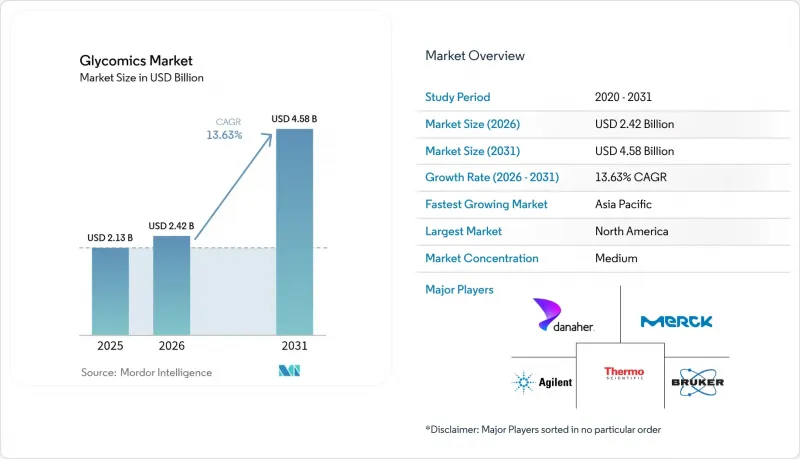
Mordor Intelligence에 의하면, 글리코믹스 시장 규모는 2025년에 21억 3,000만 달러로 평가되었고 2026년 24억 2,000만 달러에서 2031년까지 45억 8,000만 달러에 이를 것으로 예측되며, 예측 기간(2026-2031년) CAGR은 13.63%를 나타낼 전망입니다.
본 보고서는 제품 유형(장비 등), 기술(질량 분석법, HPLC 및 UHPLC 등), 용도(신약·의약품 개발, 진단 등), 최종 사용자(제약·바이오기술 기업 등), 지역(북미, 유럽, 아시아태평양, 중동 및 아프리카, 남미)별로 분류되어 있습니다. 시장 전망은 금액(달러) 기준으로 제시되어 있습니다.
세계 글리코믹스 시장 동향 및 인사이트
제약 업계의 글리코생물학에 대한 투자가 가속화되고 있습니다.
주요 제약 기업의 연구 개발(R&D) 포트폴리오에서는 현재 글리코생물학에 우선적으로 예산이 배정되고 있습니다. 이는 당사슬의 변화가 증상이 나타나기 최대 10년 전부터 질병을 예고할 가능성이 있기 때문입니다. 2025년 Glycomine사가 실시한 1억 1,500만 달러 규모의 시리즈 C 자금 조달은 투자자들의 신뢰를 보여줄 뿐만 아니라, 전문 시약에 대한 수요로 자본을 유도하고 있습니다. 학계와 산업계의 제휴도 활발해지고 있으며, 하버드 의과대학의 글리코사이언스 센터는 여러 후원사와 협력하여 연구실의 성과를 임상시험으로 발전시키고 있습니다. 제어된 당사슬 공학을 통해 단일클론 항체의 효능이 향상되고 면역원성이 감소함에 따라, 첨단 질량 분석 시스템 및 재조합 당전달효소에 대한 수요가 증가하고 있습니다. 이러한 추세는 턴키 방식의 당단백질 워크플로를 제공하는 중견 장비 공급업체에 힘을 실어주고 있으며, 플랫폼 규모의 사업을 추구하는 벤처 투자자들에게 글리코믹스 시장은 매력적인 분야로 부상하고 있습니다.
질량 분석 플랫폼의 보급 확대
질량 분석법은 단일 분자 수준의 명확한 분석이 가능해짐에 따라 구조 글리코믹스 분석의 핵심이 되고 있습니다. 2024년에 발표된 브루커(Bruker)사의 ‘glyco-PASEF’법은 복잡한 당펩타이드를 몇 분 만에 분석하고 시료량을 줄임으로써 CRO의 프로젝트 기간을 단축합니다. 고속 이온 이동도 분리와 결합된 하이브리드 분석 장치는 번거로운 유도체화 처리 없이도 결합 부위별 상세 정보를 제공합니다. CandyCrunch와 같은 AI 도구는 미지의 구조 식별 정확도를 90% 가까이 높여 신규 시장 진출기업의 학습 곡선을 완화합니다. 이러한 일련의 진보로 인해 고객 기반은 일류 핵심 시설에서 지역 병원으로 확대되었으며, 그 결과 글리코믹스 시장이 성장하고 있습니다.
글리코믹스 워크플로우의 높은 비용과 기술적 복잡성
손상되지 않은 당단백질 분석에 적합한 최첨단 LC-MS 플랫폼은 50만 달러를 초과하기도 하며, 전용 소모품도 단백질체학용 시약에 비해 몇 배나 더 많은 비용이 듭니다. 방법 개발에는 일상적인 운영 개시까지 6-12개월이 소요되는 경우가 많아 프로젝트 예산을 압박합니다. 각 시료는 효소에 의한 분리, 형광 표지, 다차원 분리를 거치는 경우가 있어 소모품 사용량이 많아집니다. 많은 소규모 연구소의 경우, 외부 위탁이 여전히 비용 대비 효과가 높기 때문에 내부 도입이 지연되고, 비용에 민감한 지역에서의 글리코믹스 시장 조기 침투가 저해되고 있습니다.
부문 분석
2025년에는 시약 및 키트가 가장 큰 수익을 창출하여 37.78%의 점유율을 차지했습니다. 이는 각 분석 주기마다 여러 가지 특수 효소, 렉틴 및 유도체화 시약이 필요하기 때문입니다. 시약 분야의 글리코믹스 시장 규모는 연구 개발(R&D) 및 품질 관리 실험실의 시료 처리량 증가에 따라 꾸준히 확대될 전망입니다. 효소는 판매량 증가를 주도하고 있으며, 2031년까지 연평균 성장률(CAGR) 15.18%를 나타낼 것으로 예측됩니다. 이는 의약품 워크플로우에서 높은 순도와 규제 승인을 얻을 수 있는 재조합 생산 경로에 힘입은 결과입니다. 공급업체들은 미량의 불순물이라도 글리칸 지문을 왜곡하여 비용이 많이 드는 배치 불합격을 초래할 수 있으므로, 로트 간 균일성을 중시하고 있습니다. 장비의 매출액은 절대값 기준으로 시약에 이어 두 번째로 높으며, 장기적인 시장 정착을 위해 여전히 중요한 역할을 하고 있습니다. 각 벤더는 서비스 계약이나 클라우드 분석 서비스 구독을 묶어 판매함으로써, 일회성 하드웨어 구매를 지속적인 수익원으로 전환하고 있습니다. 신규 사용자가 글리코믹스 시장에 진입함에 따라, 시료 전처리용 소모품과 표준 작업 절차(SOP)를 결합한 스타터 키트가 도입 장벽을 낮추고 있습니다.
장비 부문은 질량 분석기의 업그레이드에 크게 의존하고 있지만, 인라인 모세관 전기영동 및 신흥 나노포어 시퀀서가 다양성을 더하고 있습니다. 각 기술 분야는 HPLC용 형광증백제나 마이크로어레이용 캡처 프로브 등, 각각 고유한 시약 수요를 창출하고 있습니다. 연구소는 플랫폼 전반에 걸쳐 워크플로우를 최적화하고 있어, 교차 판매 기회가 창출되고 있습니다. 예측 기간 동안 시약은 글리코믹스 시장의 기반이 될 것입니다. 분석되는 시료 하나하나가 소모품에 대한 지속적인 지출을 유발하고, 임상 검사의 확대가 이러한 시너지 효과를 더욱 증폭시키기 때문입니다.
질량 분석법은 2025년 총 매출의 40.92%를 차지하고 있으며, 결정적인 결합 정보 및 위치 정보를 제공하기 때문에 앞으로도 지배적인 위치를 유지할 전망입니다. 사용자들은 속도와 초고정밀도를 겸비한 비행시간형(TOF) 및 Orbitrap 하이브리드 장비를 채택하고 있으며, 이를 통해 식별 주기가 단축되고 있습니다. 인프라가 정비됨에 따라 마이크로어레이 및 칩 기반 플랫폼의 글리코믹스 시장 규모는 가장 빠르게 확대되어 2031년까지 연평균 성장률(CAGR) 14.32%를 나타낼 것으로 예측됩니다. 소형화된 어레이는 고처리량 스크리닝을 가능하게 하여, 예산 제약 하에서 수천 개의 항원 변이체를 스크리닝해야 하는 백신 개발자들에게 매력적입니다. 단일클론 항체의 로트 릴리스를 위한 렉틴 마이크로어레이에 대한 규제 당국의 검증으로 상업적 수용이 확대되었습니다.
HPLC 및 UHPLC는 기존 품질 관리(QC) 실험실에 원활하게 통합될 수 있어 여전히 주력 기술로 자리 잡고 있습니다. 모세관 전기영동은 산성 당사슬의 전하 변이체 분리 분야에서 틈새 시장을 유지하고 있습니다. 기술 동향은 프런트엔드 분리 및 MS 검출, AI 기반 구조 동정을 융합한 통합형 멀티모달 시스템으로 전환되고 있습니다. 데이터 처리를 자동화하는 소프트웨어 플랫폼은 인력 부족을 해소하고 소규모 연구소도 글리코믹스 시장에 진입할 수 있도록 해주기 때문에 현재 구매 결정에 있어 결정적인 요소가 되고 있습니다. 향후에는 하드웨어, 시약, 바이오인포매틱스를 통합하는 장비 제조업체가 더 광범위한 도입 기반을 확보하고, 전환 비용을 높일 것으로 보입니다.
지역별 분석
북미는 NIH(미국 국립보건원)의 지속적인 자금 지원과 선진적인 바이오의약품 제조거점 덕분에 2025년 글리코믹스 시장에서 38.10%의 점유율을 유지했습니다. FDA(미국 식품의약국)가 승인한 당사슬 프로파일링 프로토콜 덕분에 로트 릴리스 시험이 효율화되었으며, 각 도구 공급업체들은 보스턴, 샌디에이고, 토론토 근교에 데모 센터를 설치하고 있습니다. 조지아 대학교 등 여러 대학은 당과학 인프라의 보급을 목적으로 미국 국립과학재단(NSF)으로부터 1,800만 달러의 보조금을 받아, 향후 도입의 기반이 될 지역 교육 허브를 설립했습니다.
유럽은 매출액 기준 2위를 차지하고 있으며, 그 기반이 되는 것은 독일의 계측 기기 관련 전문 지식, 영국의 생물제제 액셀러레이터, 그리고 프랑스의 백신 연구소입니다. 유럽 전역에 걸친 규제 조화를 통해 공동 검증 연구가 촉진되어, 규정 준수 비용 절감과 국경을 초월한 협력 증진으로 이어지고 있습니다. 아일랜드와 네덜란드의 계약연구기관(CRO)은 미국 및 아시아의 의뢰사를 대상으로 전문적인 당사슬 분석 서비스를 제공하며, 세계 공급망을 통해 대륙 간을 연결하고 있습니다.
아시아태평양은 2031년까지 연평균 성장률(CAGR)이 14.09%로 가장 빠르게 성장하고 있습니다. 중국에서 고부가가치 바이오의약품으로의 전환에 따라 각 제조 거점이 FDA 및 EMA 승인을 목표로 하는 가운데, 당사슬 모니터링 수요가 증가하고 있습니다. 일본의 장비 제조업체는 현지 대학에 고급 MS 시스템을 납품하고 있는 반면, 한국의 CDMO는 유럽 및 미국 고객을 대상으로 당사슬 공학 서비스를 패키지화하고 있습니다. 동남아시아 국가들은 중국의 생산 능력 분산 전략의 혜택을 받고 있으며, 기술 이전 및 합작 투자를 통해 지역 고객 기반을 확대되고 있습니다. 인도의 바이오시밀러 제조업체들은 미국 시장에서의 승인을 목표로 하고 있으며, 이는 글리코믹스 시장을 더욱 견인하고 있습니다. 호주는 국가 연구 보조금을 활용하여 신경퇴행성 질환에서 당사슬의 역할을 연구하고 있으며, 이는 오세아니아 지역의 기여를 뒷받침하는 기반이 되고 있습니다. 이러한 동향들이 맞물리면서 대상 도입 기반이 확대되고, 장기적인 수익 전망이 강화되고 있습니다.
기타 혜택:
- 엑셀 형식 시장 예측(ME) 시트
- 3개월간의 애널리스트 지원
자주 묻는 질문
목차
제1장 서론
제2장 조사 방법
제3장 주요 요약
제4장 시장 구도
제5장 시장 규모와 성장 예측
제6장 경쟁 구도
제7장 시장 기회와 향후 전망
JHS 26.08.26According to Mordor Intelligence, the glycomics market size was valued at USD 2.13 billion in 2025 and estimated to grow from USD 2.42 billion in 2026 to reach USD 4.58 billion by 2031, at a CAGR of 13.63% during the forecast period (2026-2031).
This report is Segmented by Product Type (Instruments, and More), Technology (Mass Spectrometry, HPLC & UHPLC, and More), Application (Drug Discovery & Development, Diagnostics, and More), End-User (Pharmaceutical & Biotechnology Companies, and More), Geography (North America, Europe, Asia-Pacific, The Middle East and Africa, and South America). The Market Forecasts are Provided in Terms of Value (USD).
Global Glycomics Market Trends and Insights
Accelerating Pharmaceutical Investments in Glycobiology
R&D portfolios inside large drug makers now assign priority budgets to glycobiology because glycan changes can foreshadow disease up to ten years before symptoms appear. Glycomine's USD 115 million Series C raise in 2025 demonstrates investor confidence and channels capital into specialized reagent demand. Alliance formation between academic centers and industry has intensified; Harvard Medical School's Center for Glycoscience works with multiple sponsors to push lab insights toward clinical trials. Controlled glyco-engineering improves monoclonal antibody potency and reduces immunogenicity, fuelling orders for advanced mass-spectrometry systems and recombinant glycosyltransferases. The trend lifts mid-cap tool suppliers that provide turnkey glycoprotein workflows, making the glycomics market attractive for venture investors searching for platform scale.
Growing Adoption of Mass Spectrometry Platforms
Mass spectrometry has become the analytical backbone for structural glycomics because it now delivers single-molecule clarity. Bruker's glyco-PASEF method, launched in 2024, reads complex glycopeptides in minutes and lowers sample volumes, shortening project timelines for CROs. Hybrid analyzers paired with rapid ion-mobility separation provide linkage-specific detail without labor-intensive derivatization. AI tools such as CandyCrunch raise identification accuracy toward 90% for unknown structures, reducing the learning curve for new entrants. Taken together, these advances broaden the customer base from elite core facilities to regional hospitals, thereby widening the glycomics market.
High Cost and Technical Complexity of Glycomics Workflows
State-of-the-art LC-MS platforms suitable for intact glycoprotein analysis can top USD 500,000, and specialized consumables remain several multiples costlier than proteomics reagents. Method development often requires six to twelve months before routine operation, which stretches project budgets. Each sample may undergo enzymatic release, fluorescent labeling, and multidimensional separation, so consumable usage is high. For many small laboratories, outsourcing remains cheaper, slowing internal adoption and constraining early glycomics market penetration in cost-sensitive regions.
Other drivers and restraints analyzed in the detailed report include:
- Expansion of Biopharmaceutical Production Capacities
- Rising Prevalence of Chronic Diseases Driving Biomarker Demand
- Limited Availability of Skilled Glycobiology Professionals
For complete list of drivers and restraints, kindly check the Table Of Contents.
Segment Analysis
Reagents and kits generated the largest revenue in 2025, capturing a 37.78% share as each analytical cycle necessitates multiple specialized enzymes, lectins, and derivatization chemicals. The glycomics market size for reagents is set to expand steadily in line with sample throughput growth in both R&D and quality-control labs. Enzymes lead volume escalation, advancing at a 15.18% CAGR through 2031, supported by recombinant production routes that offer higher purity and regulatory acceptance for pharmaceutical workflows. Suppliers emphasize lot-to-lot consistency because minute impurities can skew glycan fingerprints and trigger costly batch failures. Instrument sales trail reagents in absolute value yet remain critical for long-term market stickiness. Vendors bundle service contracts and cloud analytics subscriptions, turning one-time hardware purchases into annuity streams. As new users enter the glycomics market, starter kits that combine sample-prep consumables with SOPs lower adoption hurdles.
The instruments category relies heavily on mass spectrometry upgrades, but inline capillary electrophoresis and emerging nanopore sequencers add diversity. Each technology class spurs distinct reagent demand, including fluorescent dyes for HPLC and capture probes for microarrays. Laboratories optimize workflows across platforms, creating cross-selling opportunities. Over the forecast window, reagents will remain the foundation of the glycomics market because every sample analyzed drives recurring consumable spend, and expanded clinical testing will magnify that multiplier effect.
Mass spectrometry held 40.92% of overall revenue in 2025 and will stay dominant because it delivers definitive linkage and site information. Users embrace time-of-flight and Orbitrap hybrids that pair speed with ultra-high mass accuracy, shortening identification cycles. As infrastructure builds out, the glycomics market size for microarray and chip-based platforms rises fastest, climbing at 14.32% CAGR through 2031. Miniaturized arrays enable high-throughput screening, which appeals to vaccine developers who need thousands of antigen variants screened under budget constraints. Regulatory validation of lectin microarrays for monoclonal antibody lot release widened commercial acceptance.
HPLC and UHPLC remain staples because they integrate seamlessly into existing QC labs. Capillary electrophoresis retains niche status for charge-variant resolution of acidic glycans. The technology landscape is shifting toward integrated multi-modal systems that fuse front-end separations with MS detection and AI-based structure calling. Software platforms that automate data reduction are now decisive in purchase decisions because they relieve staff shortages and enable smaller labs to enter the glycomics market. Over time, instrument makers that combine hardware, reagents, and bioinformatics will secure a broader installed base and raise switching costs.
Complete Report Scope:
- By Product Type
- Instruments
- Reagents & Kits
- Enzymes
- By Technology
- Mass Spectrometry
- HPLC & UHPLC
- Capillary Electrophoresis
- Microarray & Chip-Based Platforms
- Lectin-Affinity Assays
- Other Techniques
- By Application
- Drug Discovery & Development
- Diagnostics
- Academic Research
- Biopharmaceutical Production
- Vaccine Development
- By End User
- Pharmaceutical & Biotechnology Companies
- Academic & Research Institutes
- Contract Research Organizations
- Hospitals & Clinical Laboratories
- Geography
- North America
- United States
- Canada
- Mexico
- Europe
- Germany
- United Kingdom
- France
- Italy
- Spain
- Rest of Europe
- Asia-Pacific
- China
- Japan
- India
- Australia
- South Korea
- Rest of Asia-Pacific
- Middle East & Africa
- GCC
- South Africa
- Rest of Middle East & Africa
- South America
- Brazil
- Argentina
- Rest of South America
- North America
Geography Analysis
North America retained 38.10% share of the glycomics market in 2025 thanks to sustained NIH funding and an advanced biopharma manufacturing base. The FDA's validated protocols for glycan profiling now streamline lot-release testing, prompting tool vendors to locate demo centers near Boston, San Diego, and Toronto. Universities such as the University of Georgia received an USD 18 million NSF award to democratize glycoscience infrastructure, creating regional training hubs that seed future adoption.
Europe ranks second in revenue, anchored by Germany's instrumentation expertise, the United Kingdom's biologics accelerators, and France's vaccine institutes. Pan-European regulatory alignment promotes shared validation studies, lowering compliance costs and fostering cross-border collaborations. Contract research organizations in Ireland and the Netherlands provide specialized glycan analysis for U.S. and Asian sponsors, linking continents within a global supply chain.
Asia-Pacific is the fastest climber with a 14.09% CAGR to 2031. China's shift toward high-value biologics drives demand for glycan monitoring as plants aim for FDA and EMA licensure. Japanese instrument makers ship high-end MS systems to local universities, while South Korean CDMOs bundle glyco-engineering services for Western clients. Southeast Asian nations benefit from China's capacity diversification strategy, receiving technology transfers and joint ventures that broaden the regional customer base. India's biosimilar manufacturers pursue U.S. market approvals, further boosting the glycomics market. Australia leverages national research grants to study glycan roles in neurodegeneration, anchoring Oceania's contribution. Together these dynamics expand the addressable installed base and strengthen long-term revenue visibility.
- Thermo Fisher Scientific
- Agilent Technologies
- Merck
- Bruker
- Danaher
- New England Biolabs
- Waters Corporation
- Takara Bio
- Shimadzu
- QA-Bio
- Bio-Techne
- Lectenz Bio
- Vector Laboratories
- Ludger Ltd.
- Asparia Glycomics
- RayBiotech
- Z Biotech
- GlycoThera GmbH
- GlycoSeLect Ltd.
- Glycomix
Additional Benefits:
- The market estimate (ME) sheet in Excel format
- 3 months of analyst support
TABLE OF CONTENTS
1 Introduction
- 1.1 Study Assumptions & Market Definition
- 1.2 Scope of the Study
2 Research Methodology
3 Executive Summary
4 Market Landscape
- 4.1 Market Overview
- 4.2 Market Drivers
- 4.2.1 Accelerating Pharmaceutical Investments in Glycobiology
- 4.2.2 Growing Adoption of Mass Spectrometry Platforms
- 4.2.3 Expansion of Biopharmaceutical Production Capacities
- 4.2.4 Rising Prevalence of Chronic Diseases Driving Biomarker Demand
- 4.2.5 Emergence of Glyco-Engineered Cell And Gene Therapies
- 4.2.6 Integration of AI-Enabled Glycan Informatics Solutions
- 4.3 Market Restraints
- 4.3.1 High Cost and Technical Complexity of Glycomics Workflows
- 4.3.2 Limited Availability of Skilled Glycobiology Professionals
- 4.3.3 Regulatory Uncertainty for Glycan-Based Diagnostics
- 4.3.4 Constrained Supply of Rare Glycan Reagents
- 4.4 Regulatory Landscape
- 4.5 Porter's Five Forces Analysis
- 4.5.1 Threat Of New Entrants
- 4.5.2 Bargaining Power Of Buyers/Consumers
- 4.5.3 Bargaining Power Of Suppliers
- 4.5.4 Threat Of Substitute Products
- 4.5.5 Intensity Of Competitive Rivalry
5 Market Size & Growth Forecasts (Value, USD)
- 5.1 By Product Type
- 5.1.1 Instruments
- 5.1.2 Reagents & Kits
- 5.1.3 Enzymes
- 5.2 By Technology
- 5.2.1 Mass Spectrometry
- 5.2.2 HPLC & UHPLC
- 5.2.3 Capillary Electrophoresis
- 5.2.4 Microarray & Chip-Based Platforms
- 5.2.5 Lectin-Affinity Assays
- 5.2.6 Other Techniques
- 5.3 By Application
- 5.3.1 Drug Discovery & Development
- 5.3.2 Diagnostics
- 5.3.3 Academic Research
- 5.3.4 Biopharmaceutical Production
- 5.3.5 Vaccine Development
- 5.4 By End User
- 5.4.1 Pharmaceutical & Biotechnology Companies
- 5.4.2 Academic & Research Institutes
- 5.4.3 Contract Research Organizations
- 5.4.4 Hospitals & Clinical Laboratories
- 5.5 Geography
- 5.5.1 North America
- 5.5.1.1 United States
- 5.5.1.2 Canada
- 5.5.1.3 Mexico
- 5.5.2 Europe
- 5.5.2.1 Germany
- 5.5.2.2 United Kingdom
- 5.5.2.3 France
- 5.5.2.4 Italy
- 5.5.2.5 Spain
- 5.5.2.6 Rest of Europe
- 5.5.3 Asia-Pacific
- 5.5.3.1 China
- 5.5.3.2 Japan
- 5.5.3.3 India
- 5.5.3.4 Australia
- 5.5.3.5 South Korea
- 5.5.3.6 Rest of Asia-Pacific
- 5.5.4 Middle East & Africa
- 5.5.4.1 GCC
- 5.5.4.2 South Africa
- 5.5.4.3 Rest of Middle East & Africa
- 5.5.5 South America
- 5.5.5.1 Brazil
- 5.5.5.2 Argentina
- 5.5.5.3 Rest of South America
- 5.5.1 North America
6 Competitive Landscape
- 6.1 Market Concentration
- 6.2 Market Share Analysis
- 6.3 Company Profiles (includes Global level Overview, Market level overview, Core Business Segments, Financials, Headcount, Key Information, Market Rank, Market Share, Products and Services, and analysis of Recent Developments)
- 6.3.1 Thermo Fisher Scientific Inc.
- 6.3.2 Agilent Technologies Inc.
- 6.3.3 Merck KGaA (Sigma-Aldrich)
- 6.3.4 Bruker Corporation
- 6.3.5 Danaher (SCIEX)
- 6.3.6 New England Biolabs Inc.
- 6.3.7 Waters Corporation
- 6.3.8 Takara Bio Inc.
- 6.3.9 Shimadzu Corporation
- 6.3.10 QA-Bio
- 6.3.11 Bio-Techne Corporation
- 6.3.12 Lectenz Bio
- 6.3.13 Vector Laboratories
- 6.3.14 Ludger Ltd.
- 6.3.15 Asparia Glycomics
- 6.3.16 RayBiotech
- 6.3.17 Z Biotech
- 6.3.18 GlycoThera GmbH
- 6.3.19 GlycoSeLect Ltd.
- 6.3.20 Glycomix
7 Market Opportunities & Future Outlook
- 7.1 White-Space & Unmet-Need Assessment


