|
시장보고서
상품코드
2114776
경두개 도플러 초음파 : 시장 점유율 분석, 업계 동향 및 통계, 성장 예측(2026-2031년)Transcranial Doppler Ultrasound - Market Share Analysis, Industry Trends & Statistics, Growth Forecasts (2026 - 2031) |
||||||
 Mordor Intelligence
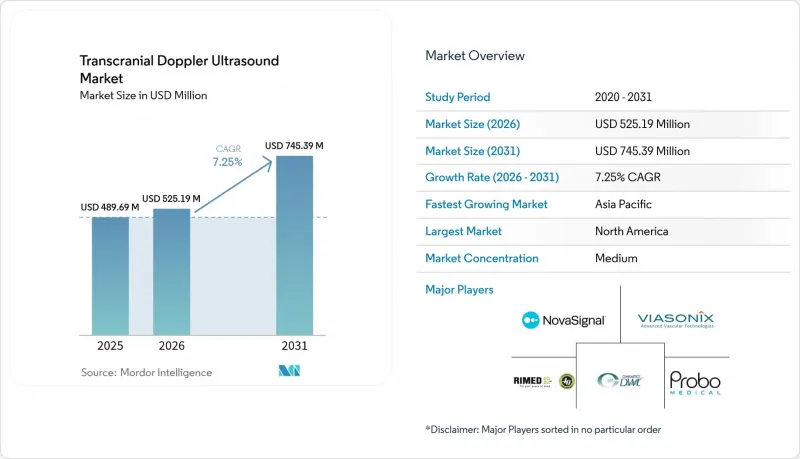
Mordor Intelligence에 의하면, 경두개 도플러 초음파 시장 규모는 2025년 4억 8,969만 달러로 평가되었습니다. 2026년에는 5억 2,519만 달러로 확대되어 2026-2031년에 걸쳐 CAGR 7.25%로 성장을 지속하여, 2031년에는 7억 4,539만 달러에 이를 것으로 예측됩니다.
본 보고서는 용도별(겸상적혈구증, 급성 허혈성 뇌졸중, 두개내 협착·폐쇄성 질환), 기기 유형별(독립형 시스템, 휴대용·핸드헬드 시스템), 최종 사용자별(병원, 진단 실험실, 기타),지역별(북미, 유럽, 아시아태평양, 중동 및 아프리카, 남미)로 분류되어 있습니다. 시장 예측은 금액(달러) 기준으로 제시되어 있습니다.
세계의 경두개 도플러 초음파 시장 동향 및 인사이트
전 세계 뇌졸중 발병률 증가와 고령화 진전에 따른 신속한 신경혈관 스크리닝 수요 증가
세계적으로 허혈성 뇌졸중 사례 수가 증가하고 있으며, 현재 연간 1,190만 건을 초과함에 따라 신속한 병상 옆 뇌혈관 평가에 대한 수요가 높아지고 있습니다. 유럽, 일본, 미국의 인구 고령화에 더해 고혈압 및 비만 유병률이 높은 수준을 유지하고 있는 것이 이러한 추세를 더욱 강화하고 있습니다. 각국 정부와 의료 제도는 조기 발견을 우선시하고 있으며, 경두개 도플러 초음파 시장의 솔루션을 뇌졸중 예방 노력의 중심에 두고 있습니다. 중대뇌동맥의 혈류 패턴과 기능적 예후를 연관 짓는 대규모 데이터 세트는 임상적 신뢰성과 보험 급여 전망을 강화하고 있습니다. 그 결과, 신경내과, 순환기내과, 응급의학과에서 휴대용 신경혈관 스캐너의 조달 예산이 증가하고 있습니다.
종합 뇌졸중 센터 및 원격 뇌졸중 네트워크의 확산에 따른 경두개 도플러(TCD) 이용 확대
각국의 뇌졸중 대책에 따라 고도 혈전 제거술 거점의 인가가 가속화되고 있으며, 각 거점에서는 24시간 체제의 신경 진단이 요구되고 있습니다. 프랑스의 경우, 기계적 혈전 제거술 시행 능력이 잠재적 2만 500건에 비해 여전히 7,500건에 그치고 있어, 병원들은 측부 혈류 분류를 위해 자동화된 경두개 도플러 초음파 시장 플랫폼 도입을 추진하고 있습니다. 원격 뇌졸중 네트워크는 실시간 도플러 파형을 더욱 활용하여 환자 이송 판단을 지원하고 있습니다. 이러한 서비스의 확대는 이송부터 재관류까지의 시간을 단축하고, 이 검사법의 중요한 역할을 부각시킴으로써 장비 판매 및 서비스 계약을 직접적으로 촉진하고 있습니다.
시설 간 표준화된 소견 해석을 방해하는 조작자에 대한 높은 의존도와 학습 곡선
기존 시스템에서는 숙련된 초음파 검사사가 음향 창을 특정해야 합니다. 중증 외상성 뇌손상(TBI)의 경우, 파형의 변동이 날마다 40%에 달한다는 사실은 이 과제를 여실히 보여줍니다. 압력과 혈류 간의 관계 분류가 의료기관마다 다르기 때문에 치료 알고리즘이 복잡해지고 있습니다. 이러한 기술적 장벽으로 인해 소규모 병원은 시스템 도입을 주저하고 있으며, 보험 적용 범위 확대도 제한되고 있습니다. 로봇 기술과 AI는 이 문제를 부분적으로 해소하지만, 체계적인 자격 인증의 필요성을 완전히 배제하는 것은 아닙니다.
부문별 분석
2025년에는 급성 허혈성 뇌졸중이 경두개 도플러 초음파 시장에서 가장 큰 점유율(34.15%)을 차지했습니다. 이는 기계적 재관류 전 측부 혈류 매핑에 관한 지침의 권고에 힘입은 결과입니다. 다중 모달 뇌졸중 치료 경로에의 통합으로 인해 종합 의료 센터에서 장비 교체 주기가 유지되고 있습니다. 외상성 뇌손상 모니터링은 국방 부문의 조사 및 스포츠 의료 프로토콜에 힘입어 연평균 성장률(CAGR) 8.62%로 가장 빠르게 성장하고 있습니다. 소아 겸상 적혈구증 선별 검사는 의무화된 연간 프로토콜에 힘입어 안정적인 수익원으로 자리 잡고 있습니다. 한편, 지주막하출혈 후 뇌혈관경련의 모니터링은 매일 실시되는 도플러 검사를 뒷받침하는 강력한 근거에 힘입어 견조한 추세를 유지하고 있습니다.
지속적인 혁신이 모든 적응 영역에 미치고 있습니다. AI를 활용한 의사 결정 지원으로, 션트의 등급 판정이 몇 초 만에 제시되어 해석의 편차가 줄어들고 있습니다. 클라우드 기반 보고 기능을 통해 신경외과 전문의와의 상담이 신속해졌으며, 혈류 속도가 임계치를 초과할 경우 즉시 혈관조영술로 전환할 수 있게 되었습니다. 이러한 발전들이 맞물려, 경두개 도플러 초음파 시장의 솔루션에 대한 임상 현장의 의존도가 높아지고 있으며, 모니터링 범위가 급성기를 넘어 2차 예방 영역으로 확대되고 있습니다.
지역별 분석
2025년에는 북미가 매출의 41.32%를 차지하며 선두를 유지했습니다. 이는 밀집된 뇌졸중 센터 네트워크와 체계화된 신경 중환자 치료 채널에 힘입은 결과입니다. 겸상적혈구증 및 경동맥 평가와 관련된 유리한 CPT 코드가 기본 검사 건수를 뒷받침하고 있지만, 적응 범위에는 여전히 격차가 남아 있습니다. 구급대원 팀에 경량 스캐너를 지급하는 시범 프로그램은 이 지역에서 병원 도착 전 도입에 대한 의지를 보여주고 있습니다.
유럽은 국민건강보험 제도와 풍부한 연구 자금의 혜택을 받아 2위를 차지했습니다. 프랑스에서 혈전 제거술의 낮은 이용률은 진단 역량 확충에 대한 잠재적 수요를 여실히 보여주고 있습니다. 또한, 영국에서 진행 중인 650만 파운드(870만 달러) 규모의 초음파 뇌-컴퓨터 인터페이스 임상시험은 최첨단 신경 기술에 대한 공공 부문의 노력을 뒷받침하고 있습니다. 한편, 독일과 북유럽 국가들에서는 도플러 측정값을 통합한 전국 등록 제도 구축이 진행되고 있으며, 증거 기반의 보험 환급에 관한 대화가 촉진되고 있습니다.
아시아태평양은 뇌졸중 발병률이 급증하고 각국 정부가 원격 의료에 투자하고 있어 연평균 성장률(CAGR) 7.95%로 가장 빠르게 성장하고 있는 지역입니다. 중국 각 성의 뇌졸중 치료 지도에 따르면, 2차 의료 기관에서 도플러 검사를 받을 수 있도록 의무화하고 있는 반면, 인도의 신설된 뇌졸중 치료실에서는 지역 의료시설에 적합한 휴대용 콘솔의 도입이 촉진되고 있습니다. 일본에서는 고령자를 대상으로 한 무증상 뇌경색 예방적 선별 검사 프로그램이 진행되고 있어, 프로브의 반복 구매 및 유지보수를 통한 수익이 확대되고 있습니다. 중동 및 아프리카 및 남미와 같이 규모는 작지만 전략적으로 중요한 시장에서는 민관 협력 자금 조달 모델을 채택하여 광범위한 응급 의료 체계 구축과 병행하여 경두개 도플러 초음파 시장의 기술을 도입하고 있습니다.
기타 혜택
- 엑셀 형식 시장 예측(ME) 시트
- 3개월간의 애널리스트 지원
자주 묻는 질문
목차
제1장 서론
제2장 조사 방법
제3장 주요 요약
제4장 시장 구도
제5장 시장 규모 및 성장 예측
제6장 경쟁 구도
제7장 시장 기회 및 향후 전망
KTH 26.08.28According to Mordor Intelligence, the transcranial doppler ultrasound market size is expected to grow from USD 489.69 million in 2025 to USD 525.19 million in 2026 and is forecast to reach USD 745.39 million by 2031 at 7.25% CAGR over 2026-2031.
This report is Segmented by Application (Sickle Cell Disease, Acute Ischemic Stroke, Intracranial Steno-Occlusive Disease), Device Type (Stand-Alone Systems, Portable/Hand-held Systems), End User (Hospitals, Diagnostic Laboratories, and More), and Geography (North America, Europe, Asia-Pacific, Middle East & Africa, South America). The Market Forecasts are Provided in Terms of Value (USD).
Global Transcranial Doppler Ultrasound Market Trends and Insights
Rising Global Stroke Incidence & Aging Demographics Elevating Demand for Rapid Neuro-vascular Screening
The worldwide rise in ischemic stroke cases, now surpassing 11.9 million annually, is intensifying demand for fast, bedside cerebrovascular assessments. Aging populations in Europe, Japan, and the United States magnify this trend as hypertension and obesity prevalence remain high. Governments and health systems are prioritizing early-stage detection, placing Transcranial Doppler Ultrasound market solutions at the center of stroke prevention pathways. Large data sets linking middle cerebral artery flow patterns to functional outcomes strengthen clinical confidence and reimbursement prospects. Consequently, procurement budgets for portable neuro-vascular scanners are rising in neurology, cardiology, and emergency departments.
Proliferation of Comprehensive Stroke Centers & Tele-stroke Networks Enhancing TCD Utilization
National stroke strategies are accelerating licensure of advanced thrombectomy hubs, each requiring around-the-clock neuro-diagnostics. In France, mechanical thrombectomy capacity remains at 7,500 procedures versus a 20,500-case potential, driving hospitals to integrate automated Transcranial Doppler Ultrasound market platforms for collateral-flow triage. Tele-stroke networks further leverage real-time Doppler waveforms to guide patient transfer decisions. These service expansions shorten door-to-reperfusion intervals and underscore the modality's critical role, directly lifting device sales and service contracts.
High Operator Dependency and Learning Curve Limiting Standardized Interpretations Across Sites
Traditional systems require expert sonographers to identify acoustic windows; waveform variability of 40% day-to-day in severe TBI illustrates the challenge. Differing pressure-flow relationship categories complicate treatment algorithms. These technical hurdles deter smaller hospitals from purchasing systems and restrain broad reimbursement approvals. Robotics and AI partially offset the problem but do not fully eliminate the need for structured credentialing.
Other drivers and restraints analyzed in the detailed report include:
- Expansion of Point-of-Care Ultrasound Programs Boosting Neuro-sonology Training & Adoption
- Technological Convergence Improving Diagnostic Yield & Accessibility
- Reimbursement Variability Across Regions Constraining Capital Procurement Budgets
For complete list of drivers and restraints, kindly check the Table Of Contents.
Segment Analysis
Acute ischemic stroke accounted for the largest transcranial doppler ultrasound market share at 34.15% in 2025, supported by guideline endorsements for collateral-flow mapping prior to mechanical reperfusion. Integration into multimodal stroke pathways sustains equipment refresh cycles across comprehensive centers. Traumatic brain injury monitoring is the fastest climber with an 8.62% CAGR, propelled by defense-sector research and sports-medicine protocols. Pediatric sickle-cell screening remains a stable revenue stream anchored by mandatory annual protocols, while cerebral vasospasm surveillance after subarachnoid hemorrhage holds steady due to strong evidence backing daily Doppler checks.
Continuous innovation overlays all applications. AI-augmented decision support now suggests shunt gradings within seconds, narrowing interpretation variance. Cloud-based reporting accelerates neurosurgeon consults, allowing rapid escalation to angiography when flow velocities exceed critical thresholds. Collectively, these advances deepen clinical reliance on transcranial doppler ultrasound market solutions and extend monitoring beyond acute episodes into secondary-prevention regimes.
Complete Report Scope:
- By Application
- Sickle Cell Disease
- Acute Ischemic Stroke
- Intracranial Steno-Occlusive Disease
- Cerebral Vasospasm Monitoring
- Traumatic Brain Injury Management
- By Device Type
- Stand-alone Systems
- Portable/Hand-held Systems
- By End User
- Hospitals
- Diagnostic Laboratories
- Ambulatory Surgical Centers
- Academic & Research Institutes
- By Geography
- North America
- United States
- Canada
- Mexico
- Europe
- Germany
- United Kingdom
- France
- Italy
- Spain
- Rest of Europe
- Asia-Pacific
- China
- Japan
- India
- Australia
- South Korea
- Rest of Asia-Pacific
- Middle East & Africa
- GCC
- South Africa
- Rest of Middle East & Africa
- South America
- Brazil
- Argentina
- Rest of South America
- North America
Geography Analysis
North America led with 41.32% revenue in 2025, anchored by dense stroke-center networks and structured neuro-critical-care pathways. Favorable CPT codes for sickle-cell and carotid assessments support baseline volumes, though wider indication gaps remain. Pilot programs equipping paramedic teams with lightweight scanners illustrate the region's appetite for pre-hospital adoption.
Europe ranks second, benefiting from universal coverage and robust research funding. France's under-utilization of thrombectomy underscores latent demand for diagnostic capacity expansion; the United Kingdom's GBP 6.5 (USD 8.7) million ultrasound brain-computer interface trial underscores public-sector commitment to frontier neuro-technologies. Meanwhile, Germany and the Nordics pursue national registry initiatives that integrate Doppler metrics, fostering evidence-based reimbursement dialogues.
Asia-Pacific is the fastest-growing territory at 7.95% CAGR as stroke incidence rises sharply and governments invest in tele-medicine. China's provincial stroke-care maps mandate Doppler access in secondary hospitals, while India's new stroke units boost procurement of portable consoles suitable for district facilities. Japan advances preventive screening programs targeting silent cerebral infarcts in seniors, amplifying recurring probe and maintenance revenues. Smaller but strategically important markets in the Middle East & Africa and South America embrace public-private financing models to import Transcranial Doppler Ultrasound market technologies alongside broader critical-care upgrades.
- NovaSignal Corp.
- Viasonix
- Rimed
- DWL Elektronische Systeme GmbH (Compumedics)
- Probo Medical
- Brawn Medical Ltd.
- Delica Medical
- Atys Medical
- Natus Medical (Nicolet)
- GE Healthcare
- Koninklijke Philips
- Fujifilm Sonosite
- Mindray
- EDAN Instruments
- Compumedics Ltd.
- EB Neuro
- Neurolite AG
- Konica Minolta Healthcare India
- Shenzhen Delica Medical Equipment
Additional Benefits:
- The market estimate (ME) sheet in Excel format
- 3 months of analyst support
TABLE OF CONTENTS
1 Introduction
- 1.1 Study Assumptions & Market Definition
- 1.2 Scope of the Study
2 Research Methodology
3 Executive Summary
4 Market Landscape
- 4.1 Market Overview
- 4.2 Market Drivers
- 4.2.1 Rising Global Stroke Incidence & Aging Demographics Elevating Demand for Rapid Neuro-vascular Screening
- 4.2.2 Proliferation of Comprehensive Stroke Centers & Tele-stroke Networks Enhancing TCD Utilization
- 4.2.3 Expansion of Point-of-Care Ultrasound Programs Boosting Neuro-sonology Training & Adoption
- 4.2.4 Technological Convergence Improving Diagnostic Yield & Accessibility
- 4.2.5 Rising Emphasis on Preventive Neurological Screening
- 4.2.6 Adoption of Portable & AI-Integrated TCD Systems
- 4.3 Market Restraints
- 4.3.1 High Operator Dependency and Learning Curve Limiting Standardized Interpretations Across Sites
- 4.3.2 Reimbursement Variability Across Regions Constraining Capital Procurement Budgets
- 4.3.3 Increasing Availability & Cost Decline of Alternative Neuro-imaging Modalities
- 4.3.4 Lack of Standardized Protocols Across Clinical Settings
- 4.4 Technological Outlook
- 4.5 Porter's Five Forces Analysis
- 4.5.1 Threat of New Entrants
- 4.5.2 Bargaining Power of Buyers/Consumers
- 4.5.3 Bargaining Power of Suppliers
- 4.5.4 Threat of Substitute Products
- 4.5.5 Intensity of Competitive Rivalry
5 Market Size & Growth Forecasts (Value in USD)
- 5.1 By Application
- 5.1.1 Sickle Cell Disease
- 5.1.2 Acute Ischemic Stroke
- 5.1.3 Intracranial Steno-Occlusive Disease
- 5.1.4 Cerebral Vasospasm Monitoring
- 5.1.5 Traumatic Brain Injury Management
- 5.2 By Device Type
- 5.2.1 Stand-alone Systems
- 5.2.2 Portable/Hand-held Systems
- 5.3 By End User
- 5.3.1 Hospitals
- 5.3.2 Diagnostic Laboratories
- 5.3.3 Ambulatory Surgical Centers
- 5.3.4 Academic & Research Institutes
- 5.4 By Geography
- 5.4.1 North America
- 5.4.1.1 United States
- 5.4.1.2 Canada
- 5.4.1.3 Mexico
- 5.4.2 Europe
- 5.4.2.1 Germany
- 5.4.2.2 United Kingdom
- 5.4.2.3 France
- 5.4.2.4 Italy
- 5.4.2.5 Spain
- 5.4.2.6 Rest of Europe
- 5.4.3 Asia-Pacific
- 5.4.3.1 China
- 5.4.3.2 Japan
- 5.4.3.3 India
- 5.4.3.4 Australia
- 5.4.3.5 South Korea
- 5.4.3.6 Rest of Asia-Pacific
- 5.4.4 Middle East & Africa
- 5.4.4.1 GCC
- 5.4.4.2 South Africa
- 5.4.4.3 Rest of Middle East & Africa
- 5.4.5 South America
- 5.4.5.1 Brazil
- 5.4.5.2 Argentina
- 5.4.5.3 Rest of South America
- 5.4.1 North America
6 Competitive Landscape
- 6.1 Market Concentration
- 6.2 Market Share Analysis
- 6.3 Company Profiles (includes Global level Overview, Market level overview, Core Segments, Financials as available, Strategic Information, Market Rank/Share for key companies, Products & Services, and Recent Developments)
- 6.3.1 NovaSignal Corp.
- 6.3.2 Viasonix
- 6.3.3 Rimed
- 6.3.4 DWL Elektronische Systeme GmbH (Compumedics)
- 6.3.5 Probo Medical
- 6.3.6 Brawn Medical Ltd.
- 6.3.7 Delica Medical
- 6.3.8 Atys Medical
- 6.3.9 Natus Medical (Nicolet)
- 6.3.10 GE Healthcare
- 6.3.11 Koninklijke Philips N.V.
- 6.3.12 Fujifilm Sonosite
- 6.3.13 Mindray Medical International
- 6.3.14 EDAN Instruments
- 6.3.15 Compumedics Ltd.
- 6.3.16 EB Neuro S.p.A.
- 6.3.17 Neurolite AG
- 6.3.18 Konica Minolta Healthcare India
- 6.3.19 Shenzhen Delica Medical Equipment
7 Market Opportunities & Future Outlook
- 7.1 White-space & Unmet-Need Assessment