

|
시장보고서
상품코드
2114785
파상풍 톡소이드 백신 시장 : 점유율 분석, 업계 동향과 통계, 성장 예측(2026-2031년)Tetanus Toxoid Vaccine - Market Share Analysis, Industry Trends & Statistics, Growth Forecasts (2026 - 2031) |
||||||
 Mordor Intelligence
Mordor Intelligence에 의하면, 2026년 파상풍 톡소이드 백신 시장 규모는 64억 7,000만 달러로 추정되고 있어 2025년 61억 3,000만 달러에서 확대해, 2031년에는 84억 9,000만 달러에 이를 것으로 예측됩니다.
2026년부터 2031년까지 연평균 성장률(CAGR) 5.59%로 성장할 것으로 전망됩니다.
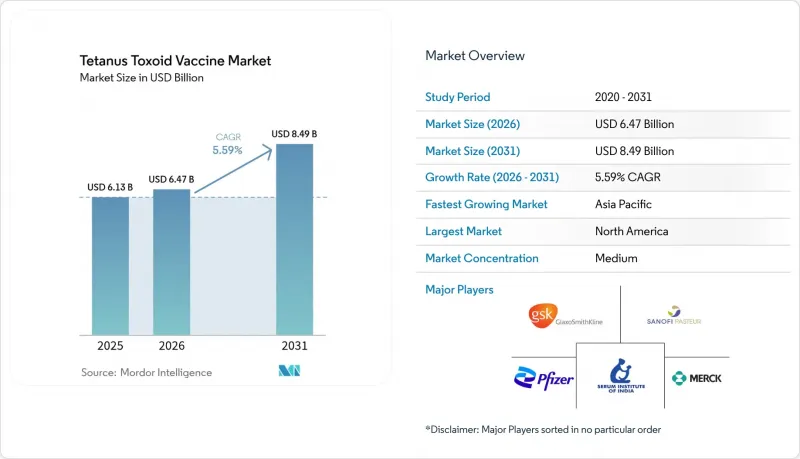
본 보고서는 백신 유형별(디프테리아, 파상풍, 백일해(DTaP) 등), 연령대별(소아(0-16세) 등), 최종 사용자(병원 및 외상 센터 등), 유통 채널(정부 조달 등),지역(북미, 유럽, 아시아태평양 등)별로 분류되어 있습니다. 시장 예측은 금액(달러) 기준으로 제시되어 있습니다.
전 세계 파상풍 톡소이드 백신 시장 동향 및 인사이트
국가 예방접종 프로그램 확대 및 추가 접종 정책 업데이트
현재 전 세계 프로그램에서는 DTP3 접종률 90%를 목표로 하는 WHO의 ‘예방접종 아젠다 2030’에 힘입어, 영유아부터 고령자에 이르는 종합적인 접종 범위가 중시되고 있습니다. 남수단 등 여러 국가들은 ‘2025년 아프리카 예방접종 주간’을 통해 이러한 접근 방식을 재확인하고, 신형 백신 도입과 파상풍 부스터 접종 보급 활동을 병행했습니다. ‘더 빅 캐치업(The Big Catch-up)’ 캠페인은 팬데믹 기간 동안 발생한 5세 미만 아동의 예방접종 격차를 해소하는 것을 목표로 하고 있으며, 한편 많은 정부 부처가 청소년 및 성인을 위한 추가 접종을 예방접종 일정에 포함시키고 있어 파상풍 톡소이드 백신 시장의 잠재적 대상층을 확대되고 있습니다. 이러한 정책 확대는 중기적으로 다양한 연령층에서 수요가 증가할 것으로 예상되는 근거가 되며, 생애 주기별 제제를 라인업에 갖춘 제약사들에게는 호재가 되고 있습니다.
5가 및 6가 혼합 백신의 채택 확대
다중 성분 백신은 병원 방문 횟수를 줄이고, 접종 완료율을 높이며, 물류를 간소화합니다. 증거에 따르면, 복합 백신을 접종한 어린이들은 예정된 접종률 측면에서 우수한 성과를 달성하고 있습니다. CanSino사의 DTcP 후보 약물은 중국에서 우선 심사 대상이며, 동사의 DTcP-Hib-MCV4 제품은 2025년 2월에 임상시험을 시작했습니다. 전환기에 있는 중소득 국가에서 2023년부터 2025년까지 5가 백신의 연간 수요는 1억 3,500만 회분으로 예측됩니다. 디프테리아, 백일해, 파상풍 항원을 1회 접종으로 통합할 수 있다는 점은 파상풍 톡소이드 백신 시장에서 복합화로의 전환을 촉진하고, 장기적인 성장을 견인할 것으로 예측됩니다.
백신에 대한 주저함과 잘못된 정보가 모든 연령대의 접종률을 낮추고 있습니다.
기관에 대한 신뢰 하락과 잘못된 정보가 확산되면서 접종률이 낮아지고 있습니다. 2023년에는 1,450만 명의 어린이가 정기 예방접종을 받지 못했으며, 이들 중 다수는 취약한 환경에 처해 있었습니다. 성인을 대상으로 한 추가 접종은 우선순위가 낮은 상황이며, 조사에 따르면 10년마다 실시하는 Td/Tdap 접종 일정에 대한 인식 차이가 지적되고 있습니다. 수요 감소는 유효기간이 만료된 재고로 이어져 재고 계획의 복잡성을 초래할 뿐만 아니라, 파상풍 톡소이드 백신 시장의 효율적인 공급을 저해하고 있습니다.
부문 분석
DTaP는 소아용 5회 접종 일정을 배경으로 2025년에는 파상풍 톡소이드 백신 시장 점유율의 41.35%를 차지했습니다. 지침에 변경 사항이 없기 때문에 이 부문의 파상풍 톡소이드 백신 시장 규모는 한 자릿수 중반대의 성장률을 보일 것으로 예측됩니다. Tdap의 연평균 성장률(CAGR)은 7.75%로, 시장 전체를 상회하고 있습니다. 이는 청소년, 임산부 및 성인을 대상으로 한 추가 접종이 확대되고 있기 때문입니다. CDC는 영아의 백일해 예방 효과가 90% 이상인 점을 고려하여, 모든 임신 기간 동안 Tdap 접종을 권장하고 있습니다.
수요가 Td로 이동함에 따라 단일 성분 TT 제품은 감소 추세를 보이고 있으며, mRNA DTP 프로토타입은 예측 기간 후반까지 가격 책정 및 제조 패러다임에 큰 변화를 가져올 가능성이 있습니다. 따라서 파상풍 톡소이드 백신 업계는 접종 일정의 변화 속에서도 입지를 유지하기 위해 고부가가치형, 내열성 또는 유전자 플랫폼을 활용한 제제에 연구 개발을 집중하고 있습니다.
2025년 파상풍 톡소이드 백신 시장 규모에서 소아 부문은 84.30%의 점유율을 차지하고 있으며, 이는 취학 시 예방접종 의무 및 VFC(백신 무상 제공 프로그램)에 의한 지원에 힘입은 것입니다. 그럼에도 불구하고, 면역 노화 및 부상을 유발하기 쉬운 생활 방식으로 인해 추가 접종의 부족이 부각되는 가운데, 성인 시장은 연평균 성장률(CAGR) 6.33%로 성장을 지속하고, 있습니다. 면역력이 상실된 고령층에서 파상풍 사례가 불균형적으로 증가하는 현상은 충족되지 않은 의료 수요를 여실히 드러내고 있습니다.
메디케어 비용 상한선과 같은 정책 조치로 경제적 장벽이 제거되는 한편, 신속한 타액 검사를 통해 몇 분 이내에 표적화된 인식 제고 활동이 가능해집니다. 이러한 요인들이 결합되어 성인층은 파상풍 톡소이드 백신 시장의 성장 견인차로 재조명되고 있습니다.
지역별 분석
북미는 성숙한 예방접종 제도와 ‘인플레이션 억제법(Inflation Reduction Act)’의 성인 백신 본인부담금 면제 조항에 힘입어 2025년 매출의 35.60%를 차지했습니다. 그러나 2024년 Td 백신 공급 부족은 취약성을 드러냈으며, 일부 의료 기관에서는 Tdap으로 대체할 수밖에 없었습니다. 캘리포니아주에서는 백일해 감염 급증에 따라, 특히 임신 27주에서 36주 사이의 임산부를 대상으로 Tdap 보급 활동을 강화하고 있습니다. 지속적인 입법 및 재정적 지원 덕분에 이 지역은 파상풍 톡소이드 백신 시장에서 중심적인 역할을 유지하고 있습니다.
아시아태평양은 2031년까지 연평균 성장률(CAGR) 7.12%로 두드러지게 성장하고 있습니다. 인도는 전 세계 예방접종 프로그램용 백신의 60%를 공급하고 있으며, 중국은 국내 수요의 90%를 충당하고 있습니다. 정부의 장려책과 WHO의 사전 인증 절차가 수출을 뒷받침하고 있습니다. 베트남의 민간 백신 매출이 3억 달러를 넘어선 것은 중산층 수요가 증가하고 있음을 보여줍니다. 지역별 생산 능력-세람 인스티튜트의 30억 회분, 바라트 바이오텍의 40억 회분-은 공급량 확대를 뒷받침하고 있으며, 파상풍 톡소이드 백신 시장에서 이 지역의 향후 영향력이 클 것임을 입증하고 있습니다.
유럽, 중동 및 아프리카, 남미에서는 다양한 요인들이 관찰됩니다. 유럽은 높은 접종률을 유지하고 있지만, 백신 접종을 주저하는 지역도 일부 존재합니다. 59개 고위험 국가 중 47개국이 현재 임산부 및 신생아의 파상풍을 근절했으며, 그 중 다수는 아프리카 국가들입니다. 이는 기부자들의 지원을 받은 노력이 성공했음을 반영합니다. AVMA의 10억 달러 규모 이니셔티브는 아프리카의 세계 생산량 점유율을 현재 0.2%에서 높이는 것을 목표로 하고 있습니다. PAHO의 일괄 조달 모델은 남미 지역의 가격을 안정시키고 있습니다. 이 지역들이 힘을 합쳐 파상풍 톡소이드 백신 시장의 지리적 다양성을 확대하고, 집중된 위험을 완화하고 있습니다.
기타 혜택:
- 엑셀 형식 시장 예측(ME) 시트
- 3개월간의 애널리스트 지원
자주 묻는 질문
목차
제1장 서론
제2장 조사 방법
제3장 주요 요약
제4장 시장 구도
제5장 시장 규모와 성장 예측
제6장 경쟁 구도
제7장 시장 기회와 향후 전망
JHS 26.08.26According to Mordor Intelligence, the tetanus toxoid vaccine market size in 2026 is estimated at USD 6.47 billion, growing from 2025 value of USD 6.13 billion with 2031 projections showing USD 8.49 billion, growing at 5.59% CAGR over 2026-2031.
This report is Segmented by Vaccine Type (Diphtheria, Tetanus, and Pertussis (DTaP), and More), Age Group (Paediatric (0-16 Yrs), and More), End-User (Hospitals & Trauma Centres, and More), Distribution Channel (Government Procurement, and More) and Geography (North America, Europe, Asia-Pacific, and More). The Market Forecasts are Provided in Terms of Value (USD).
Global Tetanus Toxoid Vaccine Market Trends and Insights
Expansion of National Immunisation Programmes & Booster Policy Updates
Global programmes now emphasise cradle-to-senior coverage, supported by WHO's Immunization Agenda 2030 that targets 90% DTP3 coverage. Countries such as South Sudan reaffirmed this approach during African Vaccination Week 2025, pairing new vaccine launches with tetanus-booster outreach. 'The Big Catch-Up' campaign seeks to close pandemic-era gaps among under-fives, while many ministries are embedding adolescent and adult boosters into schedules, enlarging the addressable segments of the tetanus toxoid vaccine market. These broadened policies underpin forecasts for incremental multi-age demand over the medium term and provide tailwinds for manufacturers positioned with life-course formulations.
Growing Adoption of Pentavalent & Hexavalent Combination Vaccines
Higher-valent combinations shorten clinic visits, lift completion rates and simplify logistics. Evidence shows children receiving combination vaccines achieve superior on-time coverage. CanSino's DTcP candidate holds Chinese priority-review status, while its DTcP-Hib-MCV4 product entered clinical trials in February 2025 . Annual pentavalent demand is projected at 135 million doses across 2023-2025 in transitioning middle-income economies. The ability to dovetail diphtheria, pertussis and tetanus antigens into a single shot reinforces the tetanus toxoid vaccine market's combination pivot and is expected to dominate long-term growth.
Vaccine Hesitancy & Misinformation Undermining Uptake Across All Age Groups
Declining trust in institutions and circulating myths depress uptake. Fourteen-and-a-half million children missed routine vaccines in 2023, many in fragile settings. Adult boosters suffer from low prioritisation; surveys indicate awareness gaps about decennial Td/Tdap schedules. Lower demand translates into expired stock, complicating inventory planning and undermining efficient delivery within the tetanus toxoid vaccine market.
Other drivers and restraints analyzed in the detailed report include:
- Sustained Procurement Funding from UNICEF, Gavi & PAHO Revolving Fund
- Rising Awareness of Adult Booster Immunisation in Developed & Emerging Markets
- Entry of Cost-competitive Manufacturers via WHO Prequalification Pathway
- Advancements in Low-dose Adjuvant & Thermostable Formulation Technologies
- Concentrated Manufacturing Base Creating Supply-chain Vulnerability
For complete list of drivers and restraints, kindly check the Table Of Contents.
Segment Analysis
DTaP secured 41.35% of tetanus toxoid vaccine market share in 2025 on the back of five-dose paediatric schedules. The tetanus toxoid vaccine market size for this segment is forecast to exhibit mid-single-digit growth as guidelines remain unchanged. Tdap's 7.75% CAGR outpaces the wider market because adolescent, maternal and adult boosters are scaling; CDC endorses Tdap during every pregnancy, with >90% infant pertussis protection.
Standalone TT products are declining as tenders pivot to Td, and mRNA DTP prototypes could disrupt pricing and manufacturing paradigms by late forecast. The tetanus toxoid vaccine industry therefore concentrates R&D on higher-valent, thermostable or genetic-platform formulations to preserve relevance amid evolving schedules.
Paediatrics held 84.30% share of the tetanus toxoid vaccine market size in 2025, sustained by school-entry mandates and VFC entitlements. Nonetheless, adults show a 6.33% CAGR as immunosenescence and injury-prone lifestyles highlight booster gaps. Evidence of disproportionate tetanus cases among seniors with lapsed immunity underscores an unmet need.
Policy levers such as Medicare cost caps remove financial barriers, while rapid saliva testing enables targeted outreach within minutes. These factors collectively reposition the adult cohort as a growth lever in the tetanus toxoid vaccine market.
Complete Report Scope:
- By Vaccine Type
- Diphtheria, Tetanus, and Pertussis (DTaP)
- Diphtheria and Tetanus (DT)
- Tetanus, Diphtheria, And Pertussis (Tdap)
- Other Vaccine Types
- By Age Group
- Paediatric (0-16 yrs)
- Adult (>16 yrs)
- By End User
- Hospitals & Trauma Centres
- Public Immunisation Clinics & EPI Sites
- Other End Users
- By Distribution Channel
- Government Procurement
- Private / Self-pay
- Geography
- North America
- United States
- Canada
- Mexico
- Europe
- Germany
- United Kingdom
- France
- Italy
- Spain
- Rest of Europe
- Asia-Pacific
- China
- Japan
- India
- South Korea
- Australia
- Rest of Asia-Pacific
- Middle-East and Africa
- GCC
- South Africa
- Rest of Middle East and Africa
- South America
- Brazil
- Argentina
- Rest of South America
- North America
Geography Analysis
North America delivered 35.60% of 2025 revenue, supported by mature coverage systems and the Inflation Reduction Act's zero cost-share adult vaccine clause. Nonetheless, the 2024 Td shortfall revealed vulnerabilities and forced clinics to substitute with Tdap in certain settings. California has intensified Tdap outreach amid pertussis spikes, especially targeting pregnancies week 27-36. Sustained legislative and funding support maintain the region's central role in the tetanus toxoid vaccine market.
Asia Pacific stands out with a 7.12% CAGR to 2031. India supplies 60% of vaccines for global immunisation programmes, while China covers 90% of its domestic need. Government incentives and WHO prequalification pathways bolster exports. Vietnam's private vaccine turnover above USD 300 million underscores rising middle-class demand. Regional capacity-Serum Institute's 3 billion doses and Bharat Biotech's 4 billion-supports scalable supply, underscoring the region's next-wave influence on the tetanus toxoid vaccine market.
Europe, the Middle East, Africa and South America exhibit heterogeneous drivers. Europe maintains high coverage but confronts pockets of hesitancy. Forty-seven of 59 high-risk nations have now eliminated maternal and neonatal tetanus, many in Africa, reflecting successful donor-backed drives. AVMA's USD 1 billion initiative seeks to lift Africa's share of global output beyond today's 0.2%. PAHO bulk-procurement models stabilise South American pricing. Collectively these regions broaden geographic diversity and mitigate concentration risks within the tetanus toxoid vaccine market.
- Sanofi (Sanofi Pasteur)
- GlaxoSmithKline
- Pfizer
- Merck
- Serum Institute of India
- Bharat Biotech International Ltd.
- Biological E Ltd.
- Panacea Biotec Ltd.
- BB-NCIPD Ltd.
- PT Bio Farma (Persero)
- Emergent Bio Solutions
- LG Chem
- Sinopharm Group Co., Ltd.
- Sinovac Biotech
- KM Biologics (Mitsubishi Tanabe)
- Seqirus (CSL Ltd.)
- Aurobindo Pharma Ltd. (Vaccines Div.)
- Valneva
Additional Benefits:
- The market estimate (ME) sheet in Excel format
- 3 months of analyst support
TABLE OF CONTENTS
1 Introduction
- 1.1 Study Assumptions & Market Definition
- 1.2 Scope of the Study
2 Research Methodology
3 Executive Summary
4 Market Landscape
- 4.1 Market Overview
- 4.2 Market Drivers
- 4.2.1 Expansion of National Immunisation Programmes & Booster Policy Updates
- 4.2.2 Growing Adoption of Pentavalent & Hexavalent Combination Vaccines
- 4.2.3 Sustained Procurement Funding from UNICEF, Gavi & PAHO Revolving Fund
- 4.2.4 Rising Awareness of Adult Booster Immunisation in Developed & Emerging Markets
- 4.2.5 Entry of Cost-competitive Manufacturers via WHO Prequalification Pathway
- 4.2.6 Advancements in Low-dose Adjuvant & Thermostable Formulation Technologies
- 4.3 Market Restraints
- 4.3.1 Vaccine Hesitancy & Misinformation Undermining Uptake Across All Age Groups
- 4.3.2 Concentrated Manufacturing Base Creating Supply-chain Vulnerability
- 4.3.3 Budgetary Constraints for Td/Tdap Transition in Low- & Middle-Income Countries
- 4.3.4 Adverse Events & Litigation Risks Linked to Combination Vaccines
- 4.4 Regulatory Outlook
- 4.5 Porter's Five Forces Analysis
- 4.5.1 Threat of New Entrants
- 4.5.2 Bargaining Power of Buyers (UNICEF, PAHO Revolving Fund)
- 4.5.3 Bargaining Power of Suppliers
- 4.5.4 Threat of Substitutes (Hyper-immune Globulin, mRNA)
- 4.5.5 Intensity of Competitive Rivalry
5 Market Size & Growth Forecasts (Value, USD)
- 5.1 By Vaccine Type
- 5.1.1 Diphtheria, Tetanus, and Pertussis (DTaP)
- 5.1.2 Diphtheria and Tetanus (DT)
- 5.1.3 Tetanus, Diphtheria, And Pertussis (Tdap)
- 5.1.4 Other Vaccine Types
- 5.2 By Age Group
- 5.2.1 Paediatric (0-16 yrs)
- 5.2.2 Adult (>16 yrs)
- 5.3 By End User
- 5.3.1 Hospitals & Trauma Centres
- 5.3.2 Public Immunisation Clinics & EPI Sites
- 5.3.3 Other End Users
- 5.4 By Distribution Channel
- 5.4.1 Government Procurement
- 5.4.2 Private / Self-pay
- 5.5 Geography
- 5.5.1 North America
- 5.5.1.1 United States
- 5.5.1.2 Canada
- 5.5.1.3 Mexico
- 5.5.2 Europe
- 5.5.2.1 Germany
- 5.5.2.2 United Kingdom
- 5.5.2.3 France
- 5.5.2.4 Italy
- 5.5.2.5 Spain
- 5.5.2.6 Rest of Europe
- 5.5.3 Asia-Pacific
- 5.5.3.1 China
- 5.5.3.2 Japan
- 5.5.3.3 India
- 5.5.3.4 South Korea
- 5.5.3.5 Australia
- 5.5.3.6 Rest of Asia-Pacific
- 5.5.4 Middle-East and Africa
- 5.5.4.1 GCC
- 5.5.4.2 South Africa
- 5.5.4.3 Rest of Middle East and Africa
- 5.5.5 South America
- 5.5.5.1 Brazil
- 5.5.5.2 Argentina
- 5.5.5.3 Rest of South America
- 5.5.1 North America
6 Competitive Landscape
- 6.1 Market Concentration
- 6.2 Strategic Moves
- 6.3 Market Share Analysis
- 6.4 Company Profiles (includes Global level Overview, Market level overview, Core Segments, Financials as available, Strategic Information, Market Rank/Share for key companies, Products & Services, and Recent Developments)
- 6.4.1 Sanofi (Sanofi Pasteur)
- 6.4.2 GSK plc
- 6.4.3 Pfizer Inc.
- 6.4.4 Merck & Co., Inc.
- 6.4.5 Serum Institute of India Pvt. Ltd.
- 6.4.6 Bharat Biotech International Ltd.
- 6.4.7 Biological E Ltd.
- 6.4.8 Panacea Biotec Ltd.
- 6.4.9 BB-NCIPD Ltd.
- 6.4.10 PT Bio Farma (Persero)
- 6.4.11 Emergent BioSolutions Inc.
- 6.4.12 LG Chem Ltd.
- 6.4.13 Sinopharm Group Co., Ltd.
- 6.4.14 Sinovac Biotech Ltd.
- 6.4.15 KM Biologics (Mitsubishi Tanabe)
- 6.4.16 Seqirus (CSL Ltd.)
- 6.4.17 Aurobindo Pharma Ltd. (Vaccines Div.)
- 6.4.18 Valneva SE
7 Market Opportunities & Future Outlook
- 7.1 White-space & Unmet-need Assessment


