|
시장보고서
상품코드
2114800
히오신 : 시장 점유율 분석, 업계 동향 및 통계, 성장 예측(2026-2031년)Hyoscine - Market Share Analysis, Industry Trends & Statistics, Growth Forecasts (2026 - 2031) |
||||||
 Mordor Intelligence
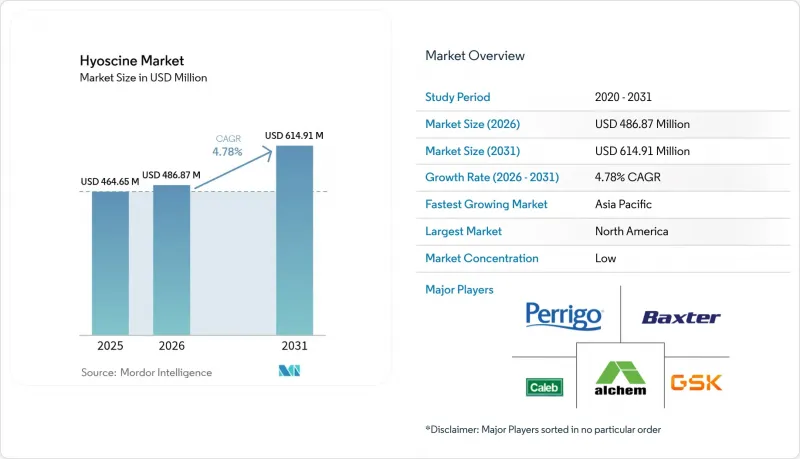
Mordor Intelligence에 의하면, 히오신 시장 규모는 2025년에 4억 6,465만 달러로 평가되었습니다. 2026년 4억 8,687만 달러에서 2031년까지 6억 1,491만 달러에 이를 것으로 예상되며, 예측 기간(2026-2031년) CAGR은 4.78%를 나타낼 전망입니다.
본 보고서는 제형(정제, 주사제, 경피 패치, 경구 액제, 기타), 적응증(멀미, 위장 장애, 수술 후 메스꺼움·구토, 신경계 질환, 호흡기계 질환, 기타), 최종 사용자(병원, 진료소, 재택 간호, 기타),및 지역(북미, 유럽, 기타)별로 분류되어 있습니다. 시장 예측은 금액(달러) 기준으로 제시되어 있습니다.
세계의 히오신 시장 동향 및 인사이트
멀미 발생률 증가
항공, 해상 및 자율주행 차량에 의한 여객 킬로미터 수 증가는 멀미를 유발하는 전정계의 불균형을 심화시키고 있습니다. 경피 흡수형 스코폴라민은 최대 72시간의 예방 효과를 발휘하며, 작용 시간이 짧은 경구제보다 우월하기 때문에 히오신 시장의 프리미엄 가격 책정을 뒷받침하고 있습니다. 비강 내 투여 형태를 모색하는 군사 프로그램은 임무 수행에 필수적인 새로운 틈새 시장의 존재를 부각시키고 있습니다. 관광 산업의 회복과 가상현실(VR) 헤드셋의 보급에 따라 대상 시장 규모는 더욱 확대되고 있습니다.
PONV를 유발하는 외과 수술의 급증
저침습 수술과 당일 퇴원 수술은 증가 추세에 있지만, 수술 후 구역질 및 구토(PONV)는 여전히 일반 증례의 경우 최대 30%, 고위험군의 경우 50% 이상에 영향을 미치고 있습니다. 무스카린 수용체 차단제는 세로토닌 길항제와 시너지 효과를 발휘하여 증상을 더욱 억제하고 회복 기간을 단축시킵니다. 제왕절개 수술 후 수유 중인 산모에 대한 안전성 근거에 힘입어 산과 수술실에서의 사용이 확대되고 있습니다.
부문별 분석
정제는 의사의 오랜 사용 실적과 저렴한 단가를 바탕으로 2025년 매출에서 히오신 시장 점유율의 36.74%를 차지하며 1위를 유지했습니다. 그러나 경피 흡수형 패치는 연평균 성장률(CAGR) 6.37%를 나타낼 것으로 예측되며, 서방형 제제가 여행자나 고령자 사이에서 지지를 얻음에 따라 히오신 시장에서 더 큰 점유율을 확보할 가능성이 있습니다.
주사제는 속효성이 중시되는 응급 의료 분야에서 여전히 중요한 위치를 차지하고 있지만, 투여가 복잡하기 때문에 병원 밖에서의 채택은 여전히 제한적입니다. 경구용 액제는 소아나 연하 장애가 있는 환자층에 사용되며, 개발 중인 비강용 겔은 군 및 우주 비행 현장을 대상으로 하고 있습니다. 전반적으로 패치 기술은 작용 지속 시간 연장 및 복약 순응도 향상을 도모하는 설계를 통해 히오신 시장에서 차별화를 추진하고 있습니다.
지역별 분석
북미는 확립된 보험 환급 제도와 서방형 제제의 조기 도입에 힘입어 2025년 매출의 41.68%를 차지했습니다. 유럽은 고령화 인구 증가와 항콜린제 병용을 규정하는 엄격한 수술 후 메스꺼움 및 구토(PONV) 지침에 힘입어 북미에 근소한 차이로 뒤를 잇고 있습니다. 또한, 북미공급업체들은 식물 원료 공급 위험을 완화하는 독자적인 두보이시아(Duboisia) 농장의 혜택도 누리고 있습니다.
아시아태평양은 진단 기술의 보급 확대, 의료 관광 증가, 그리고 유효 성분 생산의 현지화를 위한 정부의 이니셔티브에 힘입어 7.81%라는 가장 높은 연평균 성장률(CAGR)을 나타낼 전망입니다. 인도의 규제 개혁(신속한 공장 허가 및 의약품 안전성 감시의 디지털화 등)은 생산 능력 확대와 규모 확대를 촉진하고 있으며, 히오신 시장을 재편할 가능성이 있습니다.
라틴아메리카 및 중동 및 아프리카는 장기적인 성장 잠재력을 지니고 있지만, 가격 상한선 및 패치 수입 관세의 영향을 받기 쉬운 상황이 지속되고 있습니다. 다국적 기업들은 제휴를 통한 유통망과 단계적 가격 책정을 활용하여 시장 내 입지를 유지하고 있으나, 기후 변화로 인한 듀보아지아공급 충격이 서비스 수준을 저하시킬 우려가 있습니다. 따라서 농장의 지리적 분산은 히오신 시장에서 전략적인 리스크 헤지 수단이 됩니다.
기타 혜택 :
- 엑셀 형식 시장 예측(ME) 시트
- 3개월간의 애널리스트 지원
자주 묻는 질문
목차
제1장 서론
제2장 조사 방법
제3장 주요 요약
제4장 시장 구도
제5장 시장 규모 및 성장 예측
제6장 경쟁 구도
제7장 시장 기회 및 향후 전망
KTH 26.08.28According to Mordor Intelligence, the hyoscine market size was valued at USD 464.65 million in 2025 and estimated to grow from USD 486.87 million in 2026 to reach USD 614.91 million by 2031, at a CAGR of 4.78% during the forecast period (2026-2031).
This report is Segmented by Dosage Form (Tablets, Injection, Transdermal Patch, Oral Solutions, Others), Indication (Motion Sickness, Gastrointestinal Disorders, Post-Operative Nausea & Vomiting, Neurological Disorders, Respiratory Disorders, Others), End User (Hospitals, Clinics, Home-Care Settings, Others), and Geography (North America, Europe, and More). The Market Forecasts are Provided in Terms of Value (USD).
Global Hyoscine Market Trends and Insights
Rising Incidence of Motion Sickness
Growing passenger kilometres by air, sea, and autonomous vehicles heighten vestibular conflicts that precipitate motion sickness. Transdermal scopolamine delivers up to 72-hour prophylaxis, outperforming shorter-acting orals and supporting premium pricing in the hyoscine market. Military programs exploring intranasal formats underscore new mission-critical niches. With tourism rebounding and virtual reality headsets becoming mainstream, the addressable base widens further.
Surge in Surgical Procedures Leading to PONV
Minimally invasive and day-case surgeries are rising, yet PONV still affects up to 30% of general cases and over 50% of high-risk cohorts. Muscarinic blockade complements serotonin antagonists, delivering additive symptom control and shorter recovery stays. Evidence of safety in breastfeeding mothers following caesarean section broadens use in obstetric theatres.
Other drivers and restraints analyzed in the detailed report include:
- Growing Prevalence of Gastrointestinal Disorders
- Adoption of Advanced Transdermal Delivery Systems
- Anticholinergic Side-Effect Profile
- Stringent Prescription & Regulatory Controls
For complete list of drivers and restraints, kindly check the Table Of Contents.
Segment Analysis
Tablets led 2025 revenue with 36.74% hyoscine market share following decades of physician familiarity and low unit cost. However, transdermal patches are projected to clock 6.37% CAGR and could capture a larger slice of the hyoscine market size as sustained-release formats gain favour among travellers and elderly users.
Injection formats retain relevance in emergency departments that value rapid onset, yet adoption outside hospital walls remains modest due to administration complexity. Oral solutions serve paediatric and dysphagic cohorts, while pipeline nasal gels target military and spaceflight settings. Overall, patch technology is propelling differentiation within the hyoscine market through longer dwell times and adherence-friendly designs.
Complete Report Scope:
- By Dosage Form (Value)
- Tablets
- Injection
- Transdermal Patch
- Oral Solutions
- Others
- By Indication (Value)
- Motion Sickness
- Gastrointestinal Disorders
- Post-operative Nausea & Vomiting (PONV)
- Neurological Disorders
- Respiratory Disorders
- Others
- By End User (Value)
- Hospitals
- Clinics
- Home-care Settings
- Others
- By Geography (Value)
- North America
- United States
- Canada
- Mexico
- Europe
- Germany
- United Kingdom
- France
- Italy
- Spain
- Rest of Europe
- Asia-Pacific
- China
- India
- Japan
- South Korea
- Australia
- Rest of Asia-Pacific
- South America
- Brazil
- Argentina
- Rest of South America
- Middle East and Africa
- GCC
- South Africa
- Rest of Middle East and Africa
- North America
Geography Analysis
North America generated 41.68% of 2025 revenue due to entrenched reimbursement and early adoption of controlled-release formats. Europe follows closely, buoyed by older demographics and stringent PONV guidelines that specify anticholinergic combinations. North American suppliers also benefit from captive Duboisia plantations that buffer botanical supply risk.
Asia-Pacific is forecast to post the highest 7.81% CAGR, lifted by improving diagnostic penetration, rising medical tourism, and government drives to localise active pharmaceutical ingredient production. India's regulatory overhauls, including fast-track plant clearances and pharmacovigilance digitisation, are fostering capacity additions and scale that can reshape the hyoscine market.
Latin America and Middle East & Africa offer longer-term optionality but remain sensitive to price ceilings and patch import tariffs. Multinationals leverage partnered distribution and tiered-pricing to maintain presence, yet supply interruptions from climatic Duboisia shocks can impede service levels. Geographic diversification of plantations is therefore a strategic hedge for the hyoscine market.
- Perrigo Company
- Alchem International Pvt Ltd
- Alkaloids of Australia Pty Ltd
- Alvogen Group
- Myungmoon Pharmaceutical Co., Ltd.
- Boehringer Ingelheim
- Alkem Laboratories Ltd.
- Ruwex Pharma BV
- Sinochem Ningbo Ltd.
- Phyto Myco Research Corp.
- Indena S.p.A.
- Zydus Group
- MYLAN TECHNOLOGIES
- ZYDUS PHARMS
- AMNEALS PHARMS
- Baxter
Additional Benefits:
- The market estimate (ME) sheet in Excel format
- 3 months of analyst support
TABLE OF CONTENTS
1 Introduction
- 1.1 Study Assumptions & Market Definition
- 1.2 Scope of the Study
2 Research Methodology
3 Executive Summary
4 Market Landscape
- 4.1 Market Overview
- 4.2 Market Drivers
- 4.2.1 Rising incidence of motion sickness
- 4.2.2 Growing prevalence of gastrointestinal disorders
- 4.2.3 Surge in surgical procedures leading to PONV
- 4.2.4 Adoption of advanced transdermal delivery systems
- 4.2.5 Experimental use in neuro-psychiatric disorders
- 4.2.6 Bio-engineered Duboisia cultivation boosting supply
- 4.3 Market Restraints
- 4.3.1 Anticholinergic side-effect profile
- 4.3.2 Stringent prescription & regulatory controls
- 4.3.3 Duboisia crop volatility due to climate change
- 4.3.4 Geriatric formulary exclusion trends
- 4.4 Value / Supply-Chain Analysis
- 4.5 Regulatory Landscape
- 4.6 Technological Outlook
- 4.7 Porter's Five Forces
- 4.7.1 Threat of New Entrants
- 4.7.2 Bargaining Power of Suppliers
- 4.7.3 Bargaining Power of Buyers
- 4.7.4 Threat of Substitutes
- 4.7.5 Competitive Rivalry
5 Market Size & Growth Forecasts
- 5.1 By Dosage Form (Value)
- 5.1.1 Tablets
- 5.1.2 Injection
- 5.1.3 Transdermal Patch
- 5.1.4 Oral Solutions
- 5.1.5 Others
- 5.2 By Indication (Value)
- 5.2.1 Motion Sickness
- 5.2.2 Gastrointestinal Disorders
- 5.2.3 Post-operative Nausea & Vomiting (PONV)
- 5.2.4 Neurological Disorders
- 5.2.5 Respiratory Disorders
- 5.2.6 Others
- 5.3 By End User (Value)
- 5.3.1 Hospitals
- 5.3.2 Clinics
- 5.3.3 Home-care Settings
- 5.3.4 Others
- 5.4 By Geography (Value)
- 5.4.1 North America
- 5.4.1.1 United States
- 5.4.1.2 Canada
- 5.4.1.3 Mexico
- 5.4.2 Europe
- 5.4.2.1 Germany
- 5.4.2.2 United Kingdom
- 5.4.2.3 France
- 5.4.2.4 Italy
- 5.4.2.5 Spain
- 5.4.2.6 Rest of Europe
- 5.4.3 Asia-Pacific
- 5.4.3.1 China
- 5.4.3.2 India
- 5.4.3.3 Japan
- 5.4.3.4 South Korea
- 5.4.3.5 Australia
- 5.4.3.6 Rest of Asia-Pacific
- 5.4.4 South America
- 5.4.4.1 Brazil
- 5.4.4.2 Argentina
- 5.4.4.3 Rest of South America
- 5.4.5 Middle East and Africa
- 5.4.5.1 GCC
- 5.4.5.2 South Africa
- 5.4.5.3 Rest of Middle East and Africa
- 5.4.1 North America
6 Competitive Landscape
- 6.1 Market Concentration
- 6.2 Market Share Analysis
- 6.3 Company Profiles (includes Global level Overview, Market level overview, Core Segments, Financials as available, Strategic Information, Market Rank/Share for key companies, Products & Services, and Recent Developments)
- 6.3.1 Perrigo Company plc
- 6.3.2 Alchem International Pvt Ltd
- 6.3.3 Alkaloids of Australia Pty Ltd
- 6.3.4 Alvogen Group
- 6.3.5 Myungmoon Pharmaceutical Co., Ltd.
- 6.3.6 Boehringer Ingelheim International GmbH
- 6.3.7 Alkem Laboratories Ltd.
- 6.3.8 Ruwex Pharma BV
- 6.3.9 Sinochem Ningbo Ltd.
- 6.3.10 Phyto Myco Research Corp.
- 6.3.11 Indena S.p.A.
- 6.3.12 Cadila Healthcare Ltd.
- 6.3.13 MYLAN TECHNOLOGIES
- 6.3.14 ZYDUS PHARMS
- 6.3.15 AMNEALS PHARMS
- 6.3.16 Baxter International
7 Market Opportunities & Future Outlook
- 7.1 White-space & Unmet-Need Assessment