

|
시장보고서
상품코드
2114855
유제품 가공 장비 : 시장 점유율 분석, 업계 동향 및 통계, 성장 예측(2026-2031년)Dairy Processing Equipment - Market Share Analysis, Industry Trends & Statistics, Growth Forecasts (2026 - 2031) |
||||||
 Mordor Intelligence
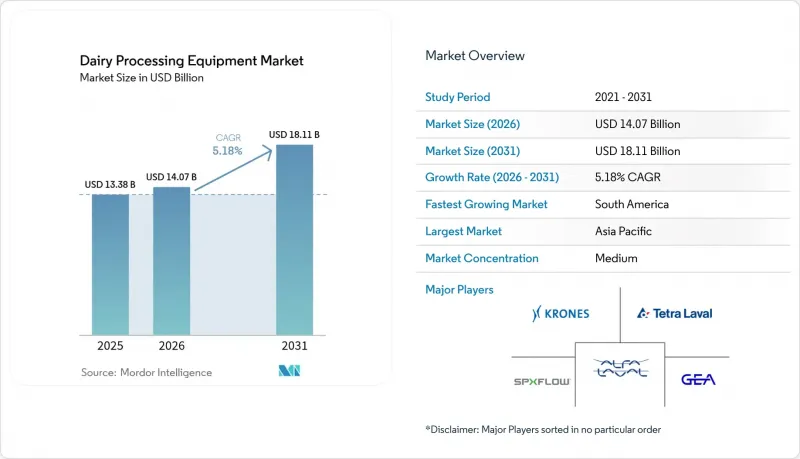
Mordor Intelligence에 의하면, 유제품 가공 장비 시장 규모는 2025년에 133억 8,000만 달러로 평가되었습니다. 2026년 140억 7,000만 달러에서 2031년까지 181억 1,000만 달러에 이를 것으로 예상되며, 예측 기간(2026-2031년) CAGR은 5.18%를 나타낼 전망입니다.
본 보고서에서는 산업을 장비 유형(살균 장치, 멸균 장치·UHT 시스템, 균질기, 기타), 용도(액상 우유, 치즈, 분유·영아용 조제분유, 요거트·발효 제품, 기타),지역(북미, 유럽, 아시아태평양, 남미, 중동 및 아프리카)별로 분류하고 있습니다. 시장 전망은 금액(달러) 기준으로 제시되어 있습니다.
세계의 유제품 가공 장비 시장 동향 및 인사이트
가공 유제품 및 부가가치 유제품 소비 확대
소비자들이 편의성을 중시하는 유제품을 점점 더 선호함에 따라, 전 세계 유제품 가공 장비 시장에서 고도의 가공 장비에 대한 수요가 증가하고 있습니다. 이러한 장비는 유통 기한 연장이나 특수한 배합을 통한 제품 제조에 특화되어 있으며, 그 결과 부가가치가 높은 유제품의 소비를 촉진하고 있습니다. 미국 농무부(USDA) 농업마케팅국은 특수 유성분에 대한 수요 증가를 지적하고 있으며, 유청 단백질과 유알부민은 수출 시장에서 견조한 성장세를 보이고 있습니다. 이러한 수요에 부응하기 위해 가공 시설에서는 여러 제품 라인을 지원할 수 있는 유연한 장비 구성에 대한 투자를 우선시하고 있습니다. 이러한 투자는 부가가치 유제품 제조에 사용되는 장비에 대한 엄격한 요건을 규정한 미국 식품의약국(FDA)의 ‘A등급 살균유 규정’에 부합하는 것입니다. 또한 펜실베이니아주 농업국은 요거트나 치즈 등 특정 유제품에 맞춘 전용 장비의 중요한 역할을 강조하고 있습니다. 이러한 제품에는 독자적인 가공 절차와 장비 사양이 요구됩니다. 이러한 틈새 제품은 변화하는 소비자 취향에 부응할 뿐만 아니라 고가로 판매할 수도 있게 해주기 때문에 생산 능력과 시장 경쟁력을 높이기 위한 첨단 장비 도입을 정당화합니다.
상온 보관 및 장기 보관이 가능한 유제품 수요 증가
상온 보관 가능한 유제품에 대한 수요가 증가함에 따라, 유제품 가공 장비 시장 전반에서 초고온 살균(UHT) 처리 시스템 및 무균 포장 기술에 대한 막대한 투자가 진행되고 있습니다. 이러한 기술 발전은 규제 기준을 충족하고 시장 기회를 확대하는 데 필수적입니다. FDA는 상온 보관 제품에 대해 특정 살균 요건을 의무화하고 있으며, 21 CFR 1240.61에서는 최종 포장 형태의 모든 유제품이 승인된 방법을 사용하여 살균되어야 한다고 규정하고 있습니다. UHT 가공 장비는 엄격한 온도와 시간 관리를 준수해야 하며, FDA는 살균 매개변수 준수를 기록하기 위해 정확한 기록 장치의 사용을 의무화하고 있습니다. 선진국 시장뿐만 아니라 콜드체인 인프라가 제한적인 지역에서도 UHT 기술이 점차 보급되고 있습니다. 미국 농무부(USDA)는 이러한 지역으로의 상온 보존 가능 유제품 수출 기회가 증가하고 있다고 보고하며, 물류상의 과제를 해결하는 데 있어 이 기술이 수행하는 역할을 강조하고 있습니다. 또한, 정부 기관은 식량 안보를 확보하기 위한 UHT 가공의 중요성을 강조하고 있습니다. 이 기술은 냉장 보관이 불가능한 비상사태에 대비하는 데 특히 필수적이며, 국내 시장과 국제 시장 모두에서 그 중요성이 부각되고 있습니다.
유제품 가공 장비의 높은 초기 투자 및 유지 관리 비용
소규모 가공업체들은 신규 장비 도입에 있어 큰 어려움에 직면해 있습니다. 그 주된 원인은 규제 준수에 따른 고비용에 있으며, 이는 유제품 가공 장비 시장에 계속해서 영향을 미치고 있습니다. 미네소타주 농업국은 규제 기준을 충족하기 위해 소규모 유제품 가공 공장이 살균기, 균질기, 발효조 등의 필수 장비를 조달하는 데 막대한 투자가 필요함을 강조하고 있습니다. 마찬가지로 테네시 대학교는 이러한 재정적 부담이 초기 구입 비용에 그치지 않고, 규제 당국이 의무화한 지속적인 유지보수, 교정, 교체 비용까지 포함된다고 지적하고 있습니다. 이러한 높은 초기 투자와 반복되는 유지보수 비용이 맞물려 중소기업(SME)이 최신 유제품 가공 장비를 도입하는 데 큰 장벽이 되고 있습니다. 게다가 정기적인 유지보수, 에너지 소비, 숙련된 인력을 포함한 운영 비용이 총 소유 비용을 더욱 끌어올리고 있습니다. 그 결과, 많은 가공업체들은 구식 시스템을 계속 사용하거나 기본적인 장비에 의존할 수밖에 없게 되어, 이는 생산 효율을 현저히 저해하고 제품 혁신을 제한하고 있습니다. 이러한 상황은 기술 발전과 고품질 유제품에 대한 소비자 수요가 점점 더 시장을 주도하는 환경에서 중소규모 가공업체의 효과적인 경쟁 능력을 제한하기 때문에 전 세계 유제품 산업에 있어 중대한 과제가 되고 있습니다.
부문별 분석
2025년 유제품 가공 장비 시장에서 저온 살균 장비가 27.84%의 점유율을 차지하며 시장을 선도했으며, 이는 유제품 가공 공정 전반에 걸쳐 식품 안전 기준 준수를 보장하는 데 있어 해당 장비가 필수적인 역할을 하고 있음을 여실히 보여줍니다. 이러한 우위는 저온 살균 과정 중 온도와 시간을 정밀하게 관리하도록 의무화하는 엄격한 규제 요건에 의해 뒷받침되고 있습니다. FDA(미국 식품의약국)는 저온 살균 장치에 대해 지정된 온도를 소정의 시간 동안 유지하고, 규정 준수를 보장하기 위한 정확한 기록 장치를 갖출 것을 요구하고 있습니다. 미네소타주 농업국 등 주 규제 당국도 살균 장치의 중요성을 더욱 강조하고 있으며, 규제 당국의 승인을 받아야 하는 유제품 가공 시설에 있어 이것이 필수적인 투자라고 평가했습니다. 또한, 테네시 대학교의 유제품 가공 공장 가이드라인에서는 연방 PMO 기준과 주별 규제를 모두 충족하고, 제품의 안전성을 확보하여 시장 진입을 촉진하는 데 있어 살균 장비가 필수적임을 강조하고 있습니다.
막 여과 시스템은 유제품 가공 장비 시장에서 가장 빠른 성장이 예상되는 장비 부문으로, 2026년부터 2031년까지 연평균 성장률(CAGR) 6.68%를 나타낼 것으로 전망됩니다. 이러한 성장을 뒷받침하는 것은 단백질 농축, 유당 제거, 물 회수 등 폭넓은 용도에서의 다용도성입니다. 캐나다 천연자원부는 막 여과를 치즈 유청 농축이나 우유 성분 표준화 과정에서 에너지 소비를 대폭 줄일 수 있는 주요 에너지 절약 기술로 주목하고 있습니다. FDA를 비롯한 규제 당국은 식품 안전성을 훼손하지 않으면서 특정 제품 특성을 달성하기 위한 승인된 방법으로 막 여과를 인정하고 있습니다. 또한, 정부 기관은 물 회수 및 폐기물 감축과 같은 이 기술의 환경적 이점을 장려하고 있으며, 이는 유제품 가공 산업을 점점 더 형성해 가는 지속가능성 요구와 부합합니다. 이 부문의 급속한 성장은 제조업체가 단일 가공 라인에서 다양한 특수 유제품을 생산하여 규제 요건과 변화하는 시장 수요를 모두 충족할 수 있게 해주는 유연한 가공 기술에 대한 수요가 증가하고 있음을 반영합니다.
지역별 분석
2025년, 아시아태평양은 세계 유제품 시장에서 39.21%의 점유율을 차지하며, 이 지역이 세계 최대의 우유 생산지인 동시에 가장 빠르게 성장하는 소비 시장이라는 위상을 확고히 했습니다. 이러한 성장은 특히 인도의 적극적인 정부 정책에 힘입고 있습니다. 인도의 식품가공산업부는 ‘PM Kisan Sampada Yojana’ 프로그램 하에 460억 루피의 예산을 배정하여 유제품 가공을 중점적으로 추진하고 있습니다. 한편, 중국에서는 규제 상황이 변화하고 있으며, 국가 식품 안전 기준에서 살균 처리된 제품에 재구성 우유의 사용을 금지하는 방안이 제안되고 있습니다. 이러한 움직임은 현지 가공업체가 필요로 하는 설비 요건을 재정의할 가능성이 있습니다. 미국 농무부(USDA)는 중국 유제품 시장의 모순을 지적하고 있습니다. 즉, 젖소 사육 두수가 감소하고 있음에도 불구하고 국내 생산량은 소폭 증가하고 있으며, 이는 효율적인 유제품 가공 장비에 있어 절호의 기회임을 시사합니다. 일본은 노동력 부족에 직면해 있으며, 인구 동향의 변화 속에서도 생산 효율을 확보하기 위한 정부의 이니셔티브에 힘입어 고도 자동화로의 전환이 진행되고 있습니다.
남미는 유제품 가공 장비 시장에서 가장 빠르게 성장하는 지역이 될 전망이며, 2026년부터 2031년까지 연평균 성장률(CAGR) 7.05%를 나타낼 것으로 예측됩니다. 이러한 성장은 양호한 생산 여건과 수출 지향적인 유제품 가공을 촉진하는 정부의 정책에 힘입은 것입니다. 미국 농무부(USDA) 농업마케팅국은 호천과 유제품 수출에 대한 견조한 수요에 힘입어 남미의 우유 생산량이 증가하고 있다고 지적하고 있습니다. 브라질의 식품 가공 산업은 해당국의 식품 제조에서 유제품이 차지하는 큰 비중을 강조하는 정부 데이터가 보여주듯이, 특히 유제품이 지배적인 위치를 차지하고 있습니다. 유리한 기후와 낮은 생산 비용이라는 장점을 활용하여 남미 국가들은 세계 유제품 시장에서 경쟁 우위를 확립해 가고 있습니다. 각 지역의 정부 기관은 이러한 잠재력을 인식하고 있을 뿐만 아니라, 전략적 산업으로서 유제품 가공을 적극적으로 추진하며, 세계적 경쟁력을 높이기 위해 인프라와 기술 정비를 진행하고 있습니다. 북미는 종합적인 규제 체계와 적극적인 정부 프로그램을 통해 시장에서 계속해서 지배적인 위치를 유지하고 있습니다. 특히 주목할 만한 것은 ‘북동부 유제품 비즈니스 혁신 센터’로, 이는 가공 기술의 현대화를 목표로 한 연방 정부의 막대한 투자를 입증하는 사례입니다.
기타 혜택
- 엑셀 형식 시장 예측(ME) 시트
- 3개월간 애널리스트 지원
자주 묻는 질문
목차
제1장 서론
제2장 조사 방법
제3장 주요 요약
제4장 시장 구도
제5장 시장 규모 및 성장 예측
제6장 경쟁 구도
제7장 시장 기회 및 향후 전망
KTH 26.08.28According to Mordor Intelligence, the dairy processing equipment market size was valued at USD 13.38 billion in 2025 and estimated to grow from USD 14.07 billion in 2026 to reach USD 18.11 billion by 2031, at a CAGR of 5.18% during the forecast period (2026-2031).
This report Segments the Industry by Equipment Type (Pasteurizers, Sterilizers and UHT Systems, Homogenizers, and More ); Application (Liquid Milk, Cheese, Milk Powder and Infant Formula, Yogurt and Fermented Products, and More); and Geography (North America, Europe, Asia-Pacific, South America, and Middle East and Africa). The Market Forecasts are Provided in Terms of Value (USD).
Global Dairy Processing Equipment Market Trends and Insights
Rising consumption of processed and value-added dairy products
As consumers increasingly favor convenience-oriented dairy products, there's a growing demand for advanced processing equipment within the global dairy processing equipment market. This equipment is tailored to produce products with extended shelf lives and specialty formulations, subsequently boosting the consumption of value-added dairy products. The USDA's Agricultural Marketing Service highlights a growing demand for specialized dairy ingredients, with whey protein and milk albumin experiencing robust growth in export markets. To meet this demand, processing facilities are prioritizing investments in flexible equipment configurations that can support multiple product lines. These investments align with the FDA's Grade 'A' Pasteurized Milk Ordinance, which outlines stringent requirements for equipment used in manufacturing value-added dairy products. Additionally, the Pennsylvania Department of Agriculture underscores the critical role of specialized equipment tailored to specific dairy products, such as yogurt and cheese, which require distinct processing protocols and equipment specifications. These niche offerings not only cater to evolving consumer preferences but also command premium pricing, justifying the adoption of advanced equipment to enhance production capabilities and competitiveness in the market.
Growing demand for shelf-stable and long-life dairy formats
The growing demand for shelf-stable dairy products is driving significant investments in ultra-high temperature (UHT) processing systems and aseptic packaging technologies across the dairy processing equipment market. These advancements are critical for meeting regulatory standards and expanding market opportunities. The FDA mandates specific pasteurization requirements for shelf-stable products, with 21 CFR 1240.61 stipulating that all milk products in their final packaged form must be pasteurized using approved methods. UHT processing equipment must adhere to strict temperature and time controls, and the FDA requires the use of accurate recording devices to document compliance with sterilization parameters. Beyond developed markets, UHT technology is gaining traction in regions with limited cold-chain infrastructure. The USDA reports increasing opportunities for exporting shelf-stable dairy products to these areas, highlighting the technology's role in addressing logistical challenges. Additionally, government agencies emphasize the importance of UHT processing for ensuring food security. This technology is particularly vital in emergency preparedness scenarios where refrigerated storage is unavailable, underscoring its relevance in both domestic and international markets.
High initial investment and maintenance costs for dairy processing equipment
Small-scale processors face significant challenges in adopting new equipment, primarily due to the high costs tied to regulatory compliance which continues to impact on the dairy processing equipment market. The Minnesota Department of Agriculture emphasizes the substantial investments required by small dairy processing plants to procure essential equipment, such as pasteurizers, homogenizers, and fermentation vats, to meet regulatory standards. Similarly, the University of Tennessee highlights that the financial burden extends beyond the initial purchase, encompassing ongoing maintenance, calibration, and replacements mandated by regulatory authorities. These high initial investments, coupled with recurring maintenance costs, create a significant barrier for small and medium-sized enterprises (SMEs) in adopting modern dairy processing equipment. Additionally, operational costs, including regular maintenance, energy consumption, and skilled labor, further escalate the total cost of ownership. As a result, many processors are compelled to either continue using outdated systems or rely on basic equipment, which significantly hampers production efficiency and limits product innovation. This situation poses a critical challenge to the global dairy industry, as it restricts the ability of small-scale and medium-sized processors to compete effectively in a market increasingly driven by technological advancements and consumer demand for high-quality dairy products.
Other drivers and restraints analyzed in the detailed report include:
- Government incentives for dairy processing modernization
- Stringent food safety regulations
- Limited technical expertise
For complete list of drivers and restraints, kindly check the Table Of Contents.
Segment Analysis
In 2025, pasteurizers dominate the dairy processing equipment market with a 27.84% share, highlighting their indispensable role in ensuring food safety compliance across dairy processing operations. This dominance is driven by stringent regulatory requirements that mandate precise temperature and time controls during pasteurization. The FDA requires pasteurization equipment to maintain specified temperatures for designated durations and to include accurate recording devices to ensure compliance. State regulatory bodies, such as the Minnesota Department of Agriculture, further emphasize the importance of pasteurization equipment, identifying it as a critical investment for dairy processing facilities seeking regulatory approval. Additionally, the University of Tennessee's guidelines for dairy processing plants underscore the necessity of pasteurizers in meeting both federal PMO standards and state-specific regulations, ensuring product safety and facilitating market access.
Membrane filtration systems are poised to be the fastest-growing equipment segment within the dairy processing equipment market, with a projected CAGR of 6.68% from 2026 to 2031. Their growth is fueled by their versatility in applications such as protein concentration, lactose removal, and water recovery. Natural Resources Canada highlights membrane filtration as a key energy-efficient technology capable of significantly reducing energy consumption while concentrating cheese whey and standardizing milk composition. Regulatory bodies, including the FDA, recognize membrane filtration as an approved method for achieving specific product characteristics without compromising food safety. Furthermore, government agencies advocate for the technology's environmental benefits, such as water recovery and waste reduction, aligning with sustainability mandates that are increasingly shaping the dairy processing industry. The segment's rapid expansion reflects the growing need for flexible processing technologies that enable manufacturers to produce a variety of specialized dairy products from a single processing line, meeting both regulatory requirements and evolving market demands.
Complete Report Scope:
- By Equipment Type
- Pasteurizers
- Sterilizers and UHT Systems
- Homogenizers
- Centrifuges and Separators
- Evaporators and Dryers
- Membrane Filtration Systems
- Mixing and Blending
- CIP and Automation Modules
- By Application
- Liquid Milk
- Cheese
- Milk Powder and Infant Formula
- Yogurt and Fermented Products
- Butter and Spreads
- Other
- By Geography
- North America
- United States
- Canada
- Mexico
- Rest of North America
- Europe
- United Kingdom
- Germany
- Spain
- France
- Italy
- Russia
- Rest of Europe
- Asia-Pacific
- China
- India
- Japan
- Australia
- Rest of Asia-Pacific
- South America
- Brazil
- Argentina
- Rest of South America
- Middle East and Africa
- Saudi Arabia
- South Africa
- Rest of Middle East and Africa
- North America
Geography Analysis
In 2025, Asia-Pacific commands a 39.21% share of the global dairy market, underscoring its position as both the leading milk producer and the fastest-growing consumer market. This growth is bolstered by proactive government policies, notably in India, where the Ministry of Food Processing Industries has earmarked INR 4,600 crore under the PM Kisan Sampada Yojana, emphasizing dairy processing. Meanwhile, China's evolving regulatory landscape sees the National Food Safety Standards proposing bans on reconstituted milk in sterilized products, a move that could redefine equipment needs for local processors. The USDA highlights a paradox in China's dairy market: domestic production inches up even as cow inventories dwindle, signaling a ripe opportunity for efficient dairy processing equipment. Japan, facing labor challenges, is turning to advanced automation, backed by government initiatives to ensure production efficiency amidst demographic shifts.
South America is set to be the fastest-growing region in the dairy processing equipment market, projected at a 7.05% CAGR from 2026 to 2031. This growth is underpinned by favorable production conditions and government policies that champion export-oriented dairy processing. The USDA's Agricultural Marketing Service notes a rise in South American milk production, thanks to favorable weather and a robust demand for dairy exports. Brazil's food processing landscape is notably dominated by dairy, as evidenced by government data highlighting its significant share in the country's food manufacturing. With advantages like a conducive climate and lower production costs, South American nations are carving out a competitive edge in the global dairy arena. Regional government agencies are not just recognizing this potential but are actively promoting dairy processing as a strategic industry, bolstering infrastructure and technology to enhance global competitiveness. North America, with its comprehensive regulatory frameworks and proactive government programs, continues to hold a dominant market position. A notable highlight is the Northeast Dairy Business Innovation Center, a testament to significant federal investment aimed at modernizing processing technologies.
- SPX FLOW, Inc
- GEA Group Aktiengesellschaft
- Alfa Laval
- Tetra Laval Group (Tetra Pack)
- Krones AG
- JBT Corporation
- Paul Mueller Company
- Pentair plc
- Feldmeier Equipment, Inc.
- Scherjon Equipment B.V.
- IDMC Limited
- Agrometal Ltd
- Fristam Pumpen KG (GmbH & Co. KG)
- IMA Group
- Van den Heuvel Dairy & Food Equipment B.V.
- Iwai Kikai Kogyo Co., Ltd.
- Shanghai Triowin Intelligent Machinery Co.,Ltd (Triowin Intelligent)
- Bucher Industries AG
- Shanghai Genyond Technology Co. LTD
- Neologic Engineers Pvt. Ltd.
Additional Benefits:
- The market estimate (ME) sheet in Excel format
- 3 months of analyst support
TABLE OF CONTENTS
1 INTRODUCTION
- 1.1 Study Assumptions and Market Definition
- 1.2 Scope of the Study
2 RESEARCH METHODOLOGY
3 EXECUTIVE SUMMARY
4 MARKET LANDSCAPE
- 4.1 Market Overview
- 4.2 Market Drivers
- 4.2.1 Rising consumption of processed and value-added dairy products
- 4.2.2 Growing demand for shelf-stable and long-life dairy formats
- 4.2.3 Government incentives for dairy processing modernization
- 4.2.4 Stringent food safety regulations
- 4.2.5 Adoption of automation and industry 4.0 technologies
- 4.2.6 Innovation in energy-efficient and low-emission processing systems
- 4.3 Market Restraints
- 4.3.1 High initial investment and maintenance costs for dairy processing equipment
- 4.3.2 Limited technical expertise
- 4.3.3 Complex integration of new equipment into legacy plants
- 4.3.4 Price sensitivity in emerging markets
- 4.4 Supply Chain Analysis
- 4.5 Regulatory Outlook
- 4.6 Porter's Five Forces
- 4.6.1 Threat of New Entrants
- 4.6.2 Bargaining Power of Buyers/Consumers
- 4.6.3 Bargaining Power of Suppliers
- 4.6.4 Threat of Substitute Products
- 4.6.5 Intensity of Competitive Rivalry
5 MARKET SIZE AND GROWTH FORECASTS (VALUE)
- 5.1 By Equipment Type
- 5.1.1 Pasteurizers
- 5.1.2 Sterilizers and UHT Systems
- 5.1.3 Homogenizers
- 5.1.4 Centrifuges and Separators
- 5.1.5 Evaporators and Dryers
- 5.1.6 Membrane Filtration Systems
- 5.1.7 Mixing and Blending
- 5.1.8 CIP and Automation Modules
- 5.2 By Application
- 5.2.1 Liquid Milk
- 5.2.2 Cheese
- 5.2.3 Milk Powder and Infant Formula
- 5.2.4 Yogurt and Fermented Products
- 5.2.5 Butter and Spreads
- 5.2.6 Other
- 5.3 By Geography
- 5.3.1 North America
- 5.3.1.1 United States
- 5.3.1.2 Canada
- 5.3.1.3 Mexico
- 5.3.1.4 Rest of North America
- 5.3.2 Europe
- 5.3.2.1 United Kingdom
- 5.3.2.2 Germany
- 5.3.2.3 Spain
- 5.3.2.4 France
- 5.3.2.5 Italy
- 5.3.2.6 Russia
- 5.3.2.7 Rest of Europe
- 5.3.3 Asia-Pacific
- 5.3.3.1 China
- 5.3.3.2 India
- 5.3.3.3 Japan
- 5.3.3.4 Australia
- 5.3.3.5 Rest of Asia-Pacific
- 5.3.4 South America
- 5.3.4.1 Brazil
- 5.3.4.2 Argentina
- 5.3.4.3 Rest of South America
- 5.3.5 Middle East and Africa
- 5.3.5.1 Saudi Arabia
- 5.3.5.2 South Africa
- 5.3.5.3 Rest of Middle East and Africa
- 5.3.1 North America
6 COMPETITIVE LANDSCAPE
- 6.1 Market Concentration
- 6.2 Strategic Moves
- 6.3 Market Ranking Analysis
- 6.4 Company Profiles (includes Global-level Overview, Market-level Overview, Core Segments, Financials (if available), Strategic Information, Market Rank/Share, Products and Services, Recent Developments)
- 6.4.1 SPX FLOW, Inc
- 6.4.2 GEA Group Aktiengesellschaft
- 6.4.3 Alfa Laval
- 6.4.4 Tetra Laval Group (Tetra Pack)
- 6.4.5 Krones AG
- 6.4.6 JBT Corporation
- 6.4.7 Paul Mueller Company
- 6.4.8 Pentair plc
- 6.4.9 Feldmeier Equipment, Inc.
- 6.4.10 Scherjon Equipment B.V.
- 6.4.11 IDMC Limited
- 6.4.12 Agrometal Ltd
- 6.4.13 Fristam Pumpen KG (GmbH & Co. KG)
- 6.4.14 IMA Group
- 6.4.15 Van den Heuvel Dairy & Food Equipment B.V.
- 6.4.16 Iwai Kikai Kogyo Co., Ltd.
- 6.4.17 Shanghai Triowin Intelligent Machinery Co.,Ltd (Triowin Intelligent)
- 6.4.18 Bucher Industries AG
- 6.4.19 Shanghai Genyond Technology Co. LTD
- 6.4.20 Neologic Engineers Pvt. Ltd.


