|
시장보고서
상품코드
2114858
심장 초음파 : 시장 점유율 분석, 업계 동향 및 통계, 성장 예측(2026-2031년)Intracardiac Echocardiography - Market Share Analysis, Industry Trends & Statistics, Growth Forecasts (2026 - 2031) |
||||||
 Mordor Intelligence
Mordor Intelligence에 의하면, 심장 초음파 시장 규모는 2025년 7억 2,844만 달러로 평가되었습니다. 2026년 7억 6,544만 달러에서 2031년까지 9억 8,113만 달러로 확대되어 2026-2031년에 걸쳐 CAGR 5.08%를 나타낼 것으로 예측됩니다.
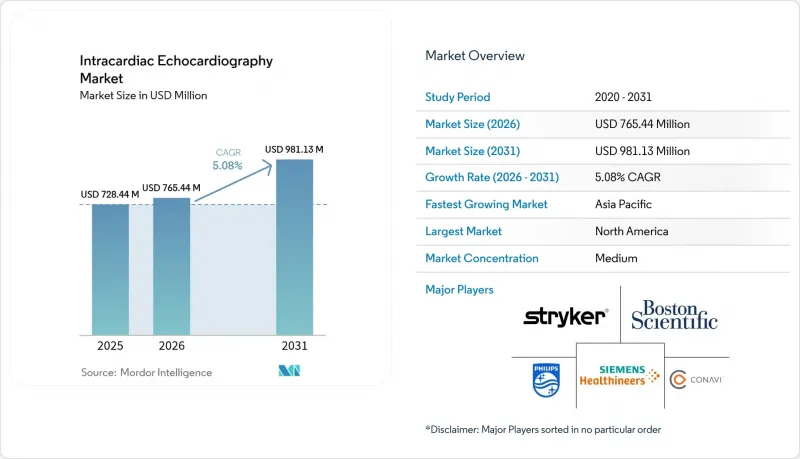
본 보고서는 제품 유형(전자 위상 배열 카테터, 기타), 기술(2D 영상, 3D 영상, 기타), 용도(전기생리학, 좌심방 폐쇄, 기타), 최종 사용자(병원, 심장 카테터 검사실, 기타),지역(북미, 유럽, 기타)별로 분류되어 있습니다. 시장 예측은 금액(미 달러) 기준으로 제시되어 있습니다.
세계의 심장 초음파 검사 시장 동향 및 인사이트
심방세동 및 구조적 심장 질환 유병률 증가
2024년, 미국에서는 670만 명의 성인이 심방세동 진단을 받았으며, 이 수치는 2030년까지 800만 명을 넘어설 것으로 예측됩니다. 이러한 급증으로 인해 심방중격 천자 시 안내 및 병변 시각화를 위해 ICE를 활용하는 절제술에 대한 수요가 증가하고 있습니다. 대동맥판막 협착증이나 승모판 역류증과 같은 구조적 심장 질환은 현재 75세 이상 성인의 2.5%에게 영향을 미치고 있습니다. 이 연령층은 2030년까지 유럽과 일본에서 30% 증가할 것으로 예측되어 그 영향이 막대합니다. 과거에는 1건의 사례당 카테터 1개면 충분했던 전기생리학 검사실도 구조적 심장 질환 치료를 위해 4D 장비를 갖추도록 업그레이드되고 있으며, 시설당 연간 ICE 지출은 실질적으로 2배로 증가했습니다. 보험 보상 체계의 발전과 중재적 심장학 교육이 2급 도시로 확대됨에 따라, 인도와 브라질 등의 신흥 시장에는 미개발된 잠재력이 숨겨져 있습니다. 그 결과, 자본 예산이 변동하는 상황 속에서도 안정적인 기초 수요가 심실 내 초음파 검사 시장을 꾸준한 성장 궤도에 올려놓고 있습니다.
3D/4D ICE 카테터의 기술적 진보
Siemens Healthineers의 ‘AcuNav Lumos’ 4D 카테터는 2024년 8월 FDA 승인을 획득했으며, 체적 영상에 더해 AI 기반 심실 인식 기능을 통해 의료진의 업무 부담을 줄여줍니다. 다중 평면 재구성 및 바이플레인 모드를 통해 의료진은 심실 중격을 가로지르는 표적을 신속하게 파악할 수 있어 형광 투시 시간을 단축할 수 있습니다. Philips는 이에 이어 2025년 5월 유럽에서 ‘VeriSight Pro’를 출시하며, 조영제가 필요 없는 워크플로우로의 경쟁적 전환을 강조했습니다. 이러한 발전으로 인해 영상 충실도가 향상되고, 피폭 선량이 감소하며, 신장 기능을 유지하는 특징을 갖추게 되어, 설비 투자 요청을 검토하는 병원의 예산 분석 위원회에게 매력적인 요소가 되고 있습니다. 4D 카테터가 주류 조달 일정에 포함됨에 따라, 심실 내 초음파 검사 시장에서는 꾸준한 업그레이드 주기가 예상됩니다.
일회용 카테터의 높은 비용과 불균일한 보험 급여
2,000-4,000달러 가격대의 ICE 카테터는 막대한 제반 비용이 소요되지만, 메디케어의 CPT 93662에 따른 지급액은 지역에 따라 다르며 정기적으로 재검토되고 있습니다. 신흥국에서는 본인 부담금이 주를 이루기 때문에 지방 병원에 있어 추가 지출은 지나치게 큰 부담이 됩니다. 이러한 격차는 외래수술센터(ASC)에서 더욱 확대되고 있습니다. 이러한 시설에서는 심장 초음파 유도 하 절제술 전용 ASC 코드가 여전히 부재하기 때문입니다. 보험사의 정책이 통일되어 있지 않아 의료진은 예산상의 제약에 직면하고 있으며, 진정 요법에 따른 단점이 있음에도 불구하고 대체 영상 진단법이나 경식도 심초음파 검사를 사용할 수밖에 없는 실정입니다. 이러한 과제들이 복합적으로 작용하여 비용에 민감한 지역에서의 심장 초음파 검사 시장 확산을 저해하고 있습니다.
부문별 분석
2025년에는 전자 위상 배열 카테터가 시장 매출의 37.35%를 차지했습니다. 800-1,200달러 가격대의 이 카테터들은 기존 CARTO 및 EnSite 콘솔과 원활하게 통합될 수 있어, 예산을 중시하는 검사실에게 매력적인 선택지가 되고 있습니다. 반면, 과거에는 360도 시야가 높이 평가되었던 기계식 회전 카테터는 프레임 속도가 느린 탓에 시장 점유율이 하락하고 있습니다. 4D 심실 내 초음파 카테터 시장은 실시간 체적 영상을 제공할 수 있다는 점을 강점으로 삼아 연평균 성장률(CAGR) 7.05%로 성장할 전망입니다. 이러한 영상을 통해 TAVR(경카테터 대동맥판막 치환술)의 수술 시간을 최대 18분 단축하고, 판막 주위 누출 위험을 줄일 수 있습니다. 또한, AI가 탑재된 콘솔은 심낭액 저류를 신속하게 파악하여 구조적 심장 질환 치료팀의 확신을 높여줍니다.
페이즈 어레이는 사례 수가 많은 부정맥 치료 센터에서 계속해서 주류를 이룰 전망이지만, 프리미엄 4D 시스템은 판매 대수가 3분의 1 수준에 그치더라도 이익률이 현저히 높습니다. 그 결과, 각 제조업체는 제품 라인업의 다양화를 추진하고 있으며, 표준 절제 시술용으로 가성비 뛰어난 페이즈드 어레이를 제공하는 한편, 고사양 4D 카테터를 TEE(경식도 심초음파) 등 기존 마취법을 대체하는 비용 절감책으로 포지셔닝하고 있습니다. 보험 급여액 인상이 확대되는 가운데, 심강 내 초음파 검사 시장은 결정적인 전환점을 맞이할 태세입니다. 페이즈 어레이가 기존 도입 기기의 점유율을 유지하는 한편, 4D 장치가 머지않아 수익의 대부분을 차지하게 될 것으로 예측됩니다.
2025년에는 2D 영상이 매출의 47.86%를 차지했습니다. 이는 주로 단면 영상이 대부분의 심방세동 절제술 요구 사항을 충족시키기 때문입니다. 또한, 2D 모델의 트랜스듀서 비용은 4D 모델에 비해 40% 저렴합니다. 그러나 병원이 구조적 병변 치료에 있어 정확성을 점점 더 중시함에 따라, 심초음파 검사에서 2D 시장 점유율은 감소할 전망입니다.
실시간 4D 영상은 특히 판막 및 심방귀 수술 분야에서 더 이상 ‘사치품’이 아닌 ‘필수품’으로 자리 잡고 있으며, 2031년까지 연평균 성장률(CAGR)은 6.90%로 예측됩니다. 매핑 시스템과의 융합을 통해 4D 영상은 단순한 내비게이션 도구에서 중요한 안전 기능으로 진화했으며, 2-3배에 달하는 가격 프리미엄도 정당화됩니다. 또한, 최신 콘솔에 탑재된 AI 모듈은 심실의 자동 분할 및 근접 경보 기능을 통해 효율성을 높여, 그 결과 시술 시간을 15% 단축하고 합병증을 감소시키는 데 기여하고 있습니다. 보험 환급 정책이 유리한 시장에서는 3D로의 업그레이드를 완전히 건너뛰고 4D를 선택하는 추세가 나타나고 있습니다. 이러한 변화는 심실 내 초음파 검사 시장 전체에서 기술 업데이트 주기를 가속화할 것으로 예측됩니다.
지역별 분석
2025년, 북미는 심실 내 초음파 검사 시장을 주도하며 전 세계 매출의 38.96%를 차지했습니다. 미국의 학술 기관들은 성숙한 절제술을 운영하고 있으며, FDA 승인을 뒷받침하는 동료 검토를 거친 증거의 대부분을 생산하고 있습니다. 한편, 캐나다 주 보건 당국은 현재 뇌졸중 관련 비용을 억제하기 위해 ICE 가이드 하의 좌심방귀개 폐쇄술에 대해 보험 적용을 실시했습니다. 멕시코에서는 정액제 절제술 패키지를 요구하는 의료 관광객을 수용하는 사립 병원에서 시술 건수가 증가하는 추세입니다.
아시아태평양은 연평균 성장률(CAGR) 7.78%라는 가장 빠른 성장 궤도를 그리고 있으며, 2031년까지 유럽의 시술 건수에 필적할 것으로 전망됩니다. 중국의 전국적인 수량 기준 조달 제도에서는 ICE 카테터가 의료기기 카탈로그에 추가되어 3차 의료기관에서의 보급이 가속화되고 있습니다. 일본의 초고령화 사회가 구조적 심장 질환에 대한 중재 시술을 뒷받침하고 있으며, 현지 제조업체들은 세계 기업과 제휴하여 작은 체격에 맞춘 영상 처리 알고리즘을 공동 개발하고 있습니다. 한국과 호주에서는 이미 도입된 콘솔이 교체 주기에 접어들면서 교체 수요가 안정적으로 유지되고 있습니다.
유럽에서는 NICE 등 기관이 주도하는 비용 대비 효과 평가를 바탕으로 여전히 신중한 도입 태도가 이어지고 있습니다. 독일은 해당 지역 최대의 구매국으로, 실제 임상 레지스트리에서 입원 기간 단축이 입증됨에 따라 건강보험조합이 PFA(폐동맥 폐쇄) 시술 시 ICE 비용을 부담하고 있습니다. 프랑스, 이탈리아, 스페인에서는 EU의 부흥 자금을 카테터실 현대화에 투입하고 있으며, 여기에는 방사선 피폭을 줄이는 영상 기술도 포함되어 있습니다. 브렉시트 이후에도 영국은 많은 CE 마크를 여전히 유효한 것으로 인정하고 있지만, UKCA 제도로의 전환을 추진하고 있어, 이로 인해 공급업체가 가격 책정에 반영해야 할 이중 검사 비용이 발생할 가능성이 있습니다.
기타 혜택
- 엑셀 형식 시장 예측(ME) 시트
- 3개월간의 애널리스트 지원
자주 묻는 질문
목차
제1장 서론
제2장 조사 방법
제3장 주요 요약
제4장 시장 구도
제5장 시장 규모 및 성장 예측
제6장 경쟁 구도
제7장 시장 기회 및 향후 전망
KTH 26.08.28According to Mordor Intelligence, the intracardiac echocardiography market size is projected to expand from USD 728.44 million in 2025 and USD 765.44 million in 2026 to USD 981.13 million by 2031, registering a CAGR of 5.08% between 2026 to 2031.
This report is Segmented by Product Type (Electronic Phased-Array Catheters, and More), Technology (2-D Imaging, 3-D Imaging, and More), Application (Electrophysiology, Left Atrial Appendage Closure, and More), End User (Hospitals, Cardiac Catheterisation Laboratories, and More), and Geography (North America, Europe, and More). The Market Forecasts are Provided in Terms of Value (USD).
Global Intracardiac Echocardiography Market Trends and Insights
Rising Prevalence of Atrial Fibrillation & Structural Heart Disorders
In 2024, 6.7 million adults in the U.S. were diagnosed with atrial fibrillation, a figure expected to exceed 8 million by 2030. This surge amplifies the demand for ablation procedures, which utilize ICE for transseptal guidance and lesion visualization. Structural heart diseases, like aortic stenosis and mitral regurgitation, currently impact 2.5% of adults over 75. With this age group projected to expand by 30% in Europe and Japan by 2030, the implications are significant. Electrophysiology labs, once content with a single catheter per case, have upgraded to stocking 4-D units for structural work, effectively doubling their annual ICE expenditure per site. As reimbursement frameworks evolve and interventional cardiology training extends into tier-2 cities, emerging markets such as India and Brazil offer untapped potential. The result? A steady baseline demand propelling the intracardiac echocardiography market on a consistent growth path, even amidst fluctuating capital budgets.
Technological Progress in 3-D / 4-D ICE Catheters
Siemens Healthineers' AcuNav Lumos 4-D catheter, cleared by the FDA in August 2024, delivers volumetric views plus AI-based chamber recognition that lighten operator workload. Multiplanar reconstruction and biplane modalities help operators locate transseptal targets swiftly, limiting fluoroscopy time. Philips followed with the VeriSight Pro launch in Europe during May 2025, underscoring a competitive pivot toward contrast-free workflows. These advances elevate image fidelity, shrink dose exposure, and preserve renal function attributes that appeal to hospital value-analysis committees weighing capital requests. As 4-D catheters enter mainstream procurement schedules, the intracardiac echocardiography market is expected to see a steady upgrade cycle.
High Disposable Catheter Cost & Inconsistent Reimbursement
ICE catheters priced between USD 2,000 and USD 4,000 incur significant overhead, yet Medicare's CPT 93662 payment varies by region and is under periodic review. In emerging economies, self-pay rates are dominant, making additional disposable income unaffordable for district hospitals. The discrepancy widens in ambulatory surgical centers, which still lack a dedicated ASC code for intracardiac ultrasound-guided ablation. Without aligned payer policies, care teams face budgetary constraints, prompting the use of alternative imaging or transesophageal echocardiography despite sedation drawbacks. These gaps collectively temper the diffusion of the intracardiac echocardiography market in cost-sensitive geographies.
Other drivers and restraints analyzed in the detailed report include:
- Shift Toward Minimally-Invasive, Radiation-Sparing Workflows
- Favorable Reimbursement in Key Developed Markets
- Steep Learning Curve & Limited Training Programs
For complete list of drivers and restraints, kindly check the Table Of Contents.
Segment Analysis
In 2025, electronic phased-array catheters are projected to generate 37.35% of the market's revenue. Priced between USD 800 and 1,200, these catheters seamlessly integrate with legacy CARTO and EnSite consoles, making them an appealing choice for budget-conscious labs. Meanwhile, mechanical rotating catheters, once favored for their 360-degree view, are losing ground due to their slower frame rates. The market for 4-D intracardiac echocardiography catheters is set to expand at a 7.05% CAGR, driven by their ability to provide real-time volumetric views. These views can shorten TAVR procedures by up to 18 minutes and lower the risk of paravalvular leaks. Additionally, AI-enhanced consoles promptly identify pericardial effusion, bolstering the confidence of structural-heart teams.
While phased arrays will continue to dominate high-volume electrophysiology centers, premium 4-D systems, despite being sold at one-third the volume, offer significantly higher profit margins. Consequently, manufacturers are diversifying their portfolios: they offer value-priced phased arrays for standard ablation procedures, while positioning high-spec 4-D catheters as cost-saving alternatives to traditional anesthesia methods like TEE. With the spread of reimbursement uplifts, the intracardiac echocardiography market is poised for a pivotal shift. It's anticipated that 4-D units will soon dominate revenue generation, even as phased arrays maintain their share in the installed base.
In 2025, 2-D imaging accounted for 47.86% of revenue, primarily because cross-sectional views meet the needs of most atrial fibrillation ablations. Additionally, transducer costs for 2-D models are 40% lower than their 4-D counterparts. However, as hospitals increasingly prioritize precision for structural cases, the market share of 2-D in intracardiac echocardiography is set to decline.
Real-time 4-D imaging is transitioning from a luxury to a necessity, especially for valve and appendage procedures, with a projected CAGR of 6.90% through 2031. When fused with mapping systems, 4-D imaging evolves from a mere navigation tool to a critical safety feature, justifying its 2-3X price premium. Furthermore, AI modules in modern consoles enhance efficiency by auto-segmenting chambers and providing proximity alerts, resulting in a 15% reduction in procedure time and fewer complications. In markets with favorable reimbursement policies, there's a trend toward bypassing 3-D upgrades altogether and opting for 4-D. This shift is poised to accelerate the technology refresh cycle in the broader intracardiac echocardiography landscape.
Complete Report Scope:
- By Product Type
- Electronic Phased-Array Catheters
- Mechanical Rotating Catheters
- 4-D Volume Catheters
- AI-Integrated Consoles & Software
- By Technology
- 2-D Imaging
- 3-D Imaging
- 4-D Imaging
- AI-assisted Navigation
- By Application
- Electrophysiology
- Left Atrial Appendage Closure
- Transcatheter Aortic Valve Implantation
- MitraClip & Mitral Valvuloplasty
- Congenital Heart Disease Interventions
- Other structural heart procedures
- By End User
- Hospitals
- Cardiac catheterisation laboratories
- Ambulatory surgical centres
- Diagnostic imaging centres
- By Geography
- North America
- United States
- Canada
- Mexico
- Europe
- Germany
- United Kingdom
- France
- Italy
- Spain
- Rest of Europe
- Asia-Pacific
- China
- Japan
- India
- Australia
- South Korea
- Rest of Asia-Pacific
- South America
- Brazil
- Argentina
- Rest of South America
- Middle East & Africa
- GCC
- South Africa
- Rest of Middle East & Africa
- North America
Geography Analysis
North America led the intracardiac echocardiography market with 38.96% of global revenue in 2025. U.S. academic hubs operate mature ablation programs and produce most peer-reviewed evidence that underpins FDA approvals, while Canada's provincial health authorities now reimburse ICE-guided left-atrial appendage closure to curb stroke-related costs. Mexico shows rising procedure counts at private hospitals catering to medical tourists seeking fixed-price ablation packages.
Asia Pacific posted the fastest trajectory at an 7.78% CAGR and is on course to rival European volumes by 2031. China's national volume-based procurement scheme has added ICE catheters to its device catalog, accelerating penetration in tertiary hospitals. Japan's super-aged demographic fuels structural heart interventions, and local manufacturers partner with global firms to co-develop imaging algorithms tuned to small stature anatomy. Korea and Australia maintain stable replacement demand as installed consoles approach refresh cycles.
Europe remains a methodical adopter, guided by cost-effectiveness appraisals led by agencies such as NICE. Germany is the region's largest buyer, with sickness funds funding ICE for PFA procedures after publication of real-world registries showing reduced hospital stay. France, Italy, and Spain channel EU recovery funds into cath-lab modernization, including radiation-saving imaging. Post-Brexit, the United Kingdom continues to honor many CE marks but is moving toward its UKCA regimen, potentially adding dual-testing costs that vendors must factor into pricing.
- Abbott Laboratories
- Acist Medical Systems
- Acutus Medical
- B. Braun
- Boston Scientific
- Conavi Medical
- Edward Lifesciences
- FUJIFILM
- GE Healthcare
- iCardio.ai
- Infraredx Inc.
- Johnson & Johnson Services, Inc. (Biosense Webster)
- Koninklijke Philips
- Medtronic
- MicroPort
- NuVera Medical (Shifamed)
- OMEGA Medical Imaging
- Mindray
- Siemens Healthineers
- Stereotaxis
- Stryker
Additional Benefits:
- The market estimate (ME) sheet in Excel format
- 3 months of analyst support
TABLE OF CONTENTS
1 Introduction
- 1.1 Study Assumptions & Market Definition
- 1.2 Scope of the Study
2 Research Methodology
3 Executive Summary
4 Market Landscape
- 4.1 Market Overview
- 4.2 Market Drivers
- 4.2.1 Rising Prevalence of Atrial Fibrillation & Structural Heart Disorders
- 4.2.2 Technological Progress in 3-D / 4-D ICE Catheters
- 4.2.3 Shift Toward Minimally-Invasive, Radiation-Sparing Workflows
- 4.2.4 Favourable Reimbursement in Key Developed Markets
- 4.2.5 Integration With Pulsed-Field Ablation Platforms
- 4.2.6 ASC Single-Operator Cost Models Accelerating Adoption
- 4.3 Market Restraints
- 4.3.1 High Disposable Catheter Cost & Inconsistent Reimbursement
- 4.3.2 Steep Learning Curve & Limited Training Programmes
- 4.3.3 Low Clinical Awareness in Developing Nations
- 4.3.4 Geopolitical-Driven Supply-Chain Price Volatility
- 4.4 Supply-Chain Analysis
- 4.5 Regulatory Landscape
- 4.6 Technological Outlook
- 4.7 Porter's Five Forces
- 4.7.1 Threat of New Entrants
- 4.7.2 Bargaining Power of Suppliers
- 4.7.3 Bargaining Power of Buyers
- 4.7.4 Threat of Substitutes
- 4.7.5 Competitive Rivalry
5 Market Size & Growth Forecasts (Value, USD)
- 5.1 By Product Type
- 5.1.1 Electronic Phased-Array Catheters
- 5.1.2 Mechanical Rotating Catheters
- 5.1.3 4-D Volume Catheters
- 5.1.4 AI-Integrated Consoles & Software
- 5.2 By Technology
- 5.2.1 2-D Imaging
- 5.2.2 3-D Imaging
- 5.2.3 4-D Imaging
- 5.2.4 AI-assisted Navigation
- 5.3 By Application
- 5.3.1 Electrophysiology
- 5.3.2 Left Atrial Appendage Closure
- 5.3.3 Transcatheter Aortic Valve Implantation
- 5.3.4 MitraClip & Mitral Valvuloplasty
- 5.3.5 Congenital Heart Disease Interventions
- 5.3.6 Other structural heart procedures
- 5.4 By End User
- 5.4.1 Hospitals
- 5.4.2 Cardiac catheterisation laboratories
- 5.4.3 Ambulatory surgical centres
- 5.4.4 Diagnostic imaging centres
- 5.5 By Geography
- 5.5.1 North America
- 5.5.1.1 United States
- 5.5.1.2 Canada
- 5.5.1.3 Mexico
- 5.5.2 Europe
- 5.5.2.1 Germany
- 5.5.2.2 United Kingdom
- 5.5.2.3 France
- 5.5.2.4 Italy
- 5.5.2.5 Spain
- 5.5.2.6 Rest of Europe
- 5.5.3 Asia-Pacific
- 5.5.3.1 China
- 5.5.3.2 Japan
- 5.5.3.3 India
- 5.5.3.4 Australia
- 5.5.3.5 South Korea
- 5.5.3.6 Rest of Asia-Pacific
- 5.5.4 South America
- 5.5.4.1 Brazil
- 5.5.4.2 Argentina
- 5.5.4.3 Rest of South America
- 5.5.5 Middle East & Africa
- 5.5.5.1 GCC
- 5.5.5.2 South Africa
- 5.5.5.3 Rest of Middle East & Africa
- 5.5.1 North America
6 Competitive Landscape
- 6.1 Market Concentration
- 6.2 Market Share Analysis
- 6.3 Company Profiles (includes Global level Overview, Market level overview, Core Segments, Financials as available, Strategic Information, Market Rank/Share for key companies, Products & Services, and Recent Developments)
- 6.3.1 Abbott Laboratories
- 6.3.2 Acist Medical Systems
- 6.3.3 Acutus Medical
- 6.3.4 B. Braun SE
- 6.3.5 Boston Scientific Corporation
- 6.3.6 Conavi Medical
- 6.3.7 Edwards Lifesciences
- 6.3.8 Fujifilm Healthcare
- 6.3.9 GE HealthCare
- 6.3.10 iCardio.ai
- 6.3.11 Infraredx Inc.
- 6.3.12 Johnson & Johnson Services, Inc. (Biosense Webster)
- 6.3.13 Koninklijke Philips N.V.
- 6.3.14 Medtronic plc
- 6.3.15 MicroPort Scientific
- 6.3.16 NuVera Medical (Shifamed)
- 6.3.17 OMEGA Medical Imaging
- 6.3.18 Shenzhen Mindray Bio-Medical Electronics
- 6.3.19 Siemens Healthineers AG
- 6.3.20 Stereotaxis Inc.
- 6.3.21 Stryker Corporation
7 Market Opportunities & Future Outlook
- 7.1 White-space & Unmet-need Assessment