
|
시장보고서
상품코드
2114866
선박용 프로펠러 : 시장 점유율 분석, 업계 동향 및 통계, 성장 예측(2026-2031년)Marine Propeller - Market Share Analysis, Industry Trends & Statistics, Growth Forecasts (2026 - 2031) |
||||||
 Mordor Intelligence
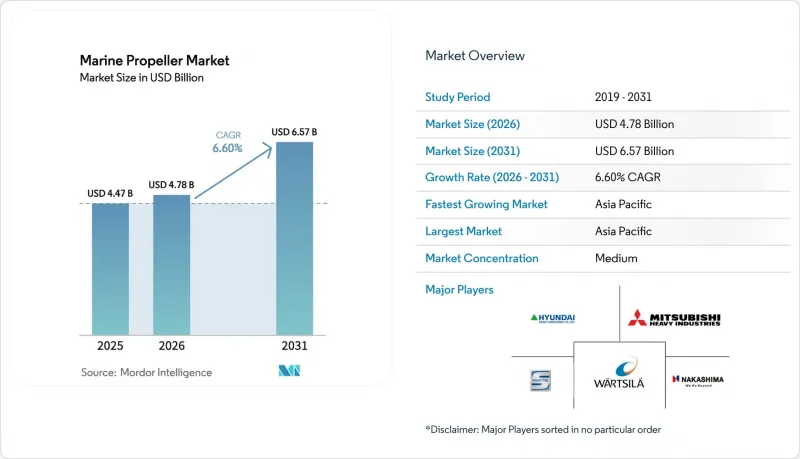
Mordor Intelligence에 의하면, 선박용 프로펠러 시장 규모는 2025년 44억 7,000만 달러로 평가되었습니다. 2026년에는 47억 8,000만 달러로 확대되어 2031년까지 65억 7,000만 달러에 이를 것으로 예상되며, 예측 기간(2026-2031년) CAGR 6.60%로 성장할 전망입니다.
본 보고서는 프로펠러 유형(고정 피치 프로펠러, 가변 피치 프로펠러, 역회전 프로펠러, 덕티드 코트 노즐 프로펠러, 기타), 블레이드 수(2장, 그 이상), 재질(니켈·알루미늄 청동, 스테인리스, 기타),추진 시스템(선내 엔진, 선외 엔진, 기타), 용도(선박 유형)(상선·화물선, 기타), 유통 채널(OEM, 애프터마켓), 지역별로 분류되어 있습니다. 예측은 금액(달러)과 수량(개)으로 이루어집니다.
세계의 선박용 프로펠러 시장 동향 및 인사이트
IMO의 EEXI·CII 효율 규제
국제해사기구(IMO)의 규정에 따라 탄소 강도의 연간 개선이 의무화되어 있으며, 이로 인해 약 1만 3,500척의 선박이 가변 피치 프로펠러로의 개조, 출력 제한 또는 보조 기관의 업그레이드를 검토하게 되었습니다. 대규모 프로펠러 작업을 처리할 수 있는 조선소는 단 27곳에 불과하여, 그 결과 18개월 치의 수주 잔고가 발생하고 있습니다. 이러한 상황으로 인해 선사는 부두에서 조립되는 모듈식 블레이드 시스템의 도입을 검토하고 있습니다. 가변 피치 프로펠러는 항해 중에 블레이드 각도를 변경할 수 있으므로, 선박 운영사는 입항하지 않고도 추력을 미세 조정할 수 있으며, 이를 통해 일정을 유지하면서 규정 준수 목표를 달성할 수 있습니다. 이동식 가공 유닛이나 주조 주기 단축을 제공하는 주조 업체들은 2027년과 2030년의 감사 기한을 앞두고 개조 수주를 확보하고 있습니다. 그 결과, 선박용 프로펠러 시장은 수년에 걸친 지속적인 개조 프로젝트 파이프라인의 혜택을 받고 있습니다.
중국과 한국의 세계 조선 능력 확대
헝리 그룹은 2025년, 초대형 컨테이너선 및 LNG선용 다롄 복합 시설을 확장하기 위해 92억 위안(12억 5,000만 달러)을 투자했습니다. 이러한 선박에는 각각 10미터를 초과하는 프로펠러가 필요합니다. 한국의 주요 기업인 현대중공업과 삼성중공업은 니켈-알루미늄 청동 주물이 3MPa를 초과하는 캐비테이션 압력을 견딜 수 있는 고급 가스 운반선 및 군용 선박 부문에서 계속해서 주도적인 위치를 차지하고 있습니다. 이러한 프로젝트에서는 가변 피치 허브, 샤프트 발전기, 하이브리드 동력 인출 모듈이 단일 조달 패키지로 통합되어 고객을 장기 서비스 계약으로 묶고 있습니다. 유럽 및 북미의 주조 제조업체들은 고속 페리용 복합재료 표면 관통 블레이드와 같은 틈새 시장을 공략하지 않는 한, 상품화로 인한 공급 부족 위험에 직면하게 될 것입니다.
원자재 가격의 급격한 변동
2024년부터 2025년에 걸쳐 니켈 가격은 톤당 1만 6,000달러에서 2만 4,000달러 사이에서 변동하여 주조 업체의 이익률을 최대 300베이시스포인트까지 떨어뜨렸습니다. 항공우주 및 자동차 산업이 프리프레그 공급을 놓고 경쟁하고 있기 때문에 탄소섬유 강화 폴리머로 만든 블레이드는 여전히 청동제보다 40-60% 더 비쌉니다. 판매업체들은 알루미늄·실리콘·마그네슘 합금의 활용을 검토하고 있지만, 피로 강도 문제로 인해 예인선에의 적용은 제한되고 있습니다. 헤지 수단으로서 금속 스크랩 재활용과 니켈 장기 계약이 주목받기 시작하고 있습니다.
부문별 분석
2025년, 고정 피치 프로펠러는 선박용 프로펠러 시장 점유율의 51.50%를 차지했습니다. 이는 초기 비용이 가변 피치 프로펠러에 비해 일반적으로 30-40% 낮고, 유지보수 요건도 간단하기 때문입니다. 이러한 장점은 연료 효율 최적화보다 자본 효율을 우선시하는 벌크선 및 유조선 운영사들로부터 지지를 받고 있습니다. 가변 피치 프로펠러는 2031년까지 연평균 성장률(CAGR) 6.70%를 나타낼 것으로 예측됩니다. 아지머스 프로펠러와 포드식 프로펠러는 해양 지원 및 크루즈선 부문에서 시장 점유율을 확대되고 있습니다. 이러한 부문에서는 동적 위치 유지 및 소반경 선회가 가능하기 때문에 50-70%의 가격 프리미엄이 정당화되고 있습니다. ABB의 ‘Azipod’ 유닛은 현재 전 세계 100척 이상의 크루즈선에 탑재되어 있으며, 각 설치 사례마다 고정 피치 샤프트 라인 구성에 비해 약 10%의 연료 절감 효과를 실현하고 있습니다.
두 개의 프로펠러를 동심축에 장착하여 토크를 상쇄하고 회전 에너지를 회수하는 역회전 프로펠러는 기계적 복잡성과 표류물이 많은 수역에서의 높은 고장률로 인해 여전히 틈새 기술에 머물러 있으며, 시장 점유율은 3% 이하입니다. 덕트식 또는 코트 노즐식 프로펠러는 예인선이나 내륙 수로 선박에서 안정적인 수요가 있습니다. 이러한 선박에서는 저속 시 슈라우드에 의해 정추력이 25-35% 향상되지만, 12노트를 초과하면 발생하는 유체역학적 손실로 인해 외해 항로에서의 채택은 제한적입니다. 고속 페리나 군용 초계정에 사용되는 수면 관통형 프로펠러는 복합 소재의 채택으로 경량화가 진행되고, 물보라와 벤트 손실을 최소화하는 블레이드 형태가 가능해짐에 따라 완만한 성장세를 보이고 있습니다.
2025년에는 4엽 프로펠러가 선박용 프로펠러 시장 점유율의 39.30%를 차지했으나, 5엽 모델은 2031년까지 연평균 성장률(CAGR) 6.06%로 4엽 모델을 웃도는 성장세를 보이며,추력을 유지하면서 진동과 캐비테이션을 저감하고 있습니다. HMS 퀸 엘리자베스에 탑재된 롤스로이스의 ‘조정식 볼트 고정 프로펠러’는 직경 6.7미터에 달하는 5엽을 갖추고 있으며, 각 날개를 개별적으로 교체할 수 있어 내구 연한을 25년 이상으로 연장할 수 있습니다.
현재, 전산유체역학(CFD) 시뮬레이션을 통해 주조 제조업체는 특정 선체 형태나 운용 프로파일에 맞추어 블레이드 수와 스큐 각도를 최적화할 수 있게 되었으며, 산업은 카탈로그 제품 중심공급에서 용도에 따른 엔지니어링 솔루션으로 전환되고 있습니다. 2024년에 출시된 나카시마 프로펠러의 가변 피치 5매 날개 설계는 유압을 통해 날개 각도를 조절하고, 다양한 해상 조건에서도 축 회전수를 일정하게 유지함으로써,아시아태평양 근해 항로를 운항하는 컨테이너 피더선에서 엔진의 마모와 연료 소비를 약 4% 절감하고 있습니다.
지역별 분석
아시아태평양은 프로펠러 수요 측면에서 여전히 세계 최대의 거점이며, 2025년에는 선박용 프로펠러 시장 점유율의 43.70%를 차지했으며, 2026년부터 2031년까지 연평균 6.76%의 성장이 전망됩니다. 중국 다롄에서 진행 중인 92억 위안(12억 5,000만 달러) 규모의 확장 계획은 10미터 청동 프로펠러를 장착한 초대형 컨테이너선을 대상으로 하고 있습니다. 한국은 여전히 높은 수익률을 보이는 LNG 및 해군 관련 프로젝트를 주도하고 있으며, 프로펠러에는 3MPa를 초과하는 캐비테이션 압력이 가해지고 있습니다. 일본의 나카지마사는 가변 피치 기술 노하우와 국내 조선소와의 제휴를 결합하고 있으며, 인도의 28억 달러 규모의 ‘해사 개발 기금’은 내륙 수로에서의 얕은 흘수 프로젝트를 지원하고 있습니다. 드라이독 대기 줄이 여전히 가장 큰 과제로 남아 있지만, 이동식 가공 기술로 인해 일부 완화되고 있습니다.
유럽이 전동화를 주도하고 있습니다. ABB의 아지포드(Azipod)를 탑재한 페리 ‘티코 브라에’호와 ‘오로라’호는 4,160kWh의 배터리 팩으로 운항되며, 선박 1척당 연간 6만 5,000tCO2의 배출을 감축하고 있습니다. 발츠일라(Wartsila)사는 2027-2028년에 취항 예정인 덴마크의 신형 배터리 페리에 트윈 아지머스 스러스터를 공급할 예정입니다. EU의 2030년 소음 규제에 따라 5개 및 6개 블레이드의 스윕 설계가 추진되고 있습니다. 북해와 발트해의 해상 풍력 발전 선박에는 저소음 아지머스 스러스터가 채택되고 있지만, 로테르담이나 함부르크의 혼잡으로 인해 튀르키예나 아랍에미리트의 조선소로 우회할 수밖에 없어 개조 비용이 증가하고 있습니다.
북미에서는 브런즈윅(Brunswick)사가 스테인리스 스틸 프로펠러 공급을 재개함에 따라 레저 보트 시장이 회복되고 있습니다. 미 해군은 전기 구동 무인정의 720시간 연속 운항을 인증함으로써, 방위 부문에서 포드(pod)의 채택이 진행되고 있음을 시사하고 있습니다. 남미의 연안 페리에서는 고정 피치 방식의 비용 대비 성능이 중시되는 반면, 걸프협력회의(GCC)의 해상 프로젝트에서는 동적 위치 유지 스러스터가 채택되고 있습니다. 렘 오프쇼어(Rem Offshore)사의 선박에 탑재된 콘스버그(Consberg)사의 아지무스 스러스터는 이러한 추세를 여실히 보여줍니다.
기타 혜택
- 엑셀 형식 시장 예측(ME) 시트
- 3개월간의 애널리스트 지원
자주 묻는 질문
목차
제1장 서론
제2장 조사 방법
제3장 주요 요약
제4장 시장 구도
제5장 시장 규모 및 성장 예측
제6장 경쟁 구도
제7장 시장 기회 및 향후 전망
KTH 26.08.28According to Mordor Intelligence, the marine propeller market size is expected to grow from USD 4.47 billion in 2025 to USD 4.78 billion in 2026 and is forecast to reach USD 6.57 billion by 2031, growing at a CAGR of 6.60% during the forecast period (2026-2031).
This report is Segmented by Propeller Type (Fixed Pitch, Controllable Pitch, Contra-Rotating, Ducted, Azimuth, Surface-Piercing, Others), Number of Blades (2 Blades, and More), Material (Ni-Al Bronze, Stainless Steel, and More), Propulsion (Inboard, Outboard, and More), Application (Merchant, and More), Sales Channel (OEM, Aftermarket), and Geography. Forecasts in Value (USD) and Volume (Units).
Global Marine Propeller Market Trends and Insights
IMO EEXI and CII Efficiency Mandates
International Maritime Organization rules require annual carbon-intensity improvements, prompting roughly 13,500 ships to contemplate controllable-pitch retrofits, power limitations, or auxiliary upgrades. Only 27 shipyards can handle large-scale propeller work, resulting in an 18-month backlog that is prompting operators to consider modular blade systems assembled at quayside. Because controllable-pitch props allow for blade-angle changes while underway, operators can fine-tune thrust without docking, thereby preserving schedules while meeting compliance targets. Foundries that furnish mobile machining units and accelerated casting cycles are capturing retrofit orders ahead of the 2027 and 2030 audit milestones. As a result, the marine propeller market benefits from a sustained multi-year retrofit pipeline.
Expansion of Global Shipbuilding Capacity in China and South Korea
Hengli Group invested CNY 9.2 billion (USD 1.25 billion) in 2025 to enlarge its Dalian complex for ultra-large container and LNG vessels, each demanding propellers exceeding 10 meters. South Korean leaders Hyundai Heavy Industries and Samsung Heavy Industries continue to dominate premium gas-carrier and naval work, where nickel-aluminum bronze castings withstand cavitation pressures exceeding 3 MPa. These programs integrate controllable-pitch hubs, shaft generators, and hybrid power-take-off modules into single procurement packages, anchoring customers to long-term service deals. Unless European and North American foundries target niches such as composite surface-piercing blades for high-speed ferries, they risk a commodity squeeze.
High Raw-Material Price Volatility
Nickel prices swung between USD 16,000 and USD 24,000 per metric ton during 2024-2025, eroding foundry margins by up to 300 basis points. Carbon-fiber-reinforced polymer blades remain 40-60% more expensive than bronze because the aerospace and automotive sectors compete for prepreg supply. Sellers are exploring aluminum-silicon-magnesium alloys, yet fatigue limits their use in tugboats. Scrap-metal recycling and long-term nickel contracts are surfacing as hedges.
Other drivers and restraints analyzed in the detailed report include:
- Accelerating Ferry Electrification Projects
- Surging Offshore-Wind Vessel Orders
- Stringent Bio-Fouling/Anti-Cavitation Certification Costs
For complete list of drivers and restraints, kindly check the Table Of Contents.
Segment Analysis
Fixed-pitch propellers accounted for 51.50% of the marine propeller market share in 2025, driven by their lower upfront cost, typically 30 to 40% below controllable-pitch equivalents, and simpler maintenance requirements, which appeal to bulk-carrier and tanker operators prioritizing capital efficiency over fuel optimization. Controllable-pitch propellers are forecast to grow at a 6.70% CAGR through 2031. Azimuth and podded propellers are carving a share in offshore-support and cruise segments, where dynamic positioning and tight-radius maneuvering justify the 50 to 70% price premium; ABB's Azipod units now power over 100 cruise ships globally, with each installation delivering approximately 10% fuel savings versus fixed-pitch shaft-line configurations.
Contra-rotating propellers, which mount two propellers on concentric shafts to cancel torque and recover rotational energy, remain a niche technology, with a market share of under 3%, due to mechanical complexity and higher failure rates in debris-laden waters. Ducted or Kort-nozzle propellers command steady demand in tugboats and inland-waterway vessels, where the shroud boosts static thrust by 25 to 35% at low speeds, though hydrodynamic losses above 12 knots limit adoption in open-ocean trades. Surface-piercing propellers, used in high-speed ferries and military patrol craft, are growing modestly as composite materials reduce weight and enable blade profiles that minimize spray and ventilation losses.
Four-blade propellers held 39.30% of the marine propeller market share in 2025; however, five-blade models outgrew them at a 6.06% CAGR through 2031, offering lower vibration and cavitation while preserving thrust. Rolls-Royce's Adjustable Bolted Propeller on HMS Queen Elizabeth features five blades spanning 6.7 meters in diameter, with each blade individually replaceable, extending the service life beyond 25 years.
Computational fluid dynamics simulations now enable foundries to optimize blade count and skew angle for specific hull forms and operating profiles, moving the industry away from catalog offerings toward application-engineered solutions. Nakashima Propeller's variable-pitch five-blade design, launched in 2024, adjusts blade angle hydraulically to maintain constant shaft speed across varying sea states, reducing engine wear and fuel consumption by approximately 4% on container feeders operating in the Asia-Pacific short-sea trades.
Complete Report Scope:
- By Propeller Type
- Fixed Pitch Propeller
- Controllable Pitch Propeller
- Contra-Rotating Propeller
- Ducted/Kort Nozzle Propeller
- Azimuth/Podded Propeller
- Surface-Piercing Propeller
- Others
- By Number of Blades
- 2 Blades
- 3 Blades
- 4 Blades
- 5 Blades
- 6+ Blades
- By Material
- Nickel-Aluminum Bronze
- Stainless Steel
- Aluminium
- Composite/CFRP
- Others
- By Propulsion System
- Inboard
- Outboard
- Sterndrive
- Electric Pod/Azipod
- By Application (Vessel Type)
- Merchant/Cargo Vessels
- Passenger Ferries and Cruise
- Naval and Defense Vessels
- Offshore Support and Tug Boats
- Recreational and Leisure Boats
- Inland Waterway Vessels
- By Sales Channel
- Original Equipment Manufacturer (OEM)
- Aftermarket
- By Geography
- North America
- United States
- Canada
- Rest of North America
- South America
- Brazil
- Argentina
- Rest of South America
- Europe
- Germany
- United Kingdom
- Norway
- France
- Italy
- Spain
- Russia
- Rest of Europe
- Asia-Pacific
- China
- Japan
- South Korea
- India
- Australia
- Rest of Asia Pacific
- Middle East and Africa
- GCC
- Turkey
- South Africa
- Rest of Middle East and Africa
- North America
Geography Analysis
Asia-Pacific remains the world's largest hub for propeller demand, with 43.70% of the marine propeller market share in 2025 and expected to grow at 6.76% between 2026 and 2031. China's CNY 9.2 billion (USD 1.25 billion) Dalian expansion targets ultra-large container vessels with 10-meter bronze propellers. South Korea still commands high-margin LNG and naval work, with propellers facing cavitation pressures above 3 MPa. Japan's Nakashima couples controllable-pitch expertise with domestic yard tie-ups, and India's USD 2.8 billion Maritime Development Fund backs shallow-draft projects on inland waterways. Dry-dock queues remain the primary headwind, although mobile machining offers partial relief.
Europe drives electrification. ABB's Azipod ferries Tycho Brahe and Aurora operate on 4,160 kWh packs, removing 65,000 tCO2 annually per ship. Wartsila will supply twin azimuth thrusters to Denmark's new battery ferries due in 2027-2028. The EU's 2030 noise rules push five- and six-blade swept designs. Offshore wind vessels in the North Sea and Baltic adopt low-noise azimuth thrusters, while congestion in Rotterdam and Hamburg forces diversions to yards in Turkey or the United Arab Emirates, inflating retrofit costs.
North America rebounds in leisure boating as Brunswick restores stainless-steel propeller supply. The United States Navy validated a 720-hour endurance for electric-drive unmanned craft, signaling the defense sector's adoption of pods. South America's coastal ferries prioritize fixed-pitch affordability, whereas Gulf Cooperation Council offshore projects adopt dynamic-positioning thrusters; Kongsberg azimuth units on Rem Offshore vessels illustrate this trend.
- Wartsila Oyj Abp
- HD Hyundai Heavy Industries Co., Ltd.
- MITSUBISHI HEAVY INDUSTRIES, LTD.
- Schottel GmbH
- Nakashima Propeller Co., Ltd.
- Mecklenburger Metallguss GmbH
- Veem Ltd
- Brunswick (Mercury Marine)
- Kawasaki Heavy Industries
- Schaffran Propeller
- Teignbridge Propellers
- Rolls-Royce plc
- ABB Ltd. (Azipod)
- Bruntons Propellers
- Flexofold
- Sharrow Marine
Additional Benefits:
- The market estimate (ME) sheet in Excel format
- 3 months of analyst support
TABLE OF CONTENTS
1 Introduction
- 1.1 Study Assumptions and Market Definition
- 1.2 Scope of the Study
2 Research Methodology
3 Executive Summary
4 Market Landscape
- 4.1 Market Overview
- 4.2 Market Drivers
- 4.2.1 IMO EEXI and CII Efficiency Mandates
- 4.2.2 Expansion of Global Shipbuilding Capacity in China and South Korea
- 4.2.3 Accelerating Ferry Electrification Projects
- 4.2.4 Surging Offshore-Wind Vessel Orders
- 4.2.5 Retro-Fit Demand to Meet Underwater-Noise Limits
- 4.2.6 Adoption of AI-Driven Digital-Twin Hydrodynamic Design Tools
- 4.3 Market Restraints
- 4.3.1 High Raw-Material Price Volatility (Ni-Al Bronze, CFRP)
- 4.3.2 Stringent Bio-Fouling/Anti-Cavitation Certification Costs
- 4.3.3 Short-Term Ship-Owner Cap-Ex Freeze Amid Freight-Rate Slump
- 4.3.4 Limited Dry-Dock Slots Slowing Propeller Retrofits
- 4.4 Value/Supply-Chain Analysis
- 4.5 Regulatory Landscape
- 4.6 Technological Outlook
- 4.7 Porter's Five Forces
- 4.7.1 Threat of New Entrants
- 4.7.2 Bargaining Power of Buyers
- 4.7.3 Bargaining Power of Suppliers
- 4.7.4 Threat of Substitutes
- 4.7.5 Intensity of Competitive Rivalry
5 Market Size and Growth Forecasts (Value (USD) and Volume (Units))
- 5.1 By Propeller Type
- 5.1.1 Fixed Pitch Propeller
- 5.1.2 Controllable Pitch Propeller
- 5.1.3 Contra-Rotating Propeller
- 5.1.4 Ducted/Kort Nozzle Propeller
- 5.1.5 Azimuth/Podded Propeller
- 5.1.6 Surface-Piercing Propeller
- 5.1.7 Others
- 5.2 By Number of Blades
- 5.2.1 2 Blades
- 5.2.2 3 Blades
- 5.2.3 4 Blades
- 5.2.4 5 Blades
- 5.2.5 6+ Blades
- 5.3 By Material
- 5.3.1 Nickel-Aluminum Bronze
- 5.3.2 Stainless Steel
- 5.3.3 Aluminium
- 5.3.4 Composite/CFRP
- 5.3.5 Others
- 5.4 By Propulsion System
- 5.4.1 Inboard
- 5.4.2 Outboard
- 5.4.3 Sterndrive
- 5.4.4 Electric Pod/Azipod
- 5.5 By Application (Vessel Type)
- 5.5.1 Merchant/Cargo Vessels
- 5.5.2 Passenger Ferries and Cruise
- 5.5.3 Naval and Defense Vessels
- 5.5.4 Offshore Support and Tug Boats
- 5.5.5 Recreational and Leisure Boats
- 5.5.6 Inland Waterway Vessels
- 5.6 By Sales Channel
- 5.6.1 Original Equipment Manufacturer (OEM)
- 5.6.2 Aftermarket
- 5.7 By Geography
- 5.7.1 North America
- 5.7.1.1 United States
- 5.7.1.2 Canada
- 5.7.1.3 Rest of North America
- 5.7.2 South America
- 5.7.2.1 Brazil
- 5.7.2.2 Argentina
- 5.7.2.3 Rest of South America
- 5.7.3 Europe
- 5.7.3.1 Germany
- 5.7.3.2 United Kingdom
- 5.7.3.3 Norway
- 5.7.3.4 France
- 5.7.3.5 Italy
- 5.7.3.6 Spain
- 5.7.3.7 Russia
- 5.7.3.8 Rest of Europe
- 5.7.4 Asia-Pacific
- 5.7.4.1 China
- 5.7.4.2 Japan
- 5.7.4.3 South Korea
- 5.7.4.4 India
- 5.7.4.5 Australia
- 5.7.4.6 Rest of Asia Pacific
- 5.7.5 Middle East and Africa
- 5.7.5.1 GCC
- 5.7.5.2 Turkey
- 5.7.5.3 South Africa
- 5.7.5.4 Rest of Middle East and Africa
- 5.7.1 North America
6 Competitive Landscape
- 6.1 Market Concentration
- 6.2 Strategic Moves
- 6.3 Market Share Analysis
- 6.4 Company Profiles (Includes Global level Overview, Market level overview, Core Segments, Financials as available, Strategic Information, Market Rank/Share for key companies, Products and Services, and Recent Developments)
- 6.4.1 Wartsila Oyj Abp
- 6.4.2 HD Hyundai Heavy Industries Co., Ltd.
- 6.4.3 MITSUBISHI HEAVY INDUSTRIES, LTD.
- 6.4.4 Schottel GmbH
- 6.4.5 Nakashima Propeller Co., Ltd.
- 6.4.6 Mecklenburger Metallguss GmbH
- 6.4.7 Veem Ltd
- 6.4.8 Brunswick (Mercury Marine)
- 6.4.9 Kawasaki Heavy Industries
- 6.4.10 Schaffran Propeller
- 6.4.11 Teignbridge Propellers
- 6.4.12 Rolls-Royce plc
- 6.4.13 ABB Ltd. (Azipod)
- 6.4.14 Bruntons Propellers
- 6.4.15 Flexofold
- 6.4.16 Sharrow Marine
7 Market Opportunities and Future Outlook
- 7.1 White-space and Unmet-Need Assessment