

|
시장보고서
상품코드
2114869
실리콘 카바이드 섬유 시장 : 시장 점유율 분석, 업계 동향 및 통계, 성장 예측(2026-2031년)Silicon Carbide Fiber - Market Share Analysis, Industry Trends & Statistics, Growth Forecasts (2026 - 2031) |
||||||
 Mordor Intelligence
Mordor Intelligence에 의하면, 실리콘 카바이드 섬유 시장 규모는 2025년에 10억 4,000만 달러로 평가되었고, 2026년 11억 2,000만 달러에서 2031년까지 16억 6,000만 달러에 이를 것으로 예측되며, 예측 기간(2026-2031년) CAGR은 8.09%를 나타낼 전망입니다.
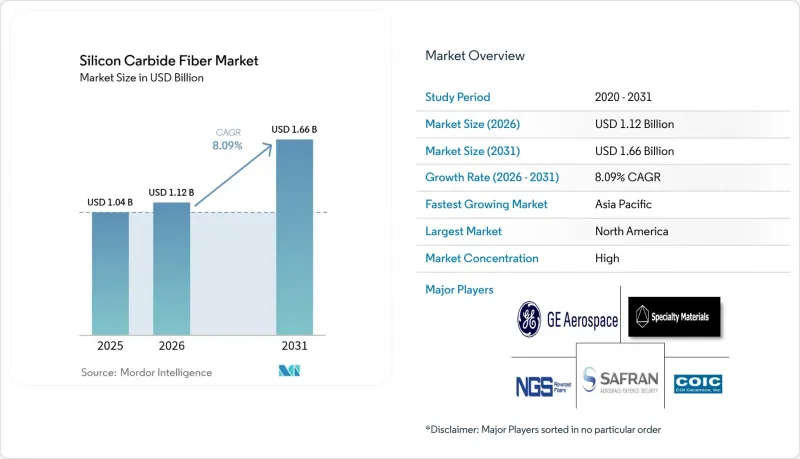
본 보고서는 섬유 유형별(연속 섬유, 단섬유), 형태별(연속형, 직물), 최종 사용자 산업별(항공우주 및 방위, 에너지·발전, 산업, 기타), 지역별(아시아태평양, 북미, 유럽, 남미, 중동 및 아프리카)로 분류되어 있습니다. 시장 예측은 금액(달러) 기준으로 제시되어 있습니다.
세계의 실리콘 카바이드 섬유 시장 동향 및 인사이트력
민간 및 군용 항공우주 엔진 생산의 급증
LEAP 시리즈의 CMC 슈라우드(shroud)는 비행 시간이 1,000만 시간을 돌파하여, 상용 서비스에서 실리콘 카바이드 섬유 복합재료의 유효성이 입증되었습니다. 군사 부문에서의 채택도 동시에 주목받고 있습니다. UH-60M 블랙호크용 T901 엔진은 SiC CMC를 통해 부품 중량을 50% 줄임으로써, 외형 치수를 그대로 유지한 채 1,000 샤프트 HP의 추가 출력을 실현하고 있습니다. 플랫 앤 휘트니(Pratt & Whitney)는 SiC 강화 베인과 연소실의 인증을 가속화하기 위해 칼스배드에 6만 제곱피트 규모의 CMC 센터를 개설했습니다. 엔진 OEM 각사는 2028년까지 LEAP 엔진의 연간 정비 횟수가 1,200회를 넘어설 것으로 전망하고 있으며, 이에 따라 사프란사는 전 세계 정비 네트워크에 10억 유로 이상을 투자하기로 결정했습니다. 항공기 운용 연수가 경과함에 따라 애프터마켓 수요가 장기적인 섬유 수요를 확보하고, 지속적인 생산 능력 확장을 정당화하는 요인이 되고 있습니다.
차세대 가스터빈에서 SiC 강화 세라믹 매트릭스 복합재료(CMC) 수요 급증
가스 터빈 제조업체들은 복합 사이클의 효율을 높이기 위해 1,300°C를 넘는 연소 온도를 목표로 하고 있으며, 니켈 합금이 크리프를 일으키는 온도 범위에서도 인장 강도를 유지할 수 있는 SiC 섬유가 매우 중요한 역할을 하고 있습니다. 과거에는 증기의 산화 작용으로 인해 CMC의 수명이 제한되었으나, SiC 섬유용으로 설계된 환경 차단 코팅 덕분에 현재는 가동 시간이 2만 5,000시간을 넘기게 되었습니다. 수소 연소 터빈도 또 다른 호재로 작용하고 있습니다. 이는 SiC가 강철에 비해 고온의 수소 환경에서 뛰어난 내성을 보이기 때문입니다. 선박용 추진 시스템 또한 중요한 부문입니다. SiC 라이너가 장착된 5MW 소형 터빈을 통해 페리 운항사는 고비용의 SCR 시스템을 도입하지 않고도 IMO Tier III 배출 기준을 충족할 수 있게 됩니다. 종합적으로 볼 때, 전력 및 선박 부문 사용자들 수요가 항공우주 부문 이외로도 확대되면서 실리콘 카바이드 섬유 시장의 성장 곡선을 안정적으로 유지하고 있습니다.
매우 높은 생산 비용과 자본 집약도
4성분 폴리카보실란의 합성과 1,800°C에서의 소결로 인해 생산 비용은 탄소섬유의 기준치를 크게 상회합니다. GE 에어로스페이스의 헌츠빌에 위치한 두 공장의 건설비는 총 2억 달러에 달하며, 이는 진입 장벽이 높음을 여실히 보여줍니다. 로 내에서는 산소 농도를 제어한 환경을 유지해야 하기 때문에 에너지 비용만으로도 완성된 섬유 가격의 20%를 초과하는 경우가 있습니다. 감광성 폴리카보실란에 관한 조사에서는 상압 하에서의 경화가 유망시되고 있지만, 여전히 파일럿 규모에 머물러 있습니다. 획기적인 가공 기술의 확립이나 생산량 확대를 통해 고정비가 희석되기 전까지는 실리콘 카바이드 섬유 시장은 자본력이 있는 기존 기업에 집중된 상태가 지속될 것이며, 비용에 민감한 부문에서의 가격 탄력성은 제한적일 것으로 보입니다.
부문 분석
2025년 시점에서 연속 섬유는 실리콘 카바이드 섬유 시장의 70.02% 점유율을 차지했으며, 2031년까지 연평균 성장률(CAGR) 8.63%를 나타낼 것으로 예측됩니다. ‘Hi-Nicalon S’와 같은 3세대 등급은 1,600°C에서 2.8GPa의 인장 강도를 발휘하며, 크리프 저항이 극히 중요한 항공우주 부문의 하중 채널 요건을 충족하고 있습니다. 비정상적인 결정립 성장을 억제하는 제조 기술의 개선을 통해 실온 강도가 4GPa 가까이 향상되어 설계 적용 범위가 확대되고 있습니다. 또한, 연속 필라멘트는 핵연료 피복관의 권선에 활용될 수 있으며, 이때 환상 응력의 정렬을 통해 냉각재 상실 사고 시 파열 저항성이 향상됩니다. 단섬유는 복잡한 형태, 특히 산업용 버너 노즐을 성형하는 폴리머 침투·열분해(PIP) 공정에서 여전히 중요한 역할을 하고 있지만, 기계적 강도의 한계로 인해 구조용도로의 광범위한 채택은 제한되고 있습니다.
결함 제어 방적 기술의 발전과 표면 산소 관리를 결합함으로써, SiC 매트릭스 내에서 균일하게 결합되는 더 매끄러운 필라멘트가 제조되고 있습니다. 이러한 미세 구조의 조화를 통해 계면 전단 강도가 25% 향상되었으며, 엔진 고온부에서의 반복 피로 수명이 개선되었습니다. 자동 와인더의 개량을 통해 로빙의 장력을 ±1% 이내로 유지할 수 있게 되어, 항공기 엔진 플랜지에서 복합재의 두께를 안정적으로 확보할 수 있게 되었습니다. 학습 곡선이 평탄해짐에 따라 생산 시 스크랩률은 5% 이하로 감소했으며, 1kg당 실질 비용이 절감되었습니다. 그 결과, 연속 섬유는 고부가가치 항공우주 관련 수주의 대부분을 뒷받침하고 있으며, 실리콘 카바이드 섬유 시장에서 안정적인 수익 기반을 확보하는 동시에, 생산자가 신흥 부문용으로 저등급 제품을 시험적으로 생산할 수 있게 되었습니다.
지역별 분석
북미는 확립된 항공우주 공급망과 고온 소재에 대한 정부 자금 지원 덕분에 2025년 매출의 37.21%를 차지했습니다. 미국 에너지부는 가혹한 환경 하에서의 SiC 섬유 프로그램에 1억 5,000만 달러를 배정하여, 발전용 및 SMR(소형 모듈 원자로)용 원자로에 대한 인증을 가속화하고 있습니다. 헌츠빌에는 서부 지역 최초의 상용 섬유 생산 라인이 설치되어 있으며, 이 지역은 자급자족형 허브로서의 입지를 확고히 하고 있습니다. 한편, 캐나다의 MDA와 멕시코 케레타로의 항공 클러스터에서는 복합 소재를 나셀 구조에 통합하고 있습니다. 이러한 지리적 집중은 얼리 어답터(early adopter)를 위한 가격 책정과 소재 개선을 촉진하는 신속한 고객 피드백 순환을 뒷받침하고 있습니다.
연평균 성장률(CAGR) 8.70%로 성장을 지속하고, 있는 아시아태평양은 폴리카보실란 화학 분야에서 일본의 리더십과 확대되는 한국의 항공 엔진 정비 네트워크의 혜택을 받고 있습니다. UBE는 국내 및 수출 수요를 충족하기 위해 향후 10년 동안 전구체의 생산량을 10배로 늘릴 계획입니다. 중국은 초극초음속 활공기용 항공 엔진 연구소의 SiC CMC 검사 설비를 확충하고 있으며, 기술 이전 장벽이 완화되면 향후 대량 소비가 예상됩니다. 한국의 반도체 제조는 SiC 히트 스프레더 개발을 촉진하고 있으며, 항공 부문 이외 수요를 뒷받침하고 있습니다. 인도와 아세안(ASEAN)은 아직 발전 단계에 있지만, 현지 복합재료 클러스터가 성숙해짐에 따라 그 잠재력을 드러내고 있습니다.
유럽은 가스터빈 및 자동차 부문에서의 견고한 기반을 활용하여 안정적인 수요를 유지하고 있습니다. STMicroelectronics사의 실리콘 카바이드 파워 디바이스 로드맵에서는 고성능 히트 스프레더가 필요로 되어, 간접적으로 섬유 채택을 촉진하고 있습니다. 독일의 엔진 개발 프로그램은 지역 난방용으로 40% 효율을 가진 마이크로 터빈을 목표로 하고 있으며, 이를 위해서는 SiC 라이너가 필요합니다. 영국은 항공우주기술연구소(Aerospace Technology Institute) 산하에서 CMC 실증 프로젝트에 자금을 지원하고 있으며, 인증 데이터 세트의 확충이 진행되고 있습니다. 복합 사이클 발전소에서 수소 혼소 연소를 검토 중인 북유럽의 전력 회사들도 SiC 라이너를 지정하고 있습니다. 현재의 거시경제적 역풍이 설비 투자에 영향을 미치고 있지만, 배출 감축에 초점을 맞춘 유럽의 규제로 인해 장기적인 섬유 수요는 유지되고 있습니다.
기타 혜택
- 엑셀 형식 시장 예측(ME) 시트
- 3개월간의 애널리스트 지원
자주 묻는 질문
목차
제1장 서론
제2장 조사 방법
제3장 주요 요약
제4장 시장 구도
제5장 시장 규모 및 성장 예측
제6장 경쟁 구도
제7장 시장 기회 및 향후 전망
AJY 26.08.28According to Mordor Intelligence, the silicon carbide fiber market size was valued at USD 1.04 billion in 2025 and estimated to grow from USD 1.12 billion in 2026 to reach USD 1.66 billion by 2031, at a CAGR of 8.09% during the forecast period (2026-2031).
This report is Segmented by Fiber Type (Continuous Fiber, and Short Fiber), Form (Continuous and Woven), End-User Industry (Aerospace and Defense, Energy and Power, Industrial, and Other End-User Industries), and Geography (Asia-Pacific, North America, Europe, South America, and Middle-East and Africa). The Market Forecasts are Provided in Terms of Value (USD).
Global Silicon Carbide Fiber Market Trends and Insights
Rapid Rise in Commercial and Military Aerospace Engine Production
LEAP-series CMC shrouds have surpassed 10 million flight hours, validating silicon carbide fiber composites in commercial service. Parallel military adoption is notable; the T901 engine for the UH-60M Black Hawk delivers 1,000 extra shaft horsepower while retaining form factor because SiC CMCs reduce component mass by 50%. Pratt & Whitney has opened a 60,000 ft2 CMC center in Carlsbad to accelerate qualification of SiC-reinforced vanes and combustors. Engine OEMs expect more than 1,200 annual LEAP shop visits by 2028, prompting Safran to commit over EUR 1 billion to global maintenance networks. As fleets mature, aftermarket demand secures long-term fiber volumes and justifies continued capacity expansion.
Surging Demand for SiC-Reinforced Ceramic Matrix Composites in Next-Gen Gas Turbines
Gas-turbine makers target firing temperatures above 1,300 °C to raise combined-cycle efficiency, and SiC fibers are pivotal because they retain tensile strength where nickel alloys creep. Steam oxidation once limited CMC lifetimes, but environmental-barrier coatings designed for SiC fibers now extend service beyond 25,000 hours. Hydrogen-fired turbines add further impetus because SiC exhibits superior resistance in high-temperature hydrogen compared with steel. Marine propulsion is another vector: 5 MW compact turbines equipped with SiC liners allow ferry operators to meet IMO Tier III emissions without costly SCR systems. Collectively, power and marine users diversify demand beyond aerospace, smoothing the silicon carbide fiber market growth curve.
Ultra-High Production Cost and Capital Intensity
Four-component polycarbosilane synthesis and 1,800 °C sintering create production costs well above carbon fiber benchmarks. GE Aerospace's twin Huntsville plants together cost USD 200 million, underscoring steep entry barriers. Energy spending alone can exceed 20% of finished-fiber price because furnaces must maintain oxygen-controlled atmospheres. Research into photosensitive polycarbosilanes shows promise for ambient-pressure curing but remains at pilot scale. Until breakthrough processing or broader volumes dilute fixed costs, the silicon carbide fiber market will stay concentrated among capital-rich incumbents, limiting price elasticity in cost-sensitive sectors.
Other drivers and restraints analyzed in the detailed report include:
- Nuclear Small Modular Reactor Vendors Adopting SiC Fibers for Accident-Tolerant Fuel Cladding
- Lightweighting Push in E-Mobility Thermal-Protection Systems
- Scale-Up Bottlenecks in Polycarbosilane Precursor Supply
For complete list of drivers and restraints, kindly check the Table Of Contents.
Segment Analysis
Continuous fibers captured 70.02% of the silicon carbide fiber market share in 2025 and are forecast to grow at an 8.63% CAGR through 2031. Third-generation grades such as Hi-Nicalon S deliver 2.8 GPa tensile strength at 1,600 °C, satisfying aerospace load paths where creep resistance is critical. Manufacturing refinements that suppress abnormal grain growth have raised room-temperature strength toward 4 GPa, widening the design envelope. Continuous filaments also enable winding of nuclear fuel cladding tubes, where hoop stress alignment enhances burst tolerance during loss-of-coolant scenarios. Short fibers remain relevant for polymer infiltration and pyrolysis (PIP) routes that mold complex geometries, especially industrial burner nozzles, but their mechanical ceiling restrains broader structural uptake.
Advances in defect-controlled spinning coupled with surface-oxygen management produce smoother filaments that bond uniformly within SiC matrices. This microstructural harmony boosts interfacial shear by 25%, improving cyclic fatigue life in engine hot-sections. Automated winder upgrades now maintain +-1% roving tension, ensuring repeatable composite thickness in aero-engine flanges. As learning curves flatten, production scrap rates have dropped below 5%, reducing effective cost per kilogram. Continuous fibers consequently underpin most high-value aerospace orders, securing the silicon carbide fiber market a stable revenue core while allowing producers to experiment with lower-grade products for emerging sectors.
Complete Report Scope:
- By Fiber Type
- Continous Fiber
- Short Fiber
- By Form
- Continuous
- Woven
- By End-user Industry
- Aerospace and Defence
- Energy and Power
- Industrial
- Other End-user Industries
- By Geography
- Asia-Pacific
- China
- Japan
- India
- South Korea
- ASEAN Countries
- Rest of Asia-Pacific
- North America
- United States
- Canada
- Mexico
- Europe
- Germany
- United Kingdom
- France
- Italy
- Spain
- Russia
- NORDIC Countries
- Rest of Europe
- South America
- Brazil
- Argentina
- Rest of South America
- Middle-East and Africa
- Saudi Arabia
- South Africa
- Rest of Middle-East and Africa
- Asia-Pacific
Geography Analysis
North America retained 37.21% of 2025 revenue due to its entrenched aerospace supply chain and government funding for high-temperature materials. The U.S. Department of Energy earmarked USD 150 million for harsh-environment SiC fiber programs, accelerating qualification for power and SMR reactors. Huntsville hosts the first western commercial fiber line, positioning the region as a self-sufficient hub, while Canada's MDA and Mexico's Queretaro aero-clusters integrate composites into nacelle structures. The geographic concentration supports early adopter pricing and tight customer feedback loops that advance material iterations.
Asia-Pacific, growing at 8.70% CAGR, benefits from Japanese leadership in polycarbosilane chemistry and expanding Korean aero-engine overhaul networks. UBE Corporation plans to multiply precursor output tenfold this decade to meet domestic and export demand. China scales its aero-engine institute's SiC CMC test bed for hypersonic glide vehicles, signaling future high-volume consumption once technology transfer hurdles ease. Semiconductor fabrication in South Korea spurs SiC heat-spreader development, anchoring non-aero demand. India and ASEAN nations are yet nascent but show potential as local composites clusters mature.
Europe leverages a robust gas-turbine and automotive footprint to sustain steady demand. STMicroelectronics' silicon-carbide power-device roadmap necessitates advanced heat spreaders, indirectly boosting fiber uptake. Germany's engine programs seek 40% efficient microturbines for district heat, requiring SiC liners. The UK funds CMC demonstrators under its Aerospace Technology Institute, widening qualification data sets. Nordic utilities exploring hydrogen co-firing in combined-cycle plants also specify SiC liners. Although current macroeconomic headwinds affect capital spending, Europe's regulatory focus on emission reduction preserves long-term fiber demand.
- BJS Ceramics GmbH
- COI Ceramics
- GE Aerospace
- General Atomics Electromagnetic Systems
- Haydale Graphene Industries plc
- MATECH
- NGS Advanced Fibers Co., Ltd.
- Nippon Carbon Co Ltd.
- Safran Ceramics
- SGL Carbon
- Specialty Materials Inc.
- Suzhou Saifei Group Ltd.
- TISICS Ltd.
- TOSHIBA ELECTRONIC DEVICES and STORAGE CORPORATION
- UBE Corporation
Additional Benefits:
- The market estimate (ME) sheet in Excel format
- 3 months of analyst support
TABLE OF CONTENTS
1 Introduction
- 1.1 Study Assumptions and Market Definition
- 1.2 Scope of the Study
2 Research Methodology
3 Executive Summary
4 Market Landscape
- 4.1 Market Overview
- 4.2 Market Drivers
- 4.2.1 Rapid Rise in Commercial and Military Aerospace Engine Production
- 4.2.2 Surging Demand for Sic-Reinforced Ceramic Matrix Composites (Cmcs) in Next-Gen Gas Turbines
- 4.2.3 Nuclear Small Modular Reactor (SMR) Vendors Adopting Sic Fibers for Accident-Tolerant Fuel Cladding
- 4.2.4 Lightweighting Push in E-Mobility Thermal-Protection Systems
- 4.2.5 Hypersonic-Flight Thermal-Shield Programs Adopting Sic Fibers
- 4.3 Market Restraints
- 4.3.1 Ultra-High Production Cost and Capital Intensity
- 4.3.2 Scale-Up Bottlenecks in Polycarbosilane Precursor Supply
- 4.3.3 Substitution Threat from Cost-Competitive Carbon and Alumina Fibers
- 4.4 Value Chain Analysis
- 4.5 Porter's Five Forces
- 4.5.1 Threat of New Entrants
- 4.5.2 Bargaining Power of Buyers
- 4.5.3 Bargaining Power of Suppliers
- 4.5.4 Threat of Substitutes
- 4.5.5 Degree of Competition
5 Market Size and Growth Forecasts (Value)
- 5.1 By Fiber Type
- 5.1.1 Continous Fiber
- 5.1.2 Short Fiber
- 5.2 By Form
- 5.2.1 Continuous
- 5.2.2 Woven
- 5.3 By End-user Industry
- 5.3.1 Aerospace and Defence
- 5.3.2 Energy and Power
- 5.3.3 Industrial
- 5.3.4 Other End-user Industries
- 5.4 By Geography
- 5.4.1 Asia-Pacific
- 5.4.1.1 China
- 5.4.1.2 Japan
- 5.4.1.3 India
- 5.4.1.4 South Korea
- 5.4.1.5 ASEAN Countries
- 5.4.1.6 Rest of Asia-Pacific
- 5.4.2 North America
- 5.4.2.1 United States
- 5.4.2.2 Canada
- 5.4.2.3 Mexico
- 5.4.3 Europe
- 5.4.3.1 Germany
- 5.4.3.2 United Kingdom
- 5.4.3.3 France
- 5.4.3.4 Italy
- 5.4.3.5 Spain
- 5.4.3.6 Russia
- 5.4.3.7 NORDIC Countries
- 5.4.3.8 Rest of Europe
- 5.4.4 South America
- 5.4.4.1 Brazil
- 5.4.4.2 Argentina
- 5.4.4.3 Rest of South America
- 5.4.5 Middle-East and Africa
- 5.4.5.1 Saudi Arabia
- 5.4.5.2 South Africa
- 5.4.5.3 Rest of Middle-East and Africa
- 5.4.1 Asia-Pacific
6 Competitive Landscape
- 6.1 Market Concentration
- 6.2 Strategic Moves
- 6.3 Market Share (%)/Ranking Analysis
- 6.4 Company Profiles (includes Global level Overview, Market level overview, Core Segments, Financials as available, Strategic Information, Market Rank/Share for key companies, Products and Services, and Recent Developments)
- 6.4.1 BJS Ceramics GmbH
- 6.4.2 COI Ceramics
- 6.4.3 GE Aerospace
- 6.4.4 General Atomics Electromagnetic Systems
- 6.4.5 Haydale Graphene Industries plc
- 6.4.6 MATECH
- 6.4.7 NGS Advanced Fibers Co., Ltd.
- 6.4.8 Nippon Carbon Co Ltd.
- 6.4.9 Safran Ceramics
- 6.4.10 SGL Carbon
- 6.4.11 Specialty Materials Inc.
- 6.4.12 Suzhou Saifei Group Ltd.
- 6.4.13 TISICS Ltd.
- 6.4.14 TOSHIBA ELECTRONIC DEVICES and STORAGE CORPORATION
- 6.4.15 UBE Corporation
7 Market Opportunities and Future Outlook
- 7.1 White-space and Unmet-Need Assessment


