

|
시장보고서
상품코드
2114876
표백 점토 시장 : 점유율 분석, 업계 동향과 통계, 성장 예측(2026-2031년)Bleaching Clay - Market Share Analysis, Industry Trends & Statistics, Growth Forecasts (2026 - 2031) |
||||||
 Mordor Intelligence
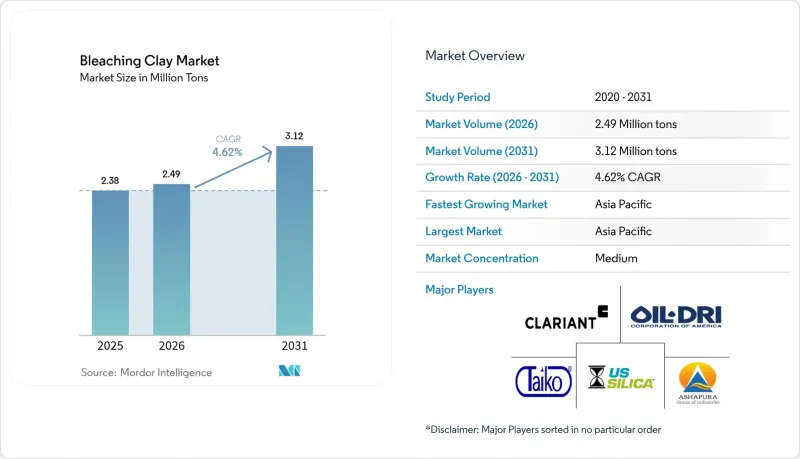
Mordor Intelligence에 의하면, 표백 점토 시장 규모는 2025년 238만 톤에서 2026년에는 249만 톤으로 확대되어 2026년부터 2031년까지 CAGR 4.62%로 성장을 지속하여, 2031년까지 312만 톤에 이를 것으로 예측됩니다.
본 보고서는 유형(플루어스 어스, 활성 점토, 활성 보크사이트), 용도(광물유·왁스, 공업용유, 식물성 기름·동물성 지방), 최종 사용자 산업(식품 및 음료 가공, 화장품 및 퍼스널케어, 기타), 지역(아시아태평양, 북미, 기타)별로 분류되어 있습니다. 시장 전망은 판매량(톤) 기준으로 제시되어 있습니다.
전 세계 표백 점토 시장 동향 및 인사이트
정제 식물성 오일 소비 확대
2024/25년 시즌에는 전 세계 유지종자 생산량이 6억 8,000만 톤에 달하고, 이에 따라 용매 추출유에서 엽록소, 카로티노이드 및 미량 금속을 제거하는 특수 표백 제제에 대한 수요가 증가하고 있습니다. 물류상의 이점과 압착 능력 확대에 힘입은 아시아태평양의 정제 업체들이 증가분의 가장 큰 비중을 차지하고 있습니다. 또한, 이 부문은 대두유와 해바라기유로의 식생활 변화로부터도 혜택을 받고 있습니다. 이들 모두는 콜드 프레스 방식의 대체유에 비해 더 높은 점토 첨가율을 필요로 합니다. 특정 유지의 화학적 특성에 맞추어 기공 구조를 조정할 수 있는 제조업체는 조달처로 우선적으로 선정되고 있습니다. 특히 OPEC이 2050년까지 개발도상 지역에서 하루 1,920만 배럴의 새로운 정제 능력 증설을 예측하고 있는 만큼, 이러한 추세는 두드러집니다. 이러한 구조적인 호재 덕분에 표백 점토 시장의 장기적인 판매량 안정성이 확보되고 있습니다.
화장품 및 퍼스널케어 제품에서 수요 증가
화장품 브랜드들은 클린 라벨에 대한 기대와 미세 플라스틱 관련 규제 압력에 대응하기 위해, 합성 흡착제를 천연 유래 점토로 대체하는 움직임을 강화하고 있습니다. 높은 비표면적과 양이온 교환 용량을 갖춘 표백 점토는 유분 흡착제일 뿐만 아니라 자외선 차단제의 안정제 역할도 하기 때문에 선크림이나 매트 마감제품에서의 활용이 확대되고 있습니다. 클라리언트의 루카스 마이어 코스메틱스 인수는 이러한 고수익 최종 용도 시장에서의 부가가치 공급을 강화하는 것으로, 2024년 해당 회사의 케어 케미컬 부문 수익성 향상으로 그 성과가 나타나고 있습니다. 프리미엄 제형에는 중금속 함량이 낮은 점토가 요구되며, 이는 가격 차별화를 뒷받침하고 식용유에 비해 취급량이 적은 점을 상쇄하고 있습니다.
광업 및 산 활성화 폐기물에 대한 엄격한 환경 규제
미국 환경보호청(EPA)의 배출 기준 개정과 사용 후 표백 점토에 대한 EU의 유해 폐기물 지정에 따라 처리 비용이 톤당 50-100달러 증가하여, 각 시설은 제로 액체 배출 시스템에 대한 투자를 강요받고 있습니다. 소규모 사업자들은 이러한 설비 갱신을 위한 자금 조달에 어려움을 겪고 있어, 생산 능력의 합리화나 향후 업계 재편으로 이어질 가능성이 있습니다. 한편, 지속가능성 노력의 일환으로 특정 점토 유형에서 최대 35%의 유분을 회수하여 폐기물량을 줄이는 동시에 부가 가치를 창출하는 용매 추출법 및 열분해법에 대한 연구 개발이 가속화되고 있습니다.
부문별 분석
풀러스는 아타팔자이트나 세피올라이트와 같은 대체재에 비해 유분 손실을 15-20% 줄임으로써, 2025년에는 표백 점토 시장의 40.68% 점유율을 차지했습니다. 이러한 절감 효과로 인해, 대두유 100만 톤을 처리하는 제유소에서는 연간 최대 300만 달러의 비용 절감이 가능해집니다. 이 부문은 전 세계적으로 풍부한 매장량과 간단한 활성화 요건이라는 장점에 힘입어 비용 면에서의 우위를 유지하고 있습니다. 한편, 활성 점토는 제조업체들이 산 활성화 기술을 정교화하고 비표면적을 250 m²/g 이상으로 높임으로써 의약품 및 화장품용 유지에 필수적인 높은 흡착 능력을 실현하여, 연평균 성장률(CAGR) 5.21%로 풀러스 어스를 능가하는 성장이 예상됩니다. 예측 기간 동안, 정제 업체들은 단위 비용과 성능의 균형을 고려할 것이므로, 두 부문 모두 표백 점토 시장에서 중요한 위치를 계속 차지할 것입니다.
활성 보크사이트는 처리 온도가 200°C를 초과하는 특정 석유 용도에 사용됩니다. 공급량은 제한적이지만, 안정적인 격자 구조 덕분에 변압기유 및 항공기용 윤활유 정제 과정에서 선호되어 사용되고 있습니다. 지속적인 연구 개발을 통해 최적의 표백 능력은 평균 기공 반경 50-60 A 범위 내에 있는 것으로 밝혀졌으며, 이에 따라 성능 편차를 줄이는 제어된 활성화 기술에 대한 투자가 촉진되고 있습니다. 이러한 진전은 틈새 등급을 통한 표백 점토 시장 규모에 소폭이지만 지속적인 기여를 뒷받침하고 있습니다.
지역별 분석
2025년 아시아태평양이 차지하는 47.10%의 수량 점유율은 중국, 인도, 인도네시아, 말레이시아의 광대한 정제 거점에 기인합니다. 이 국가들은 모두 유지종자 생산지 및 대규모 소비 시장에 인접해 있다는 이점을 누리고 있습니다. 이 지역의 4.95%라는 CAGR 전망은 OPEC이 2028년까지 최대 490만 배럴/일의 정제 능력 증대를 예상하고 있는 것과 관련이 있습니다. 인도네시아만 해도 식용유 정제에 연간 약 20만 톤의 벤토나이트를 사용하고 있으며, 이는 전용 점토 활성화 시설을 뒷받침할 만한 규모의 경제성을 보여줍니다. 현지 대학은 산업계와 협력하여 사용 후 점토의 재활용 기술을 개발하고 있으며, 바이오디젤 수율 85%를 달성함으로써 공급 안정성과 환경 규제 준수를 강화하고 있습니다.
북미에서는 기술적 리더십과 엄격한 규제 준수가 양립하고 있습니다. 정유사는 재생 가능 디젤의 수소화 처리 촉매를 보호하기 위해 저금속 함유 점토를 사용하고 있으며, 윤활유 블렌더는 10억 분의 1 단위의 황 제거를 실현하는 등급을 요구하고 있습니다. 2024년 하반기 오일 드라이(Oil Dry)사의 5-8% 가격 조정은 수요가 지속되는 가운데, 해당 지역이 비용 상승분을 가격에 전가할 수 있는 능력을 보여줍니다. 유럽의 엄격한 폐기물 규제는 규정 준수 비용을 높이는 한편, 폐쇄형 처리(closed-loop processing)에 대한 투자를 가속화하고 있습니다. 세피올라이트에서 35%의 유분을 회수하는 재활용 기술은 해당 지역의 혁신 속도를 여실히 보여주고 있습니다. 높은 정밀도를 추구하는 독일과 스위스의 화장품 제조업체들은 약전 규격에 부합하는 초고순도 점토를 조달하고 있으며, 프리미엄 제품 취급량을 늘리고 있습니다.
남미는 대두 재배에서 브라질의 우위를 활용하여, 압착 능력 및 현지 점토 수요 간의 시너지 효과를 창출하고 있습니다. 중동 및 아프리카는 특히 정부가 광물 하류 가공을 추진하고 있는 지역에서 새로운 가능성을 내포하고 있습니다. 남아프리카공화국에서 광업이 GDP의 8.3%를 차지하고 있으며, 나이지리아에서 해당 부문의 현대화가 진행됨에 따라 수입 의존도를 낮출 수 있는 현지 선광 및 정제 작업이 촉진되고 있습니다. 이러한 동향은 표백 점토 시장 공급망을 다각화하고, 지역적 공급 차질에 대한 회복력을 높이고 있습니다.
기타 혜택:
- 엑셀 형식 시장 예측(ME) 시트
- 3개월간의 애널리스트 지원
자주 묻는 질문
목차
제1장 서론
제2장 조사 방법
제3장 주요 요약
제4장 시장 구도
제5장 시장 규모와 성장 예측
제6장 경쟁 구도
제7장 시장 기회와 향후 전망
JHS 26.08.26According to Mordor Intelligence, the bleaching clay market size is expected to grow from 2.38 Million tons in 2025 to 2.49 Million tons in 2026 and is forecast to reach 3.12 Million tons by 2031 at 4.62% CAGR over 2026-2031.
This report is Segmented by Type (Fuller's Earth, Activated Clays, and Activated Bauxite), Application (Mineral Oil and Waxes, Industrial Oil, and Vegetable Oil and Animal Fats), End-User Industry (Food and Beverage Processing, Cosmetics and Personal Care, and More), and Geography (Asia-Pacific, North America, and More). The Market Forecasts are Provided in Terms of Volume (Tons).
Global Bleaching Clay Market Trends and Insights
Accelerating Consumption of Refined Vegetable Oils
Global oilseed output is set to touch 680 million tons in the 2024/25 season, lifting demand for specialized bleaching formulations that remove chlorophyll, carotenoids, and trace metals from solvent-extracted oils. Asia-Pacific refiners, supported by favorable logistics and expanding crushing capacity, represent the largest incremental volume. The segment also benefits from dietary shifts toward soybean and sunflower oil, both of which require higher clay dosage rates than cold-pressed alternatives. Producers that can tailor pore structure for specific oil chemistries capture procurement preference, especially as OPEC projects 19.2 million barrels per day of new refining capacity in developing regions by 2050. This structural uplift secures long-run volume visibility for the bleaching clay market.
Rising Demand from Cosmetics and Personal Care Formulations
Cosmetic brands increasingly replace synthetic absorbents with naturally derived clays to meet clean-label expectations and regulatory pressure over microplastics. High surface area and cation exchange capacity allow bleaching clays to act both as oil absorbers and as stabilizers for ultraviolet filters, encouraging wider use in sun-care and matte-finish products. Clariant's acquisition of Lucas Meyer Cosmetics strengthens value-added supply for this high-margin end-use, evidenced by the firm's Care Chemicals profitability increase in 2024. Premium formulations demand low-heavy-metal content clays, which supports price differentiation and compensates for the smaller tonnage relative to edible oils.
Strict Environmental Regulations on Mining and Acid Activation Waste
EPA discharge revisions and EU hazardous waste designation for spent bleaching earth add USD 50-100 per ton to processing costs, prompting facilities to invest in zero-liquid-discharge systems. Smaller operators struggle to finance such upgrades, leading to capacity rationalization and potential consolidation. Conversely, the push for sustainability accelerates R&D into solvent extraction and pyrolysis routes that recover up to 35% oil from certain clay types, cutting waste volumes and generating secondary products.
Other drivers and restraints analyzed in the detailed report include:
- Growth of Biodiesel and Renewable Diesel Refining
- Increasing Need for Ultra-Low-Sulfur Mineral Oils and Lubricants
- Competition from Synthetic Adsorbents (Silica Gels)
For complete list of drivers and restraints, kindly check the Table Of Contents.
Segment Analysis
Fuller's Earth captured 40.68% of bleaching clay market share in 2025 by delivering 15-20% lower oil loss than attapulgite or sepiolite alternatives, a saving that can reach USD 3 million annually for a refinery processing 1 million tons of soybean oil. The segment benefits from abundant global deposits and simple activation requirements, supporting cost leadership. Activated clays, however, are forecast to outpace Fuller's Earth at 5.21% CAGR as producers refine acid activation to raise surface area beyond 250 m2/g, unlocking higher adsorption capacity essential for pharmaceutical and cosmetic oils. Over the forecast period, refiners will balance unit cost with performance, keeping both segments relevant to the bleaching clay market.
Activated bauxite serves a focused subset of petroleum applications where processing temperatures exceed 200 °C. Although supply is limited, its stable lattice earns preference in transformer oil and aviation lubricant purification. Continued R&D shows that optimal bleaching capacity lies in a 50-60 A average pore radius, encouraging investments in controlled activation technology that narrows performance variance. These advances underpin enduring, if modest, contribution from niche grades to the bleaching clay market size.
Complete Report Scope:
- By Type
- Activated Clays
- Fuller's Earth
- Activated Bauxite
- By Application
- Mineral Oil and Waxes
- Industrial Oil
- Vegetable Oil and Animal Fats
- By End-user Industry
- Food and Beverage Processing
- Cosmetics and Personal Care
- Chemicals
- Other End-user Industries (Energy and Power, etc.)
- By Geography
- Asia-Pacific
- China
- Japan
- India
- South Korea
- ASEAN Countries
- Rest of Asia-Pacific
- North America
- United States
- Canada
- Mexico
- Europe
- Germany
- United Kingdom
- France
- Italy
- Spain
- Russia
- NORDIC Countries
- Rest of Europe
- South America
- Brazil
- Argentina
- Rest of South America
- Middle East and Africa
- Saudi Arabia
- South Africa
- Rest of Middle East and Africa
- Asia-Pacific
Geography Analysis
Asia-Pacific's 47.10% volume share in 2025 stems from vast refining footprints in China, India, Indonesia, and Malaysia, each benefitting from proximity to oilseed production and large consumer markets. The region's 4.95% CAGR forecast links to OPEC-projected incremental refining capacity of up to 4.9 million barrels per day by 2028. Indonesia alone uses roughly 200,000 tons of bentonite annually in cooking-oil refining, illustrating the scale advantage that supports dedicated clay activation facilities. Local universities collaborate with industry on spent earth recycling methods achieving 85% biodiesel yield, reinforcing supply security and environmental compliance.
North America combines technological leadership with regulatory discipline. Refiners use low-metal clays to protect hydrotreating catalysts in renewable diesel, and lubricant blenders demand grades delivering parts-per-billion sulfur removal. Oil-Dri's price adjustment of 5-8% in late 2024 shows the region's ability to pass on cost inflation amid persistent demand. Europe's stringent waste regulation raises compliance costs yet accelerates investment in closed-loop processing. Recycling techniques that recover 35% oil from sepiolite illustrate the region's innovation pace. High-precision German and Swiss cosmetic manufacturers source ultra-pure clays under pharmacopeia specifications, adding premium tonnage.
South America benefits from Brazil's dominance in soybean cultivation, offering synergies between crushing capacity and local clay demand. Middle-East and Africa present emerging potentials, especially where governments push for downstream mineral processing. South Africa's mining contribution of 8.3% GDP and Nigeria's sector modernization foster local beneficiation that can reduce import reliance. These developments diversify the bleaching clay market supply chain and add resilience against regional disruptions.
- 20 Microns Ltd
- American Colloid Company
- Ashapura Group
- Clariant AG
- HRP Industries
- Minerals Technologies Inc.
- Musim Mas Group
- Oil-Dri Corporation of America
- Refoil Earth Pvt Ltd
- Shell plc
- Taiko Clay
- The W Clay Industries Sdn Bhd
- U.S. Silica
Additional Benefits:
- The market estimate (ME) sheet in Excel format
- 3 months of analyst support
TABLE OF CONTENTS
1 Introduction
- 1.1 Study Assumptions and Market Definition
- 1.2 Scope of the Study
2 Research Methodology
3 Executive Summary
4 Market Landscape
- 4.1 Market Overview
- 4.2 Market Drivers
- 4.2.1 Accelerating Consumption of Refined Vegetable Oils
- 4.2.2 Rising Demand from Cosmetics and Personal Care Formulations
- 4.2.3 Growth Of Biodiesel and Renewable Diesel Refining
- 4.2.4 Increasing Need for Ultra-Low-Sulfur Mineral Oils and Lubricants
- 4.2.5 Pharmaceutical-Grade Cannabinoid Oil Purification Adoption
- 4.2.6 Local Beneficiation of Bentonite Deposits In Africa
- 4.3 Market Restraints
- 4.3.1 Strict Environmental Regulations on Mining and Acid Activation Waste
- 4.3.2 Competition from Synthetic Adsorbents (Silica Gels)
- 4.3.3 Volatile Bentonite Prices Due to Supply Concentration
- 4.4 Value Chain Analysis
- 4.5 Porters Five Forces
- 4.5.1 Bargaining Power of Suppliers
- 4.5.2 Bargaining Power of Buyers
- 4.5.3 Threat of New Entrants
- 4.5.4 Threat of Substitute Products
- 4.5.5 Degree of Competition
5 Market Size and Growth Forecasts (Volume)
- 5.1 By Type
- 5.1.1 Activated Clays
- 5.1.2 Fuller's Earth
- 5.1.3 Activated Bauxite
- 5.2 By Application
- 5.2.1 Mineral Oil and Waxes
- 5.2.2 Industrial Oil
- 5.2.3 Vegetable Oil and Animal Fats
- 5.3 By End-user Industry
- 5.3.1 Food and Beverage Processing
- 5.3.2 Cosmetics and Personal Care
- 5.3.3 Chemicals
- 5.3.4 Other End-user Industries (Energy and Power, etc.)
- 5.4 By Geography
- 5.4.1 Asia-Pacific
- 5.4.1.1 China
- 5.4.1.2 Japan
- 5.4.1.3 India
- 5.4.1.4 South Korea
- 5.4.1.5 ASEAN Countries
- 5.4.1.6 Rest of Asia-Pacific
- 5.4.2 North America
- 5.4.2.1 United States
- 5.4.2.2 Canada
- 5.4.2.3 Mexico
- 5.4.3 Europe
- 5.4.3.1 Germany
- 5.4.3.2 United Kingdom
- 5.4.3.3 France
- 5.4.3.4 Italy
- 5.4.3.5 Spain
- 5.4.3.6 Russia
- 5.4.3.7 NORDIC Countries
- 5.4.3.8 Rest of Europe
- 5.4.4 South America
- 5.4.4.1 Brazil
- 5.4.4.2 Argentina
- 5.4.4.3 Rest of South America
- 5.4.5 Middle East and Africa
- 5.4.5.1 Saudi Arabia
- 5.4.5.2 South Africa
- 5.4.5.3 Rest of Middle East and Africa
- 5.4.1 Asia-Pacific
6 Competitive Landscape
- 6.1 Market Concentration
- 6.2 Strategic Moves
- 6.3 Market Share(%)/Ranking Analysis
- 6.4 Company Profiles {(includes Global level Overview, Market level overview, Core Segments, Financials as available, Strategic Information, Market Rank/Share for key companies, Products and Services, and Recent Developments)}
- 6.4.1 20 Microns Ltd
- 6.4.2 American Colloid Company
- 6.4.3 Ashapura Group
- 6.4.4 Clariant AG
- 6.4.5 HRP Industries
- 6.4.6 Minerals Technologies Inc.
- 6.4.7 Musim Mas Group
- 6.4.8 Oil-Dri Corporation of America
- 6.4.9 Refoil Earth Pvt Ltd
- 6.4.10 Shell plc
- 6.4.11 Taiko Clay
- 6.4.12 The W Clay Industries Sdn Bhd
- 6.4.13 U.S. Silica
7 Market Opportunities and Future Outlook
- 7.1 White-space and Unmet-Need Assessment


