|
시장보고서
상품코드
2114887
경피 모니터 시장 : 시장 점유율 분석, 업계 동향 및 통계, 성장 예측(2026-2031년)Transcutaneous Monitors - Market Share Analysis, Industry Trends & Statistics, Growth Forecasts (2026 - 2031) |
||||||
 Mordor Intelligence
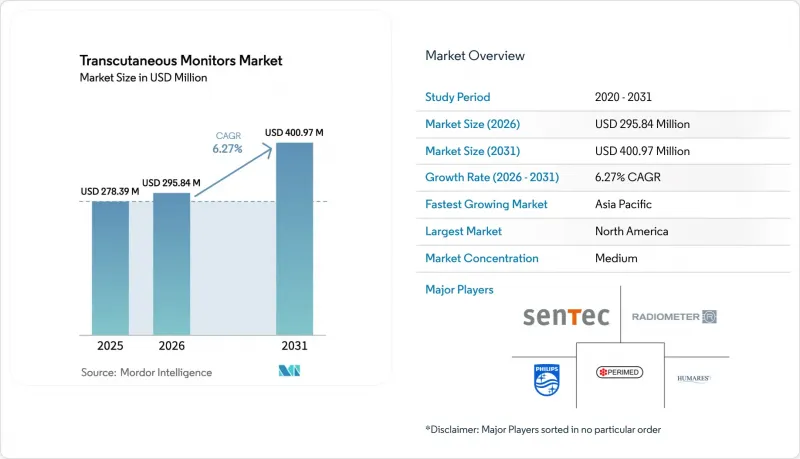
Mordor Intelligence에 의하면, 경피 모니터 시장 규모는 2025년에 2억 7,839만 달러로 평가되었, 2026년 2억 9,584만 달러에서 2031년까지 4억 97만 달러에 이를 것으로 예측되며, 예측 기간(2026-2031년) CAGR은 6.27%를 나타낼 전망입니다.
본 보고서는 용도별(상처 치료, 혈액가스 모니터링, 기타), 최종 사용자별(병원, 외래수술센터(ASC), 전문 클리닉, 기타), 모니터링 대상 매개변수별(경피적 CO₂, 기타), 환자 연령대별(신생아, 소아, 성인, 고령자), 지역별(북미, 유럽, 아시아태평양, 기타)로 세분화되어 있습니다. 시장 예측은 금액(달러) 기준으로 제시되어 있습니다.
세계 경피 모니터링 시장 동향 및 인사이트
호흡기 질환 증가 추세
만성 폐쇄성 폐질환(COPD), 수면 무호흡증후군, 바이러스 감염 후 발생하는 호흡기 합병증이 지속적인 비침습적 모니터링에 대한 꾸준한 수요를 견인하고 있습니다. 신생아 집중 치료실(NICU)에 경피 CO₂ 센서를 도입한 병원에서는 동맥혈 채취가 25% 감소하여 감염 위험과 간호 시간을 줄이는 데 기여했습니다. 스마트 워치와 연동된 혈중 산소 포화도 측정 알고리즘을 활용한 재택 수면 진단 프로그램은 89.4%의 민감도를 달성하여, 클리닉 중심의 검사에서 소비자가 이용하기 쉬운 선별 검사로의 전환을 보여주고 있습니다. 미국 내 보험 적용 심사에서는 현재 제한성 흉부 질환에 대해 경피형 시스템이 의학적으로 필요하다고 인정받고 있으며, 보험 환급 대상이 확대됨과 동시에 가치 기반 의료에서 그 역할이 강화되고 있습니다. 이러한 질환 부담과 정책의 일관성이 어우러져 경피형 모니터 시장의 견고한 전망을 뒷받침하고 있습니다.
기술의 미세화와 센서 정밀도 향상
루미네스런스, 광음향, 전자 상자성 공명 센싱 기술을 통해 프로브의 설치 면적이 축소되는 동시에 발열막이 불필요해졌으며, 동맥 채혈과 동등한 정확도를 자랑하는 24시간 연속 착용형 웨어러블 기기의 길이 열렸습니다. 『Nature』지에 발표된 비접촉형 표피 플럭스 모니터는 피부에 직접 접촉하지 않고도 임상적으로 허용 가능한 편차를 보여주고 있어, 허약한 환자나 화상 환자에 대한 적용 범위를 확대되고 있습니다. 마시모(Masimo)사는 하루 7만 건의 건강 데이터를 기록하는 일반 소비자용 기기에 머신러닝(ML)을 활용한 ‘Sleep Halo’ 분석 기능을 탑재하여, 소프트웨어의 지속성이 하드웨어의 수명을 연장할 수 있음을 보여주었습니다. 미국 식품의약국(FDA)은 최근 멜라닌과 관련된 신호 저하를 보정하는 레이저 방식의 맥박 산소 측정기를 승인하며, 공정성을 중시한 정확도 향상 노력에 대한 규제 당국의 지지를 표명했습니다. 이러한 획기적인 진전은 적어도 차세대 제품의 플랫폼 사양에 영향을 미칠 것으로 예측됩니다.
복잡해지고 장기화되는 규제 당국의 승인 절차
유럽 의료기기 규정(MDR)에서는 분류 범위가 독립형 소프트웨어까지 확대되었으며, 제조업체는 경피형 시스템에 대해 완전한 임상 평가와 시판 후 조사를 실시해야 할 의무가 부과되었습니다. 미국에서는 클래스 II 신청 시, 선행 기기와 실질적 동등성을 입증하고 다양한 환자 그룹에 걸친 정확성을 증명해야 하므로, 이로 인해 ‘실험실에서 임상 현장으로’의 일정이 길어지는 경우가 많습니다. 최근 지침에서는 제한적인 데이터 면제가 허용되고 있지만, 기업들은 여전히 MDR 및 510(k) 신청을 위해 방대한 기술 문서를 작성해야 하며, 이는 중소규모 진출기업들에게 부담이 되어 반복 개발 주기를 지연시키고 있습니다. 미국과 EU에서 요구하는 증거 요건이 다르기 때문에 세계 기업들은 병행하여 규제 전략을 수립할 수밖에 없으며, 이로 인해 초기 규정 준수 비용이 증가하고 혁신 속도가 둔화될 가능성이 있습니다.
부문 분석
2025년 기준, 경피 모니터 시장 규모의 41.02%를 혈액가스 모니터링이 차지했습니다. 이는 말단 호기 및 피부 기반 측정을 통해 중환자실에서 침습적 샘플링 빈도가 감소한다는 수십 년간의 증거를 반영한 것입니다. 인공호흡기 대시보드와의 통합을 통해 호흡 관리에서의 그 역할은 더욱 확고해지고 있습니다. 상처 치료 부문은 규모는 작지만 연평균 성장률(CAGR) 6.95%로 성장하고 있습니다. 고압 산소 요법 클리닉에서는 사지 보존 치료 대상자를 선별하기 위해 경피 산소 분압(TcPO2)을 활용하고 있습니다. 30mmHg 이하의 수치는 미세순환 장애를 나타내며, 보조 요법의 시작을 촉진합니다. 당뇨병성 족부 병변 프로그램에 대한 자금 지원이 늘어남에 따라 TcPO2는 일상적인 예후 지표로 자리 잡고 있으며, 이 틈새 시장은 급속히 성장하고 있습니다.
고압 산소 요법의 적용 범위 확대와 휴대용 TcPO2 측정 기기의 보급이 맞물리면서, 외래 상처 치료 센터에 유리한 환경이 조성되고 있습니다. 현재 각 학회에서는 말초동맥질환의 수술 전 검사로 TcPO2를 권장하고 있으며, 이 검사는 혈관질환의 진료 알고리즘에 포함되어 있습니다. 한편, AI를 활용한 카프노그래피가 수면 진단 툴킷에도 도입되고 있어, 호흡기 분야와 상처 관리 분야 사이에 새로운 교차점이 생겨날 조짐이 보입니다. 그 결과, 경피 모니터링 시장은 기존 부문을 잠식하지 않으면서도 그 임상적 적용 범위를 확대되고 있습니다.
2025년에는 중환자실이 24시간 체제의 생리학적 데이터에 의존하고 있기 때문에 병원이 매출의 67.12%를 차지했습니다. 그러나 휴대용 모니터가 외래 수액 센터나 투석실에 적합하기 때문에 전문 클리닉은 연평균 성장률(CAGR) 7.03%로 성장을 지속하고 있습니다. 외래수술센터(ASC)에서는 의식 하 진정 중 발생하는 저환기 증상을 감지하기 위해 일회용 센서를 도입하여 수술 후 합병증을 줄이고 있습니다.
Philips가 Healthdot 사업을 smartQare로 이전하기로 한 결정은 생태계 내의 전환을 여실히 보여줍니다. 즉, 여러 공급업체의 데이터를 통합하는 개방형 플랫폼이 독자적인 사양을 가진 사일로형 시스템을 점차 대체하고 있는 것입니다. 이 모델은 인력 배치의 효율성을 향상시킵니다. 네덜란드에서 진행된 한 시범 프로젝트에서는 지속적인 무선 센서 데이터가 전자 건강 기록에 직접 통합됨으로써 일상적인 활력 징후 측정 횟수가 47% 감소한 것이 입증되었습니다. 예산에 민감한 클리닉에서는 이러한 인건비 절감 효과를 설비 투자의 타당한 근거로 간주하고 있으며, 이는 병원 외부에서 수요를 촉진하고 있습니다.
지역별 분석
북미는 견실한 보험 환급 제도, 통합된 케어 네트워크, 기술 도입 실적을 통해 경피 모니터링 시장의 핵심으로 자리매김하고 있습니다. 메디케어는 외래 심전도에서 연속 카프노그래피에 이르기까지 다양한 이용 사례를 포괄하고 있어, 예산이 빠듯한 상황에서도 병원의 조달을 뒷받침하고 있습니다. BD가 에드워즈 생명과학(Edwards Lifesciences)의 중환자 치료 부문을 42억 달러에 인수한 것은 종단간 모니터링 생태계 구축을 목표로 한 규모 확대를 지향하는 산업 재편의 좋은 예입니다. 마시모의 헬스케어 부문은 2024년에 10% 성장하여 13억 9,500만 달러에 달했습니다. 이는 고급 맥박 산소 측정기 및 카프노미터에 대한 높은 교체 수요를 반영한 것입니다.
아시아태평양은 고령화, 인프라 확충, 의료기기 규제 조화에 힘입어 연평균 성장률(CAGR) 7.05%로 가장 빠르게 성장하고 있는 지역입니다. 일본에서는 국가 환급 규정에 따라 연속 산소 모니터링이 수술 후 관리 패키지에 포함되게 되었습니다. 한편, 인도의 ‘아유슈만 바라트’ 계획에서는 중환자 치료용 기기에 대한 공공 자금 지원이 확대되고 있습니다. 많은 의료 기관이 구식 유선 기술을 건너뛰고 도입하고 있기 때문에 모바일형이며 클라우드 연동이 가능한 모니터를 제공하는 공급업체는 선구자로서의 우위를 확보하고 있습니다. 또한, 이 지역에 밀집해 있는 혁신 허브들도 센서 연구개발을 가속화하고 있으며, 한국과 싱가포르의 여러 광음향 스타트업 기업들이 2025년에 웨어러블 카프노그래프를 위한 시리즈 B 자금 조달에 성공했습니다.
유럽은 여전히 규모가 큰 시장이지만, 규제가 점점 강화되고 있습니다. MDR(의료기기 규정) 시행으로 인해 신청까지의 리드타임은 길어지고 있지만, 한편으로는 품질에 대한 기대치가 안정화되고 있어, 이는 강력한 임상 데이터 세트를 보유한 제조업체에게 유리하게 작용합니다. 로슈의 AI 지원형 혈당 센서는 2025년에 신규 규정에 따라 CE 마크 승인을 획득했으며, 증거가 풍부한 신청 서류라면 여전히 효율적으로 절차를 진행할 수 있음을 입증하고 있습니다. 지역별 조달 동향을 보면, 워크플로우에 통합된 실적이 있는 의료기기가 선호되고 있습니다. 따라서 병원의 전자의무기록(EMR)과 연동 가능한 플랫폼은 입찰에서 원활하게 수주하는 경향이 있습니다. 환율 변동과 국가별로 상이한 보험 제도로 인해 가격 책정은 복잡해지고 있지만, 독일과 프랑스의 전문 클리닉에서 고압 산소 요법 프로그램이 도입됨에 따라 신생아용 및 상처 치료용 모니터에 대한 수요가 증가하고 있습니다.
기타 혜택
- 엑셀 형식 시장 예측(ME) 시트
- 3개월간의 애널리스트 지원
자주 묻는 질문
목차
제1장 서론
제2장 조사 방법
제3장 주요 요약
제4장 시장 구도
제5장 시장 규모 및 성장 예측
제6장 경쟁 구도
제7장 시장 기회 및 향후 전망
AJY 26.08.28According to Mordor Intelligence, the transcutaneous monitors market size was valued at USD 278.39 million in 2025 and estimated to grow from USD 295.84 million in 2026 to reach USD 400.97 million by 2031, at a CAGR of 6.27% during the forecast period (2026-2031).
This report is Segmented by Application (Wound Healing, Blood Gas Monitoring, and More), End User (Hospitals, Ambulatory Surgical Centers, Specialty Clinics, Others), Parameter Monitored (Transcutaneous CO2, and More), Patient Age Group (Neonates, Pediatric, Adult, Geriatric), and Geography (North America, Europe, Asia-Pacific, and More). The Market Forecasts are Provided in Terms of Value (USD).
Global Transcutaneous Monitors Market Trends and Insights
Growing Prevalence of Respiratory Diseases
Chronic obstructive pulmonary disease, sleep apnea, and post-viral respiratory complications are driving sustained demand for continuous non-invasive monitoring . Hospitals that introduced transcutaneous CO2 sensors in neonatal intensive care units reduced arterial blood draws by 25%, lowering infection risk and nursing time. Home-based sleep-diagnostic programs using smartwatch-linked oximetry algorithms achieved 89.4% sensitivity, illustrating the shift from clinic-centric testing to consumer-friendly screening . U.S. coverage determinations now deem transcutaneous systems medically necessary for restrictive thoracic disorders, broadening reimbursement and reinforcing their role in value-based care. Together, disease burden and policy alignment underpin a robust outlook for the transcutaneous monitors market.
Technological Miniaturization & Sensor Accuracy Gains
Luminescence, photoacoustic, and electronic-paramagnetic-resonance sensing have trimmed probe footprints while dispensing with heating membranes, clearing a path for round-the-clock wearables that rival arterial sampling accuracy. Non-contact epidermal flux monitors showcased by Nature reported clinically acceptable variance without direct skin coupling, extending use cases to fragile or burn patients. Masimo embedded ML-driven "Sleep Halo" analytics in consumer devices that log 70,000 daily health points, illustrating how software stickiness can lengthen hardware life cycles. The U.S. Food & Drug Administration recently cleared laser-based oximeters that correct melanin-related signal drop, signaling regulatory support for equity-minded accuracy upgrades. Such breakthroughs are expected to influence platform specifications for at least the next product generation.
Complex & Lengthy Regulatory Approvals
Europe's Medical Device Regulation widened classification scope to include stand-alone software, compelling manufacturers to run full clinical evaluations and post-market surveillance for transcutaneous systems. In the United States, Class II filings must show substantial equivalence with predicate devices and prove accuracy across diverse patient groups, often extending bench-to-bedside timelines. Although recent guidance permits limited data waivers, companies still prepare extensive technical dossiers for MDR and 510(k) submissions, straining smaller entrants and slowing iteration cycles. Divergent U.S.-EU evidence expectations oblige global firms to conduct parallel regulatory strategies, adding up-front compliance costs that can dampen innovation velocity.
Other drivers and restraints analyzed in the detailed report include:
- Rise in Chronic Disorders Necessitating Continuous Monitoring
- Demand Spike for Non-Invasive Neonatal & Critical-Care Monitoring
- High Device & Sensor Replacement Cost
For complete list of drivers and restraints, kindly check the Table Of Contents.
Segment Analysis
Blood Gas Monitoring accounted for 41.02% of the transcutaneous monitors market size in 2025, reflecting decades of evidence that end-tidal and skin-based measurements reduce invasive sampling frequency in intensive-care suites. Integration with ventilator dashboards further cements its role in respiratory management. Wound Healing, though smaller, is advancing at a 6.95% CAGR. Hyperbaric clinics rely on transcutaneous oxygen (TcPO2) to triage limb-salvage candidates; values below 30 mmHg flag compromised microcirculation, prompting adjunctive therapy. As funding for diabetic-foot programs rises, TcPO2 is becoming a routine prognostic marker, placing this niche on a rapid ascent.
The convergence of expanded hyperbaric coverage and portable TcPO2 devices creates favorable conditions for outpatient wound centers. Societies now list TcPO2 as a pre-operative measure for peripheral arterial disease, embedding the test in vascular algorithms. Meanwhile, AI-enhanced capnography is spilling into sleep-diagnostic toolkits, foreshadowing new overlaps between pulmonary and wound-care domains. Consequently, the transcutaneous monitors market is widening its clinical footprint without cannibalizing incumbent segments.
Hospitals retained 67.12% of revenue in 2025 as critical-care units depend on round-the-clock physiology data. Yet Specialty Clinics are registering 7.03% CAGR because portable monitors now suit outpatient infusion centers and dialysis suites. Ambulatory Surgical Centers deploy single-use sensors to flag hypoventilation episodes during conscious sedation, mitigating post-op complications.
Philips' decision to move its Healthdot business into smartQare highlights an ecosystem pivot: open platforms that aggregate feeds from multiple vendors are edging out proprietary silos. The model improves staffing efficiency; one Dutch pilot demonstrated 47% less routine vitals collection when continuous wireless sensors fed directly into electronic medical records. Budget-minded clinics view such labor offsets as justification for capital outlay, fuelling demand beyond hospital campuses.
Complete Report Scope:
- By Application
- Wound Healing
- Blood Gas Monitoring
- Respiratory Care
- Sleep Diagnostics
- Others
- By End User
- Hospitals
- Ambulatory Surgical Centers
- Specialty Clinics
- Others
- By Parameter Monitored
- Transcutaneous CO2
- Transcutaneous O2
- Bilirubin
- Combined Parameters
- By Patient Age Group
- Neonates
- Pediatric
- Adult
- Geriatric
- By Geography
- North America
- United States
- Canada
- Mexico
- Europe
- Germany
- United Kingdom
- France
- Italy
- Spain
- Rest of Europe
- Asia-Pacific
- China
- Japan
- India
- Australia
- South Korea
- Rest of Asia-Pacific
- Middle East and Africa
- GCC
- South Africa
- Rest of Middle East and Africa
- South America
- Brazil
- Argentina
- Rest of South America
- North America
Geography Analysis
North America continues to anchor the transcutaneous monitors market through robust reimbursement, integrated care networks, and a track record of technology uptake. Medicare covers multiple use cases, from ambulatory ECGs to continuous capnography, encouraging hospital procurement even during budget squeezes. BD's USD 4.2 billion purchase of Edwards Lifesciences' critical-care unit exemplifies scale-seeking consolidation aimed at building end-to-end monitoring ecosystems. Masimo's healthcare segment grew 10% in 2024 to USD 1,395 million, reflecting high replacement demand for advanced pulse oximeters and capnometers.
Asia-Pacific is the fastest-growing region at 7.05% CAGR, propelled by aging demographics, infrastructure upgrades, and harmonizing device rules. National reimbursement codes in Japan now bundle continuous oxygen monitoring into postoperative packages, while India's Ayushman Bharat scheme broadens public funding for critical-care instrumentation. Because many facilities leapfrog older wired technology, suppliers that offer mobile, cloud-linked monitors gain early-mover advantages. The region's dense innovation hubs also accelerate sensor R&D; several photoacoustic startups in South Korea and Singapore secured Series B funding for wearable capnographs in 2025.
Europe remains a sizeable but increasingly regulated arena. MDR enforcement lengthens submission lead-times, yet it also stabilizes quality expectations, which benefits manufacturers with strong clinical datasets. Roche's AI-assisted glucose sensor received CE Mark clearance in 2025 under the new rules, proving that evidence-rich dossiers can still move efficiently. Regional procurement patterns favor devices with proven workflow integrations; thus, platforms capable of merging with hospital EMRs see smoother tender wins. While currency volatility and varied national insurance models complicate pricing, the demand for neonatal and wound-healing monitors is rising as speciality clinics across Germany and France adopt hyperbaric programs.
- SenTec
- Radiometer
- HUMARES GmbH
- Perimed
- Koninklijke Philips
- Masimo
- Dragerwerk
- Siemens Healthineers
- GE Healthcare
- Medtronic
- Kent Imaging
- Perimed AB (PeriFlux)
- Baxter International (O? Boot)
- Natus Medical
- Atom Medical Corp.
- Nihon Kohden Corp.
- Smith & Nephew (O? therapy patches)
- Abbott Laboratories (Libre Sense)
- AliveCor
- iRhythm Technologies
- Convatec
- Solventum
- Johnson & Johnson
- Boston Scientific (TENS)
Additional Benefits:
- The market estimate (ME) sheet in Excel format
- 3 months of analyst support
TABLE OF CONTENTS
1 Introduction
- 1.1 Study Assumptions & Market Definition
- 1.2 Scope of the Study
2 Research Methodology
3 Executive Summary
4 Market Landscape
- 4.1 Market Overview
- 4.2 Market Drivers
- 4.2.1 Growing Prevalence of Respiratory Diseases
- 4.2.2 Technological Miniaturization & Sensor Accuracy Gains
- 4.2.3 Rise In Chronic Disorders Necessitating Continuous Monitoring
- 4.2.4 Demand Spike for Non-Invasive Neonatal & Critical-Care Monitoring
- 4.2.5 AI-Enabled Wearable Capnometry for Home & Sleep Diagnostics
- 4.2.6 Hyperbaric-Medicine Expansion Driving Tcpo? Adoption in Wound Clinics
- 4.3 Market Restraints
- 4.3.1 Complex & Lengthy Regulatory Approvals
- 4.3.2 High Device & Sensor Replacement Cost
- 4.3.3 Limited Clinician Training in TC Monitoring Workflows
- 4.3.4 Skin-Tone Accuracy Bias Triggering Additional Validation Needs
- 4.4 Regulatory Landscape
- 4.5 Technological Outlook
- 4.6 Porters Five Forces Analysis
- 4.6.1 Threat of New Entrants
- 4.6.2 Bargaining Power of Buyers
- 4.6.3 Bargaining Power of Suppliers
- 4.6.4 Threat of Substitutes
- 4.6.5 Competitive Rivalry
5 Market Size & Growth Forecasts (Value, USD)
- 5.1 By Application
- 5.1.1 Wound Healing
- 5.1.2 Blood Gas Monitoring
- 5.1.3 Respiratory Care
- 5.1.4 Sleep Diagnostics
- 5.1.5 Others
- 5.2 By End User
- 5.2.1 Hospitals
- 5.2.2 Ambulatory Surgical Centers
- 5.2.3 Specialty Clinics
- 5.2.4 Others
- 5.3 By Parameter Monitored
- 5.3.1 Transcutaneous CO2
- 5.3.2 Transcutaneous O2
- 5.3.3 Bilirubin
- 5.3.4 Combined Parameters
- 5.4 By Patient Age Group
- 5.4.1 Neonates
- 5.4.2 Pediatric
- 5.4.3 Adult
- 5.4.4 Geriatric
- 5.5 By Geography
- 5.5.1 North America
- 5.5.1.1 United States
- 5.5.1.2 Canada
- 5.5.1.3 Mexico
- 5.5.2 Europe
- 5.5.2.1 Germany
- 5.5.2.2 United Kingdom
- 5.5.2.3 France
- 5.5.2.4 Italy
- 5.5.2.5 Spain
- 5.5.2.6 Rest of Europe
- 5.5.3 Asia-Pacific
- 5.5.3.1 China
- 5.5.3.2 Japan
- 5.5.3.3 India
- 5.5.3.4 Australia
- 5.5.3.5 South Korea
- 5.5.3.6 Rest of Asia-Pacific
- 5.5.4 Middle East and Africa
- 5.5.4.1 GCC
- 5.5.4.2 South Africa
- 5.5.4.3 Rest of Middle East and Africa
- 5.5.5 South America
- 5.5.5.1 Brazil
- 5.5.5.2 Argentina
- 5.5.5.3 Rest of South America
- 5.5.1 North America
6 Competitive Landscape
- 6.1 Market Concentration
- 6.2 Market Share Analysis
- 6.3 Company Profiles (includes Global level Overview, Market level overview, Core Segments, Financials as available, Strategic Information, Market Rank/Share for key companies, Products & Services, and Recent Developments)
- 6.3.1 Sentec AG
- 6.3.2 Radiometer
- 6.3.3 HUMARES GmbH
- 6.3.4 Perimed AB
- 6.3.5 Koninklijke Philips N.V.
- 6.3.6 Masimo Corporation
- 6.3.7 Dragerwerk AG & Co. KGaA
- 6.3.8 Siemens Healthineers
- 6.3.9 GE HealthCare
- 6.3.10 Medtronic plc
- 6.3.11 Kent Imaging Inc.
- 6.3.12 Perimed AB (PeriFlux)
- 6.3.13 Baxter International (O? Boot)
- 6.3.14 Natus Medical Inc.
- 6.3.15 Atom Medical Corp.
- 6.3.16 Nihon Kohden Corp.
- 6.3.17 Smith & Nephew (O? therapy patches)
- 6.3.18 Abbott Laboratories (Libre Sense)
- 6.3.19 AliveCor Inc.
- 6.3.20 iRhythm Technologies
- 6.3.21 ConvaTec Group
- 6.3.22 Solventum
- 6.3.23 Johnson & Johnson (Ethicon)
- 6.3.24 Boston Scientific (TENS)
7 Market Opportunities & Future Outlook
- 7.1 White-Space & Unmet-Need Assessment