

|
시장보고서
상품코드
2114909
비양자성 용매 시장 : 점유율 분석, 업계 동향과 통계, 성장 예측(2026-2031년)Aprotic Solvents - Market Share Analysis, Industry Trends & Statistics, Growth Forecasts (2026 - 2031) |
||||||
 Mordor Intelligence
Mordor Intelligence에 의하면, 비양자성 용매 시장 규모는 2025년에 196억 5,000만 달러로 평가되었고 2026년 202억 4,000만 달러에서 2031년까지 234억 7,000만 달러에 이를 것으로 예측되며, 예측 기간(2026-2031년) CAGR은 3.01%를 나타낼 전망입니다.
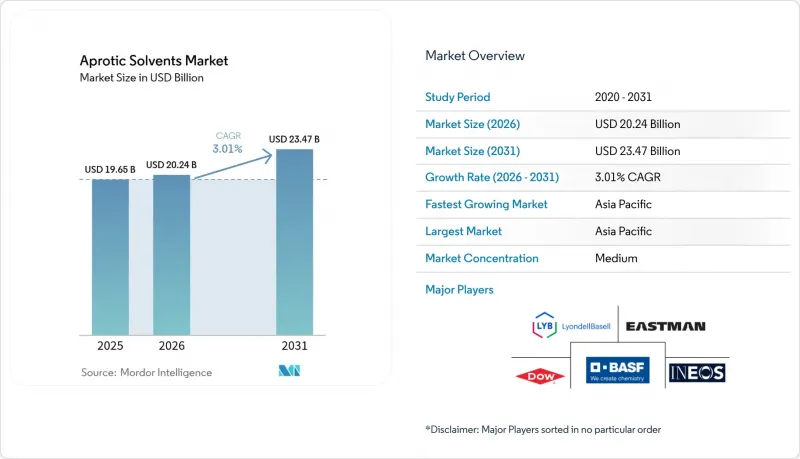
본 보고서는 유형별(N-메틸-2-피롤리돈(NMP), 톨루엔, 벤젠,아세톤, 기타), 용도(석유 및 가스, 의약품, 플라스틱, 전자기기, 페인트 및 코팅, 접착제, 기타 용도), 지역(아시아태평양, 북미, 유럽, 남미, 중동 및 아프리카)별로 분류되어 있습니다. 시장 예측은 금액(미 달러)으로 표시되어 있습니다.
세계 비양자성 용매 시장 동향 및 인사이트
아시아의 리튬 이온 배터리 생산 능력 급속한 확대
중국의 배터리 기가팩토리 건설 계획에 따르면, 2030년까지 연간 설치 생산 능력이 1,300 GWh를 초과할 전망이며, 1 기가와트시당 일반적으로 200-300톤의 용매를 소비하므로,N-메틸-2-피롤리돈의 연간 수요는 26만-39만 톤 증가하게 됩니다. 지역 생산자들은 석유화학 원료 지수에 연동된 가격 산정식을 고정하는 다년 공급 계약을 체결하고 있으며, 이러한 관행은 가격 변동을 완화하는 한편 구매자의 협상력을 강화하고 있습니다. 전지 제조업체들이 양극재의 에너지 밀도 향상을 추진하는 가운데, 점도 제어 요건으로 인해 불순물 규격이 엄격한 양극성 비양자성 용매가 선호되면서 NMP의 입지를 더욱 공고히 하고 있습니다. 디메틸 카보네이트(DMC) 및 에틸메틸 카보네이트(EMC)와 같은 전해액용 공용매에 대한 보완적인 투자는 용매 간 수요 상관관계를 강화하여 수직 통합형 기업에 이익을 가져다주고 있습니다. 그러나 재료 비용을 96% 절감하는 비용 경쟁력이 뛰어난 수계 전극 처리 기술이 2020년대 후반공급량에 위협이 되고 있습니다. 개발 중인 드라이 필름 기술은 일부 양극 라인에서 용매 사용을 완전히 배제할 가능성이 있는 병행 경로를 추가하는 것입니다.
심층 유정 및 가스정의 채굴 유체에 의한 지속적인 수요 급증
수평 및 초심부 저류층에서는 200°C를 초과하는 온도와 20,000 psi를 초과하는 압력 하에서도 안정성을 유지하는 완비 유체가 요구됩니다. 양극성 비양자성 용매는 수성 유체로는 실현할 수 없는 높은 염류 용해도와 열적 안정성을 가능하게 합니다. 북미의 셰일 프로젝트와 중동의 탄산염암층이 수요 증가의 대부분을 차지하고 있습니다. 그다지 가혹하지 않은 조건에서는 천연 심공융 용매(NADES)의 채택이 환경적으로 바람직한 선택이 되지만, 극한 조건에서는 여전히 비양자성 골격에 의존하고 있습니다. 칼슘 질산염 기반의 완성된 시스템에 대한 지속적인 혁신은 화학 조성의 다양화가 진행되고 있음을 보여 주지만, 그럼에도 불구하고 호환 가능한 비양자성 운반체에 대한 수요를 더욱 강화하고 있습니다. 대체 유체 조성을 위해 필요한 설비 개조에 자본 비용이 소요되기 때문에 현재 시추 장비 가동률이 높은 주기에서는 사업자들이 해당 비용을 미루고 있어 단기적인 성장이 확실시되고 있습니다.
EU REACH에 따른 NMP, DMF, NEP의 생식독성 물질 재분류
유럽연합 집행위원회가 NMP, DMF, NEP를 부속서 XVII에 추가함에 따라, 2026년 12월부터 혼합물 내 농도 상한이 0.3%로 설정되고, 근로자의 노출 상한도 부과될 예정입니다. 다국적 제조업체들은 대개 가장 엄격한 규제를 세계 기준으로 채택하고 있어, 그 결과 유럽 이외의 공장에도 규정 준수 비용이 파급될 것입니다. 즉시 발생하게 될 설비 투자에는 폐쇄형 처리 시스템, 개인 노출 모니터링, 환기 설비 강화 등이 포함됩니다. 수처리용 막 모듈 제조업체들은 대체용 양극성 화합물이 고분자의 형태를 변화시키기 때문에 제품 인증 지연에 직면해 있습니다. 면제 신청은 가능하지만, 그에 따른 행정적 부담으로 인해 사용자들은 대체 프로젝트를 가속화할 수밖에 없는 상황입니다.
부문 분석
N-메틸-2-피롤리돈은 2025년 비양자성 용매 시장에서 25.05%를 차지하며, 리튬 이온 배터리 전극 및 고성능 폴리머 제조에 있어 매우 중요한 역할을 하고 있음이 부각되었습니다. EU의 분류 압력에도 불구하고, 양극 슬러리의 유변학적 특성과 폴리이미드 전구체와의 호환성 측면에서 NMP는 여전히 우위를 점하고 있으며, 높은 가격대가 유지되고 있습니다. 각 생산 업체들은 3nm 노드 반도체 팹에 대응하기 위해 금속 함량 5ppb 규격을 달성하는 추가 정제 라인을 도입하고 있습니다.
‘기타 유형’ 카테고리에서 동시에 이루어진 기술 혁신이 경쟁 환경의 양상을 완전히 바꾸고 있습니다. 사이렌(Cyrene), GVL, 디메틸이소소르비드가 결합되어 이 그룹을 연평균 성장률(CAGR) 3.70%라는 가장 빠른 성장 궤도로 끌어올렸습니다. 2024년에 발표된 조사 결과에 따르면, GVL은 폴리이미드 막의 인장 강도를 NMP의 벤치마크 값에서 2% 이내의 범위로 유지하면서 독성 등급을 낮출 수 있는 것으로 확인되었습니다. 이러한 기술적 검증은 성능 측면의 장벽이 낮아지고 있음을 보여 주며, 특히 유럽에서의 신규 생산 능력 확대는 바이오 유래 분자로 편중될 것임을 시사합니다. 톨루엔 및 벤젠 부문은 작업장 노출 한계치의 영향으로 선진국에서 계속 축소되고 있지만, 아세톤은 부문 전반에 걸친 범용성 덕분에 혜택을 보고 있어 급격한 감소는 피하고 있습니다.
지역별 분석
아시아태평양은 2025년에 전 세계 매출의 53.15%를 차지하고, 중국의 급속히 확장되는 배터리 밸류체인과 일본의 전해액 생산에 집중된 투자에 힘입어 2031년까지 연평균 성장률(CAGR) 3.55%를 나타낼 것으로 전망됩니다. 쓰촨성, 광둥성, 장쑤성 주변에 집적된 기가팩토리 군은 업스트림 DMC 및 EMC공급을 확보하고 있으며, 이는 지역 내 용제 무역 흐름을 촉진하고 있습니다. 국내 반도체 생산 능력에 대한 정책 지원에 힘입어 고순도 제품의 사용자 기반은 더욱 확대되고 있습니다. 그러나 용제 사용량을 96% 절감하는 코스모트로픽 수성 양극 슬러리 처리와 같은 공정 혁신으로 인해 장기적인 수요 의존도는 낮아질 가능성이 있습니다.
북미에서는 ‘CHIPS 법’에 힘입은 팹 건설과 비양성자성 시추 유체에 의존하는 셰일 생산의 지속이 시장을 견인하고 있습니다. 텍사스주에 연간 160킬로톤 규모의 프로파일렌 옥사이드 플랜트가 건설됨에 따라, 제품별 아세톤의 후방 통합이 강화될 것입니다. 콜로라도주와 매사추세츠주에서 진행 중인 GLP-1 원료의약품에 특화된 제약 분야의 그린필드 프로젝트는 새로운 용매 수요 거점이 되는 한편, 지역 유통업체들은 물류 효율화를 위해 통합을 추진하고 있습니다.
유럽에서는 REACH 규제로 인해 생식 독성 기준치가 상향 조정되는 등 가장 엄격한 규제의 압박에 직면해 있습니다. 생산자들은 이에 대응하여 회수율 95%, 순도 99%를 달성하는 폐쇄형 회수 설비를 도입하고 있으며, 3년 이내에 투자 회수가 가능한 턴키 시스템이 그 실례를 보여주고 있습니다. 대형 종합 기업들의 투자는 여전히 계속되고 있으며, 그 일례로 앤트워프에 위치한 BASF의 알킬에탄올아민 공장이 연간 14만 톤의 생산 능력을 보유하고 있다는 점을 들 수 있습니다. 규제 동향을 주도하는 유럽의 영향력으로 인해, 보다 안전한 용매를 둘러싼 전 세계적 조화가 가속화되고 있으며, 향후 제품 포트폴리오 재구성이 진행되고 있습니다.
기타 혜택:
- 엑셀 형식 시장 예측(ME) 시트
- 3개월간의 애널리스트 지원
자주 묻는 질문
목차
제1장 서론
제2장 조사 방법
제3장 주요 요약
제4장 시장 구도
제5장 시장 규모와 성장 예측
제6장 경쟁 구도
제7장 시장 기회와 향후 전망
JHS 26.08.26According to Mordor Intelligence, the aprotic solvents market size was valued at USD 19.65 billion in 2025 and estimated to grow from USD 20.24 billion in 2026 to reach USD 23.47 billion by 2031, at a CAGR of 3.01% during the forecast period (2026-2031).
This report is Segmented by Type (N-Methyl-2-Pyrrolidone (NMP), Toluene, Benzene, Acetone, and Other Types), Application (Oil and Gas, Pharmaceuticals, Plastics, Electronic Equipments, Paints and Coatings, Adhesives, and Other Applications), and Geography (Asia-Pacific, North America, Europe, South America, and Middle-East and Africa). The Market Forecasts are Provided in Terms of Value (USD).
Global Aprotic Solvents Market Trends and Insights
Rapid Capacity Additions in Asian Lithium-Ion Battery Production
China's battery gigafactory pipeline is on track to surpass 1,300 GWh per year of installed output by 2030, which raises annual N-Methyl-2-Pyrrolidone demand by 260,000-390,000 tons since each gigawatt-hour typically consumes 200-300 tons of solvent. Regional producers negotiate multiyear supply agreements that lock in pricing formulas tied to petrochemical feedstock indices, a practice that mitigates volatility but strengthens buyer bargaining power. As cell makers push cathode energy densities higher, viscosity control requirements favor dipolar aprotics with narrow impurity specifications, further entrenching NMP. Complementary investments in electrolyte co-solvents, such as dimethyl carbonate (DMC) and ethyl methyl carbonate (EMC), reinforce cross-solvent demand correlation, benefiting vertically integrated firms. Nevertheless, cost-competitive water-based electrode processing that cuts material costs by 96% threatens late-decade volumes. Dry-film techniques under development add a parallel route that could remove solvent use entirely in some cathode lines
Persistent Demand Spike from Deep-Well Oil and Gas Extraction Fluids
Horizontal and ultra-deep reservoirs require completion fluids that remain stable at temperatures exceeding 200 °C and pressures above 20,000 psi. Dipolar aprotic solvents enable high-salt solubility and thermal stability that water-based fluids cannot match. North American shale projects and Middle Eastern carbonate formations together underpin most incremental uptake. Adoption of natural deep eutectic solvents (NADES) for less severe conditions provides an environmentally favorable pathway, yet still relies on aprotic backbones for extreme conditions. Continued innovation in calcium nitrate-based completion systems highlights ongoing chemistry diversification that nonetheless reinforces demand for compatible aprotic carriers. Short-term growth is secure because equipment retrofits required for alternative fluid chemistries carry capital costs that operators defer during current high-rig utilization cycles.
EU REACH Re-classification of NMP, DMF and NEP as Reproductive Toxics
The European Commission's addition of NMP, DMF, and NEP to Annex XVII introduces a 0.3% concentration limit in mixtures effective December 2026 and imposes employee exposure caps. Multinational manufacturers often adopt the strictest jurisdiction as their global default, extending compliance costs to plants beyond Europe. Immediate capital outlays include closed-loop handling systems, personal exposure monitoring, and enhanced ventilation. Membrane module producers for water treatment face qualification delays because alternative dipolars change polymer morphology. While exemption dossiers are possible, the administrative burden pushes users to accelerate substitution projects.
Other drivers and restraints analyzed in the detailed report include:
- Pharmaceutical Greenfield API Capacity Expansions (2025-2029)
- Regulatory Relaxation for High-Purity Electronic-Grade Solvents in China
- Rapid Scale-up of Supercritical CO2 and Ionic-Liquid Extraction Technologies
For complete list of drivers and restraints, kindly check the Table Of Contents.
Segment Analysis
N-Methyl-2-Pyrrolidone accounted for 25.05% of the aprotic solvents market in 2025, underscoring its critical role in lithium-ion battery electrodes and high-performance polymer production. Despite EU classification pressure, cathode slurry rheology and polyimide precursor compatibility still favor NMP, sustaining premium pricing. Producers are installing additional purification trains that achieve 5 ppb metal specifications, catering to 3 nm node semiconductor fabs.
Parallel innovation in the "Other Types" category is reshaping competitive contours. Cyrene, GVL, and dimethyl isosorbide collectively lifted the group to the fastest 3.70% CAGR trajectory. Research published in 2024 confirmed GVL's ability to maintain polyimide membrane tensile strength within 2% of NMP benchmarks while lowering toxicity classifications. This technical validation demonstrates diminishing performance barriers and suggests that new capacity additions, particularly in Europe, will be skewed toward bio-based molecules. Toluene and benzene segments continue to contract in advanced economies due to workplace exposure limits, whereas acetone benefits from cross-sector versatility, shielding it from steep declines.
Complete Report Scope:
- By Type
- N-Methyl-2-Pyrrolidone (NMP)
- Toluene
- Benzene
- Acetone
- Other Types (Propylene Carbonate, Bio-based, etc.)
- By Application
- Oil and Gas
- Pharmaceuticals
- Plastics
- Electronic Equipments
- Paints and Coatings
- Adhesives
- Other Applications (Polymer and Plastics Processing, etc.)
- By Geography
- Asia-Pacific
- China
- Japan
- India
- South Korea
- ASEAN Countries
- Rest of Asia-Pacific
- North America
- United States
- Canada
- Mexico
- Europe
- Germany
- United Kingdom
- France
- Italy
- Spain
- Russia
- NORDIC Countries
- Rest of Europe
- South America
- Brazil
- Argentina
- Rest of South America
- Middle-East and Africa
- Saudi Arabia
- South Africa
- Rest of Middle-East and Africa
- Asia-Pacific
Geography Analysis
Asia-Pacific held 53.15% of global revenue in 2025 and is projected to record a 3.55% CAGR through 2031, anchored by China's rapidly expanding battery value chain and Japan's targeted investments in electrolyte production. Gigafactory clusters around Sichuan, Guangdong, and Jiangsu provinces secure upstream DMC and EMC supply, which drives intra-regional solvent trade flows. Policy support for domestic semiconductor capacity further broadens the user base for high-purity variants. Nevertheless, process innovation, such as kosmotropic aqueous cathode slurry processing that cuts solvent intensity by 96% could erode long-term volume dependence.
North America is driven by CHIPS Act-driven fab construction and sustained shale output that relies on aprotic drill fluids. The buildout of a 160 kiloton per year propylene oxide plant in Texas improves backward integration for acetone co-product streams. Pharmaceutical greenfield projects in Colorado and Massachusetts, specializing in GLP-1 APIs, add another solvent offtake node while regional distributors consolidate to streamline logistics.
Europe experiences the sharpest regulatory overhang as REACH restrictions tighten reproductive toxicity thresholds. Producers respond by installing closed-loop recovery equipment that reaches 95% capture and 99% purity, as showcased by turnkey systems achieving payback in under three years. Large integrated firms still invest, evidenced by BASF's alkyl ethanolamine plant in Antwerp delivering 140,000 tons per year capacity. Europe's influence as a regulatory trendsetter accelerates global harmonization around safer solvents, reshaping future product portfolios.
- Ashland
- BASF
- Dow
- Eastman Chemical Company
- Gaylord Chemical Company LLC
- Huntsman International LLC
- INEOS
- LyondellBasell Industries Holdings B.V.
- Merck KGaA
- Mitsubishi Chemical Group Corporation.
- Solvay
- UBE Corporation
Additional Benefits:
- The market estimate (ME) sheet in Excel format
- 3 months of analyst support
TABLE OF CONTENTS
1 Introduction
- 1.1 Study Assumptions and Market Definition
- 1.2 Scope of the Study
2 Research Methodology
3 Executive Summary
4 Market Landscape
- 4.1 Market Overview
- 4.2 Market Drivers
- 4.2.1 Rapid Capacity Additions in Asian Lithium-Ion Battery Production
- 4.2.2 Persistent Demand Spike from Deep-Well Oil and Gas Extraction Fluids
- 4.2.3 Pharmaceutical Greenfield API Capacity Expansions (2025-2029)
- 4.2.4 Regulatory Relaxation for High-Purity Electronic-Grade Solvents in China
- 4.2.5 Emergence of Biomass-Derived Dipolar Aprotics (e.g.., Cyrene, GVL)
- 4.2.6 AI-Accelerated Solvent Selection Platforms Cutting Formulation Times
- 4.3 Market Restraints
- 4.3.1 EU REACH Re-Classification Of NMP, DMF, and NEP as Reproductive Toxics
- 4.3.2 Rapid Scale-Up of Super-Critical CO2 and Ionic-Liquid Extraction Tech
- 4.3.3 Volatility of Crude-Based Feedstocks Widening Cost Swings
- 4.3.4 Accelerated OEM Bans on Residual Aprotics in Semiconductor Fabs
- 4.4 Value / Supply-Chain Analysis
- 4.5 Regulatory Landscape
- 4.6 Technological Outlook
- 4.7 Porter's Five Forces
- 4.7.1 Bargaining Power of Suppliers
- 4.7.2 Bargaining Power of Buyers
- 4.7.3 Threat of New Entrants
- 4.7.4 Threat of Substitutes
- 4.7.5 Degree of Competition
5 Market Size and Growth Forecasts (Value)
- 5.1 By Type
- 5.1.1 N-Methyl-2-Pyrrolidone (NMP)
- 5.1.2 Toluene
- 5.1.3 Benzene
- 5.1.4 Acetone
- 5.1.5 Other Types (Propylene Carbonate, Bio-based, etc.)
- 5.2 By Application
- 5.2.1 Oil and Gas
- 5.2.2 Pharmaceuticals
- 5.2.3 Plastics
- 5.2.4 Electronic Equipments
- 5.2.5 Paints and Coatings
- 5.2.6 Adhesives
- 5.2.7 Other Applications (Polymer and Plastics Processing, etc.)
- 5.3 By Geography
- 5.3.1 Asia-Pacific
- 5.3.1.1 China
- 5.3.1.2 Japan
- 5.3.1.3 India
- 5.3.1.4 South Korea
- 5.3.1.5 ASEAN Countries
- 5.3.1.6 Rest of Asia-Pacific
- 5.3.2 North America
- 5.3.2.1 United States
- 5.3.2.2 Canada
- 5.3.2.3 Mexico
- 5.3.3 Europe
- 5.3.3.1 Germany
- 5.3.3.2 United Kingdom
- 5.3.3.3 France
- 5.3.3.4 Italy
- 5.3.3.5 Spain
- 5.3.3.6 Russia
- 5.3.3.7 NORDIC Countries
- 5.3.3.8 Rest of Europe
- 5.3.4 South America
- 5.3.4.1 Brazil
- 5.3.4.2 Argentina
- 5.3.4.3 Rest of South America
- 5.3.5 Middle-East and Africa
- 5.3.5.1 Saudi Arabia
- 5.3.5.2 South Africa
- 5.3.5.3 Rest of Middle-East and Africa
- 5.3.1 Asia-Pacific
6 Competitive Landscape
- 6.1 Market Concentration
- 6.2 Strategic Moves
- 6.3 Market Share(%)/Ranking Analysis
- 6.4 Company Profiles (includes Global level Overview, Market level overview, Core Segments, Financials as available, Strategic Information, Market Rank/Share for key companies, Products and Services, and Recent Developments)
- 6.4.1 Ashland
- 6.4.2 BASF
- 6.4.3 Dow
- 6.4.4 Eastman Chemical Company
- 6.4.5 Gaylord Chemical Company LLC
- 6.4.6 Huntsman International LLC
- 6.4.7 INEOS
- 6.4.8 LyondellBasell Industries Holdings B.V.
- 6.4.9 Merck KGaA
- 6.4.10 Mitsubishi Chemical Group Corporation.
- 6.4.11 Solvay
- 6.4.12 UBE Corporation
7 Market Opportunities and Future Outlook
- 7.1 White-space and Unmet-need Assessment


