

|
시장보고서
상품코드
2114915
폴리에틸렌 폼 시장 : 점유율 분석, 업계 동향과 통계, 성장 예측(2026-2031년)Polyethylene Foam - Market Share Analysis, Industry Trends & Statistics, Growth Forecasts (2026 - 2031) |
||||||
 Mordor Intelligence
Mordor Intelligence에 의하면, 폴리에틸렌 폼 시장 규모는 2026년에 22억 1,000만 달러로 추정되고 있어 예측 기간(2026-2031년)에서 CAGR 4.12%로 성장을 지속하여, 2031년까지 27억 달러에 이를 전망입니다.
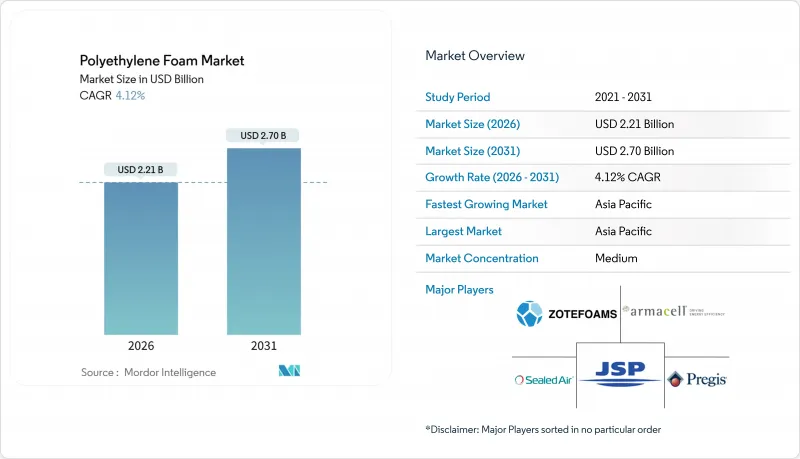
본 보고서는 유형(XLPE 발포체 및 비-XLPE 발포체), 용도(완충재, 포장재, 기타 용도), 최종 사용자 산업(자동차, 건축 및 건설,FMCG, 제약 및 헬스케어, 기타 최종 사용자 산업), 지역(아시아태평양, 북미, 유럽, 남미, 중동 및 아프리카)별로 분류되어 있습니다. 시장 예측은 금액(달러) 기준으로 제시되어 있습니다.
세계 폴리에틸렌 폼 시장 동향 및 인사이트
전자상거래용 보호 포장재의 급증
풀필먼트 센터에서는 포장 라인의 자동화가 진행되어 개당 공극 충전재 사용량이 감소하고 있지만, 전 세계 B2B 분야의 전자기기 및 기계류 출하에서는 정전기 방지 및 방습 보호를 위해 폴리에틸렌 폼 인서트가 여전히 필수적입니다. 2024년 말까지 아마존은 이미 플라스틱 에어필로우를 폐지했으며, 2025년 6월까지 종이 충전재로 전환하는 것을 목표로 하고 있습니다. 이러한 움직임은 북미의 저밀도 폼 수요 감소에 기여하고 있습니다. 유럽에서는 생산자 책임 확대(EPR) 규제로 인해 종이로의 전환이 가속화되고 있습니다. 한편, 아세안(ASEAN) 국가들의 전자기기 수출로 인해 산업용 완충재 수요량은 안정적입니다. 소매용 포장재 수요는 줄어들고 있지만, 반도체 물류 분야에서는 정밀 다이컷 발포재가 여전히 주류 선택지로 자리 잡고 있어 안정적인 기초 소비량을 확보하고 있습니다.
건축물 개보수 공사에서는 독립 기포 단열재가 요구되고 있습니다.
캘리포니아주의 ‘타이틀 24’ 및 개정된 EU 건축 기준에서는 크롤 스페이스나 지하 단열재에 대해 높은 R값과 최소한의 수분 흡수율을 중시하고 있으며, 그 결과 가교 폴리에틸렌(XLPE) 폼이 선호되고 있습니다. 인도의 건설 생산량은 2029년까지 매년 성장할 것으로 예측되어, 독립 기포 단열재 시장이 확대되고 있습니다. XLPE의 치수 안정성과 곰팡이 방지 성능은 단열 콘크리트 거푸집, 구조용 단열 패널 및 리모델링용 크롤 스페이스 라이너 분야에서 표준적인 선택지로 자리 잡고 있습니다. 일회용 플라스틱에 대한 규제가 강화되고 있음에도 불구하고, 이러한 건축 기준에 따른 리모델링 공사는 폴리에틸렌 폼 시장에 안정적인 성장 동력을 제공합니다.
에틸렌 원료 가격 변동
수증기 분해에 의한 에틸렌 생산량은 나프타 가격이나 LNG 공급 상황에 따라 변동하며, 경기 상승 국면에서는 가공업체의 이익률을 압박하고 있습니다. 중국의 새로운 석유화학 단지는 지역 생산량을 끌어올려 현물 가격을 억제하는 한편, 유럽의 크래커는 높은 에너지 비용에 직면해 있어, 이로 인해 가공업체들은 압출 라인을 저비용 원료 공급 거점 근처로 옮겨야만 하는 상황에 처해 있습니다. 다우(Dow)나 바스프(BASF) 등이 시행하고 있는 전기로 파일럿 프로젝트를 통해 향후 10년 동안 가격 변동은 완화될 가능성이 있지만, 단기적인 가격 충격은 여전히 폴리에틸렌 폼 시장에 대한 하방 리스크로 남아 있습니다.
부문 분석
가교 폴리에틸렌(XLPE)은 프리미엄 가격을 확보하고 있으며, 2031년까지 연평균 성장률(CAGR) 5.24%를 나타낼 것으로 예측되어, 폴리에틸렌 폼 시장 전체의 성장률 4.12%를 상회할 것으로 보입니다. 비-XLPE는 저밀도와 신속한 열성형성 덕분에 2025년에는 57.42%의 점유율을 차지했으나, 습기의 영향을 받기 쉬운 구조물에서 독립 기포 단열재 사용을 의무화하는 규제 변경으로 인해 수요는 꾸준히 XLPE로 이동하고 있습니다. 2025년 『Angewandte Chemie』지에 게재된 논문에서는 크리프 저항을 저해하지 않으면서 XLPE를 재가공할 수 있는 동적 가교제에 대해 상세하게 설명하고 있어, 순환 경제로 가는 길이 열리고 있습니다. 건축 외피 및 전기차용 단열재 분야의 XLPE 용도 폴리에틸렌 폼 시장 규모는 재활용이 가능한 화학 조성으로 인해 범용 등급과의 비용 격차가 좁혀짐에 따라 확대세가 더욱 가속화될 전망입니다. 한편, 비XLPE는 용이한 성형 가공과 기존 재활용 체제가 경쟁 우위를 유지하고 있는 보호용 포장 분야에서 여전히 기세를 유지하고 있습니다. 유럽의 식품 접촉 규정 2025/351이 재활용 함유량에 관한 고순도 증명서를 의무화했을 때, ISO 인증을 받은 추적성 시스템을 보유한 가공업체들이 장기 계약을 체결함에 따라 시장 계층의 양극화가 더욱 심화되었습니다.
지역별 분석
아시아태평양은 2025년 매출의 48.53%를 차지하며, 중국의 신에너지차 및 인도의 건설 부문 확장에 힘입어 2031년까지 연평균 6.03%의 성장이 예상됩니다. 통합형 복합 시설에서 생산된 현지산 에틸렌공급 과잉이 수지 가격을 끌어내리고 있기 때문에 다국적 가공업체들은 중국 연안 지역의 압출 성형 능력 확대에 나서고 있습니다. 일본과 한국은 전자제품용 정전기 방지·난연 등급의 혁신을 추진하며, 지역의 고부가가치 수출을 주도하고 있습니다.
북미에서는 아마존의 종이 제품 전환으로 인해 소비자용 전자상거래 발포재 수요가 축소되어 정체 상태에서 한 자릿수 초반의 저성장에 그칠 것으로 예상되지만, ‘인플레이션 억제법’에 따른 건축물 개보수 및 제약 업계의 콜드체인 확장이 감소분을 일부 상쇄할 전망입니다. EU 규정 2025/40에 따라 재생 소재 함유율 할당이 의무화되어, 용해제 기술에 대한 설비 투자가 촉진되는 한편, ISO 인증을 취득한 품질 관리 시스템을 갖춘 기존 기업들이 유리한 입지를 점하고 있습니다. 캘리포니아주의 ‘타이틀 24’ 개정에 따라, 바닥 밑 공간용 방습 XLPE에 대한 수요가 유지되고 있습니다.
남미, 중동 및 아프리카는 폴리에틸렌 폼 시장에서 규모는 작지만 성장세가 두드러지는 점유율을 차지하고 있습니다. 브라질의 도시 주택 건설 프로그램과 사우디아라비아의 ‘비전 2030’에 기반한 석유화학 산업의 확장은 하류 시장에서 새로운 비즈니스 기회를 약속하고 있습니다. 재활용 인프라가 미비하여 규제 압력은 제한적이며, 버진 수지가 여전히 주류를 이루고 있습니다. 따라서 가공업체들은 순환형 경제로의 전환보다는 주로 물류 및 서비스 측면에서 경쟁을 펼치고 있습니다.
기타 혜택:
- 엑셀 형식 시장 예측(ME) 시트
- 3개월간의 애널리스트 지원
자주 묻는 질문
목차
제1장 서론
제2장 조사 방법
제3장 주요 요약
제4장 시장 구도
제5장 시장 규모와 성장 예측
제6장 경쟁 구도
제7장 시장 기회와 향후 전망
JHS 26.08.26According to Mordor Intelligence, the polyethylene foam market size is estimated at USD 2.21 billion in 2026, and is expected to reach USD 2.70 billion by 2031, at a CAGR of 4.12% during the forecast period (2026-2031).
This report is Segmented by Type (XLPE Foam and Non-XLPE Foam), Application (Cushioning, Packaging, and Other Applications), End-User Industry (Automotive, Building and Construction, FMCG, Pharmaceutical and Healthcare, and Other End-User Industries), and Geography (Asia-Pacific, North America, Europe, South America, and Middle-East and Africa). Market Forecasts are Provided in Terms of Value (USD).
Global Polyethylene Foam Market Trends and Insights
Surge in E-Commerce Protective Packaging
While fulfillment centers are automating their pack-out lines and reducing void fill per parcel, global B2B shipments of electronics and machinery continue to rely on polyethylene foam inserts for anti-static and moisture-barrier protection. By late 2024, Amazon had already eliminated plastic air pillows and was now aiming for paper filler by June 2025. This move is contributing to a decline in North American demand for light-density foam. In Europe, extended producer responsibility rules are accelerating the shift to paper. Meanwhile, ASEAN electronics exports are keeping industrial cushioning volumes steady. Despite a contraction in retail packaging, precision die-cut foam remains the go-to choice for semiconductor logistics, ensuring consistent baseline consumption.
Construction Retrofits Demanding Closed-Cell Insulation
California's Title 24 and the updated EU building codes emphasize high R-values and minimal water absorption for crawlspace and below-grade insulation, leading to a preference for cross-linked polyethylene (XLPE) foam. India's construction output is forecast to grow annually until 2029, expanding the market for closed-cell insulation. XLPE's dimensional stability and resistance to mold have made it the go-to choice for insulated concrete forms, structural insulated panels, and retrofit crawlspace liners. Despite increasing scrutiny on single-use plastics, these code-driven retrofits provide consistent momentum for the Polyethylene foam market.
Volatile Ethylene Feedstock Pricing
Steam-cracked ethylene output swings with naphtha prices and LNG availability, squeezing converter margins during upcycles. China's new petrochemical complexes elevate regional production and suppress spot prices, while European crackers bear higher energy costs, prompting converters to shift extrusion lines close to low-cost feedstock hubs. Electrified furnace pilots by Dow, BASF, and others could dull volatility over the next decade, yet near-term price shocks remain a downside risk to the Polyethylene foam market.
Other drivers and restraints analyzed in the detailed report include:
- Lightweight NVH Solutions in Electric Vehicles
- Cold-Chain Expansion for Biologics and Meal Kits
- Intensifying Bans on Single-Use Plastic Foams
For complete list of drivers and restraints, kindly check the Table Of Contents.
Segment Analysis
Cross-linked polyethylene (XLPE) captured a premium price and is forecast to post a 5.24% CAGR through 2031, outstripping the Polyethylene foam market's overall 4.12% pace. Non-XLPE held a 57.42% share in 2025 thanks to low density and rapid thermoformability, yet code changes that mandate closed-cell insulation in moisture-prone assemblies steadily shift demand toward XLPE. A 2025 Angewandte Chemie paper detailed dynamic cross-linkers that let XLPE be reprocessed without sacrificing creep resistance, opening circular-economy pathways. The Polyethylene foam market size for XLPE applications in building envelopes and EV thermal barriers is poised to accelerate as recyclate-ready chemistries narrow the cost gap with commodity grades. Meanwhile, non-XLPE maintains traction in protective packaging where easy die-cutting and existing recycling streams sustain its competitive edge. When European food-contact regulation 2025/351 required high-purity documentation for recycled content, converters with ISO-certified traceability systems locked in long-term contracts, further polarizing market tiers.
Complete Report Scope:
- By Type
- XLPE Foam
- Non-XLPE Foam
- By Application
- Cushioning
- Packaging
- Other Applications (Insulations, Composite Materials, etc.)
- By End-user Industry
- Automotive
- Building and Construction
- FMCG
- Pharmaceutical and Healthcare
- Other End-user Industries (Furniture and Beedings, Sports, etc.)
- By Geography
- Asia-Pacific
- China
- India
- Japan
- South Korea
- ASEAN Countries
- Rest of Asia-Pacific
- North America
- United States
- Canada
- Mexico
- Europe
- Germany
- United Kingdom
- France
- Italy
- Spain
- Nordic Countries
- Russia
- Rest of Europe
- South America
- Brazil
- Argentina
- Colombia
- Rest of South America
- Middle-East and Africa
- Saudi Arabia
- South Africa
- Rest of Middle-East and Africa
- Asia-Pacific
Geography Analysis
Asia-Pacific contributed 48.53% of 2025 revenue and is set to grow 6.03% annually through 2031, underpinned by China's new-energy vehicles and India's construction sector expansion. Local ethylene oversupply from integrated complexes compresses resin prices, incentivizing multinational converters to expand extrusion capacity in coastal China. Japan and South Korea innovate anti-static and flame-retardant grades for electronics, feeding regional value-added exports.
North America shows flat to low-single-digit growth as Amazon's paper pivot trims consumer e-commerce foam, though construction retrofits under the Inflation Reduction Act and pharma cold-chain expansions partly offset declines. EU Regulation 2025/40 enforces recycled-content quotas, spurring capital investment in compatibilizer technology and favoring incumbents with ISO-certified quality systems. California Title 24 upgrades sustain demand for vapor-barrier XLPE in crawlspaces.
South America, the Middle East, and Africa together form a small but rising slice of the Polyethylene foam market. Brazil's urban housing programs and Saudi Arabia's Vision 2030 petrochemical build-out promise new downstream opportunities. Weak recycling infrastructure limits regulatory pressure, so virgin resin remains the norm, allowing converters to compete mainly on logistics and service rather than circularity credentials.
- Armacell
- DAFA US Inc.
- Foamcraft
- FoamPartner (Recticel)
- FURUKAWA ELECTRIC CO., LTD.
- Hira Industries LLC
- JSP
- Palziv
- PAR Group
- Pregis LLC
- Rogers Corporation
- Sealed Air
- Sekisui Voltek
- Sintex (Welspun)
- Thermotec
- Toray Industries
- Trocellen
- Wisconsin Foam Products
- Zotefoams PLC
Additional Benefits:
- The market estimate (ME) sheet in Excel format
- 3 months of analyst support
TABLE OF CONTENTS
1 Introduction
- 1.1 Study Assumptions and Market Definition
- 1.2 Scope of the Study
2 Research Methodology
3 Executive Summary
4 Market Landscape
- 4.1 Market Overview
- 4.2 Market Drivers
- 4.2.1 Surge in e-commerce protective packaging
- 4.2.2 Construction retrofits demanding closed-cell insulation
- 4.2.3 Lightweight NVH solutions in Electric Vehicles
- 4.2.4 Cold-chain expansion for biologics and meal-kits
- 4.2.5 Recyclate-compatible compatibilizer breakthroughs
- 4.3 Market Restraints
- 4.3.1 Volatile ethylene feedstock pricing
- 4.3.2 Intensifying bans on single-use plastic foams
- 4.3.3 Collection and sorting hurdles for Polyethylene foam recycling
- 4.4 Value Chain Analysis
- 4.5 Porter's Five Forces
- 4.5.1 Bargaining Power of Suppliers
- 4.5.2 Bargaining Power of Consumers
- 4.5.3 Threat of New Entrants
- 4.5.4 Threat of Substitute Products
- 4.5.5 Degree of Competition
5 Market Size and Growth Forecasts (Value)
- 5.1 By Type
- 5.1.1 XLPE Foam
- 5.1.2 Non-XLPE Foam
- 5.2 By Application
- 5.2.1 Cushioning
- 5.2.2 Packaging
- 5.2.3 Other Applications (Insulations, Composite Materials, etc.)
- 5.3 By End-user Industry
- 5.3.1 Automotive
- 5.3.2 Building and Construction
- 5.3.3 FMCG
- 5.3.4 Pharmaceutical and Healthcare
- 5.3.5 Other End-user Industries (Furniture and Beedings, Sports, etc.)
- 5.4 By Geography
- 5.4.1 Asia-Pacific
- 5.4.1.1 China
- 5.4.1.2 India
- 5.4.1.3 Japan
- 5.4.1.4 South Korea
- 5.4.1.5 ASEAN Countries
- 5.4.1.6 Rest of Asia-Pacific
- 5.4.2 North America
- 5.4.2.1 United States
- 5.4.2.2 Canada
- 5.4.2.3 Mexico
- 5.4.3 Europe
- 5.4.3.1 Germany
- 5.4.3.2 United Kingdom
- 5.4.3.3 France
- 5.4.3.4 Italy
- 5.4.3.5 Spain
- 5.4.3.6 Nordic Countries
- 5.4.3.7 Russia
- 5.4.3.8 Rest of Europe
- 5.4.4 South America
- 5.4.4.1 Brazil
- 5.4.4.2 Argentina
- 5.4.4.3 Colombia
- 5.4.4.4 Rest of South America
- 5.4.5 Middle-East and Africa
- 5.4.5.1 Saudi Arabia
- 5.4.5.2 South Africa
- 5.4.5.3 Rest of Middle-East and Africa
- 5.4.1 Asia-Pacific
6 Competitive Landscape
- 6.1 Market Concentration
- 6.2 Strategic Moves
- 6.3 Market Share(%)/Ranking Analysis
- 6.4 Company Profiles {(includes Global level Overview, Market level overview, Core Segments, Financials as available, Strategic Information, Products and Services, and Recent Developments)}
- 6.4.1 Armacell
- 6.4.2 DAFA US Inc.
- 6.4.3 Foamcraft
- 6.4.4 FoamPartner (Recticel)
- 6.4.5 FURUKAWA ELECTRIC CO., LTD.
- 6.4.6 Hira Industries LLC
- 6.4.7 JSP
- 6.4.8 Palziv
- 6.4.9 PAR Group
- 6.4.10 Pregis LLC
- 6.4.11 Rogers Corporation
- 6.4.12 Sealed Air
- 6.4.13 Sekisui Voltek
- 6.4.14 Sintex (Welspun)
- 6.4.15 Thermotec
- 6.4.16 Toray Industries
- 6.4.17 Trocellen
- 6.4.18 Wisconsin Foam Products
- 6.4.19 Zotefoams PLC
7 Market Opportunities and Future Outlook
- 7.1 White-space and Unmet-need Assessment


