
|
시장보고서
상품코드
2114924
IV 튜브 세트 및 부속품 시장 : 시장 점유율 분석, 업계 동향 및 통계, 성장 예측(2026-2031년)IV Tubing Sets And Accessories - Market Share Analysis, Industry Trends & Statistics, Growth Forecasts (2026 - 2031) |
||||||
 Mordor Intelligence
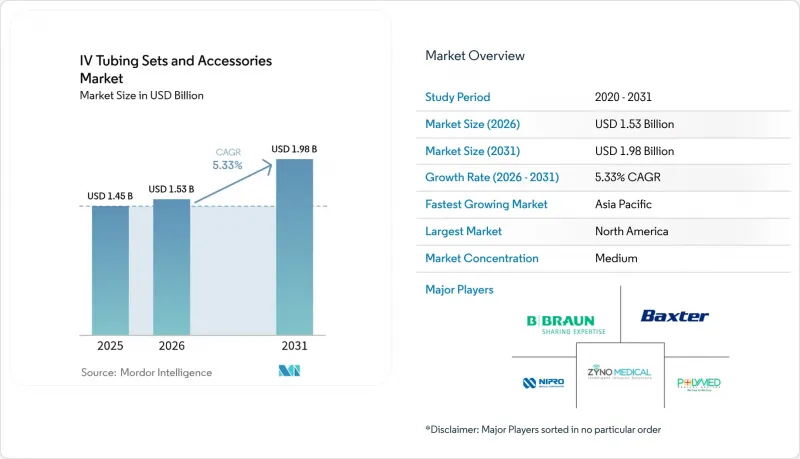
Mordor Intelligence에 의하면, 2026년 IV 튜브 세트 및 부속품 시장 규모는 15억 3,000만 달러로 추정되고, 2025년 14억 5,000만 달러에서 성장하여 2031년에는 19억 8,000만 달러에 이를 것으로 예측됩니다.
2026-2031년 연평균 성장률(CAGR) 5.33%로 성장할 것으로 전망됩니다.
본 보고서는 제품별(1차 IV 튜브 세트, 2차 IV 튜브 세트, 연장 IV 튜브 세트, IV 튜브 부속품, 기타), 용도별(중심정맥 카테터 삽입, 기타), 최종 사용자별(병원, 외래수술센터(ASC), 기타), 지역별(북미, 유럽, 기타)로 분류되어 있습니다. 시장 전망은 금액(달러) 기준으로 제시되어 있습니다.
세계의 IV 튜브 세트 및 부속품 시장 동향과 인사이트
가정 내 정맥 주입 요법의 급속한 확대
가정 내 수액 요법의 보급으로 인해 IV 튜브 세트 및 부속품 시장 수요 중심이 단기 입원에서 장기적인 외래 사용으로 이동했습니다. 현재 보험사는 가정에서 시행되는 정맥영양 및 화학요법 비용을 보상하고 있으며, 이를 위해서는 내구성이 높고 사용하기 쉬운 커넥터가 장착된 튜브가 요구됩니다. FDA는 지속적인 임상 감독이 없는 환경에서 오염을 방지하기 위해 폐쇄형 채널과 무바늘 밸브의 사용을 강조하는 지침을 발표했습니다. RFID 태그가 부착된 튜브와 결합된 스마트팜프를 통해 원격 모니터링이 가능해졌으며, 유량이 설정된 매개변수에서 벗어날 경우 간병인에게 경고가 전송됩니다. 의료 서비스 제공업체들이 이러한 시스템을 도입함에 따라, 소모품을 클라우드 연결형 펌프와 세트로 판매하는 제조업체들은 안정적인 수익원을 확보하고 있습니다. 이러한 변화는 입원 비용 절감으로도 이어지고 있으며, 이는 재입원 벌금 감축에 초점을 맞춘 의료 시스템의 전략과도 부합합니다.
무바늘·밀폐형 수액 시스템으로의 전환
무바늘 커넥터는 직업적 노출을 줄이고, 병원체가 침투할 가능성이 있는 진입 지점을 감소시킵니다. 캘리포니아주의 AB 2300 법안은 급성기 의료시설에 밀폐형 시스템의 도입을 의무화함으로써 더 광범위한 채택을 촉진했습니다. 이는 현재 많은 주와 국가가 따르고 있는 모델이 되었습니다. 임상 연구에 따르면, 커넥터에 의도적으로 눌러 열 때까지 닫힌 상태를 유지하는 기계식 밸브가 내장된 경우, 카테터 관련 혈류 감염이 감소하는 것으로 나타났습니다. 시장을 선도하는 기업들은 항균 코팅이나 적절한 소독 여부를 확인할 수 있는 변색 표시기 등의 기술로 이에 대응하고 있습니다. 세척 기술이 불충분하면 기기의 장점이 사라지므로, 교육은 여전히 필수적입니다. 미국에서의 조기 도입 사례는 아시아태평양의 구매 행태에 영향을 미치고 있으며, 이 지역에서는 JCI(Joint Commission International) 기준을 준수하기 위해 폐쇄형 시스템 구성 요소를 필수로 요구하는 병원이 늘어나고 있습니다.
엄격한 규제 체계
FDA와 유럽의 MDR은 모두 새로운 튜브 재료를 승인하기 전에 실제 사용 환경에서의 증거를 요구하고 있으며, 이로 인해 개발 주기가 길어지고 규정 준수 비용이 증가하고 있습니다. 유럽 내 인증 기관의 병목 현상으로 인해 소규모 혁신 기업 시장 진입이 지연되고 있습니다. 사이버 보안 관련 조항은 연결된 펌프와 통신하는 모든 튜브에 적용되며, 10년 전에는 상상도 할 수 없었던 침투 테스트 및 문서화 절차가 추가되었습니다. 이러한 규제는 전담 규제 대응 팀을 보유한 기존 기업들에게는 유리하지만, 특수 튜브를 통해 오류율을 낮출 수 있는 소아 종양학 등 틈새 부문에서의 혁신을 저해하고 있습니다. 스타트업 기업들은 기존의 품질 관리 체계를 활용하기 위해 대개 유서 깊은 OEM과 제휴하지만, 이익 분배로 인해 이익률이 떨어지게 됩니다.
부문 분석
2025년에는 1차 정맥 내(IV) 튜브 세트가 매출의 45.12%를 차지했으며, 모든 의료 현장에서 일상적인 수분 공급 및 항생제 투여라는 처치의 기반을 뒷받침하고 있습니다. 높은 도입 실적과 표준화된 커넥터 덕분에 이러한 제품은 계속해서 필수적인 존재로 남아 있으며, IV 튜브 세트 및 부속품 산업의 기반이 되는 일괄 구매 계약을 뒷받침하고 있습니다. 그러나 이러한 계약에는 2차용 튜브가 점점 더 세트에 포함되고 있으며, 이 카테고리는 임상의들이 1차 라인을 중단하지 않고 병행 점적 주입이 필요한 다제 병용 요법을 채택함에 따라 연평균 성장률(CAGR) 6.11%를 나타낼 것으로 예측됩니다. 이러한 증가 추세는 각 루멘을 통과하는 유량을 자동으로 조절하여 가정 환경에서도 정확한 투여량을 보장하는 스마트팜프의 보급과 맞물려 진행되고 있습니다. 제조업체들은 안티사이폰 밸브나 백체크 기능을 탑재함으로써 부가가치를 높이고 안전성을 향상시키는 동시에, 적정한 가격 프리미엄을 정당화하고 있습니다.
의료진이 환자의 체위 변경 시 라인 재연결을 줄여주는 인체공학적 옵션을 요구함에 따라, 연장 세트 및 부속품의 제품 라인업도 확대되고 있습니다. 기기 밀도가 높고 유연한 배관 솔루션이 요구되는 중환자실에서는 수요가 더욱 증가하고 있습니다. 수혈 세트나 화학요법용 라인은 ‘기타’ 범주로 분류되며, 화학적 적합성이나 차광성이 있는 소재가 채택되어 있어 고가 대에 속합니다. 일부 튜브 제품에는 RFID 태그가 탑재되어 있어, 펌프가 각 세트를 인증함으로써 잘못된 장착 발생을 줄이고 있습니다. 디지털 기반 추적성이 보편화됨에 따라, 독자적인 사양의 커넥터가 락인 효과를 강화하여 교체 주기와 연동되는 IV 튜브 세트 및 부속품 시장 규모에 영향을 미치고 있습니다.
지역별 분석
북미는 2025년에 전 세계 매출의 41.55%를 차지했으며, 폐쇄형 시스템용 커넥터의 조기 도입, OSHA(미국 직업안전보건청)의 엄격한 규제, 펌프, 수액, 일회용 제품을 포함한 여러 제품의 번들 계약을 통해 그 입지를 강화했습니다. 허리케인과 팬데믹으로 인한 화물 운송 혼란으로 공급망의 취약성이 드러난 것을 계기로, 미국 제조업체들은 향후 발생할 수 있는 충격에 대비하기 위해 국내 생산 능력에 약 10억 달러를 투자했습니다. 현재 각 지역의 보험사는 감염 예방용 추가 장비 비용을 상환하고 있으며, 이로 인해 병원들은 항균 포트나 RFID 지원 세트에 대해 높은 가격을 지불하게 되었습니다.
아시아태평양은 중국과 인도의 수술 건수 증가 및 공적 보험 제도의 확대에 힘입어 2031년까지 연평균 성장률(CAGR)이 6.27%로, 이 지역 내에서 가장 높은 성장세를 보이고 있습니다. 수량 기준 조달 모델은 표준화된 튜브의 대량 발주를 촉진하고 있지만, 한편으로는 규제 당국이 안전 기준을 강화하고 있어 양극화된 시장이 형성되고 있습니다. 현지 기업들은 가격을 무기로 한 현물 입찰을 통해 수주를 확보하는 반면, 다국적 브랜드들은 의료 관광을 염두에 두고 감염 지표를 중시하는 3차 의료 기관 시장을 장악하고 있습니다. 또한, 아시아태평양 각국 정부는 스마트팜프 시범 사업에 보조금을 지원하고 있으며, 이에 따라 GS1 식별자로우코드화된 호환 가능한 튜브에 대한 수요도 증가하고 있습니다.
유럽은 두 번째로 큰 점유율을 차지하고 있으며, 그 기반이 되는 것은 표면적인 가격보다 임상 데이터를 중시하는 근거 기반 조달 지침입니다. 브렉시트 이후의 규제 분열로 인해 규정 준수 비용이 상승하면서, 제조업체는 EU와 영국 양쪽에 대한 신청을 병행하여 유지하지 않을 수 없게 되었습니다. 독일과 프랑스에서는 여전히 고급 폐쇄형 시스템이 선호되는 반면, 동유럽의 병원들은 성숙도 곡선을 상승하고 있습니다. 중동 및 아프리카에서는 도입이 초기 단계에 있지만, 걸프협력회의(GCC)의 플래그십 의료 도시 투자가 국지적인 고부가가치 수요를 창출하고 있습니다. 남미의 성장은 더욱 꾸준합니다. 브라질의 경제 회복과 아르헨티나의 통화 안정화로 인해 새로운 의료기기 구매가 촉진되고 있지만, 수입 관세가 가격 책정에 영향을 미치고 있습니다.
기타 혜택
- 엑셀 형식 시장 예측(ME) 시트
- 3개월간의 애널리스트 지원
자주 묻는 질문
목차
제1장 서론
제2장 조사 방법
제3장 주요 요약
제4장 시장 구도
제5장 시장 규모 및 성장 예측
제6장 경쟁 구도
제7장 시장 기회 및 향후 전망
AJY 26.08.28According to Mordor Intelligence, IV tubing sets & accessories market size in 2026 is estimated at USD 1.53 billion, growing from 2025 value of USD 1.45 billion with 2031 projections showing USD 1.98 billion, growing at 5.33% CAGR over 2026-2031.
This report is Segmented by Product (Primary IV Tubing Sets, Secondary IV Tubing Sets, Extension IV Tubing Sets, IV Tubing Accessories, Others), Application (Central Venous Catheter Placement, and More), End User (Hospitals, Ambulatory Surgical Centers, and More), and Geography (North America, Europe, and More). The Market Forecasts are Provided in Terms of Value (USD).
Global IV Tubing Sets And Accessories Market Trends and Insights
Rapid Growth in Home-Infusion Therapies
Home infusion has shifted the IV tubing sets & accessories market by moving demand from short hospital stays to prolonged outpatient use. Payers now reimburse parenteral nutrition and chemotherapy administered at home, which requires tubing with higher durability and user-friendly connectors. The FDA has released guidance emphasizing closed pathways and needle-free valves to prevent contamination in settings without continuous clinical supervision. Smart pumps paired with RFID-tagged tubing allow remote monitoring, so caregivers receive alerts when flow deviates from prescribed parameters. As providers adopt these systems, manufacturers that bundle consumables with cloud-connected pumps secure sticky revenue streams. The shift also reduces inpatient costs, a point that aligns with health system strategies focused on lowering readmission penalties.
Shift Toward Needle-Free Closed IV Systems
Needle-free connectors reduce occupational exposure and cut the number of breach points that can harbor pathogens. California's AB 2300 law sparked broader adoption by mandating closed systems in acute-care facilities, a template many states and countries now emulate . Clinical studies show decreased catheter-related bloodstream infections when connectors incorporate mechanical valves that stay closed unless positively displaced. Market leaders respond with antimicrobial coatings and color-change indicators that confirm proper disinfection. Training remains essential because poor scrubbing technique negates device benefits. Early adopters in the United States influence purchasing behavior in Asia-Pacific, where hospitals upgrading to Joint Commission International standards must include closed-system components.
Stringent Regulatory Framework
The FDA and European MDR both demand real-world evidence before approving new tubing materials, lengthening development cycles and raising compliance costs. Notified-body bottlenecks in Europe delay market entry for smaller innovators. Cybersecurity clauses extend to any tubing that communicates with connected pumps, adding penetration testing and documentation steps unheard of a decade ago. While these rules favor entrenched firms with dedicated regulatory teams, they also slow innovation in niche segments such as pediatric oncology where specialized tubing could lower error rates. Start-ups often partner with established OEMs to piggyback on existing quality systems, but profit sharing erodes their margins.
Other drivers and restraints analyzed in the detailed report include:
- Rising Surgical Volumes in Emerging Economies
- Government Initiatives Improving Vascular-Access Safety
- Plasticizer and PVC-Phthalate Bans
For complete list of drivers and restraints, kindly check the Table Of Contents.
Segment Analysis
Primary IV tubing sets accounted for 45.12% of revenue in 2025, underpinning the procedural backbone of routine hydration and antibiotic administration across all care settings. Their high installed base and standardized connectors keep them indispensable, anchoring bulk-purchase contracts that underpin the IV tubing sets & accessories industry. Yet the same contracts increasingly bundle secondary tubing, a category forecast to grow at 6.11% CAGR as clinicians adopt multi-drug regimens that call for parallel infusions without pausing the primary line. This rise dovetails with smart pumps that auto-adjust flow through each lumen, ensuring precise dosing even in home settings. Manufacturers add value by integrating anti-siphon valves and back-check features, enhancing safety while justifying moderate price premiums.
Extension sets and accessory portfolios expand as providers seek ergonomic options that reduce line restarts when repositioning patients. Demand intensifies in critical-care units where equipment density requires flexible routing solutions. Blood administration sets and chemotherapy-grade lines fall under the Others category, where chemical compatibility and light-blocking materials command premium prices. RFID tagging within select tubing ranges allows the pump to authenticate each set, reducing misload events. As digital traceability becomes routine, proprietary connectors strengthen lock-in effects, influencing the IV tubing sets & accessories market size tied to replacement cycles.
Complete Report Scope:
- By Product
- Primary IV Tubing Sets
- Secondary IV Tubing Sets
- Extension IV Tubing Sets
- IV Tubing Accessories
- Others
- By Application
- Central Venous Catheter Placement
- Peripheral Intravenous Catheter Insertion
- PICC Line Insertion
- Others
- By End User
- Hospitals
- Ambulatory Surgical Centers
- Home-care Settings
- Others
- By Geography
- North America
- United States
- Canada
- Mexico
- Europe
- Germany
- United Kingdom
- France
- Italy
- Spain
- Rest of Europe
- Asia-Pacific
- China
- Japan
- India
- Australia
- South Korea
- Rest of Asia-Pacific
- Middle East and Africa
- GCC
- South Africa
- Rest of Middle East and Africa
- South America
- Brazil
- Argentina
- Rest of South America
- North America
Geography Analysis
North America held 41.55% of global revenue in 2025, strengthened by early adoption of closed-system connectors, stringent OSHA mandates, and bundled multi-product contracts that include pumps, solutions, and disposables. Hurricanes and pandemic-related freight disruptions exposed supply chain weaknesses, prompting U.S. manufacturers to invest almost USD 1 billion in domestic capacity that cushions against future shocks. Regional payers now reimburse infection-prevention add-ons, which encourages hospitals to pay a premium for antimicrobial ports and RFID-enabled sets.
Asia-Pacific posts the fastest regional CAGR at 6.27% through 2031, fueled by rising surgical caseloads and expansion of public insurance schemes in China and India. Volume-based procurement models encourage bulk orders of standardized tubing, yet regulators simultaneously tighten safety criteria, creating a two-tier market. Local firms win spot tenders on price, whereas multinational brands capture tertiary hospitals that prioritize infection metrics for medical tourism. APAC governments also channel grants into smart-pump pilots, driving accompanying demand for compatible tubing coded with GS1 identifiers.
Europe occupies the second-largest share, anchored by evidence-based procurement guidelines that stress clinical data over headline price. The post-Brexit regulatory split raised compliance costs, compelling manufacturers to maintain parallel EU and UK submissions. Germany and France continue to favor premium closed systems, while Eastern European hospitals climb the maturity curve. Middle East and Africa register early-stage adoption, yet Gulf Cooperation Council investments in flagship medical cities generate pockets of high-value demand. South America's growth is steadier; Brazil's economic rebound and Argentina's currency stabilization unlock new device purchases, though import duties influence price positioning.
- B. Braun
- Baxter
- Fresenius
- ICU Medical
- BD (Becton, Dickinson & Co.)
- Smiths Group
- Terumo
- Nipro
- Polymedicure Ltd.
- Vygon
- Codan Medizinische Gerate
- AngioDynamics
- Grifols
- Moog
- Zyno Medical
- AdvaCare
- Jiangsu Huida Medical Instruments
- Medline Industries
- Q Medical Industries
- Amsino International
Additional Benefits:
- The market estimate (ME) sheet in Excel format
- 3 months of analyst support
TABLE OF CONTENTS
1 Introduction
- 1.1 Study Assumptions & Market Definition
- 1.2 Scope of the Study
2 Research Methodology
3 Executive Summary
4 Market Landscape
- 4.1 Market Overview
- 4.2 Market Drivers
- 4.2.1 Rapid growth in home-infusion therapies
- 4.2.2 Shift toward needle-free closed IV systems
- 4.2.3 Rising surgical volumes in emerging economies
- 4.2.4 Increasing natality rate
- 4.2.5 Government initiatives improving vascular-access safety
- 4.2.6 AI-enabled predictive maintenance of IV equipment
- 4.3 Market Restraints
- 4.3.1 Stringent regulatory framework
- 4.3.2 Plasticizer & PVC-phthalate bans
- 4.3.3 Supply-chain fragility for medical-grade resins
- 4.3.4 Increasing recalls tied to flow-rate inaccuracy
- 4.4 Value / Supply-Chain Analysis
- 4.5 Regulatory Landscape
- 4.6 Technological Outlook
- 4.7 Porter's Five Forces Analysis
- 4.7.1 Threat of New Entrants
- 4.7.2 Bargaining Power of Buyers
- 4.7.3 Bargaining Power of Suppliers
- 4.7.4 Threat of Substitutes
- 4.7.5 Intensity of Rivalry
5 Market Size & Growth Forecasts (Value, USD)
- 5.1 By Product
- 5.1.1 Primary IV Tubing Sets
- 5.1.2 Secondary IV Tubing Sets
- 5.1.3 Extension IV Tubing Sets
- 5.1.4 IV Tubing Accessories
- 5.1.5 Others
- 5.2 By Application
- 5.2.1 Central Venous Catheter Placement
- 5.2.2 Peripheral Intravenous Catheter Insertion
- 5.2.3 PICC Line Insertion
- 5.2.4 Others
- 5.3 By End User
- 5.3.1 Hospitals
- 5.3.2 Ambulatory Surgical Centers
- 5.3.3 Home-care Settings
- 5.3.4 Others
- 5.4 By Geography
- 5.4.1 North America
- 5.4.1.1 United States
- 5.4.1.2 Canada
- 5.4.1.3 Mexico
- 5.4.2 Europe
- 5.4.2.1 Germany
- 5.4.2.2 United Kingdom
- 5.4.2.3 France
- 5.4.2.4 Italy
- 5.4.2.5 Spain
- 5.4.2.6 Rest of Europe
- 5.4.3 Asia-Pacific
- 5.4.3.1 China
- 5.4.3.2 Japan
- 5.4.3.3 India
- 5.4.3.4 Australia
- 5.4.3.5 South Korea
- 5.4.3.6 Rest of Asia-Pacific
- 5.4.4 Middle East and Africa
- 5.4.4.1 GCC
- 5.4.4.2 South Africa
- 5.4.4.3 Rest of Middle East and Africa
- 5.4.5 South America
- 5.4.5.1 Brazil
- 5.4.5.2 Argentina
- 5.4.5.3 Rest of South America
- 5.4.1 North America
6 Competitive Landscape
- 6.1 Market Concentration
- 6.2 Market Share Analysis
- 6.3 Company Profiles (includes Global level Overview, Market level overview, Core Segments, Financials as available, Strategic Information, Market Rank/Share for key companies, Products & Services, and Recent Developments)
- 6.3.1 B. Braun Melsungen AG
- 6.3.2 Baxter International Inc.
- 6.3.3 Fresenius Kabi AG
- 6.3.4 ICU Medical Inc.
- 6.3.5 BD (Becton, Dickinson & Co.)
- 6.3.6 Smiths Medical
- 6.3.7 Terumo Corporation
- 6.3.8 Nipro Corporation
- 6.3.9 Polymedicure Ltd.
- 6.3.10 Vygon SA
- 6.3.11 Codan Medizinische Gerate
- 6.3.12 AngioDynamics Inc.
- 6.3.13 Grifols SA
- 6.3.14 Moog Inc.
- 6.3.15 Zyno Medical LLC
- 6.3.16 AdvaCare Pharma
- 6.3.17 Jiangsu Huida Medical Instruments
- 6.3.18 Medline Industries LP
- 6.3.19 Q Medical Industries
- 6.3.20 Amsino International Inc.
7 Market Opportunities & Future Outlook
- 7.1 White-space & Unmet-need Assessment