

|
시장보고서
상품코드
2114929
산업용 흡수제 시장: 시장 점유율 분석, 업계 동향 및 통계, 성장 예측(2026-2031년)Industrial Absorbent - Market Share Analysis, Industry Trends & Statistics, Growth Forecasts (2026 - 2031) |
||||||
 Mordor Intelligence
Mordor Intelligence에 의하면, 산업용 흡수제 시장 규모는 2026년에 43억 5,000만 달러로 추정되고, 예측 기간(2026-2031년) CAGR 4.21%로 성장을 지속할 전망이며, 2031년까지 53억 5,000만 달러에 이를 전망입니다.
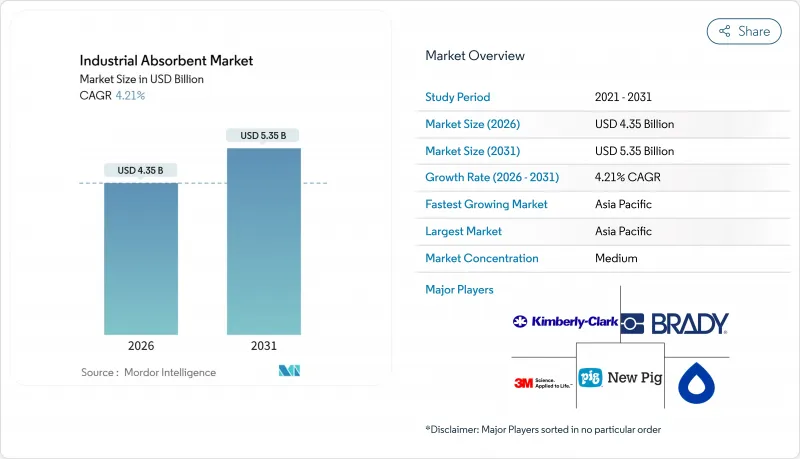
본 보고서는 소재 유형별(천연, 합성), 유형별(범용, 오일 전용, 기타), 최종 사용자 산업별(석유 및 가스, 화학,식품 가공, 의료, 제조, 발전, 해양·해운, 기타), 지역별(아시아태평양, 북미, 유럽, 남미, 중동 및 아프리카)로 분류되어 있습니다. 시장 예측은 금액(달러) 기준으로 제시되어 있습니다.
세계의 산업용 흡수제 시장 동향 및 인사이트
석유 및 가스 사업의 확대에 따른 유출 방지 대책에 대한 수요 증가
2025년 전 세계 업스트림 부문의 설비 투자액은 5,250억 달러에 달하여 2024년 대비 12% 증가했습니다. 이 증가분의 38%는 중동에서 비롯된 것입니다. 새로운 시추 장비, 파이프라인 또는 처리 스키드가 설치될 때마다, 미국의 ‘수질정화법’과 걸프협력회의(GCC)의 유사 규정에 따른 유출 방지 기준을 준수하기 위해 오일 전용 붐이나 패드가 필요합니다. 북미의 셰일 사업자들은 2025년에 1,200개의 수평 유정을 추가로 시추할 예정이며, 각 유정의 완공 작업 과정에서 탱크 간 이송 시 18배럴의 플로우백 액체를 흡수할 수 있는 발수성 매트에 대한 유출 방지 수요가 발생했습니다. 측면 연장 거리가 긴 유정(일부는 3km를 초과하기도 함)의 경우, 지표면과의 연결 지점이 늘어나 미세 누출 위험이 높아지기 때문에 시추 장비 수가 정체되더라도 흡수제 수요는 지속되고 있습니다. 현재 보험사들은 일반 배상 책임 보험을 인수하기 전에 흡수제 재고 기록을 제출하도록 요구하고 있으며, 이로 인해 시설 측에서는 안전 재고 수준을 유지해야 하는 압박을 받게 되어 산업용 흡수제 시장을 더욱 부양하고 있습니다.
여러 지역에 걸친 환경 규제 집행 강화
2024년에 개정된 유럽연합(EU)의 ‘산업 배출 지침’에서는 연간 10톤 이상의 유해 액체를 취급하는 시설에 대해 유출 봉쇄와 관련된 ‘이용 가능한 최선의 기술’을 입증할 것을 의무화하고 있으며, 이에 따라 인증된 흡수제의 사용 및 폐기 추적 기록이 사실상 법제화되었습니다. 중국 생태환경부는 2025년, 양쯔강 경제 벨트 연안의 석유화학 클러스터에 대해 GB 18597의 침출수 방지 기준을 충족하는 흡수제 라이너 사용을 의무화하는 병행 체계를 도입했습니다. 규제 집행 강도는 현저하며, EU 회원국들은 2025년에 1,840건의 유출 방지 위반 통지서를 발부하고, 건당 평균 벌금을 4만 7,000유로로 인상했습니다. ISO 14001 감사에는 현재 흡수제 재고 확인이 포함되어 있으며, 이전에는 선택적 항목이었던 것이 필수 준수 항목으로 변경되었습니다. 이러한 규제 강화는 산업용 흡수제 시장에서 장기 연평균 성장률(CAGR)을 1% 포인트 끌어올리는 요인이 되고 있습니다.
제조 및 폐기 처리 과정에서 근로자의 노출 위험
OSHA의 2025년 결정질 실리카 규제에 따라 허용 노출 농도가 50μg/m³로 하향 조정됨에 따라, 점토계 흡수제 공장은 대용량 환기 설비를 설치하거나, 재료비가 30-40% 더 비싼 비결정질 실리카로 전환할 수밖에 없게 되었습니다. 미국의 3개 제조업체는 규제 준수 첫해에 총 120만 달러의 벌금을 부과받았습니다. 폐기 처리 측면에서는 유해 화학물질로 오염된 사용 후 흡착제가 현재 ‘자원보전·재생법(RCRA)’에 따라 F 목록 폐기물로 분류되어 있으며, 매립지 용량 부족을 배경으로 2025년에는 소각 처리 비용이 18% 상승했습니다. EU의 ‘주의 의무(duty of care)’ 조항은 폐기물 처리 하류 단계에서의 책임 범위를 확대하고 있어, 규정 준수 전담 인력을 보유하지 않은 중소기업이 일회용 흡착제를 채택하는 것을 방해하고 있습니다. 이러한 요인들로 인해 중기적인 연평균 성장률(CAGR)은 0.4포인트 하락할 것으로 예측됩니다.
부문 분석
2025년에도 합성 소재 제품은 여전히 매출의 55.12%를 차지했으며, 이러한 우위는 미처리 천연섬유의 보존 기간이 18-24개월인 반면, 밀봉된 멜트블로운 웹의 보존 기간이 5년이라는 점에 기인합니다. 그러나 바이오 공급업체들은 배리어 코팅이 적용된 호일 포장을 채택함으로써 그 격차를 점차 좁혀가고 있습니다. 셀룰로오스 코어를 폴리프로필렌 층으로 감싼 범용 흡수제는 물과 기름이 모두 누출될 가능성이 있는 자동차 공장에서 지지를 얻고 있으며, 이를 통해 재고 관리가 간소화되고 있습니다. 산이나 부식성이 강한 화학 물질에 대응하는 위험물용 흡수제는 배터리 제조 부문에서 틈새 수요가 있습니다. 이 부문에서는 전해액 누출에 대응하기 위해 불화수소산에 내성을 가진 폴리프로필렌 부직포가 필요합니다. 천연섬유는 2031년까지 연평균 성장률(CAGR) 5.13%를 나타낼 것으로 예측되며, 규모는 작지만 합성 소재를 능가하는 성장률을 보이고 있습니다. 2025년에는 탄화 및 발수 처리를 거친 벼 껍질 흡수제가 폴리프로필렌 패드에 비해 도입 비용을 20-30% 낮추면서도 8-12배의 유분 보유 능력을 발휘했습니다. 인도의 과학산업연구위원회(CSIR)는 실란 커플링제로 처리된 코코넛 코이아 매트의 유효성을 검증하여 유럽 및 북미로의 수출 가능성을 열었습니다.
폐기 처리의 경제성 측면에서 경량 천연 매트는 매립 폐기물의 톤수와 운송 비용을 절감하며, EU와 일본의 폐기물 처리 비용 상승으로 인해 그 이점은 더욱 확대되고 있습니다. 탄소 회계도 추가적인 호재로 작용하고 있습니다. 바이오 매트는 동등한 폴리머 제품에 비해 ‘크래들-투-게이트’ 배출량이 약 3분의 1 수준이며, 이 지표는 현재 EU의 ‘기업 지속가능성 보고 지침’에 따라 엄격하게 검토되고 있습니다. 천연 소재 공급업체들이 업스트림의 원료 집약 단계부터 하류의 완제품 패드 생산에 이르기까지 사업을 통합함에 따라, 납품 비용 측면에서의 우위는 더욱 확대될 가능성이 있습니다. 규모 측면의 제약은 여전히 남아 있습니다. 농업 폐기물의 확보는 계절에 좌우될 뿐만 아니라, 전처리 공장은 최적의 가동률 미만으로 운영되는 경우가 많아, 폴리머 공급 과잉이 정점에 달하는 시기에는 가격 경쟁이 제한될 수밖에 없습니다.
지역별 분석
아시아태평양은 2025년 매출의 38.32%를 차지한 것으로 평가되었으며, 2031년까지 연평균 성장률(CAGR) 5.78%로 확대될 것으로 전망되는데, 석유화학 생산 능력 확대와 점점 더 엄격해지는 환경 규제라는 두 가지 성장 요인이 두드러집니다. 2025년 중국에서 420만 톤의 에틸렌 생산 능력이 추가됨에 따라, 유지보수 및 비상사태 대비를 위해 크래커 1기당 약 120-180톤의 흡수제에 대한 지속적인 수요가 발생했습니다. 인도의 중앙공해관리위원회는 유해 액체를 5톤 이상 취급하는 시설을 대상으로 유출 사고 대응 계획의 의무화 범위를 확대하여, 2025년에는 1,200곳의 시설이 새롭게 대상에 포함되었습니다. 일본에서는 2025년 4월 ‘산업안전보건법’ 개정에 따라 흡수제 비축량에 대한 문서화가 의무화되어 연간 800톤 수요가 추가되었습니다. 아세안(ASEAN)의 석유화학 산업에 신규로 진출하는 기업들은 ASTM 규격을 준수하는 유출 대응 키트를 요구하는 수출 지향적 고객들을 상대해야 하므로, 이에 따라 베트남과 인도네시아로의 수입량이 증가하고 있습니다.
북미는 셰일 산업의 확대와 멕시코만 연안 지역의 화학 플랜트 증설에 힘입어 여전히 2위의 규모를 자랑하고 있습니다. 퍼미안 분지에서는 2025년에 1,200개의 수평 유정이 신설되었으며, 각 유정마다 유체 역류(flowback)를 차단하기 위한 발수 매트가 필요합니다. 미국의 SPCC 규정은 지상 석유 저장량이 1,320갤런을 초과하는 638,000개의 시설에 적용되어, 석유 전용 흡수제의 기본 수요를 뒷받침하고 있습니다. 캐나다의 오일샌드 생산량은 일일 3.1mb/d까지 회복되어, 이로 인해 점토 과립 및 폴리프로필렌 패드의 재고 보충 주기가 촉발되었습니다. 멕시코의 페멕스(Pemex)는 2024년 환경 관련 벌금을 부과받은 후 유출 대응 키트 업그레이드를 시작하여, 범용형 및 위험물 대응형 제품에 대한 새로운 수주를 창출했습니다.
유럽에서는 지속가능성을 중시하는 조달이 진행되고 있습니다. ‘기업 지속가능성 보고 지침’에 따라 대기업은 소모품의 탄소 발자국을 공개해야 할 의무가 있으며, 바이오 매트 및 재사용형 시스템의 도입이 가속화되고 있습니다. 독일, 영국, 프랑스는 이 지역 수요의 절반 이상을 차지하고 있으며, 그 수요량은 화학, 자동차, 식품 부문에 의해 뒷받침되고 있습니다. 기업들이 저배출 대체품을 우선시하는 내부 탄소 가격을 설정함에 따라 가격에 대한 민감도는 완화되고 있습니다.
남미의 성장은 에너지와 광업이 주축을 이루고 있습니다. 브라질의 프레스솔트층 생산량은 2025년에 하루 24만 배럴 증가했으며, 이바마(Ibama)의 라이선스 요건에 따라 각 해상 플랫폼에 원유 전용 오일 펜스 설치가 의무화되었습니다. 아르헨티나의 바카 무에르타(Vaca Muerta)에서는 2025년에 180개의 신규 유정이 가동을 시작하며, 흡수제는 현지 및 미국에서 조달되고 있습니다. 중동 및 아프리카는 탄화수소에 대한 투자에 의존하고 있습니다. 2024년 하반기부터 가동 중인 사우디아라비아의 ‘아미랄(Amiral)’ 복합 시설에서는 아시아 제조업체로부터 패드와 양말을 수입하고 있습니다. 아랍에미리트와 카타르의 LNG 프로젝트도 유사한 사양을 채택하고 있는 반면, 남아프리카공화국과 나이지리아에서는 발전소 정비 및 항만 확장에 따른 간헐적인 수요 급증이 나타나고 있습니다. 이러한 지역별 상황을 종합해 보면, 산업용 흡수제 시장은 다양한 지역적 기반을 유지하고 있으며, 아시아태평양이 그 성장세를 주도하고 있음이 확인됩니다.
기타 혜택
- 엑셀 형식 시장 예측(ME) 시트
- 3개월간의 애널리스트 지원
자주 묻는 질문
목차
제1장 서론
제2장 조사 방법
제3장 주요 요약
제4장 시장 구도
제5장 시장 규모 및 성장 예측
제6장 경쟁 구도
제7장 시장 기회 및 향후 전망
AJY 26.08.28According to Mordor Intelligence, the industrial absorbent market size is estimated at USD 4.35 billion in 2026, and is expected to reach USD 5.35 billion by 2031, at a CAGR of 4.21% during the forecast period (2026-2031).
This report is Segmented by Material Type (Natural and Synthetic), Type (Universal, Oil-Only, and More), End-User Industry (Oil and Gas, Chemical, Food Processing, Healthcare, Manufacturing, Power Generation, Marine and Shipping, and More), and Geography (Asia-Pacific, North America, Europe, South America, and Middle East and Africa). The Market Forecasts are Provided in Terms of Value (USD).
Global Industrial Absorbent Market Trends and Insights
Rising Demand for Spill-Control in Oil and Gas Expansion
Global upstream capital expenditure reached USD 525 billion in 2025, a 12% jump over 2024, with the Middle East supplying 38% of the incremental outlay. Each new rig, pipeline, or processing skid requires oil-only booms and pads to comply with spill-prevention standards under the US Clean Water Act and similar regulations in the Gulf Cooperation Council. North American shale operators drilled 1,200 additional horizontal wells in 2025, and each completion generated spill-control demand for hydrophobic mats that contain 18 barrels of flow-back fluid during tank transfers. Longer-lateral wells, some exceeding 3 km, raise the number of surface connections and elevate micro-leak risks, which sustains absorbent pull-through even as rig counts plateau. Insurance carriers now request documented absorbent inventories before underwriting general liability policies, pushing facilities to hold safety-stock levels that further buoy the industrial absorbents market.
Stricter Multi-Regional Environmental Enforcement
The European Union's Industrial Emissions Directive, revised in 2024, obliges sites handling more than 10 t of hazardous liquids annually to demonstrate "best available techniques" for spill containment, effectively codifying certified absorbent usage and disposal trails. China's Ministry of Ecology and Environment instituted a parallel framework in 2025 for petrochemical clusters along the Yangtze River Economic Belt, requiring absorbent liners that meet GB 18597 leachate-prevention standards. Enforcement intensity is tangible: EU states issued 1,840 spill-control citations in 2025 and lifted average fines to EUR 47,000 per incident. ISO 14001 audits now include absorbent stock verification, turning previously discretionary spending into a non-negotiable compliance line item. This regulatory ratchet is translating into a full percentage point of additional long-term CAGR for the industrial absorbents market.
Worker-Exposure Hazards in Manufacturing and Disposal
OSHA's 2025 crystalline-silica rule lowered permissible exposure to 50 µg/m3, forcing clay-absorbent plants to install high-capacity ventilation or switch to amorphous silica at 30-40% higher material cost. Three US manufacturers accrued USD 1.2 million in fines during the first compliance year. On the disposal side, spent absorbents contaminated with hazardous chemicals are now F-listed waste under the Resource Conservation and Recovery Act, and incineration fees rose 18% in 2025 amid landfill-capacity tightness. EU "duty of care" clauses extend liability down the waste stream, discouraging smaller firms without dedicated compliance staff from adopting single-use absorbents. These factors remove 0.4 percentage points from medium-term CAGR.
Other drivers and restraints analyzed in the detailed report include:
- Increasing Cost and Frequency of Industrial Spills
- Rapid Growth of Asia-Pacific Petrochemical Output
- Volatile Polypropylene and Mineral Feedstock Prices
For complete list of drivers and restraints, kindly check the Table Of Contents.
Segment Analysis
Synthetic formats still held 55.12% revenue in 2025, a lead underpinned by the five-year shelf life of sealed melt-blown webs compared with 18-24 months for untreated natural fibers, yet bio-based suppliers are closing the gap with barrier-coated foil packaging. Universal absorbents that sandwich polypropylene layers around a cellulose core are gaining favor in automotive plants where spills may involve both water and oil, thereby simplifying inventory management. Hazmat absorbents, tailored for acids and aggressive chemicals, enjoy niche demand in battery manufacturing, where electrolyte leaks require polypropylene fabrics resistant to hydrofluoric acid. Natural fibers are projected to grow at a 5.13% CAGR through 2031, outpacing synthetics despite their smaller base. In 2025, rice-husk absorbents processed via carbonization and hydrophobization delivered 8-12X oil retention at 20-30% lower landed cost than polypropylene pads. India's Council of Scientific and Industrial Research validated coconut-coir mats treated with silane coupling agents, unlocking export potential to Europe and North America.
In disposal economics, lighter-weight natural mats reduce landfill tonnage and transportation costs, advantages amplified by rising waste-management fees in the EU and Japan. Carbon accounting adds a further tailwind: a bio-based mat carries about one-third the cradle-to-gate emissions of a polymer equivalent, a metric now scrutinized under the EU Corporate Sustainability Reporting Directive. As natural suppliers integrate upstream into feedstock aggregation and downstream into finished pad production, their delivered-cost advantage could widen. Nonetheless, scale constraints persist; agro-waste availability is seasonal, and pre-treatment plants often operate below optimal utilization, limiting price competitiveness during peak polymer oversupply.
Complete Report Scope:
- By Material Type
- Natural
- Synthetic
- By Type
- Universal
- Oil-only
- Hazmat
- Other Types
- By End-user Industry
- Oil and Gas
- Chemical
- Food Processing
- Healthcare
- Manufacturing
- Power Generation
- Marine and Shipping
- Automotive
- Other Industries
- By Geography
- Asia-Pacific
- China
- India
- Japan
- South Korea
- ASEAN Countries
- Australia and New Zealand
- Rest of Asia-Pacific
- North America
- United States
- Canada
- Mexico
- Europe
- Germany
- United Kingdom
- France
- Italy
- Spain
- Russia
- Rest of Europe
- South America
- Brazil
- Argentina
- Rest of South America
- Middle East and Africa
- Saudi Arabia
- United Arab Emirates
- South Africa
- Nigeria
- Rest of Africa
- Asia-Pacific
Geography Analysis
Asia-Pacific contributed 38.32% of 2025 revenue and is projected to expand at a 5.78% CAGR to 2031, underscoring its dual drivers of petrochemical capacity growth and increasingly stringent environmental mandates. China's 4.2 million t ethylene additions in 2025 created recurring demand of roughly 120-180 t of absorbents per cracker for maintenance and emergency readiness. India's Central Pollution Control Board broadened mandatory spill-response plans to facilities handling more than 5 t of hazardous liquids, capturing 1,200 additional sites in 2025. Japan's April 2025 revision of the Industrial Safety and Health Act requires documented absorbent stockpiles, adding 800 t of annual demand. ASEAN petrochemical entrants face export-oriented customers that demand ASTM-compliant spill kits, lifting import volumes into Vietnam and Indonesia.
North America remains the second-largest region, buoyed by shale expansion and Gulf Coast chemical builds. The Permian Basin added 1,200 horizontals in 2025, each requiring hydrophobic mats for flow-back containment. The US SPCC rule applies to 638,000 facilities with above-ground oil storage exceeding 1,320 gal and underpins baseline demand for oil-only absorbents. Canada's oil-sands production rebounded to 3.1 mb/d, triggering restock cycles for clay granules and polypropylene pads. Mexico's Pemex began upgrading spill-response kits after environmental fines in 2024, creating fresh orders for universal and hazmat variants.
Europe is oriented toward sustainability-driven procurement. The Corporate Sustainability Reporting Directive forces large enterprises to disclose carbon footprints of consumables, accelerating adoption of bio-based mats and reusable systems. Germany, the UK, and France collectively account for more than half of regional demand, with volumes anchored in chemicals, automotive, and food. Price sensitivity has moderated as corporations assign internal carbon prices that favor low-emission alternatives.
South America's growth pivots on energy and mining. Brazil's pre-salt output rose by 240,000 b/d in 2025, and Ibama licenses require oil-only booms on each offshore platform. Argentina's Vaca Muerta ramped 180 new wells in 2025, sourcing absorbent supplies both locally and from the US. The Middle East and Africa rely on hydrocarbon investments; Saudi Arabia's Amiral complex, operational since late 2024, imports pads and socks from Asian fabricators. UAE and Qatar LNG projects mirror those specifications, while South Africa and Nigeria see intermittent demand spikes tied to power-plant overhauls and port expansions. Collectively, the geographic mosaic confirms that the industrial absorbents market maintains diversified regional anchors, with Asia-Pacific setting the pace.
- 3M
- Absorbent Products
- Ansell Ltd.
- Brady Worldwide, Inc.
- Chemtex Industries
- Decorus Europe
- EP Minerals
- ITU AbsorbTech, Inc.
- Jaycot Industries
- Johnson Matthey
- Justrite
- Kimberly-Clark Worldwide, Inc.
- Meltblown Technologies Inc.
- New Pig Corporation
- Oil-Dri Corporation of America
- Tosla
Additional Benefits:
- The market estimate (ME) sheet in Excel format
- 3 months of analyst support
TABLE OF CONTENTS
1 Introduction
- 1.1 Study Assumptions and Market Definition
- 1.2 Scope of the Study
2 Research Methodology
3 Executive Summary
4 Market Landscape
- 4.1 Market Overview
- 4.2 Market Drivers
- 4.2.1 Rising demand for spill-control in oil and gas expansion
- 4.2.2 Stricter multi-regional environmental enforcement
- 4.2.3 Increasing cost and frequency of industrial spills
- 4.2.4 Rapid growth of Asia-Pacific petro-chemical output
- 4.2.5 Commercialisation of bio-based sorbents from agro-waste
- 4.3 Market Restraints
- 4.3.1 Worker-exposure hazards in manufacturing and disposal
- 4.3.2 Volatile polypropylene and mineral feed-stock prices
- 4.3.3 Shift toward reusable spill-containment booms and pads
- 4.4 Value Chain Analysis
- 4.5 Porter's Five Forces
- 4.5.1 Bargaining Power of Suppliers
- 4.5.2 Bargaining Power of Buyers
- 4.5.3 Threat of New Entrants
- 4.5.4 Threat of Substitutes
- 4.5.5 Degree of Competition
5 Market Size and Growth Forecasts (Value)
- 5.1 By Material Type
- 5.1.1 Natural
- 5.1.2 Synthetic
- 5.2 By Type
- 5.2.1 Universal
- 5.2.2 Oil-only
- 5.2.3 Hazmat
- 5.2.4 Other Types
- 5.3 By End-user Industry
- 5.3.1 Oil and Gas
- 5.3.2 Chemical
- 5.3.3 Food Processing
- 5.3.4 Healthcare
- 5.3.5 Manufacturing
- 5.3.6 Power Generation
- 5.3.7 Marine and Shipping
- 5.3.8 Automotive
- 5.3.9 Other Industries
- 5.4 By Geography
- 5.4.1 Asia-Pacific
- 5.4.1.1 China
- 5.4.1.2 India
- 5.4.1.3 Japan
- 5.4.1.4 South Korea
- 5.4.1.5 ASEAN Countries
- 5.4.1.6 Australia and New Zealand
- 5.4.1.7 Rest of Asia-Pacific
- 5.4.2 North America
- 5.4.2.1 United States
- 5.4.2.2 Canada
- 5.4.2.3 Mexico
- 5.4.3 Europe
- 5.4.3.1 Germany
- 5.4.3.2 United Kingdom
- 5.4.3.3 France
- 5.4.3.4 Italy
- 5.4.3.5 Spain
- 5.4.3.6 Russia
- 5.4.3.7 Rest of Europe
- 5.4.4 South America
- 5.4.4.1 Brazil
- 5.4.4.2 Argentina
- 5.4.4.3 Rest of South America
- 5.4.5 Middle East and Africa
- 5.4.5.1 Saudi Arabia
- 5.4.5.2 United Arab Emirates
- 5.4.5.3 South Africa
- 5.4.5.4 Nigeria
- 5.4.5.5 Rest of Africa
- 5.4.1 Asia-Pacific
6 Competitive Landscape
- 6.1 Market Concentration
- 6.2 Strategic Moves
- 6.3 Market Share/Ranking Analysis
- 6.4 Company Profiles (includes Global-level Overview, Market-level Overview, Core Segments, Financials as available, Strategic Information, Products and Services, and Recent Developments)
- 6.4.1 3M
- 6.4.2 Absorbent Products
- 6.4.3 Ansell Ltd.
- 6.4.4 Brady Worldwide, Inc.
- 6.4.5 Chemtex Industries
- 6.4.6 Decorus Europe
- 6.4.7 EP Minerals
- 6.4.8 ITU AbsorbTech, Inc.
- 6.4.9 Jaycot Industries
- 6.4.10 Johnson Matthey
- 6.4.11 Justrite
- 6.4.12 Kimberly-Clark Worldwide, Inc.
- 6.4.13 Meltblown Technologies Inc.
- 6.4.14 New Pig Corporation
- 6.4.15 Oil-Dri Corporation of America
- 6.4.16 Tosla
7 Market Opportunities and Future Outlook
- 7.1 White-space and Unmet-need Assessment


