

|
시장보고서
상품코드
2114935
양성 계면활성제 시장 : 점유율 분석, 업계 동향과 통계, 성장 예측(2026-2031년)Amphoteric Surfactant - Market Share Analysis, Industry Trends & Statistics, Growth Forecasts (2026 - 2031) |
||||||
 Mordor Intelligence
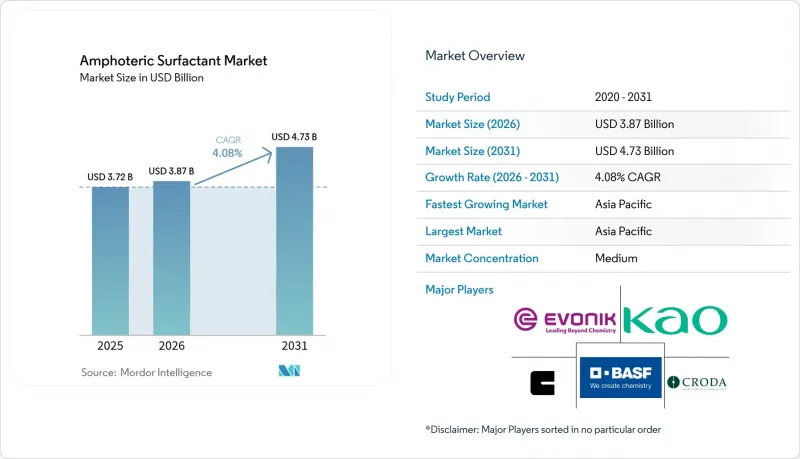
Mordor Intelligence에 의하면, 양성 계면활성제 시장 규모는 2025년 37억 2,000만 달러에서 2026년에는 38억 7,000만 달러로 확대되어 2026년부터 2031년까지 CAGR 4.08%로 성장을 지속하여, 2031년에는 47억 3,000만 달러에 이를 것으로 예측됩니다.
본 보고서는 유형(베타인, 암포아세테이트, 아민옥사이드 등), 용도(퍼스널케어 및 화장품, 세제·산업용 세정제, 석유 및 가스, 난연제 등), 원료(합성 및 바이오/천연),지역(아시아태평양, 북미, 유럽, 남미, 중동 및 아프리카)별로 분류되어 있습니다. 시장 예측은 금액(미화) 기준으로 제시되어 있습니다.
전 세계 양성 계면활성제 시장 동향 및 인사이트
퍼스널케어 및 화장품 분야 수요 증가
현재, 프리미엄 스킨 클렌징 제품 라인에는 강력한 발포성과 저자극성을 겸비한 매우 순한 계면활성제 시스템이 요구되고 있으며, 양성 계면활성제는 이 두 가지 요건을 모두 충족합니다. 레인포레스트 얼라이언스 인증을 받은 코코넛 오일을 원료로 한 BASF사의 ‘Dehyton PK45GA/RA’는 추적 가능성과 성능이 브랜드 스토리에서 어떻게 융합되는지를 보여주는 좋은 예입니다. 전 세계 고형 비누 소비량은 감소 추세에 있지만, 액상 비누, 미셀 워터, 두피 스크럽은 증가하고 있으며, 이들 모두 베타인을 점도 증강제나 거품 안정제로 활용하고 있습니다. 인도, 인도네시아, 베트남의 신흥 중산층 소비자들은 황산염이 함유되지 않은 샴푸로 전환하고 있으며, 이는 양성 계면활성제 시장 규모를 확대시키고 있습니다. 일본의 의약외품에 대한 최대 허용 질소 함량 규제의 조화 등 규제 통일화를 통해 처방의 중복이 줄어들고, 지역별 시장 출시 주기가 가속화되고 있습니다. 성분 투명성을 요구하는 앱의 영향으로, 마케팅 담당자들은 미국 마약단속국(DEA)에서 유래한 양성 계면활성제를 지속 가능한 팜유 원탁회의(RSPO) 인증을 받았으며 1,4-디옥산을 포함하지 않는 대체품으로 교체할 수밖에 없게 되었으며, 이로 인해 중가대에서 고급 가격대에 이르는 수요의 다양화가 더욱 촉진되고 있습니다.
바이오 및 황산염 무첨가 제형으로의 전환
Locus Ingredients사는 자사의 소포롤리피드 제품군에 대해 미국 환경보호청(EPA)의 TSCA(유해물질 규제법) 등록을 획득하고, 국제표준화기구(ISO) 인증을 받은 오하이오주 시설에서 상업 규모의 발효 기술을 입증했습니다. 이 획기적인 성과를 통해, 아시아의 유화 화학제품 공급이 지배적인 시장에서 미국산 바이오 계면활성제의 타당성이 인정받게 되었습니다. BASF의 ‘EcoBalanced’ 접근 방식은 REDcert2에 따라 검증되었으며, 국제 화장품 성분 명명법(INCI) 명칭을 변경하지 않고 화석 유래 탄소를 폐기물 유래 원료로 대체함으로써, 브랜드 소유주에게 스코프 3 배출 감축을 위한 드롭인 방식의 로드맵을 제공합니다. 유럽연합(EU)의 세제 규정 개정에 따라 디지털 제품 여권이 의무화되어, 최종 사용자는 배치 단위까지 탄소 강도를 추적할 수 있게 되었습니다. 이는 공급업체 간의 경쟁을 심화시키는 인센티브가 되고 있습니다. 에보닉(Evonik)이 슬로벤스카 류프차에 건설한 최초의 람노리피드 공장은 유럽산 옥수수 유래 포도당을 활용하고 있어, 팜 유래 성분에 대한 의존도를 낮추고 산림 파괴의 위험을 방지하고 있습니다. 규모의 경제로 인해 합성계 및 바이오 양성 계면활성제 간의 가격 차이는 점차 줄어들고 있으며, 생명주기 평가(LCA) 데이터에 따르면 지구 온난화 지수가 두 자릿수 감소한 것으로 나타나 구매 결정이 바이오 유래 제품 쪽으로 기울고 있습니다.
엄격한 환경 및 유해물질 규제
‘지속가능성을 위한 유럽 화학물질 전략’에서는 범용 위험 평가 모델이 도입되어, 실제 노출 시나리오와 관계없이 수생 독성이나 내분비 교란 우려가 발생할 경우, 계면활성제 계열 전체가 ‘우려 물질’로 분류될 가능성이 있습니다. 미국 환경보호청(EPA)은 ‘유해물질 규제법(TSCA)’에 근거한 ‘중요 신규 용도 규정(SNUR)’의 심사 기간을 단축하고 있으며, 특히 리드-어크로스 데이터가 없는 신규 양성이온성 아세테이트계 계면활성제의 경우, 제조 전 신고 비용이 증가하고 있습니다. 중국의 세제 규격 GB/T 42072-2022에서는 28일 이내에 90%의 생분해성을 요구하게 되어, 소규모 제조업체의 경우 시험 비용 부담이 증가하고 시장 출시까지의 기간이 길어지고 있습니다. 아세안(ASEAN) 국가들 간에 ‘천연’의 정의가 통일되어 있지 않아 여러 개의 친환경 인증 심사가 필요하게 되었으며, 연구 개발(R&D) 예산이 제품 개발이 아닌 규정 준수 대응에 투입되는 상황이 발생하고 있습니다. 규제 당국이 위험 기반 규제로 전환하는 가운데, 배합 제조업체들은 제품별 생성물을 발생시키지 않는 합성 경로를 채택하여 위험을 회피하고 있으나, 설비 투자 부담이 이익률을 압박하고 있어 양성 계면활성제 시장 전체의 성장세가 둔화되고 있습니다.
부문 분석
2025년, 베타인 계열 제품은 양성 계면활성제 시장 점유율의 42.55%를 차지했으며, 2025년 내내 안정적인 한 자릿수 판매량 증가를 유지했습니다. 코카미도프로파일베타인의 저자극성과 충분히 입증된 독성학적 실적에 대한 소비자의 신뢰가 샴푸,세안제, 유아용 세정제에서 그 인기를 뒷받침하고 있습니다. 베타인과 관련된 양성 계면활성제 시장 규모는 위생용품에 그치지 않고 확대되고 있으며, 소화용 거품제나 유전용 마찰 저감제에서는 점도 조절을 위해 그 양성이온성이 활용되고 있습니다. 파이프라인 운영 사업자들은 유정 내 염분 농도가 변동하더라도 효과가 지속되고, 첨가제의 재조정에 따른 가동 중단 시간을 줄일 수 있기 때문에 베타인계 첨가제를 높이 평가했습니다.
양성 아미도프로파일하이드록시스울타인은 업소용 주방 탈지제의 엄격한 점도 요건을 충족하며, 온도 변동 속에서도 겔 구조를 유지합니다. 아민 옥사이드(amino oxide)는 틈새 시장 분야이긴 하지만, 유제품 및 양조장의 위생 라인에서 사용되는 염소 강화형 세정제에 산화 안정성을 제공하여, 소매 가격 압박으로부터 보호받는 견실한 수익원을 구축하고 있습니다. 다이셀과 같은 혁신적인 기업은 폴리글리세린 골격과 양성 머리기를 결합하여 수성 금속 가공액에 최적화된 투명하고 저발포성 계면활성제를 개발함으로써 새로운 산업 분야를 개척하고 있습니다. 이러한 동향은 양성 계면활성제 시장이 분자 분류보다는 기능성에 기반하여 점점 더 세분화되고, 용도에 특화된 유도체가 프리미엄 가격에 판매될 것임을 시사합니다.
지역별 분석
아시아태평양은 2025년에 양성 계면활성제 시장 점유율의 41.10%를 차지하며, 국내 하류 수요 및 장쑤성, 마하라슈트라주, 지바의 각 클러스터에서 이루어지는 적극적인 생산 능력 확대에 힘입어 2031년까지 연평균 성장률(CAGR) 4.88%를 나타낼 것으로 예측됩니다. 지방 자치 단체는 석유화학제품 수입을 대체하는 프로젝트에 대해 저금리 융자 프로그램 및 허가 절차 간소화를 통해 바이오 루트를 통한 사업 확장을 지원하고 있습니다. 높은 도시화율은 액체 세정제 및 손 위생 제품의 지속적인 성장으로 이어지고 있으며, 이는 순한 양성 계면활성제 시스템에 대한 선택적 지출을 촉진하고 있습니다. 인도의 퍼스널케어 분야 스타트업 기업들은 남부 지역의 농장에서 반정제 코코넛 오일 유래 베타인을 직접 조달함으로써 물류 비용을 절감하고 공급망의 투명성을 높이고 있습니다.
북미의 양성 계면활성제 시장은 성숙기에 접어들었음에도 여전히 혁신의 한계를 넓혀가고 있습니다. EPA 인증을 받은 소포롤리피드 제품군이 일반 가정용 세제 매대에 등장하며, 바이오 제품의 대규모 상용화 가능성을 보여주고 있습니다. 미국의 유전용 화학약품 공급업체들은 염분 농도와 온도가 변동하기 쉬운 셰일층에서의 시추 작업 시, 시추 효율을 유지하기 위해 양성 마찰 저감제를 배합하고 있습니다. 또한, 이 지역은 양성 골격과 양이온성 폴리머를 결합하여 프리미엄 가격대의 헤어케어 제품을 위한 하이브리드 컨디셔닝제를 형성하는 다기능 블렌드 관련 특허가 집중된 거점이 되고 있습니다.
유럽은 규제 정비와 수명 주기 내 투명성 확보에 있어 여전히 최전선에 서 있으며, 이 지역은 고순도 등급의 인큐베이터 역할을 하고 있습니다. REACH 등록 포트폴리오에는 기존의 에톡실화 아민을 대체하는 양성계 기반의 “드롭인” 대체품이 점점 더 많이 포함되고 있으며, 이는 만성 독성 기준치가 더욱 엄격해지고 있음을 반영합니다. 세제 브랜드들은 스마트폰으로 스캔하기만 하면 ‘제조부터 폐기까지’의 환경 지표를 소비자에게 전달하는 EU의 디지털 제품 여권을 활용하여, 100% 재생 가능한 탄소 유래 계면활성제 시스템을 홍보하고 있습니다. 동유럽의 시설들은 수탁 제조 계약에 따라 서유럽 브랜드 소유주들에게 제품을 공급하고 있으며, 생명공학 경로에서 사용되는 사탕무 원료와의 근접성을 활용하여 치솟는 에너지 비용을 상쇄하고 있습니다.
남미 및 중동 및 아프리카는 급속히 부상하고 있으며 수요가 세분화되어 있는 지역입니다. 브라질의 대두 생산자들은 지속 가능한 농업 인증에 따라 양성 계면활성제를 채택하고 있는 반면, 걸프협력회의(GCC) 국가들은 해수 담수화 플랜트에서 나오는 염수 흐름을 활용하여 베타인 합성용 원료를 생산함으로써 수입 원료에 대한 의존도를 낮추고 있습니다. 절대적인 수량은 여전히 소규모이지만, 높은 성장률 덕분에 이 지역들은 세계 수요의 균형을 유지하기 위한 추가적인 공급량을 제공하게 될 것입니다.
기타 혜택:
- 엑셀 형식 시장 예측(ME) 시트
- 3개월간의 애널리스트 지원
자주 묻는 질문
목차
제1장 서론
제2장 조사 방법
제3장 주요 요약
제4장 시장 구도
제5장 시장 규모와 성장 예측
제6장 경쟁 구도
제7장 시장 기회와 향후 전망
JHS 26.08.26According to Mordor Intelligence, the amphoteric surfactant market size is expected to grow from USD 3.72 billion in 2025 to USD 3.87 billion in 2026 and is forecast to reach USD 4.73 billion by 2031 at 4.08% CAGR over 2026-2031.
This report is Segmented by Type (Betaines, Amphoacetates, Aminoxides, and More), Application (Personal Care and Cosmetics, Detergents and Industrial Cleaning Agents, Oil and Gas, Flame-Retardants, and More), Origin (Synthetic and Bio-based/Natural), and Geography (Asia-Pacific, North America, Europe, South America, and Middle East and Africa). The Market Forecasts are Provided in Terms of Value (USD).
Global Amphoteric Surfactant Market Trends and Insights
Growing Demand from Personal Care and Cosmetics
Premium skin-cleansing lines now require ultra-mild surfactant systems that pair strong foaming with low irritation potential, and amphoteric chemistries satisfy both checkpoints. BASF's Dehyton PK45 GA/RA, sourced from Rainforest Alliance-certified coconut oil, exemplifies how traceability and performance converge in brand storytelling . Global bar-soap consumption is declining, but liquid formats, micellar waters, and scalp scrubs are rising, each leveraging betaines as viscosity builders and foam stabilizers. Emerging middle-class consumers in India, Indonesia, and Vietnam are upgrading to sulfate-free shampoos, adding volume to the amphoteric surfactants market. Regulatory convergence, such as Japan's quasi-drug alignment on maximum allowable nitrogen content, reduces formulation redundancy and speeds regional launch cycles. Ingredient-transparency apps compel marketers to replace Drug Enforcement Administration (DEA)-derived amphoterics with Roundtable on Sustainable Palm Oil (RSPO)-certified, 1,4-dioxane-free variants, reinforcing demand diversity across mid-price and prestige tiers.
Shift Toward Bio-based and Sulfate-free Formulations
Locus Ingredients secured Environmental Protection Agency (EPA)-TSCA (Toxic Substances Control Act) registration for its sophorolipid portfolio, demonstrating commercial-scale fermentation at International Organization for Standardization (ISO)-certified Ohio facilities. This milestone legitimizes home-grown biosurfactants in a space dominated by Asian oleochemical supply. BASF's EcoBalanced approach, verified under REDcert2, swaps fossil carbon for waste-based feedstocks without changing International Nomenclature of Cosmetic Ingredients (INCI) names, giving brand owners a drop-in route to Scope 3 reduction. European Union (EU) detergent revisions now mandate digital product passports, allowing end users to trace carbon intensity to the batch level, an incentive that heightens competitive stakes among suppliers. Evonik's first rhamnolipid plant in Slovenska Ľupca leverages European corn glucose, cutting dependence on palm derivatives and avoiding deforestation risks. Economies of scale are narrowing the price delta between synthetic and bio-based amphoterics, and life-cycle-assessment data reveal double-digit reductions in global-warming potential, tipping purchasing decisions in favor of bio-routes.
Stringent Environmental and Tox-substance Regulations
The European Chemicals Strategy for Sustainability introduces a Generic Risk Assessment model that may classify entire surfactant families as substances of concern if aquatic-tox or endocrine-disruption flags rise, irrespective of actual exposure scenarios. US EPA strengthens Significant New Use Rules (SNUR) review timelines under Toxic Substances Control Act (TSCA), raising pre-manufacture notification costs, particularly for novel amphoacetates lacking read-across data . China's detergent standard GB/T 42072 -2022 now requires 90% biodegradation within 28 days, forcing testing expenditures that lengthen time-to-market for small producers. Fragmented definitions of "natural" across ASEAN jurisdictions demand multiple eco-cert audits, siphoning research and development (R&D) budgets into compliance rather than application development. As regulators pivot toward hazard-based rules, formulators hedge by adopting by-product-free synthetic routes, but the capex burden narrows margins, tempering the overall amphoteric surfactants market growth trajectory.
Other drivers and restraints analyzed in the detailed report include:
- Expansion of Industrial and Institutional Cleaning Sector
- Growing Utilization as an Adjuvant in Pesticide Formulations
- Volatility in Fatty Alcohol and Petro Feedstock Prices
For complete list of drivers and restraints, kindly check the Table Of Contents.
Segment Analysis
Betaines anchored 42.55% of the Amphoteric Surfactant market share in 2025 and continued to post stable single-digit volume gains during 2025. Consumer trust in cocamidopropyl betaine's mildness and well-documented toxicology history underpins its popularity in shampoos, facial washes, and baby cleansers. The Amphoteric Surfactant market size attached to betaines has broadened beyond toiletries, with foam-firefighting foams and oilfield friction-reducers relying on their zwitterionic nature for viscosity control. Pipeline operators appreciate betaine additives because they remain effective even when salt concentrations fluctuate across the wellbore, reducing downtime for additive recalibration.
Amphoteric amidopropyl hydroxysultaines address stringent viscosity demands in professional kitchen degreasers, preserving gel structure across temperature swings. Aminoxides, though niche, provide oxidative stability in chlorine-enhanced cleaners used in dairy and brewery sanitation lines, carving a resilient revenue stream shielded from retail-price pressures. Innovators like Daicel blend polyglycerin backbones with amphoteric heads to create transparent, low-foam surfactants tailored for water-based metal-working fluids, opening fresh industrial corridors. These developments suggest that the amphoteric surfactants market will increasingly segment along functionality rather than raw molecule class, with tailored derivatives carrying premium price tags.
Complete Report Scope:
- By Type
- Betaines
- Amphoacetates
- Aminoxides
- Other Types (Imidazoline-based Amphoterics, etc.)
- By Application
- Personal Care and Cosmetics
- Detergents and Industrial Cleaning Agents
- Oil and Gas
- Flame-Retardants
- Other Applications (Agricultural Chemicals and Adjuvants, etc.)
- By Origin
- Synthetic
- Bio-based / Natural
- By Geography
- Asia-Pacific
- China
- Japan
- India
- South Korea
- ASEAN Countries
- Rest of Asia-Pacific
- North America
- United States
- Canada
- Mexico
- Europe
- Germany
- United Kingdom
- France
- Italy
- Spain
- Russia
- NORDIC Countries
- Rest of Europe
- South America
- Brazil
- Argentina
- Rest of South America
- Middle East and Africa
- Saudi Arabia
- South Africa
- Rest of Middle East and Africa
- Asia-Pacific
Geography Analysis
Asia-Pacific delivered 41.10% of the Amphoteric Surfactants market share in 2025 and is expected to advance at a 4.88% CAGR to 2031, buoyed by domestic downstream demand and aggressive capacity build-outs in Jiangsu, Maharashtra, and Chiba clusters. Local governments support bio-route expansions through soft-loan programs and expedited permitting for projects that displace petrochemical imports. High urbanization rates translate into sustained growth for liquid cleansers and hand hygiene products, which lift discretionary spending on mild amphoteric systems. Indian personal-care startups source semi-refined coconut-oil betaines directly from southern plantations, trimming logistics costs and reinforcing supply-chain transparency.
North America's Amphoteric Surfactants market exhibits maturity yet continues to push the innovation envelope. EPA-certified sophorolipid lines enter mass-market household-cleaning aisles, signaling bio-based viability at scale. The United States oilfield chemical suppliers integrate amphoteric friction reducers to maintain drilling efficiency in shale operations characterized by variable salinity and temperature. The region also acts as a patent hotbed for multifunctional blends that marry amphoteric backbones with cationic polymers to form hybrid conditioning agents for hair-care lines positioned at premium price points.
Europe remains at the forefront of regulatory sculpting and life-cycle transparency, making the region an incubator for high-purity grades. REACH registration portfolios increasingly include amphoteric-based "drop-in" replacements for legacy ethoxylated amines, reflecting tighter chronic-toxicity thresholds]. Detergent brands advertise 100% renewable-carbon surfactant systems, capitalizing on the EU digital product passport that communicates cradle-to-grave environmental metrics to consumers with smartphone scans. Eastern European facilities supply Western brand owners under tolling agreements, offsetting higher energy costs through proximity to sugar-beet feedstocks used in biotechnological routes.
South America and the Middle East & Africa represent fast-emerging but fragmented demand pockets. Brazilian soy growers adopt amphoteric adjuvants in line with sustainable-farming certification, while Gulf Cooperation Council (GCC) countries leverage desalination plants' brine streams to produce feedstocks for betaine synthesis, reducing dependence on imported raw materials. Although absolute volume remains modest, high growth rates mean these regions will contribute incremental tonnage that sustains global demand equilibrium.
- Aarti Surfactants
- Alfa Chemistry
- BASF
- Chempri
- Clariant
- Croda International Plc
- Enaspol a.s.
- Evonik Industries AG
- Galaxy
- Innospec Inc.
- Kao Corporation
- NOF Corporation
- Pilot Chemical Company
- Stepan Company
Additional Benefits:
- The market estimate (ME) sheet in Excel format
- 3 months of analyst support
TABLE OF CONTENTS
1 Introduction
- 1.1 Study Assumptions and Market Definition
- 1.2 Scope of the Study
2 Research Methodology
3 Executive Summary
4 Market Landscape
- 4.1 Market Overview
- 4.2 Market Drivers
- 4.2.1 Growing Demand from Personal Care and Cosmetics
- 4.2.2 Shift Toward Bio-based and Sulfate-free Formulations
- 4.2.3 Expansion of Industrial and Institutional Cleaning Sector
- 4.2.4 Growing Utilization as an Adjuvant in Pesticide Formulations
- 4.2.5 PFAS-free High-performance Firefighting Foams Requiring Amphoteric Blends
- 4.3 Market Restraints
- 4.3.1 Stringent Environmental and Tox-substance Regulations
- 4.3.2 Volatility in Fatty Alcohol and Petro Feedstock Prices
- 4.3.3 Enzyme-based Cleaners Cannibalising Surfactant Volumes
- 4.4 Value Chain Analysis
- 4.5 Porter's Five Forces
- 4.5.1 Bargaining Power of Suppliers
- 4.5.2 Bargaining Power of Buyers
- 4.5.3 Threat of New Entrants
- 4.5.4 Threat of Substitutes
- 4.5.5 Degree of Competition
5 Market Size and Growth Forecasts (Value)
- 5.1 By Type
- 5.1.1 Betaines
- 5.1.2 Amphoacetates
- 5.1.3 Aminoxides
- 5.1.4 Other Types (Imidazoline-based Amphoterics, etc.)
- 5.2 By Application
- 5.2.1 Personal Care and Cosmetics
- 5.2.2 Detergents and Industrial Cleaning Agents
- 5.2.3 Oil and Gas
- 5.2.4 Flame-Retardants
- 5.2.5 Other Applications (Agricultural Chemicals and Adjuvants, etc.)
- 5.3 By Origin
- 5.3.1 Synthetic
- 5.3.2 Bio-based / Natural
- 5.4 By Geography
- 5.4.1 Asia-Pacific
- 5.4.1.1 China
- 5.4.1.2 Japan
- 5.4.1.3 India
- 5.4.1.4 South Korea
- 5.4.1.5 ASEAN Countries
- 5.4.1.6 Rest of Asia-Pacific
- 5.4.2 North America
- 5.4.2.1 United States
- 5.4.2.2 Canada
- 5.4.2.3 Mexico
- 5.4.3 Europe
- 5.4.3.1 Germany
- 5.4.3.2 United Kingdom
- 5.4.3.3 France
- 5.4.3.4 Italy
- 5.4.3.5 Spain
- 5.4.3.6 Russia
- 5.4.3.7 NORDIC Countries
- 5.4.3.8 Rest of Europe
- 5.4.4 South America
- 5.4.4.1 Brazil
- 5.4.4.2 Argentina
- 5.4.4.3 Rest of South America
- 5.4.5 Middle East and Africa
- 5.4.5.1 Saudi Arabia
- 5.4.5.2 South Africa
- 5.4.5.3 Rest of Middle East and Africa
- 5.4.1 Asia-Pacific
6 Competitive Landscape
- 6.1 Market Concentration
- 6.2 Strategic Moves
- 6.3 Market Share(%)/Ranking Analysis
- 6.4 Company Profiles (includes Global level Overview, Market level overview, Core Segments, Financials as available, Strategic Information, Market Rank/Share for key companies, Products and Services, and Recent Developments)
- 6.4.1 Aarti Surfactants
- 6.4.2 Alfa Chemistry
- 6.4.3 BASF
- 6.4.4 Chempri
- 6.4.5 Clariant
- 6.4.6 Croda International Plc
- 6.4.7 Enaspol a.s.
- 6.4.8 Evonik Industries AG
- 6.4.9 Galaxy
- 6.4.10 Innospec Inc.
- 6.4.11 Kao Corporation
- 6.4.12 NOF Corporation
- 6.4.13 Pilot Chemical Company
- 6.4.14 Stepan Company
7 Market Opportunities and Future Outlook
- 7.1 White-space and Unmet-need Assessment
- 7.2 Increasing Use in Lipid Nanoparticles


