

|
시장보고서
상품코드
2114938
금속 폼 시장 : 점유율 분석, 업계 동향과 통계, 성장 예측(2026-2031년)Metal Foam - Market Share Analysis, Industry Trends & Statistics, Growth Forecasts (2026 - 2031) |
||||||
 Mordor Intelligence
Mordor Intelligence에 의하면, 금속 폼 시장 규모는 2025년에 1억 912만 달러로 평가되었고 2026년 1억 1,367만 달러에서 2031년까지 1억 3,943만 달러에 이를 것으로 예측되며, 예측 기간(2026-2031년) CAGR은 4.17%를 나타낼 전망입니다.
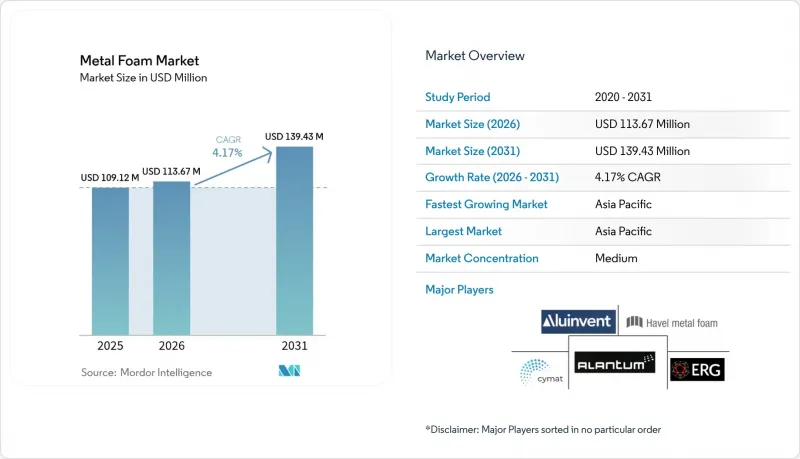
본 보고서는 유형(오픈 셀 폼, 클로즈드 셀 폼, 확률론적 금속 폼), 소재(알루미늄, 구리, 니켈, 기타 소재), 제조 공정(분말 야금법, 용융 발포법 등), 용도(자동차, 항공우주, 산업기계 등), 지역(아시아태평양, 북미, 유럽 등)별로 분류되어 있습니다. 시장 예측은 금액(미 달러) 기준으로 제시되어 있습니다.
세계 금속 폼 시장 동향 및 인사이트
전기차(EV) 및 내연기관(ICE) 승용차 분야의 경량화 수요 급증
세계 자동차 제조업체들은 주행 거리 연장 및 연비 규제 준수를 목표로 차량 경량화를 지속하고 있으며, 셀룰러 메탈은 이 전략에 필수적인 요소로 자리 잡고 있습니다. 테슬라는 ‘모델 Y’의 배터리 하우징 내부에 알루미늄 폼 리브를 통합하여 경량화를 도모하는 동시에 측면 충돌 내성을 강화하고 있습니다. 유럽연합(EU)의 CO₂ 배출량 평균 규제 및 중국의 듀얼 크레딧 제도 역시 마찬가지로, 제조업체들에게 금속 폼 시장이 충족시킬 수 있는 경량 구조로의 전환을 촉진하고 있습니다. 공급망 내 알루미늄 합금에 대한 높은 이해도는 인증 절차를 원활하게 하여, 모델 연도별 채택 주기를 단축시키고 있습니다. 이와 병행하여 철강 제조업체들은 범퍼 빔용 강철과 발포체의 복합 적층재 실험을 진행하고 있어, 알루미늄 이외의 소재 선택지도 넓어지고 있습니다. 자동차 제조업체들이 엔트리급 차종을 전동화함에 따라, 소재 대체는 다운스트림 공정으로 확대되고 있으며, 오픈 셀 및 클로즈드 셀 발포체의 총 시장 규모가 확대되고 있습니다.
항공우주 업계에서 충돌 및 화재 안전용 에너지 흡수재에 대한 관심 증가
규제 당국은 현재 더 오랜 시간 동안 지속되는 풀 화재 시나리오를 견딜 수 있는 객실 및 화물실 구조를 요구하고 있으며, 복합 금속 폼은 825°C 환경에서 100분이 경과한 후에도 보호면 온도를 379°C 이하로 유지함으로써 스테인리스 스틸 패널을 능가하는 성능을 발휘합니다. 따라서 항공기 제조업체들은 손상을 입기 쉬운 기체 하부 외판과 랜딩 기어 페어링에 셀 구조의 알루미늄 및 티타늄 인서트를 지정하고 있습니다. 군용 회전익기 프로그램에서는 탑재량 저하를 초래하지 않으면서 탄도 내성 향상을 우선시하고 있으며, 이것이 강철 발포체 장갑에 대한 틈새 수요를 견인하고 있습니다. 적층 가공 플랫폼을 통해 공급업체는 토폴로지 최적화된 격자 코어를 샌드위치 패널에 성형할 수 있게 되어, 부품 수와 유지보수 시간을 줄일 수 있습니다. 항공 분야의 신소재 인증에는 막대한 투자가 필요하기 때문에 조기에 시장에 진입한 기업들은 장기적인 수주 전망을 확보할 수 있으며, 금속 폼 시장에서 수익 회복력을 강화하고 있습니다.
확장 가능한 용융 발포 및 후가공에는 막대한 투자가 필요합니다.
산업용 용융 발포로는 제어된 가스 분사, 정밀한 단계별 온도 제어 및 급속 냉각에 의존하며, 중규모 생산 라인의 경우 설비 투자액이 400만 달러를 초과하기도 합니다. 중소기업에게 이러한 지출은 감당하기 어려운 수준이며, 금속 폼 업계에서 공급업체의 다양성을 저해하고 있습니다. 후공정인 CNC 트리밍 및 표면 밀봉에는 추가 비용이 소요됩니다. 이는 다공성 격자 구조가 버를 발생시키기 쉬우며, 항공우주용 지그에는 엄격한 공차가 요구되기 때문입니다. 적층 가공는 일부 금형 비용을 절감할 수 있지만, 레이저·파우더 베드 방식은 그 자체로 고액의 설비 투자(CAPEX)가 필요하며, 엄격한 분말 조정 프로토콜도 유지해야 합니다. 북미의 정부 보조금이나 EU의 세액 공제로 인해 부담은 줄어들고 있지만, 현지 은행이 첨단 소재를 ‘고위험’으로 간주하는 신흥 시장에서는 여전히 자금 조달 격차가 남아 있습니다.
부문 분석
2025년 현재, 오픈 셀 폼은 금속 폼 시장 점유율의 48.25%를 차지하고 있으며, 이는 배터리 팩, 열교환기, 데이터센터의 콜드 플레이트에 대한 광범위한 고표면적 코어 수요를 반영합니다. 다공성 덕분에 핫스팟을 분산시키는 대류 흐름이 가능해지는데, 이는 폐쇄형 셀 폼에는 없는 특성입니다. 오픈 셀 부문은 2031년까지 연평균 성장률(CAGR) 4.92%를 나타낼 것으로 예측되며, 금속 폼 시장에서 주도적인 입지를 더욱 공고히 할 전망입니다. 세계과학·공학·기술아카데미(WASET)의 조사에 따르면, 초음파와 오픈 셀 구조를 결합함으로써 전체 열전달 계수를 최대 38%까지 향상시킬 수 있어, 그 응용 사례가 더욱 확대되고 있습니다.
클로즈드 셀 폼은 부력, 침투 저항 및 압축 충격 성능이 중시되는 분야에서 여전히 중요한 역할을 하고 있습니다. 항공기 벌크헤드나 해상 부력 모듈에서는 침수를 방지하기 위해 기밀성이 높은 셀이 채택되고 있습니다. 현재 각 공급업체들은 오픈 셀 코어와 클로즈드 셀 스킨을 결합한 하이브리드 적층재를 제공하며, 단일 패널 내에서 열적 성능, 기계적 성능 및 불투과성을 균형 있게 구현하고 있습니다.
2025년에는 56.55%의 점유율을 차지한 알루미늄은 뛰어난 강도 대 중량비와 용이한 재활용성 덕분에 모빌리티 및 항공우주 분야에서 채택의 대부분을 차지하고 있습니다. 금속 폼 시장에서 알루미늄의 점유율은 항공기 객실 개조 및 프레스 가공 판재를 대체하는 EV 섀시 재설계에 힘입어 2031년까지 연평균 성장률(CAGR) 4.97%로 성장할 전망입니다. 전이 금속을 첨가한 초고강도 알루미늄 합금은 피로 수명을 연장하여 배터리 하우징의 충돌 구역 등 더 높은 하중이 가해지는 영역에서의 사용을 가능하게 합니다.
구리 폼은 전도성이 질량 증가라는 단점을 상쇄하는 전자 기기의 방열재로 활용되고 있는 반면, 니켈 폼은 수소 연료전지나 고온 공정 라인에서 뛰어난 성능을 발휘합니다. 마그네슘 및 강철 변형 제품은 각각 선박 용도나 방폭 장갑 용도에 대응하고 있습니다. 소재 대체 동향은 합금의 가격 차이에 좌우됩니다. 알루미늄 공급이 부족해지는 가운데, OEM 각사는 비용이 증가하더라도 미션 크리티컬한 냉각 용도에 구리 폼 인서트를 채택할 가능성이 있습니다. 따라서 전문 공급업체들은 원자재 가격 변동 위험을 헤지하고 수주의 지속성을 확보하기 위해 분말 제품 포트폴리오를 다각화하고 있습니다.
지역별 분석
2025년, 아시아태평양은 전 세계 매출의 44.10%를 차지했습니다. 광둥성 전역에 걸친 기가팩토리 확장과 위성 추진기용 일본의 정밀 가공된 격자 코어가 맞물려, 2031년까지 해당 지역의 연평균 성장률(CAGR)은 5.03%에 달할 전망입니다. 아세안(ASEAN) 국가들, 특히 베트남과 태국에서는 전자기기 조립의 국내 복귀가 진행되고 있어, 서버 랙용 오픈 셀 구리 폼에 대한 새로운 수요를 창출하고 있습니다. 한국의 재벌들은 수소 트럭용 니켈 폼 생산 능력에 투자하고 있으며, 정부 보조금을 활용하여 전기 주조 라인의 감가상각을 도모하고 있습니다.
북미에서는 원자력 열교환기 및 방위용 장갑 프로그램에 대한 연방 정부의 자금 지원이 시장을 뒷받침하고 있습니다. Advanced Materials Manufacturing사는 원자로 모듈용 니켈계 복합 폼의 양산화를 위해 310만 달러의 보조금을 확보했습니다. 멕시코 코아우일라주의 자동차 산업 클러스터에서는 경량 프레임용으로 알루미늄 폼이 지정되어 있어, 북미 대륙 전체 수요 다양성이 확보되고 있습니다. 캐나다의 CYMAT Technologies사는 프랑스 군용 SmartMetal 실린더 2만 1,000개를 수주했으며, 이는 지역 기업이 틈새 전문 기술을 전 세계 고객에게 수출하고 있는 실제 사례를 보여줍니다.
유럽에서는 지속가능성과 고급 엔지니어링이 중시되고 있습니다. 독일의 한 공급업체는 고급 전기차 차체 프레임용으로 탄소섬유 샌드위치 패널에 폼 코어를 통합하고 있는데, 이는 저배출 소재를 우선시하는 EU의 탄소국경조정메커니즘에 부합하는 조치입니다. 프랑스의 수소 클러스터에서는 니켈 폼으로 만든 방열판의 시범 운영이 진행되고 있는 반면, 이탈리아의 생의학 분야 스타트업은 고관절 임플란트용 탄탈륨 격자 구조를 3D 프린팅으로 제조하고 있습니다. 남미와 중동의 신흥 산업국에서는 모듈식 건축물의 외벽이나 해수 담수화 장치에 알루미늄 폼이 채택되어, 금속 폼 시장에 점진적이면서도 꾸준히 증가하는 수요를 창출하고 있습니다.
기타 혜택:
- 엑셀 형식 시장 예측(ME) 시트
- 3개월간의 애널리스트 지원
자주 묻는 질문
목차
제1장 서론
제2장 조사 방법
제3장 주요 요약
제4장 시장 구도
제5장 시장 규모와 성장 예측
제6장 경쟁 구도
제7장 시장 기회와 향후 전망
JHS 26.08.26According to Mordor Intelligence, the metal foam market size was valued at USD 109.12 million in 2025 and estimated to grow from USD 113.67 million in 2026 to reach USD 139.43 million by 2031, at a CAGR of 4.17% during the forecast period (2026-2031).
This report is Segmented by Type (Open-Cell Foam, Closed-Cell Foam, and Stochastic Metal Foam), Material (Aluminum, Copper, Nickel, and Other Materials), Manufacturing Process (Powder Metallurgy Route, Melt Foaming Route, and More), Application (Automotive, Aerospace, Industrial Machines, and More), and Geography (Asia-Pacific, North America, Europe, and More). The Market Forecasts are Provided in Terms of Value (USD).
Global Metal Foam Market Trends and Insights
Surging Lightweighting Demand in EV and ICE Passenger Vehicles
Global automakers continue to remove vehicle mass in pursuit of range extension and fuel-economy compliance, and cellular metals have become integral to this strategy. Tesla integrates aluminium foam ribs inside Model Y battery enclosures, trimming weight while bolstering side-impact resistance. The European Union's CO2 fleet-average rules and China's dual-credit system likewise push manufacturers toward lighter architectures that the metal foam market can satisfy. Supply-chain familiarity with aluminium alloys eases qualification, enabling faster model-year adoption cycles. In parallel, steelmakers are experimenting with composite steel-foam laminates for bumper beams, widening material options beyond aluminium. As automakers electrify entry-level nameplates, material substitution moves downstream, enlarging the total available market for open-cell and closed-cell foams.
Intensifying Aerospace Focus on Crash and Fire-Safety Energy Absorbers
Regulators now require cabin and cargo structures that withstand longer-duration pool-fire scenarios, and composite metal foams outperform stainless-steel panels by maintaining protected-side temperatures below 379 °C after 100 minutes at 825 °C. Aircraft makers therefore specify cellular aluminum and titanium inserts for vulnerable belly skins and landing-gear fairings. Military rotor-craft programs prioritize ballistic-limit enhancement without payload penalties, driving niche demand for steel-foam armor. Additive platforms let suppliers print topology-optimized lattice cores into sandwich panels, compressing part counts and maintenance time. Because qualifying new materials in aviation is capital-intensive, early entrants gain durable order visibility, reinforcing revenue resilience in the metal foam market.
High Investment Required for Scalable Melt-Foaming and Post-Machining
Industrial melt-foaming furnaces rely on controlled gas injection, precise temperature staging, and rapid quenching, a capital stack that can exceed USD 4 million for a mid-size line. Small and mid-size enterprises find such outlays prohibitive, curbing supplier diversity in the metal foam industry. Post-process CNC trimming and surface sealing add incremental cost layers because the cellular lattice is prone to burrs and requires tight tolerances in aerospace fixtures. Although additive manufacturing bypasses some tooling expenses, laser-powder-bed systems carry their own high CAPEX and maintain strict powder-conditioning protocols. Government grants in North America and tax credits in the EU soften the burden, but financing gaps persist in emerging markets where local banks label advanced materials as high-risk.
Other drivers and restraints analyzed in the detailed report include:
- Rapid Adoption of Metal-Foam Heat Spreaders in Battery Thermal Packs
- Novel Hydrogen-Fuel-Cell Heat-Exchanger Designs Using Nickel Foams
- Recycling Complexity of Multi-Phase Composite Metal Foams
For complete list of drivers and restraints, kindly check the Table Of Contents.
Segment Analysis
Open-cell foams held 48.25% of the metal foam market share in 2025, reflecting widespread demand for high-surface-area cores in battery packs, heat exchangers, and data-center cold plates. Their porosity enables convective flows that dissipate hot spots, a capability that closed-cell foams lack. The open-cell segment is expected to register a 4.92% CAGR to 2031, reinforcing its leadership in the metal foam market. Research from the World Academy of Science, Engineering and Technology confirms that coupling ultrasound with open-cell structures can raise overall heat-transfer coefficients by up to 38%, strengthening the application case.
Closed-cell foams maintain relevance where buoyancy, infiltration resistance, and compressive crash performance dominate. Aeronautical bulkheads and offshore buoyancy modules rely on gas-tight cells to prevent flooding. Suppliers now offer hybrid laminates that marry an open-cell core with a closed-cell skin, balancing thermal, mechanical, and impermeability performance within a single panel.
At 56.55% share in 2025, aluminium anchors most mobility and aerospace deployments thanks to a favorable strength-to-weight ratio and ready recyclability. The aluminium slice of the metal foam market size is set to expand at 4.97% CAGR through 2031, supported by aircraft cabin retrofits and EV chassis redesigns that displace stamped sheet. Ultrahigh-strength aluminium alloys infused with transition metals extend fatigue life, unlocking higher-load zones such as battery-enclosure crumple zones.
Copper foams serve thermal spreaders in electronics where conductivity trumps mass penalties, while nickel foams excel in hydrogen fuel cells and high-temperature process lines. Magnesium and steel variants address marine and blast-armor applications, respectively. Material substitution dynamics hinge on alloy price spreads; as aluminium tightens, OEMs may adopt copper-foam inserts despite cost for mission-critical cooling. Specialty suppliers therefore diversify powder portfolios to hedge commodity risk and preserve order continuity.
Complete Report Scope:
- By Type
- Open-Cell Foam
- Closed-Cell Foam
- Stochastic Metal Foam
- By Material
- Aluminum
- Copper
- Nickel
- Other Materials (Magnesium, Steel, Alloys)
- By Manufacturing Process
- Powder Metallurgy Route
- Melt Foaming Route
- Additive Manufacturing / 3-D Printing
- Other Manufacturing Processes (CVD and Electro-Deposition, etc.)
- By Application
- Automotive
- Aerospace
- Industrial Machines
- Construction
- Biomedical
- Other Applications (Marine and Rail, Energy and Power, etc.)
- By Geography
- Asia-Pacific
- China
- Japan
- India
- South Korea
- ASEAN Countries
- Rest of Asia-Pacific
- North America
- United States
- Canada
- Mexico
- Europe
- Germany
- United Kingdom
- France
- Italy
- Spain
- Russia
- NORDIC Countries
- Rest of Europe
- South America
- Brazil
- Argentina
- Rest of South America
- Middle-East and Africa
- Saudi Arabia
- South Africa
- Rest of Middle-East and Africa
- Asia-Pacific
Geography Analysis
Asia-Pacific accounted for 44.10% of global revenue in 2025. Expansion of gigafactories across Guangdong, coupled with Japan's precision-machined lattice cores for satellite thrusters, underpins a 5.03% regional CAGR to 2031. ASEAN economies, notably Vietnam and Thailand, attract the reshoring of electronics assembly, creating fresh pull for open-cell copper foams in server racks. South Korean conglomerates invest in nickel-foam capacity aimed at hydrogen trucks, leveraging government subsidies to amortize electro-forming lines.
North America is buoyed by federal funding for nuclear-energy heat exchangers and defense armor programs. Advanced Materials Manufacturing secured USD 3.1 million in grants to scale nickel-based composite foams for reactor modules. Mexico's automotive corridor in Coahuila specifies aluminium foams for lightweight frames, ensuring continental demand diversity. Canada's CYMAT Technologies won a 21,000-unit order for SmartMetal cylinders for the French armed forces, illustrating how regional firms export niche expertise to global clients.
Europe emphasizes sustainability and high-end engineering. German suppliers integrate foam cores into carbon-fiber sandwich panels for luxury EV cradles, aligning with the EU Carbon Border Adjustment Mechanism that favors low-emissions inputs. French hydrogen clusters pilot nickel-foam heat sinks, while Italian biomedical startups 3-D print tantalum lattices for hip implants. Newly industrializing economies in South America and the Middle East adopt aluminium foams for modular building facades and desalination equipment, contributing incremental yet rising volumes to the metal foam market.
- Admatis
- Alantum
- Aluinvent
- American Elements
- ARMACELL
- CYMAT Technologies Ltd.
- ERG Aerospace
- FoamTech Saudi Arabia
- Havel metal foam GmbH
- hollomet GmbH
- Mayser GmbH and Co. KG
- Metal-Foams New Material Co.,Limited.
- Metecno Group
- Nanoshel LLC
- Ultramet
Additional Benefits:
- The market estimate (ME) sheet in Excel format
- 3 months of analyst support
TABLE OF CONTENTS
1 Introduction
- 1.1 Study Assumptions and Market Definition
- 1.2 Scope of the Study
2 Research Methodology
3 Executive Summary
4 Market Landscape
- 4.1 Market Overview
- 4.2 Market Drivers
- 4.2.1 Surging Lightweighting Demand in EV And ICE Passenger Vehicles
- 4.2.2 Intensifying Aerospace Focus on Crash and Fire Safety Energy Absorbers
- 4.2.3 Rapid Adoption of Metal-Foam Heat Spreaders in Battery Thermal Packs
- 4.2.4 Novel Hydrogen-Fuel-Cell Heat-Exchanger Designs Using Nickel Foams
- 4.2.5 Custom 3-D Printed Bio-Implant Foams Accelerating Orthopaedic Uptake
- 4.3 Market Restraints
- 4.3.1 High Investment Required for Scalable Melt-Foaming and Post-Machining
- 4.3.2 Limited Industrial?Grade Volume Availability Outside Aluminium
- 4.3.3 Recycling Complexity of Multi-Phase Composite Metal Foams
- 4.4 Value Chain Analysis
- 4.5 Porter's Five Forces Analysis
- 4.5.1 Threat of New Entrants
- 4.5.2 Bargaining Power of Buyers
- 4.5.3 Bargaining Power of Suppliers
- 4.5.4 Threat of Substitutes
- 4.5.5 Degree of Competition
5 Market Size and Growth Forecasts (Value)
- 5.1 By Type
- 5.1.1 Open-Cell Foam
- 5.1.2 Closed-Cell Foam
- 5.1.3 Stochastic Metal Foam
- 5.2 By Material
- 5.2.1 Aluminum
- 5.2.2 Copper
- 5.2.3 Nickel
- 5.2.4 Other Materials (Magnesium, Steel, Alloys)
- 5.3 By Manufacturing Process
- 5.3.1 Powder Metallurgy Route
- 5.3.2 Melt Foaming Route
- 5.3.3 Additive Manufacturing / 3-D Printing
- 5.3.4 Other Manufacturing Processes (CVD and Electro-Deposition, etc.)
- 5.4 By Application
- 5.4.1 Automotive
- 5.4.2 Aerospace
- 5.4.3 Industrial Machines
- 5.4.4 Construction
- 5.4.5 Biomedical
- 5.4.6 Other Applications (Marine and Rail, Energy and Power, etc.)
- 5.5 By Geography
- 5.5.1 Asia-Pacific
- 5.5.1.1 China
- 5.5.1.2 Japan
- 5.5.1.3 India
- 5.5.1.4 South Korea
- 5.5.1.5 ASEAN Countries
- 5.5.1.6 Rest of Asia-Pacific
- 5.5.2 North America
- 5.5.2.1 United States
- 5.5.2.2 Canada
- 5.5.2.3 Mexico
- 5.5.3 Europe
- 5.5.3.1 Germany
- 5.5.3.2 United Kingdom
- 5.5.3.3 France
- 5.5.3.4 Italy
- 5.5.3.5 Spain
- 5.5.3.6 Russia
- 5.5.3.7 NORDIC Countries
- 5.5.3.8 Rest of Europe
- 5.5.4 South America
- 5.5.4.1 Brazil
- 5.5.4.2 Argentina
- 5.5.4.3 Rest of South America
- 5.5.5 Middle-East and Africa
- 5.5.5.1 Saudi Arabia
- 5.5.5.2 South Africa
- 5.5.5.3 Rest of Middle-East and Africa
- 5.5.1 Asia-Pacific
6 Competitive Landscape
- 6.1 Market Concentration
- 6.2 Strategic Moves
- 6.3 Market Share(%)/Ranking Analysis
- 6.4 Company Profiles (includes Global-level Overview, Market-level Overview, Core Segments, Financials, Strategic Info, Market Rank/Share, Products and Services, Recent Developments)
- 6.4.1 Admatis
- 6.4.2 Alantum
- 6.4.3 Aluinvent
- 6.4.4 American Elements
- 6.4.5 ARMACELL
- 6.4.6 CYMAT Technologies Ltd.
- 6.4.7 ERG Aerospace
- 6.4.8 FoamTech Saudi Arabia
- 6.4.9 Havel metal foam GmbH
- 6.4.10 hollomet GmbH
- 6.4.11 Mayser GmbH and Co. KG
- 6.4.12 Metal-Foams New Material Co.,Limited.
- 6.4.13 Metecno Group
- 6.4.14 Nanoshel LLC
- 6.4.15 Ultramet
7 Market Opportunities and Future Outlook
- 7.1 White-space and Unmet-Need Assessment


