

|
시장보고서
상품코드
2114944
항균 첨가제 시장 : 시장 점유율 분석, 업계 동향 및 통계, 성장 예측(2026-2031년)Antimicrobial Additive - Market Share Analysis, Industry Trends & Statistics, Growth Forecasts (2026 - 2031) |
||||||
 Mordor Intelligence
Mordor Intelligence에 의하면, 2026년 항균 첨가제 시장 규모는 55억 1,000만 달러로 추정되고, 2025년 51억 9,000만 달러에서 확대해, 2031년에는 74억 5,000만 달러에 이를 것으로 예측됩니다.
2026-2031년 연평균 성장률(CAGR) 6.20%로 성장할 것으로 전망됩니다.
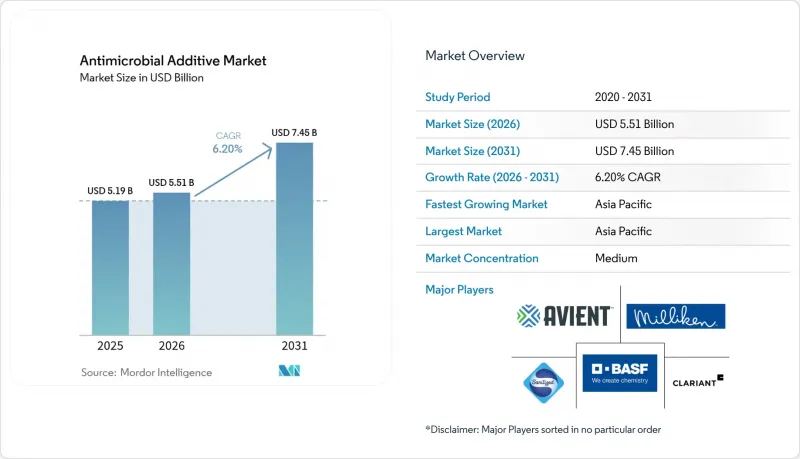
본 보고서에서는 산업을 유형별(무기계, 유기계), 캐리어 재료별(플라스틱, 페인트 및 코팅, 기타), 최종 사용자 산업별(건설, 헬스케어, 기타), 지역별(아시아태평양, 북미, 유럽, 남미, 중동 및 아프리카)로 분류하고 있습니다. 시장 전망은 금액(달러) 단위로 표시되어 있습니다.
세계의 항균 첨가제 시장 동향 및 인사이트
식품용 위생 포장재 수요의 급증
소비자들은 현재 유해한 미생물을 적극적으로 억제하는 포장을 기대하고 있으며, 이에 따라 항균 첨가제 시장에서는 식품과의 직접 접촉이 승인된 은 산화아연, 천연 박테리오신 계열 제품이 공급되고 있습니다. 2024년에 갱신된 FDA 지침에 따라 신규 유효 성분의 승인 절차가 간소화되었으며, 공급업체는 식품 폐기물을 줄이면서 유통 기한을 30-50% 연장하는 서방형 제제를 배합하도록 권장받고 있습니다. ‘클린 라벨’ 트렌드에 따라 식물 유래 방부제로의 전환이 더욱 가속화되고 있으며, 브랜드 소유주들은 소매점에서 항균 성능을 입증하기 위해 QR 코드를 통한 추적 시스템을 도입하고 있습니다. 이러한 동향은 안전성과 지속가능성을 결합하여 차세대 액티브 포장에 대한 전 세계적 수요를 견인하고 있습니다.
의료 및 제약 시설의 감염 관리 기준 강화
의료 관련 감염증은 미국에 연간 46억 달러의 비용을 발생시키고 있어, 병원 내 항균 표면에 대한 관심이 높아지고 있습니다. 2024년에 확립된 FDA의 신속 승인 절차에 따라 코팅이 적용된 의료기기의 승인 리드타임이 40% 단축되어, 산화구리 나노 입자가 코팅된 카테터나 은 팔라듐이 코팅된 수술 기구가 신속하게 시장에 출시될 수 있게 되었습니다. 마찬가지로, 제약 산업의 클린룸에서도 무균 생산을 유지하기 위해 항균성 벽 패널, 바닥재, HVAC 코팅이 규정되어 있으며, 이러한 첨가제는 단순한 선택적 기능에서 필수적인 인프라로 그 위상이 변화하고 있습니다.
항균 첨가제의 독성
강화된 EU의 살생물제 규제로 인해 시장 진입 전에 상세한 위험 평가 자료의 제출이 의무화되었으며, 트리클로산 및 기타 기존 살생물제가 엄격한 심사 대상이 되고 있습니다. 미국 규제 당국은 내분비계 및 미생물군집에 미치는 영향을 평가하고 있으며, 이에 따라 제제 개발자들은 생분해성 폴리머나 에센셜 오일 유래의 유효 성분으로 전환해야 하는 상황에 직면해 있습니다. 수생 환경 내 은 나노입자의 축적에 대한 우려로 인해, 생태계에 악영향을 미치지 않으면서도 효능을 유지하기 위해 표적 지향형 전달 기술 및 투여량 감소를 위한 연구가 진행되고 있습니다.
부문 분석
2025년 시점에서 무기계 제제는 항균 첨가제 시장 점유율의 61.68%를 차지했으며, 이는 항균 첨가제 시장 전체 규모에서 상당한 비중을 차지하고 있어, 광범위한 효능 면에서 은이 오랫동안 쌓아온 평가를 뒷받침하고 있습니다. 은 나노 입자는 여러 산화 기전을 통해 세균의 세포막을 파괴하며, MRSA 및 카르바페넴 내성 균주에 대해 급속한 내성 발생을 유발하지 않으면서 확실한 살균률을 발휘합니다. 산화구리와 피리티온 아연은 특히 가격 민감도가 높아 은의 채택을 제한하는 건축용 도료 및 선박용 도료 분야에서 비용 대비 효과가 높은 대체재로 자리 잡고 있습니다.
유기계 제품은 현재 매출 기준으로는 규모가 작지만, 연평균 성장률(CAGR) 9.62%로 확대되고 있으며, 항균 첨가제 시장을 꾸준히 변화시키고 있습니다. 타임, 오레가노, 시나몬 등의 에센셜 오일은 강력한 항균 활성과 생분해성을 겸비하고 있어, 규제 당국과 환경 의식이 높은 구매자들에게 지지를 받고 있습니다. 유산균 유래 박테리오신은 유익한 미생물 군집을 손상시키지 않는 좁은 범위의 효능을 보여주고 있으며, 이러한 특성은 의료 및 식품 부문에서 높이 평가받고 있습니다. 키토산 유래 폴리머는 피막 형성 특성과 천연 항균 작용을 겸비하고 있어, 상처 피복재 및 지속 가능한 포장재에서의 용도가 확대되고 있습니다.
이러한 동향에 따라 2031년까지는 무기계 제품이 항균 첨가제 시장의 기반을 유지할 것으로 보이지만, 성능의 동등성이 향상되고 규제상의 인센티브가 저독성 접근 방식을 뒷받침함에 따라 유기계 대체품 시장 점유율이 점차 확대될 것으로 예측됩니다.
지역별 분석
아시아태평양은 2025년에 전 세계 매출의 39.08%를 차지했으며, 연평균 성장률(CAGR) 8.78%로 성장하고 있어 항균 첨가제 시장의 핵심으로 자리 잡고 있습니다. 중국의 병원 현대화 진행, 인도의 의약품 제조 확대, 싱가포르의 박테리오파지 연구 프로그램이 맞물려 고도의 감염 방지 소재에 대한 수요를 뒷받침하고 있습니다. 인도네시아와 베트남의 건설 붐은 방균 도료 및 실런트에 대한 수요를 더욱 높이고 있습니다. BASF나 다우(Dow)와 같은 다국적 기업들은 현지 규제의 미세한 차이에 맞춘 배합을 개발하기 위해 합작 투자를 확대하고 있는 반면, 지역의 신생 기업들은 비용 면에서의 우위를 활용하여 중견 부문에 공급하고 있습니다.
북미는 의료기기, 식품 포장, 첨단 폴리머 부문에서 성숙해 가면서도 수익성이 높은 최종 사용자 기반을 보유하고 있습니다. 식품 접촉 재료용 항균 첨가제의 승인 절차를 간소화하는 최근 FDA의 지침은 개발 파이프라인의 진전을 뒷받침하고 있는 반면, 의료 분야의 조달 예산에서는 실적이 입증된 광범위한 효과를 발휘하는 코팅이 우선시되고 있습니다. 순환형 경제 목표에 따라 재활용 플라스틱, 특히 접촉에 민감한 용도에서의 항균 마스터배치 사용이 가속화되고 있습니다.
유럽에서는 시장 진입 장벽을 높이는 한편, 보다 친환경적인 화학 물질의 연구 개발을 촉진하는 엄격한 살생물제 규제가 유지되고 있습니다. 건설업체들은 에너지 절약 건물에 대한 곰팡이 방지 기준을 충족하기 위해 항균성 건식 벽체와 지붕용 방수 시트를 채택하고 있습니다. 소비자의 선호도는 천연 유래 및 생분해성 솔루션으로 기울고 있으며, 공급업체들은 마케팅에서 투명성과 친환경 라벨을 강조하고 있습니다.
남미와 중동 및 아프리카는 절대액 기준으로는 규모가 작지만, 기회가 확대되고 있습니다. 브라질의 유통업체은 도료 및 윤활유용 살균제 포트폴리오를 확충하고 있는 반면, 걸프 지역 국가들에서는 감염 관리 의무와 부합하도록 병원 투자가 진행되고 있습니다. 이 지역 전반에 걸쳐 규제가 점차 성숙해짐에 따라, 국제적인 모범 사례가 항균제 조달 기준을 서서히 형성해 나갈 것으로 확실시되고 있습니다.
기타 혜택
- 엑셀 형식 시장 예측(ME) 시트
- 3개월간의 애널리스트 지원
자주 묻는 질문
목차
제1장 서론
제2장 조사 방법
제3장 주요 요약
제4장 시장 구도
제5장 시장 규모 및 성장 예측
제6장 경쟁 구도
제7장 시장 기회 및 향후 전망
AJY 26.08.28According to Mordor Intelligence, antimicrobial additives market size in 2026 is estimated at USD 5.51 billion, growing from 2025 value of USD 5.19 billion with 2031 projections showing USD 7.45 billion, growing at 6.20% CAGR over 2026-2031.
This report Segments the Industry by Type (Inorganic and Organic), Carrier Material (Plastics, Paints and Coatings, and More), End-User Industry (Construction, Healthcare, and More), and Geography (Asia-Pacific, North America, Europe, South America, and Middle East and Africa). The Market Forecasts are Provided in Terms of Value (USD).
Global Antimicrobial Additive Market Trends and Insights
Boom in Hygienic Food-Grade Packaging Demand
Consumers now expect packaging that actively suppresses harmful microbes, prompting the antimicrobial additives market to supply silver, zinc oxide, and natural bacteriocin systems certified for direct food contact. Updated FDA guidance in 2024 simplifies clearance for novel actives, encouraging suppliers to embed controlled-release agents that extend shelf life by 30-50% while cutting food waste. Clean-label trends reinforce the pivot toward plant-based preservatives, and brand owners adopt QR-code traceability to evidence antimicrobial performance at retail. These developments intertwine safety and sustainability, driving global demand for next-generation active packaging.
Stricter Infection-Control Norms in Healthcare & Pharma Plants
Healthcare-associated infections cost the United States USD 4.6 billion yearly, intensifying hospital focus on antimicrobial surfaces. Accelerated FDA pathways established in 2024 shorten approval lead-times for coated devices by 40%, bringing copper-oxide nanoparticle catheters and silver-parylene surgical tools to market swiftly. Pharmaceutical cleanrooms likewise specify antimicrobial wall panels, flooring, and HVAC coatings to uphold aseptic production, recasting these additives from optional features into essential infrastructure.
Toxic Nature of Antimicrobial Additives
Rigorous EU Biocidal Products Regulation now demands extensive risk dossiers before market entry, placing triclosan and other legacy biocides under intense review. U.S. agencies weigh endocrine and microbiome effects, spurring formulators to pivot toward biodegradable polymers and essential-oil actives. Concerns about silver nanoparticle accumulation in aquatic habitats push research into targeted delivery and lower dosage thresholds to uphold efficacy without ecological harm.
Other drivers and restraints analyzed in the detailed report include:
- Surge in Antimicrobial Masterbatch Used in Recycled Plastics
- Growing Usage in Plastic Applications
- Volatility in Raw Material Prices
For complete list of drivers and restraints, kindly check the Table Of Contents.
Segment Analysis
Inorganic formulations accounted for 61.68% of the antimicrobial additives market share in 2025, translating to a sizable portion of the overall antimicrobial additives market size and underscoring silver's long-standing reputation for broad-spectrum efficacy. Silver nanoparticles rupture bacterial membranes through multiple oxidative mechanisms, delivering reliable kill rates against MRSA and carbapenem-resistant strains without prompting rapid resistance. Copper oxide and zinc pyrithione provide cost-effective alternatives, especially in construction paints and marine coatings where price sensitivity limits silver's reach.
Organic systems, while representing a smaller revenue base today, are expanding at a 9.62% CAGR and steadily reshaping the antimicrobial additives market. Essential oils such as thyme, oregano, and cinnamon exhibit potent antimicrobial activity combined with biodegradability, appealing to regulators and eco-conscious buyers. Bacteriocins sourced from lactic-acid bacteria offer narrow-spectrum efficacy that spares beneficial flora, a trait valued in medical and food applications. Chitosan-derived polymers offer film-forming properties and natural antimicrobial action, broadening usage in wound dressings and sustainable packaging.
These dynamics indicate that although inorganic chemistries will continue to anchor the antimicrobial additives market through 2031, organic alternatives are set to capture incremental share as performance parity improves and regulatory incentives favor low-tox approaches.
Complete Report Scope:
- By Type
- Inorganic
- Organic
- By Carrier Material
- Plastics
- Paints and Coatings
- Pulp and Paper
- Textiles and Fibers
- Silicone and Elastomers
- Other Carrier Materials
- By End-User Industry
- Construction
- Healthcare
- Automotive
- Food and Beverage
- Other End-User Industries
- By Geography
- Asia-Pacific
- China
- Japan
- India
- South Korea
- Rest of Asia-Pacific
- North America
- United States
- Canada
- Mexico
- Europe
- Germany
- United Kingdom
- France
- Italy
- Rest of Europe
- South America
- Brazil
- Argentina
- Rest of South America
- Middle-East and Africa
- Saudi Arabia
- South Africa
- Rest of Middle-East and Africa
- Asia-Pacific
Geography Analysis
Asia-Pacific steered 39.08% of global revenue in 2025 and is climbing at an 8.78% CAGR, making it the fulcrum of the antimicrobial additives market. China's ongoing hospital modernization, India's scale-up of pharmaceutical manufacture, and Singapore's bacteriophage research programs together fuel demand for advanced infection-control materials. Construction booms in Indonesia and Vietnam further amplify needs for mold-resistant paints and sealants. Multinationals such as BASF and Dow expand joint ventures to tailor formulations for local regulatory nuances, while regional challengers leverage cost advantages to supply mid-tier segments.
North America commands mature yet lucrative end-user bases in medical devices, food packaging, and advanced polymers. Recent FDA guidance that simplifies antimicrobial additive clearance for food contact materials stimulates pipeline movement, while healthcare procurement budgets prioritize proven, broad-spectrum coatings. Circular-economy targets accelerate use of antimicrobial masterbatch in recycled plastics, especially for contact-sensitive applications.
Europe maintains stringent biocide regulations that both elevate market entry barriers and stimulate R&D into greener chemistries. Builders adopt antimicrobial drywall and roofing membranes to meet mold-management standards in energy-efficient structures. Consumer preference skews toward natural and biodegradable solutions, prompting suppliers to emphasize transparency and eco-labels in marketing.
South America and Middle East & Africa, although smaller in absolute dollars, present rising opportunities. Brazil's distributors broaden biocide portfolios for coatings and lubricants, while Gulf states align hospital investments with infection-control mandates. Regulatory maturation across these regions ensures that international best practices progressively shape antimicrobial procurement criteria.
- Addmaster (U.K.) Limited
- Ampacet Corporation
- Arxada AG
- Avient Corporation
- Bactiblock
- BASF
- BioCote Limited
- Clariant
- Dow
- LG
- Microban International
- Milliken & Company
- Momentive
- Radical Materials Ltd.
- RTP Company
- SANITIZED AG
- Symphony Environmental Ltd.
Additional Benefits:
- The market estimate (ME) sheet in Excel format
- 3 months of analyst support
TABLE OF CONTENTS
1 Introduction
- 1.1 Study Assumptions & Market Definition
- 1.2 Scope of the Study
2 Research Methodology
3 Executive Summary
4 Market Landscape
- 4.1 Market Overview
- 4.2 Market Drivers
- 4.2.1 Boom in hygienic food-grade packaging demand
- 4.2.2 Stricter infection-control norms in healthcare & pharma plants
- 4.2.3 Surge in antimicrobial masterbatch used in recycled plastics
- 4.2.4 Growing usage of antimicrobial additive in plastic application
- 4.2.5 Growing utilization from the construction industry
- 4.3 Market Restraints
- 4.3.1 Toxic nature of antimicrobial additives
- 4.3.2 Volatility in raw material prices
- 4.3.3 High production cost
- 4.4 Value Chain Analysis
- 4.5 Porter's Five Forces
- 4.5.1 Threat of New Entrants
- 4.5.2 Bargaining Power of Buyers
- 4.5.3 Bargaining Power of Suppliers
- 4.5.4 Threat of Substitutes
- 4.5.5 Degree of Competition
5 Market Size & Growth Forecasts (Value)
- 5.1 By Type
- 5.1.1 Inorganic
- 5.1.2 Organic
- 5.2 By Carrier Material
- 5.2.1 Plastics
- 5.2.2 Paints and Coatings
- 5.2.3 Pulp and Paper
- 5.2.4 Textiles and Fibers
- 5.2.5 Silicone and Elastomers
- 5.2.6 Other Carrier Materials
- 5.3 By End-User Industry
- 5.3.1 Construction
- 5.3.2 Healthcare
- 5.3.3 Automotive
- 5.3.4 Food and Beverage
- 5.3.5 Other End-User Industries
- 5.4 By Geography
- 5.4.1 Asia-Pacific
- 5.4.1.1 China
- 5.4.1.2 Japan
- 5.4.1.3 India
- 5.4.1.4 South Korea
- 5.4.1.5 Rest of Asia-Pacific
- 5.4.2 North America
- 5.4.2.1 United States
- 5.4.2.2 Canada
- 5.4.2.3 Mexico
- 5.4.3 Europe
- 5.4.3.1 Germany
- 5.4.3.2 United Kingdom
- 5.4.3.3 France
- 5.4.3.4 Italy
- 5.4.3.5 Rest of Europe
- 5.4.4 South America
- 5.4.4.1 Brazil
- 5.4.4.2 Argentina
- 5.4.4.3 Rest of South America
- 5.4.5 Middle-East and Africa
- 5.4.5.1 Saudi Arabia
- 5.4.5.2 South Africa
- 5.4.5.3 Rest of Middle-East and Africa
- 5.4.1 Asia-Pacific
6 Competitive Landscape
- 6.1 Market Concentration
- 6.2 Strategic Moves
- 6.3 Market Share (%)/Ranking Analysis
- 6.4 Company Profiles (includes Global-level Overview, Market-level Overview, Core Segments, Financials as available, Strategic Information, Market Rank/Share for key companies, Products & Services, and Recent Developments)
- 6.4.1 Addmaster (U.K.) Limited
- 6.4.2 Ampacet Corporation
- 6.4.3 Arxada AG
- 6.4.4 Avient Corporation
- 6.4.5 Bactiblock
- 6.4.6 BASF
- 6.4.7 BioCote Limited
- 6.4.8 Clariant
- 6.4.9 Dow
- 6.4.10 LG
- 6.4.11 Microban International
- 6.4.12 Milliken & Company
- 6.4.13 Momentive
- 6.4.14 Radical Materials Ltd.
- 6.4.15 RTP Company
- 6.4.16 SANITIZED AG
- 6.4.17 Symphony Environmental Ltd.
7 Market Opportunities & Future Outlook
- 7.1 White-space & Unmet-Need Assessment


