

|
시장보고서
상품코드
2114946
금속 스테아레이트 시장 : 점유율 분석, 업계 동향과 통계, 성장 예측(2026-2031년)Metallic Stearate - Market Share Analysis, Industry Trends & Statistics, Growth Forecasts (2026 - 2031) |
||||||
 Mordor Intelligence
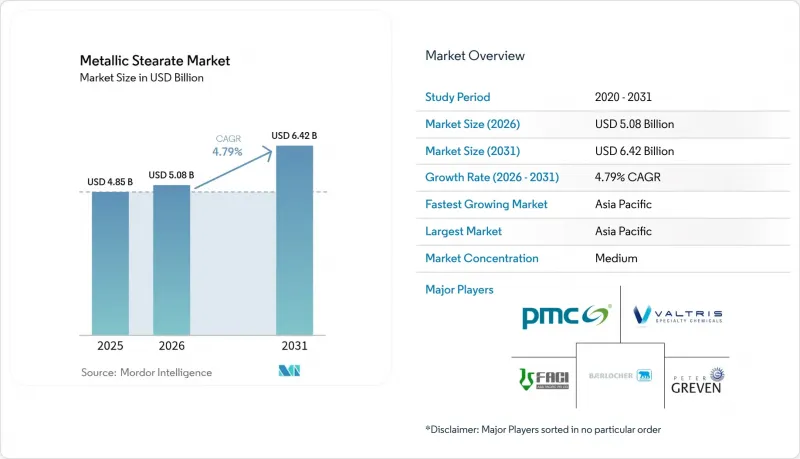
Mordor Intelligence에 의하면, 금속 스테아레이트 시장 규모는 2025년에 48억 5,000만 달러로 평가되었고 2026년 50억 8,000만 달러에서 2031년까지 64억 2,000만 달러에 이를 것으로 예측되며, 예측 기간(2026-2031년) CAGR은 4.79%를 나타낼 전망입니다.
본 보고서는 제품 유형(아연 스테아레이트, 칼슘 스테아레이트 등),형태(분말, 플레이크, 과립, 수성 분산액), 최종 사용자 산업(플라스틱, 고무, 의약품 등), 지역(아시아태평양, 북미, 유럽, 남미, 중동 및 아프리카)별로 세분화되어 있습니다. 시장 예측은 금액(미 달러) 기준으로 제시되어 있습니다.
세계 금속 스테아레이트 시장 동향 및 인사이트
전 세계 플라스틱 생산의 급속한 확대
폴리에틸렌 및 폴리프로필렌 생산량 증가에 따라, 가공업체들이 사이클 타임 단축 및 표면 마감 개선을 위해 금속 스테아레이트에 의존하고 있어 첨가제 수요가 증가하고 있습니다. 차량의 경량화 설계와 재생 소재를 사용한 포장의 보급으로 인해, 변색 및 열 열화에 견디는 안정적인 배합에 대한 수요가 높아지고 있습니다. 중국이 폴리머 생산 능력에서 주도적인 위치를 차지하고 있어 해당 지역의 소비는 계속해서 견조한 반면, 동남아시아의 통합된 공급망은 원료의 가용성과 비용 면에서의 이점을 모두 제공합니다. 배터리 케이스나 태양광 발전용 백시트와 같은 새로운 용도의 등장으로 성장은 기존 부문을 넘어 확대되고 있습니다. 자동차, 건축자재, 연포장 등 각 부문에 걸친 이러한 다양한 수요가 금속 스테아레이트 시장의 견실한 전망을 뒷받침하고 있습니다.
의약품 정제 생산량의 급증
평균 수명의 연장 및 생물학적 제제의 혁신으로 인해 전 세계 고형 제제 생산량은 증가 추세를 보이고 있으며, 검증된 윤활제로서 스테아린산 마그네슘의 역할이 커지고 있습니다. 2012년부터 2023년 사이, 미국 식품의약국(FDA)은 비결정질 고체 분산체를 이용한 48건의 신약을 승인했습니다. 이 제형 분류에서 금속 스테아레이트는 안정성과 압축성을 향상시킵니다. 연속 제조 플랫폼에서는 분진 발생을 억제하고 세척 주기를 단축하는 수성 분산체가 선호되므로, 액상 제형에의 채택이 더욱 촉진되고 있습니다. 인도의 제네릭 의약품 시장 확대와 라틴아메리카의 주사제에서 경구제로의 전환으로 인해 수요 기반이 확대되고 있습니다. 그 결과, 규제 시장에서 경쟁력을 유지하기 위해 엔도톡신 한계치가 엄격하게 규정된 고순도 등급을 선호하는 의약품 업계의 추세가 나타나고 있습니다.
더욱 엄격해진 직업적 노출 한계치
미국 국립직업안전보건연구소(NIOSH)는 스테아린산 아연 분진에 대해 시간 가중 평균치로 총 입자상 물질 10 mg/m3, 호흡성 입자상 물질 5 mg/m3를 규정하고 있습니다. 세계 조화 시스템(GHS)에 따라 개정된 유해성 정보 전달 기준에 따라, 제조업체는 안전 데이터 시트 업데이트, 라벨 변경 및 집진 설비에 대한 투자를 의무화하고 있습니다. 작업장에서는 공기 중의 입자를 최소화하기 위해 과립이나 액체 분산액으로의 전환이 진행되고 있으며, 이로 인해 전환 비용은 증가하지만 고가 책정 기회가 생기고 있습니다. 소규모 컴파운더는 설비 투자를 미룰 가능성이 있어, 기존 분말 등급에 대한 수요는 일시적으로 주춤할 것입니다. 그러나 규제의 지속적인 시행으로 인해 2027년까지 금속 스테아레이트 시장은 보다 안전한 공급 형태로 전환될 것으로 예측됩니다.
부문 분석
아연 스테아레이트는 PVC, 고무, 화장품 제형에서 높은 범용성으로 인해 필수적인 첨가제가 되었으며, 2025년에는 금속 스테아레이트 시장에서 41.75%의 점유율을 차지했습니다. 각 컴파운더 기업들은 그 윤활성, 이형성, 열안정성의 균형이 뛰어나다는 점을 높이 평가하고 있어 수요는 견조한 추세를 보이고 있습니다. 재활용 소재를 많이 포함하는 폴리올레핀 블렌드의 경우, 균일한 용융 유동성을 실현하기 위해 효율적인 내부 윤활제가 필요하기 때문에 수요가 서서히 증가하고 있습니다. 대조적으로, 스테아린산 마그네슘은 적절한 압축성을 얻기 위해 0.25-5 중량%의 농도가 필요한 의약품 정제의 생산량이 급증하고 있어, 2031년까지 연평균 성장률(CAGR) 6.15%를 나타낼 것으로 예측됩니다. 규제 측면에서의 높은 인지도와 낮은 독성이 이러한 지속적인 성장을 뒷받침하고 있습니다. 칼슘 스테아레이트는 콘크리트용 방수 혼화제 및 시멘트계 제품의 백화 현상 억제를 통해 안정적인 성장을 보이고 있는 반면, 알루미늄 스테아레이트는 높은 겔 강도가 필수적인 틈새 코팅 용도나 윤활 그리스 용도로 사용되고 있습니다. 하이브리드형 아연·칼슘 계열 등급을 대상으로 한 학술적 공동 연구는 기능성을 맞춤화하는 광범위한 동향을 보여주고 있으며, 금속 스테아레이트 시장에서 아연 스테아레이트가 성숙한 위치를 차지하고 있음에도 불구하고 새로운 혁신의 조짐을 보이고 있습니다.
스테아린산 나트륨 및 스테아린산 칼륨으로 구성된 두 번째 계층은 생분해성을 요구하는 퍼스널케어용 세정제 및 산업용 세제에 대응하고 있습니다. 스테아린산 칼륨의 높은 용해성은 황산염이 함유되지 않은 샴푸에서 주목을 받고 있는 반면, 스테아린산 나트륨은 고형 비누의 투명도를 높이는 역할을 하고 있습니다. 시장을 선도하는 기업들은 급성장하는 소비재에 대한 규제 요건을 충족하기 위해 코셔 및 할랄 인증을 제공함으로써 차별화를 꾀하고 있습니다. 모든 화학 조성에 있어 구매자들은 지속 가능한 방식으로 조달된 지방산에 대해 더욱 엄격한 금속 함량 사양과 추적성을 요구하고 있습니다. 이러한 특성은 주문 결정에 점점 더 큰 영향을 미치고 있으며, 지방산과 금속염의 가공을 일원적으로 관리하는 완전 통합형 공급업체의 경쟁 우위를 강화하고 있습니다.
지역별 분석
아시아태평양은 2025년 매출의 50.85%를 차지하며 주도적인 위치를 차지하고 있으며, 2031년까지 연평균 성장률(CAGR) 5.61%로 확대될 것으로 예측됩니다. 중국은 수지 및 고무 생산량의 대부분을 차지하며, 스테아린산 아연 및 스테아린산 칼슘의 국내 소비를 견인하고 있습니다. 한편, 인도의 화학 부문은 2022년 2,200억 달러에서 2025년에는 3,000억 달러로 확대될 전망이며, 이는 해당 지역의 특수 첨가제 수요를 더욱 심화시키고 있습니다. 동남아시아 국가들은 수출 지향형 금속 스테아레이트 제조 공장에 원료를 공급하는 팜유 유래 지방산을 통합적으로 제공함으로써 공급망의 효율성과 경쟁력 있는 가격 책정을 뒷받침하고 있습니다.
북미는 시장 규모에서 2위를 차지하고 있습니다. 이는 해당 지역의 제약 제조 거점에 현행 우수 제조 기준(GMP) 인증을 필수로 하는 대규모 부형제 구매자들이 집중되어 있기 때문입니다. 전선, 케이블, 비닐 사이딩 분야에서 무연 PVC 컴파운드로의 전환이 추가적인 수요를 견인하고 있습니다. 캐나다의 인프라 부양책에 따라 스테아린산 칼슘으로 처리된 콘크리트 첨가제가 고속도로 및 교량 건설 프로젝트에 활용되면서 완만한 성장을 뒷받침하고 있습니다. 유럽은 친환경 설계 및 순환 경제의 최전선에 위치해 있으며, PVC용 칼슘·아연 안정제 시스템을 조기에 도입한 기업들을 보유하고 있을 뿐만 아니라, 고순도 스테아린산 등급을 선호하는 규제 준수를 위한 투자를 확대되고 있습니다. 독일과 이탈리아에는 유럽 전역의 플라스틱 네트워크에 공급하는 주요 마스터배치 제조업체들이 거점을 두고 있습니다.
남미에서는 주로 브라질의 PVC 파이프 및 신발 산업에서 기초 수요량은 안정적이지만 낮은 수준을 유지하고 있으나, 멕시코와 콜롬비아에서 부상하고 있는 제약 클러스터가 수요가 빠르게 증가하는 지역을 만들어내고 있습니다. 중동 및 아프리카의 소비 점유율은 현재로서는 작지만, 정유시설 및 폴리머 가공 능력의 확대에 따라 장기적으로는 유망한 것으로 전망됩니다. 걸프협력회의(GCC) 국가들의 폴리올레핀 유도체에 대한 투자가 첨가제 수요를 자극하는 한편, 아프리카의 도시화가 PVC 파이프 및 화장품 수요를 견인하고 있으며, 해당 지역의 제조업 심화에 따라 금속 스테아레이트 시장은 점차 확대될 전망입니다.
기타 혜택:
- 엑셀 형식 시장 예측(ME) 시트
- 3개월간의 애널리스트 지원
자주 묻는 질문
목차
제1장 서론
제2장 조사 방법
제3장 주요 요약
제4장 시장 구도
제5장 시장 규모와 성장 예측
제6장 경쟁 구도
제7장 시장 기회와 향후 전망
JHS 26.08.26According to Mordor Intelligence, the metallic stearate market size was valued at USD 4.85 billion in 2025 and estimated to grow from USD 5.08 billion in 2026 to reach USD 6.42 billion by 2031, at a CAGR of 4.79% during the forecast period (2026-2031).
This report is Segmented by Product Type (Zinc Stearate, Calcium Stearate, and More), Form (Powder, Flakes, Granules, Aqueous Dispersion), End-User Industry (Plastics, Rubber, Pharmaceuticals, and More), and Geography (Asia-Pacific, North America, Europe, South America, Middle East and Africa). The Market Forecasts are Provided in Terms of Value (USD).
Global Metallic Stearate Market Trends and Insights
Rapid Expansion of Global Plastics Production
Escalating polyethylene and polypropylene output boosts additive demand as processors rely on metallic stearates to shorten cycle times and improve surface finish. Lightweight vehicle design and recycled-content packaging intensify the need for stable formulations that resist discoloration and thermal degradation. China's polymer capacity leadership ensures regional consumption remains strong, while Southeast Asia's integrated supply chains offer both feedstock availability and cost advantages. Emerging applications in battery casings and photovoltaic back-sheets extend growth beyond legacy sectors. This diversified pull across automotive, building-products, and flexible-packaging segments underlies a resilient outlook for the metallic stearate market.
Pharmaceutical Tablet Output Surge
Higher life-expectancy and biologic drug innovation push global solid-dosage production upward, elevating the role of magnesium stearate as a proven lubricant. Between 2012 and 2023, the United States Food and Drug Administration cleared 48 new drug approvals that rely on amorphous solid dispersions, a formulation class in which metallic stearates enhance stability and compressibility. Continuous-manufacturing platforms favor aqueous dispersions that reduce dust and speed cleaning cycles, further stimulating liquid-form uptake. Expansion of generics in India and injectable-to-oral switches in Latin America widen the demand base. Consequently, pharmaceutical preferences shift toward high-purity grades with strict endotoxin limits that support competitiveness in regulated markets.
Stricter Occupational Exposure Limits
The National Institute for Occupational Safety and Health sets a time-weighted average of 10 mg/m3 total particulate and 5 mg/m3 respirable particulate for zinc stearate dust. Updated Hazard Communication Standard alignment with the Globally Harmonized System obliges manufacturers to upgrade safety-data sheets, alter labels, and invest in dust-collection equipment. Workplaces shift toward granules and liquid dispersions that minimize airborne particles, adding conversion costs yet opening premium pricing opportunities. Smaller compounders may defer capital upgrades, temporarily damping demand for traditional powder grades. However, sustained enforcement is expected to push the metallic stearate market toward safer delivery formats by 2027.
Other drivers and restraints analyzed in the detailed report include:
- Rising Cosmetics Consumption
- Shift to Lead-Free PVC Stabilizers
- Stearic-Acid Feedstock Price Volatility
For complete list of drivers and restraints, kindly check the Table Of Contents.
Segment Analysis
Zinc stearate captured 41.75% metallic stearate market share in 2025 as its versatility across PVC, rubber, and cosmetic formulations made it an indispensable additive. Demand remains steady because compounders value its balance of lubrication, mold-release, and heat-stability properties. Incremental gains arise from recyclate-rich polyolefin blends that need efficient internal lubricants to achieve uniform melt flow. In contrast, magnesium stearate is forecast at 6.15% CAGR through 2031 thanks to surging pharmaceutical tablet volumes that rely on concentrations between 0.25% and 5% weight for proper compressibility. Regulatory familiarity and low toxicity underpin this sustained lift. Calcium stearate absorbs stable growth from waterproofing admixtures in concrete and efflorescence mitigation in cementitious products, while aluminum stearate serves niche coatings and lubricating-grease uses where high gel strength is critical. Academic collaborations targeting hybrid zinc-calcium grades illustrate a broader trend toward tailored functionality, signaling renewed innovation despite zinc stearate's mature status in the metallic stearate market.
A secondary tier comprising sodium and potassium stearates addresses personal-care cleansers and industrial detergents that seek biodegradable profiles. Potassium stearate's high solubility gains traction in sulfate-free shampoos, while sodium stearate supports soap bar transparency. Market leaders differentiate by offering kosher and halal certifications to meet fast-growing consumer-goods regulatory requirements. Across all chemistries, buyers demand tighter metal content specifications and traceability to sustainably sourced fatty acids. Those attributes increasingly influence contract awards, reinforcing the competitive advantage of fully integrated suppliers that control both fatty-acid and metal-salt processing under one roof.
Complete Report Scope:
- By Product Type
- Zinc Stearate
- Calcium Stearate
- Magnesium Stearate
- Aluminium Stearate
- Others (Sodium and Potassium Stearate, etc.)
- By Form
- Powder
- Flakes
- Granules
- Aqueous Dispersion
- By End-User Industry
- Plastics
- Rubber
- Pharmaceuticals
- Personal Care
- Construction Materials
- Paints and Coatings
- Other Industries (Food and Packaging, etc.)
- By Geography
- Asia-Pacific
- China
- India
- Japan
- South Korea
- ASEAN Countries
- Rest of Asia-Pacific
- North America
- United States
- Canada
- Mexico
- Europe
- Germany
- United Kingdom
- France
- Italy
- NORDIC Countries
- Rest of Europe
- South America
- Brazil
- Argentina
- Rest of South America
- Middle East and Africa
- Saudi Arabia
- South Africa
- Rest of Middle-East and Africa
- Asia-Pacific
Geography Analysis
Asia-Pacific dominated with a 50.85% revenue contribution in 2025 and is projected to expand at 5.61% CAGR through 2031. China commands the bulk of resin and rubber output, reinforcing local consumption of both zinc and calcium stearates, while India's chemical sector is on track to rise from USD 220 billion in 2022 to USD 300 billion in 2025, deepening regional specialty-additive requirement. Southeast Asian economies provide integrated palm-oil based fatty acids that feed export-oriented metallic stearate plants, thereby anchoring supply chain efficiency and competitive pricing.
North America ranks second in market size because its pharmaceutical manufacturing footprint concentrates large excipient buyers that insist on current Good Manufacturing Practice accreditation. The transition toward lead-free PVC compounds in wire, cable, and vinyl siding supplies incremental pull. Canada's infrastructure stimulus directs calcium stearate-treated concrete additives into highway and bridge projects, supporting modest growth. Europe positions itself at the forefront of eco-design and circularity, hosting early adopters of calcium-zinc stabilizer systems for PVC and ramping up regulatory compliance investments that favor high-purity stearate grades. Germany and Italy house major masterbatch producers that serve the broader European plastics network.
South America records stable but lower base volumes, mainly in Brazil's PVC pipe and footwear industries, while emerging pharmaceutical clusters in Mexico and Colombia create pockets of faster uptake. The Middle East and Africa currently consume a small share yet show long-term promise as refinery and polymer-conversion capacity grows. Gulf Cooperation Council investments in polyolefin derivatives spur additive demand, whereas African urbanization drives PVC pipe and cosmetic needs, positioning the metallic stearate market for gradual penetration as regional manufacturing deepens.
- Allbright Industries (M) Sdn Bhd
- Baerlocher GmbH
- Dover Chemical Corporation
- Faci Asia Pacific Pte Ltd
- Goldstab Organics Pvt Ltd
- IRRH Specialty Chemicals
- Kemipex
- Marathwada Chemicals
- Merck KGaA
- Mittal Dhatu Rashayan Udyog (Mittal Group)
- Nimbasia
- Peter Greven GmbH and Co. KG
- Platinum Industries Limited
- PMC Group, Inc.
- Sankalp Organics Private Limited
- Synergy Poly Additives Pvt Ltd
- Valtris Specialty Chemicals
- WSD CHEMICAL COMPANY
Additional Benefits:
- The market estimate (ME) sheet in Excel format
- 3 months of analyst support
TABLE OF CONTENTS
1 Introduction
- 1.1 Study Assumptions and Market Definition
- 1.2 Scope of the Study
2 Research Methodology
3 Executive Summary
4 Market Landscape
- 4.1 Market Overview
- 4.2 Market Drivers
- 4.2.1 Rapid expansion of global plastics production
- 4.2.2 Pharmaceutical tablet output surge
- 4.2.3 Rising cosmetics consumption
- 4.2.4 Shift to lead-free PVC stabilizers
- 4.2.5 Rising Demand from Rubber Segment
- 4.3 Market Restraints
- 4.3.1 Stricter occupational exposure limits
- 4.3.2 Stearic-acid feedstock price volatility
- 4.3.3 Substitution by montan-wax slip agents
- 4.4 Value Chain Analysis
- 4.5 Porter's Five Forces Analysis
- 4.5.1 Threat of New Entrants
- 4.5.2 Bargaining Power of Buyers
- 4.5.3 Bargaining Power of Suppliers
- 4.5.4 Threat of Substitutes
- 4.5.5 Degree of Competition
5 Market Size and Growth Forecasts (Value)
- 5.1 By Product Type
- 5.1.1 Zinc Stearate
- 5.1.2 Calcium Stearate
- 5.1.3 Magnesium Stearate
- 5.1.4 Aluminium Stearate
- 5.1.5 Others (Sodium and Potassium Stearate, etc.)
- 5.2 By Form
- 5.2.1 Powder
- 5.2.2 Flakes
- 5.2.3 Granules
- 5.2.4 Aqueous Dispersion
- 5.3 By End-User Industry
- 5.3.1 Plastics
- 5.3.2 Rubber
- 5.3.3 Pharmaceuticals
- 5.3.4 Personal Care
- 5.3.5 Construction Materials
- 5.3.6 Paints and Coatings
- 5.3.7 Other Industries (Food and Packaging, etc.)
- 5.4 By Geography
- 5.4.1 Asia-Pacific
- 5.4.1.1 China
- 5.4.1.2 India
- 5.4.1.3 Japan
- 5.4.1.4 South Korea
- 5.4.1.5 ASEAN Countries
- 5.4.1.6 Rest of Asia-Pacific
- 5.4.2 North America
- 5.4.2.1 United States
- 5.4.2.2 Canada
- 5.4.2.3 Mexico
- 5.4.3 Europe
- 5.4.3.1 Germany
- 5.4.3.2 United Kingdom
- 5.4.3.3 France
- 5.4.3.4 Italy
- 5.4.3.5 NORDIC Countries
- 5.4.3.6 Rest of Europe
- 5.4.4 South America
- 5.4.4.1 Brazil
- 5.4.4.2 Argentina
- 5.4.4.3 Rest of South America
- 5.4.5 Middle East and Africa
- 5.4.5.1 Saudi Arabia
- 5.4.5.2 South Africa
- 5.4.5.3 Rest of Middle-East and Africa
- 5.4.1 Asia-Pacific
6 Competitive Landscape
- 6.1 Market Concentration
- 6.2 Strategic Moves
- 6.3 Market Share(%)/Ranking Analysis
- 6.4 Company Profiles (includes Global level Overview, Market level overview, Core Segments, Financials as available, Strategic Information, Market Rank/Share for key companies, Products and Services, and Recent Developments)
- 6.4.1 Allbright Industries (M) Sdn Bhd
- 6.4.2 Baerlocher GmbH
- 6.4.3 Dover Chemical Corporation
- 6.4.4 Faci Asia Pacific Pte Ltd
- 6.4.5 Goldstab Organics Pvt Ltd
- 6.4.6 IRRH Specialty Chemicals
- 6.4.7 Kemipex
- 6.4.8 Marathwada Chemicals
- 6.4.9 Merck KGaA
- 6.4.10 Mittal Dhatu Rashayan Udyog (Mittal Group)
- 6.4.11 Nimbasia
- 6.4.12 Peter Greven GmbH and Co. KG
- 6.4.13 Platinum Industries Limited
- 6.4.14 PMC Group, Inc.
- 6.4.15 Sankalp Organics Private Limited
- 6.4.16 Synergy Poly Additives Pvt Ltd
- 6.4.17 Valtris Specialty Chemicals
- 6.4.18 WSD CHEMICAL COMPANY
7 Market Opportunities and Future Outlook
- 7.1 White-space and Unmet-Need Assessment
- 7.2 RandD on Metallic Stearate-Antioxidant Synergy


