

|
시장보고서
상품코드
2114947
금속 산화물 나노입자 시장 : 점유율 분석, 업계 동향과 통계, 성장 예측(2026-2031년)Metal Oxide Nanoparticles - Market Share Analysis, Industry Trends & Statistics, Growth Forecasts (2026 - 2031) |
||||||
 Mordor Intelligence
Mordor Intelligence에 의하면, 금속 산화물 나노입자 시장 규모는 2025년 10억 4,000만 달러에서 2026년에는 11억 1,000만 달러로 확대되어 2026년부터 2031년까지 CAGR 6.74%로 성장을 지속하여, 2031년에는 15억 4,000만 달러에 이를 것으로 예측됩니다.
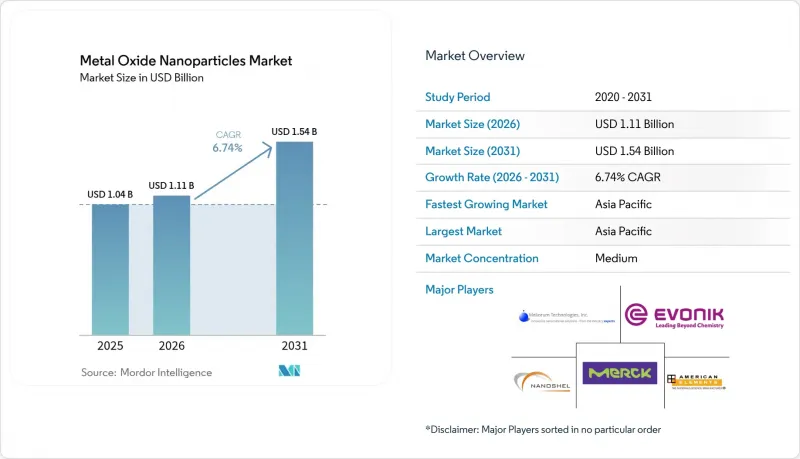
본 보고서는 제품별(알루미늄 산화물, 이산화 티타늄 등), 합성 방법별(물리적, 화학적, 친환경/바이오), 최종 사용자 산업별(전자·광학, 헬스케어 등), 지역별(아시아태평양, 북미, 유럽, 남미, 중동 및 아프리카)로 분류되어 있습니다. 시장 예측은 금액(달러) 단위로 표시되어 있습니다.
세계 금속 산화물 나노입자 시장 동향 및 인사이트
고유전율(high-k) 유전체 및 투명 전도성 필름에 대한 전자 분야 수요 증가
5nm 이하의 첨단 노드 로직 칩에는 정전 용량을 유지하면서 누설 전류를 최소화하는 이산화티타늄 및 산화하프늄 나노 입자로 구성된 초박형 게이트 스택이 필요합니다. 미국에서는 첨단 패키징을 위해 총 14억 달러의 인센티브가 마련되어 있으며, 이 자금은 반도체 등급 산화물에 의존하는 소재의 선정을 지원하고 있습니다. 터치스크린과 플렉서블 OLED 디스플레이는 반복적인 굽힘 사이클에서도 전도성을 유지하는 산화 인듐-주석 및 산화 아연 나노 입자 필름에 의존하고 있습니다. 가장자리에 배치되는 AI 가속기는 더 높은 작동 온도가 필요하기 때문에 설계자는 전기 상수가 드리프트되지 않고 열 스파이크를 견딜 수 있는 유전체 층을 지정할 수밖에 없습니다. HP가 오리건주에서 추진하는 5,000만 달러 규모의 확장 계획은 노즐과 채널의 절연에 산화물 박막을 통합한 마이크로플루이딕스 MEMS 기술의 규모 확대를 목표로 하고 있습니다. 이러한 수렴하는 동향은 금속 산화물 나노입자 시장의 기반이 되는 고순도 소재공급원을 뒷받침하고 있습니다.
퍼스널케어 및 코팅 분야에서 항균제로서의 활용 확대
산화아연 및 산화구리 나노입자는 활성산소를 방출하여 10분 이내에 박테리아의 99.9%를 불활성화시켜, 기존의 방부제를 대체할 수 있는 대안을 제공합니다. 팬데믹 기간 중 진행된 건물 개보수 공사로 인해, 이러한 산화물을 배합한 항균 벽면용 도료 및 HVAC 필터에 대한 수주가 가속화되었습니다. 유럽 규제 당국은 화장품에 사용되는 이산화티타늄(TiO₂) 및 산화아연(ZnO)에 대해 나노 입자에 특화된 안전성 자료 제출을 공식적으로 의무화했습니다. 이는 다른 관할 구역에서도 유사한 조치가 도입될 가능성을 시사하며, 규정을 준수하는 제조업체에게는 선구자로서의 우위를 가져다주고 있습니다. 건설 사양서에서는 유지보수 주기를 연장하기 위해 항균 코팅의 채택이 점점 더 늘어나고 있는 반면, 스마트 텍스타일 제조업체들은 50회 이상의 세탁 주기를 견딜 수 있는 나노 입자 마감 처리를 채택하고 있습니다. 이러한 광범위한 용도가 금속 산화물 나노 입자 시장에 계속해서 새로운 수요를 불러오고 있습니다.
독성과 환경 내 잔류성으로 인해 규제가 강화되고 있습니다.
도쿄 이과대학은 초미세 실리카 나노 입자가 단백질의 2차 구조를 변화시켜 신경 퇴화와 관련된 B-시트 함량을 증가시킨다는 사실을 밝혀냈습니다. 수처리 시설에서는 50 nm 미만의 입자를 포집하기 어려워, 그 결과 수생 생태계로의 축적이 우려되고 있습니다. 유럽연합(EU)은 REACH 규제를 확대하여 나노 물질에 대해 전체 수명 주기에 걸친 안전성 데이터 제출을 의무화했습니다. 이로 인해 제품 인증에 소요되는 기간이 길어지고, 규정 준수 비용이 증가하고 있습니다. 만성 독성 데이터를 제출할 수 없는 제조업체는 시장 진입이 지연될 위험이 있으며, 이는 금속 산화물 나노입자 시장의 단기적인 확장을 억제하는 요인이 되고 있습니다.
부문 분석
이산화티타늄은 자외선 차단 선크림과 5nm 게이트 유전체에서의 이중 역할에 힘입어, 2025년 금속 산화물 나노입자 시장에서 38.20%의 점유율을 유지했습니다. 가시광 투과율 98% 이상의 포토레지스트는 TiO2의 높은 굴절률에 의존하며, 극자외선 리소그래피에서 결함 밀도를 0.3 cm-2 미만으로 억제하고 있습니다. 산화 마그네슘은 300°C에서 세라믹 전해질의 안정화 능력에 힘입어 2031년까지 연평균 성장률(CAGR) 7.78%로 가장 높은 성장세를 보이고 있습니다. 이산화규소는 적층 조형용 분말로의 적용 범위를 넓히고 있는 반면, 산화아연은 항균성 폴리머 필름 분야에서의 활용을 확대되고 있습니다. 이러한 변화로 인해 제품 차별화가 유지되며, 금속 산화물 나노입자 시장에서의 가치 창출이 뒷받침되고 있습니다.
일본의 플라즈마 용사 기술에 있어 획기적인 진보로 인해, 현재는 평균 입자 직경 40 nm의 TiO2 나노 입자를 12.3 g/min의 처리 능력으로 공급할 수 있게 되어, 파일럿 생산과 양산 간의 규모 격차가 해소되었습니다. 알루미나(Alumina)는 분리막 코팅 및 세라믹 기판에 채택됨에 따라, 특히 에보닉(Evonik)사의 생산 능력 확대에 힘입어 그 역할을 더욱 공고히 하고 있습니다. 산화구리와 산화철은 촉매 및 자기 기록 분야의 틈새 시장을 차지하고 있으며, 산화세륨과 산화지르코늄은 연료전지 및 고온 터빈 시장에 기여하고 있습니다. 이러한 제품 포트폴리오의 복잡화로 인해 비용, 순도, 기능적 성능의 균형을 고려한 전략적 조달 프로그램이 촉진되고 있으며, 금속 산화물 나노 입자 산업 전반의 회복력이 강화되고 있습니다.
지역별 분석
아시아태평양은 2025년에 금속 산화물 나노 입자 시장의 47.40%를 차지하고, 2031년까지 연평균 성장률(CAGR) 7.55%로 성장할 전망입니다. 중국에서는 여러 성에 걸친 생산 확대로 이산화티타늄 생산 능력이 700만 톤에 육박하고 있지만, EU와 브라질의 반덤핑 조치로 인해 이익률은 압박을 받고 있습니다. 일본의 대학들은 암 치료를 위한 자성 나노입자 요법 연구를 주도하고 있으며, 분말 배치의 결함 검출 정확도를 향상시킴으로써 국내 고부가가치 수요를 강화하고 있습니다. 한국과 대만은 산화물의 순도를 활용해 파운드리 경쟁력을 유지하고 있으며, 인도는 자외선 차단제 및 건축용 도료용 생산량을 확대되고 있습니다. 종단 간 전자 생태계와 표적화된 보조금 덕분에 이 지역은 금속 산화물 나노입자 시장에서 우위를 유지하고 있습니다.
북미에서는 ‘CHIPS 법’에 따른 자금 지원이 폴리실리콘 및 기판 프로젝트를 뒷받침하고 있으며, 이를 통해 현지 산화물이 첨단 패키징 공급망에 임베디드되고 있습니다. 헴록 세미컨덕터(Hemlock Semiconductor)는 미시간주에 3억 2,500만 달러를 투자하여 연간 5만 9,000미터톤의 초고순도 폴리실리콘을 출하할 예정입니다. 각 잉곳에는 미량의 금속 산화물이 첨가되어 있습니다. 광범위한 조사 개발 활동을 통해 바이오 합성 기술이 조기에 채택되는 한편, 항공우주 분야에서는 내방사선성 산화물에 대한 수요가 증가하고 있습니다. 캐나다의 광산 및 멕시코의 조립 공장과 맺은 국경을 초월한 협력 관계가 이 지역의 금속 산화물 나노입자 시장의 탄력성을 뒷받침하고 있습니다.
유럽에서는 지속가능성과 규정 준수가 최우선으로 다뤄지고 있습니다. REACH 규정의 나노 물질 관련 개정으로 인해 자동차 제조업체들은 클리어 코트 배합용 저탄소 알루미나를 조달하도록 권장받고 있으며, 항공우주 산업은 이트리아 안정화 지르코니아(Yttria-stabilised zirconia) 나노 분말에 의존하는 세라믹 매트릭스 복합재료에 대한 투자를 주도하고 있습니다. 독일이 산업 생산량을 주도하는 한편, 북유럽 국가들에서는 사용 후 배터리에서 산화물을 회수하는 순환 경제 시범 사업이 추진되고 있습니다. 아프리카와 남미에서는 열 반사 도료에 나노 입자 첨가제를 접목한 건설 및 태양광 발전 프로젝트가 진행되고 있습니다. 중동과 남미에서는 광석 선광 및 비료 효율을 높이기 위해 산화물이 활용되고 있어, 금속 산화물 나노 입자 시장에 추가적인 수요를 창출하고 있습니다.
기타 혜택:
- 엑셀 형식 시장 예측(ME) 시트
- 3개월간의 애널리스트 지원
자주 묻는 질문
목차
제1장 서론
제2장 조사 방법
제3장 주요 요약
제4장 시장 구도
제5장 시장 규모와 성장 예측
제6장 경쟁 구도
제7장 시장 기회와 향후 전망
JHS 26.08.26According to Mordor Intelligence, the metal oxide nanoparticles market size market is expected to grow from USD 1.04 billion in 2025 to USD 1.11 billion in 2026 and is forecast to reach USD 1.54 billion by 2031 at 6.74% CAGR over 2026-2031.
This report is Segmented by Product (Aluminium Oxide, Titanium Dioxide, and More), Synthesis Method (Physical, Chemical, and Green/Bio-based), End-User Industry (Electronics and Optics, Healthcare, and More), and Geography (Asia-Pacific, North America, Europe, South America, Middle East and Africa). The Market Forecasts are Provided in Terms of Value (USD).
Global Metal Oxide Nanoparticles Market Trends and Insights
Growing electronics demand for high-k dielectric & transparent conductive films
Advanced node logic chips below 5 nm require ultrathin gate stacks made from titanium dioxide and hafnium oxide nanoparticles that minimize leakage currents while preserving capacitance. United States incentives total USD 1.4 billion for advanced packaging, with funds supporting materials down-selection that depends on semiconductor-grade oxides. Touchscreens and flexible OLED displays rely on indium tin oxide and zinc oxide nanoparticle films that remain conductive under repeated bending cycles. AI accelerators positioned at the edge drive higher operating temperatures, compelling designers to specify dielectric layers able to withstand thermal spikes without drifting electrical constants. HP's USD 50 million Oregon expansion aims to scale microfluidic MEMS technologies that incorporate oxide thin films for nozzle and channel insulation. These converging trends sustain a high-purity materials pipeline that anchors the Metal oxide nanoparticles market.
Rising use as antibacterial agents in personal care & coatings
Zinc oxide and copper oxide nanoparticles deactivate 99.9% of bacteria within 10 minutes by releasing reactive oxygen species, offering an alternative to conventional preservatives. Pandemic-era building retrofits accelerated orders for antimicrobial wall paints and HVAC filters embedding these oxides. European regulators formalised nano-specific safety dossiers for TiO2 and ZnO in cosmetics, signalling likely adoption in other jurisdictions and giving compliant producers first-mover advantage. Construction specifications increasingly embed antimicrobial coatings to extend maintenance intervals, while smart-textile manufacturers incorporate nanoparticle finishes that survive 50+ wash cycles. The breadth of applications continues to pull new volumes into the Metal oxide nanoparticles market.
Toxicity and environmental persistence prompting stricter regulations
Tokyo University of Science revealed that ultra-small silica nanoparticles alter protein secondary structures, increasing B-sheet content linked to neurodegeneration. Water-treatment plants struggle to capture sub-50 nm particles, leading to accumulation in aquatic ecosystems. The European Union broadened REACH to mandate full life-cycle safety files for nanomaterials, stretching product qualification timelines and raising compliance costs. Manufacturers unable to furnish chronic toxicity data risk delayed market entry, tempering near-term expansion of the Metal oxide nanoparticles market.
Other drivers and restraints analyzed in the detailed report include:
- Surge in Li-ion battery cathode & solid-state electrolyte R&D
- Transition to green synthesis routes enhancing regulatory acceptance
- Lack of standardized nano-scale metrology across supply chains
For complete list of drivers and restraints, kindly check the Table Of Contents.
Segment Analysis
Titanium Dioxide retained a 38.20% stake in the Metal oxide nanoparticles market in 2025, buoyed by dual roles in UV-blocking sunscreens and 5 nm gate dielectrics. Over 98% visible-light transmission photoresists rely on TiO2's high refractive index, keeping defect densities below 0.3 cm^-2 in extreme-ultraviolet lithography. Magnesium Oxide posts the fastest CAGR at 7.78% through 2031, propelled by its ability to stabilise ceramic electrolytes at 300 °C. Silicon Dioxide broadens its reach into additive manufacturing powders, while Zinc Oxide expands inside antimicrobial polymer films. These shifts keep product differentiation high and support value capture inside the Metal oxide nanoparticles market.
Japanese plasma-spray breakthroughs now deliver TiO2 nanoparticles averaging 40 nm at 12.3 g/min throughput, closing the scale gap between pilot and mass production. Aluminum Oxide's presence in separator coatings and ceramic substrates further entrenches its role, especially following Evonik's capacity build-out. Copper and Iron Oxides occupy catalysis and magnetic-storage niches, and ceria or zirconia oxides serve fuel cell and high-temperature turbine markets. The resulting portfolio complexity encourages strategic sourcing programs that balance cost, purity and functional performance, bolstering resilience across the Metal oxide nanoparticles industry.
Complete Report Scope:
- By Product
- Aluminium Oxide
- Titanium Dioxide
- Silicon Dioxide
- Zinc Oxide
- Magnesium Oxide
- Copper Oxide
- Iron Oxide
- Others (Cerium, Zirconium, etc.)
- By Synthesis Method
- Physical (Mechanical Milling, Vapor Deposition)
- Chemical (Sol-Gel, Precipitation)
- Green / Bio-based
- By End-User Industry
- Electronics and Optics
- Healthcare
- Construction
- Automotive and Transportation
- Personal Care
- Other End-user Industries (Energy and Environment, etc.)
- By Geography
- Asia-Pacific
- China
- India
- Japan
- South Korea
- ASEAN Countries
- Rest of Asia-Pacific
- North America
- United States
- Canada
- Mexico
- Europe
- Germany
- United Kingdom
- France
- Italy
- NORDIC Countries
- Rest of Europe
- South America
- Brazil
- Argentina
- Rest of South America
- Middle East and Africa
- Saudi Arabia
- South Africa
- Rest of Middle-East and Africa
- Asia-Pacific
Geography Analysis
Asia-Pacific held 47.40% of the Metal oxide nanoparticles market in 2025 and is poised for 7.55% CAGR through 2031. China's titanium dioxide capacity nears 7 million tons following multi-province expansions, yet anti-dumping actions by the EU and Brazil tighten margins. Japan's universities pioneer magnetic nanoparticle therapies for cancer and improve defect detection in powder batches, reinforcing domestic high-value demand. South Korea and Taiwan leverage oxide purity to sustain foundry competitiveness, and India grows output for sunscreens and architectural coatings. End-to-end electronics ecosystems and targeted subsidies preserve the region's primacy within the Metal oxide nanoparticles market.
North America benefits from CHIPS Act funding that underwrites polysilicon and substrate projects, pulling local oxides into advanced-packaging supply chains. Hemlock Semiconductor's USD 325 million Michigan investment will ship 59,000 metric tons of hyper-pure polysilicon annually, each ingot doped with metal oxide trace additives. Extensive R&D activity translates to early adoption of bio-based synthesis, while aerospace primes demand for radiation-hard oxides. Cross-border integration with Canada's mining and Mexico's assembly plants underpins a resilient regional Metal oxide nanoparticles market.
Europe prioritises sustainability and compliance. REACH nano-amendments motivate automakers to source low-carbon alumina for clear-coat formulations, and aerospace primes ceramic-matrix composite investments that rely on yttria-stabilised zirconia nanopowders. Germany leads industrial throughput, while Nordic nations incubate circular-economy pilots reclaiming oxides from end-of-life batteries. Middle East and Africa build construction and solar projects that integrate nanoparticle additives for heat-reflective paints. South America deploys oxides to enhance ore beneficiation and fertiliser efficiency, adding incremental volumes to the Metal oxide nanoparticles market.
- American Elements
- ANP CORPORATION
- ATLANTA
- EPRUI Biotech Co., Ltd.
- Evonik Industries AG
- Hongwu International Group Ltd
- MATEXCEL
- Meliorum Technologies, Inc.
- Merck KGaA
- Nanorh
- Nanoshell LLC
- Resonac Holdings Corporation
- SkySpring Nanomaterials, Inc.
- Sumitomo Chemical Co., Ltd.
- US Research Nanomaterials, Inc.
- Xuan Cheng Jing Rui New Material Co.,Ltd
Additional Benefits:
- The market estimate (ME) sheet in Excel format
- 3 months of analyst support
TABLE OF CONTENTS
1 Introduction
- 1.1 Study Assumptions & Market Definition
- 1.2 Scope of the Study
2 Research Methodology
3 Executive Summary
4 Market Landscape
- 4.1 Market Overview
- 4.2 Market Drivers
- 4.2.1 Growing electronics demand for high-k dielectric & transparent conductive films
- 4.2.2 Rising use as antibacterial agents in personal care & coatings
- 4.2.3 Surge in Li-ion battery cathode & solid-state electrolyte R&D
- 4.2.4 Transition to green synthesis routes enhancing regulatory acceptance
- 4.2.5 Demand for UV-blocking additives in 3D-printing photopolymers
- 4.2.6 Government incentives for semiconductor fabs needing high-purity oxide nanopowders
- 4.3 Market Restraints
- 4.3.1 Toxicity and environmental persistence prompting stricter regulations
- 4.3.2 Lack of standardized nano-scale metrology across supply chains
- 4.3.3 Price volatility of rare-earth precursors for complex oxides
- 4.4 Value Chain Analysis
- 4.5 Porter's Five Forces
- 4.5.1 Bargaining Power of Suppliers
- 4.5.2 Bargaining Power of Buyers
- 4.5.3 Threat of New Entrants
- 4.5.4 Threat of Substitutes
- 4.5.5 Degree of Competition
- 4.6 Patent Analysis
5 Market Size & Growth Forecasts
- 5.1 By Product
- 5.1.1 Aluminium Oxide
- 5.1.2 Titanium Dioxide
- 5.1.3 Silicon Dioxide
- 5.1.4 Zinc Oxide
- 5.1.5 Magnesium Oxide
- 5.1.6 Copper Oxide
- 5.1.7 Iron Oxide
- 5.1.8 Others (Cerium, Zirconium, etc.)
- 5.2 By Synthesis Method
- 5.2.1 Physical (Mechanical Milling, Vapor Deposition)
- 5.2.2 Chemical (Sol-Gel, Precipitation)
- 5.2.3 Green / Bio-based
- 5.3 By End-User Industry
- 5.3.1 Electronics and Optics
- 5.3.2 Healthcare
- 5.3.3 Construction
- 5.3.4 Automotive and Transportation
- 5.3.5 Personal Care
- 5.3.6 Other End-user Industries (Energy and Environment, etc.)
- 5.4 By Geography
- 5.4.1 Asia-Pacific
- 5.4.1.1 China
- 5.4.1.2 India
- 5.4.1.3 Japan
- 5.4.1.4 South Korea
- 5.4.1.5 ASEAN Countries
- 5.4.1.6 Rest of Asia-Pacific
- 5.4.2 North America
- 5.4.2.1 United States
- 5.4.2.2 Canada
- 5.4.2.3 Mexico
- 5.4.3 Europe
- 5.4.3.1 Germany
- 5.4.3.2 United Kingdom
- 5.4.3.3 France
- 5.4.3.4 Italy
- 5.4.3.5 NORDIC Countries
- 5.4.3.6 Rest of Europe
- 5.4.4 South America
- 5.4.4.1 Brazil
- 5.4.4.2 Argentina
- 5.4.4.3 Rest of South America
- 5.4.5 Middle East and Africa
- 5.4.5.1 Saudi Arabia
- 5.4.5.2 South Africa
- 5.4.5.3 Rest of Middle-East and Africa
- 5.4.1 Asia-Pacific
6 Competitive Landscape
- 6.1 Market Concentration
- 6.2 Strategic Moves
- 6.3 Market Share Analysis
- 6.4 Company Profiles (includes Global level Overview, Market level overview, Core Segments, Financials as available, Strategic Information, Market Rank/Share for key companies, Products & Services, and Recent Developments)
- 6.4.1 American Elements
- 6.4.2 ANP CORPORATION
- 6.4.3 ATLANTA
- 6.4.4 EPRUI Biotech Co., Ltd.
- 6.4.5 Evonik Industries AG
- 6.4.6 Hongwu International Group Ltd
- 6.4.7 MATEXCEL
- 6.4.8 Meliorum Technologies, Inc.
- 6.4.9 Merck KGaA
- 6.4.10 Nanorh
- 6.4.11 Nanoshell LLC
- 6.4.12 Resonac Holdings Corporation
- 6.4.13 SkySpring Nanomaterials, Inc.
- 6.4.14 Sumitomo Chemical Co., Ltd.
- 6.4.15 US Research Nanomaterials, Inc.
- 6.4.16 Xuan Cheng Jing Rui New Material Co.,Ltd
7 Market Opportunities & Future Outlook
- 7.1 White-space & Unmet-need Assessment


