

|
시장보고서
상품코드
2114953
진공 그리스 시장 : 점유율 분석, 업계 동향과 통계, 성장 예측(2026-2031년)Vacuum Grease - Market Share Analysis, Industry Trends & Statistics, Growth Forecasts (2026 - 2031) |
||||||
 Mordor Intelligence
Mordor Intelligence에 의하면, 진공 그리스 시장 규모는 2025년 1억 4,921만 달러에서 2026년에는 1억 5,582만 달러로 확대되어 2026년부터 2031년까지 CAGR 4.43%로 성장을 지속하여, 2031년에는 1억 9,357만 달러에 이를 것으로 예측됩니다.
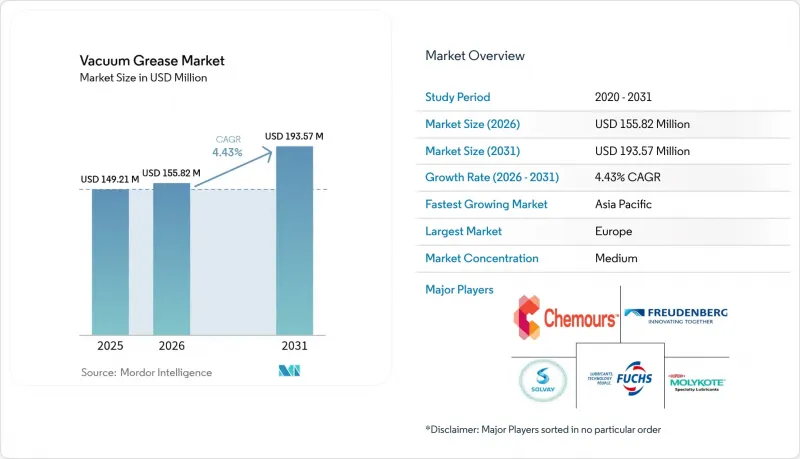
본 보고서는 유형별(실리콘계, 플루오로카본계, 탄화수소계), 용도별(실험실·산업용 장비, 자동차 및 항공우주, 제약, 식품 가공, 기타 용도), 지역별(아시아태평양, 북미, 유럽, 남미, 중동 및 아프리카)로 분류되어 있습니다. 시장 예측은 금액(달러)으로 표시되어 있습니다.
세계 진공 그리스 시장 동향 및 인사이트
반도체 제조에서의 고진공 공정 확대
5nm 미만으로의 소자 미세화가 진행됨에 따라 오염이 없는 환경에 대한 수요가 높아지고 있으며, 그 결과 팹당 진공 그리스 소비량이 증가하고 있습니다. 화학 기상 증착(CVD) 및 물리적 기상 증착(PVD)과 같은 첨단 패키징 공정에서는 상압과 초고진공(UHV) 사이의 사이클을 견디고 아웃가스를 발생시키지 않는 견고한 씰링 솔루션이 요구됩니다. 300mm 이상의 웨이퍼 도입과 2.5D/3D 집적화로 인해 장비 1대당 그리스 사용량은 더욱 증가하고 있습니다. 한편, Nye Lubricants와 같은 공급업체들은 제로 결함 목표를 달성하기 위해 TML <1% 및 CVCM <0.10%라는 사양을 공표하고 있습니다.
제약용 동결건조 장비에서의 채택 확대
동결 건조는 바이오 의약품 제조에 정착되어 있으며, 장기간의 사이클에 걸쳐 진공의 무결성을 유지하는 FDA 준수 그리스에 대한 수요가 증가하고 있습니다. 소수성 바이알 코팅은 진공 상태에서 비행을 유발할 가능성이 있어, 표면의 동결 이상을 완화하기 위한 제형 개선이 요구되고 있습니다. 듀폰의 MOLYKOTE 시리즈는 드라이 펌프 시스템용으로 배합되어, 오일 캐리오버를 방지하면서 씰의 내구성을 유지합니다. 각 제조업체들이 오일 씰식 펌프에서 드라이 스크롤식 및 드라이 스크류식 펌프로 전환함에 따라, 특수 그리스는 성능의 핵심 요소로 부상하고 있으며, 진공 그리스 시장은 제약 분야에서의 꾸준한 수요 증가가 예상됩니다.
진공 그리스의 높은 비용
특수 그리스는 엄격한 공정 사양, 생산량 제한 및 엄격한 품질 관리(QC)로 인해 표준 윤활유보다 10-20배 높은 가격대를 형성하고 있습니다. 바이오 대체품의 경우, 원료 및 정제 공정의 비용이 높기 때문에 가격이 더욱 비쌉니다. 소규모 제조업체는 대형 제조업체의 가격을 따라가기 어려워, 미션 크리티컬하지 않은 용도로의 보급이 저해되고 있습니다.
부문 분석
2025년 현재, 불소계 부문은 진공 그리스 시장 점유율의 45.62%를 차지하고 있으며, 2031년까지 연평균 4.62%의 성장률로 확대될 것으로 예측됩니다. 이러한 성장 추세는 산소 농도가 높은 환경이나 고온 환경에서 PFPE 계열 제품이 지닌 타의 추종을 불허하는 안정성에 힘입은 것입니다. 실리콘 계열 대체품에 의한 진공 그리스 시장 규모는 넓은 사용 온도 범위가 약간 높은 아웃가스량을 상쇄하는 용도에서 확대되고 있습니다. 탄화수소계 그리스는 특히 저진공 영역에서 비용을 중시하는 틈새 시장을 차지하고 있습니다. 유럽의 PFAS 규제안은 반도체 및 항공우주 분야 사용자들 사이에서 재고 확보 움직임을 유발하여, 연구 개발이 규제를 준수하는 화학 조성으로 전환되고 있음에도 불구하고 일시적으로 수요를 끌어올리고 있습니다. 듀폰사의 실리콘계 ‘MOLYKOTE 고진공 그리스’(-40°C-204°C 인증 획득)는 FDA 기준을 준수하는 비불소계 제품의 대표적인 예입니다.
특허 출원 현황을 보면, 에테르 및 용제 무함유 증점제 시스템으로의 점진적인 전환이 확인되며, 향후 진공 그리스 시장 규모는 계속 확대되는 한편, 제품 구성은 EU의 생태독성 기준을 충족할 수 있는 실리콘·불소 폴리머 하이브리드 매트릭스로 전환될 것으로 시사됩니다.
지역별 분석
2025년, 유럽은 전 세계 매출의 37.02%를 계속 차지했습니다. 이는 해당 지역의 항공우주, 제약, 정밀 공학 생태계에서 가격에 관계없이 최고 수준의 배합이 요구되었기 때문입니다. 예상되는 PFAS에 대한 종합적인 규제를 포함한 엄격한 화학 물질 정책은 이미 불소화학물을 다루고 있으며, 배합 변경 파이프라인을 가속화할 자금력을 갖춘 기존 제조업체에 유리하게 작용하고 있습니다. 자동차 1차 공급업체부터 분석 장비 OEM 제조업체에 이르기까지 다각적인 산업 기반을 갖춘 독일이 지역 수요를 뒷받침하는 한편, 북유럽은 첨단 가공 및 연구 인프라를 통해 시장 전체에서 차지하는 비중을 상회하는 판매량을 기여하고 있습니다.
아시아태평양은 중국, 대만, 한국의 대규모 반도체 팹과 더불어 인도의 확대되는 바이오의약품 제조 네트워크에 힘입어 2031년까지 연평균 성장률(CAGR) 5.65%로 성장하고 있습니다. 새로운 팹 하나당 수백 대의 진공 장비가 필요하며, 이는 가동 주기마다 고품질 그리스가 안정적으로 소비된다는 것을 의미합니다. 일본의 예방 정비 문화로 인해 설비당 지출액은 높은 수준을 유지하고 있으며, 의료기기 및 전자 분야 투자자를 유치하는 아세안(ASEAN) 국가 정부들도 수요의 점진적인 증가를 뒷받침하고 있습니다. 공급망의 현지화가 진행되면서 쉘(Shell)사는 태국 내 그리스 생산량을 3배로 늘려 연간 1만 5,000톤에 도달했습니다. 이를 통해 리드타임 단축과 환율 변동에 대한 완충 효과가 실현되고 있습니다.
북미에서는 방위, 우주, 생명공학 각 분야에서 꾸준한 수요가 발생하고 있습니다. 미국은 NASA의 아웃가스 제한을 준수하는 우주용 그리스 사양을 주도하고 있으며, 이 하위 부문에서는 가격에 구애받지 않는 조달이 이루어지고 있습니다. 멕시코의 마키라도라(수출가공구) 클러스터에서는 HVAC(공조·환기·냉난방) 및 가전제품 생산을 위해 중급 등급의 그리스가 대량으로 소비되는 반면, 캐나다의 자원 가공 플랜트에서는 부식성 가스 방출에 내성이 있는 특수 등급의 그리스가 사용되고 있습니다.
기타 혜택:
- 엑셀 형식 시장 예측(ME) 시트
- 3개월간의 애널리스트 지원
자주 묻는 질문
목차
제1장 서론
제2장 조사 방법
제3장 주요 요약
제4장 시장 구도
제5장 시장 규모와 성장 예측
제6장 경쟁 구도
제7장 시장 기회와 향후 전망
JHS 26.08.26According to Mordor Intelligence, the vacuum grease market size is expected to grow from USD 149.21 million in 2025 to USD 155.82 million in 2026 and is forecast to reach USD 193.57 million by 2031 at 4.43% CAGR over 2026-2031.
This report is Segmented by Type (Silicone-Based, Fluorocarbon-Based, and Hydrocarbon-Based), Application (Laboratory and Industrial Equipment, Automotive and Aerospace, Pharmaceuticals, Food Processing, and Other Applications), and Geography (Asia-Pacific, North America, Europe, South America, and Middle East and Africa). The Market Forecasts are Provided in Terms of Value (USD).
Global Vacuum Grease Market Trends and Insights
Expansion of High-Vacuum Processes in Semiconductor Manufacturing
Shrinking device geometries below 5 nm amplify the need for contamination-free environments, thereby raising per-fab consumption of vacuum grease. Advanced packaging steps such as chemical and physical vapor deposition require robust sealing solutions that withstand cycling between ambient and UHV without outgassing. CAdoption of 300 mm and larger wafers, plus 2.5D/3D integration, further multiplies grease volumes per tool, while suppliers such as Nye Lubricants publish TML < 1% and CVCM <0.10% specifications to match zero-defect targets.
Rising Adoption in Pharmaceutical Freeze-Drying Equipment
Lyophilization is entrenched in biologics production, elevating demand for FDA-compliant greases that sustain vacuum integrity over long cycles. Hydrophobic vial coatings can trigger boiling under vacuum, prompting formulation refinements to mitigate surface freezing anomalies. DuPont's MOLYKOTE grades are formulated for dry-pump systems, averting oil carryover while maintaining seal longevity. As manufacturers swap oil-sealed pumps for dry scroll or screw variants, specialty greases become pivotal to performance, positioning the vacuum grease market for steady pharmaceutical pull-through.
High Cost of Vacuum Greases
Specialty greases command price points 10-20 times standard lubricants owing to tight process specifications, limited volumes and rigorous QC. Bio-based alternatives add further premium because feedstocks and refining steps are costlier. Small producers struggle to match pricing of larger peers, curbing penetration in non-mission-critical uses.
Other drivers and restraints analyzed in the detailed report include:
- Growth of Vacuum-Assisted Food Packaging
- Shift to PFAS-Free Formulations Driven by Emerging Regulation
- Competition from Dry-Film Lubricants in UHV Systems
For complete list of drivers and restraints, kindly check the Table Of Contents.
Segment Analysis
The fluorocarbon segment accounted for 45.62% of vacuum grease market share in 2025 and is projected to compound at 4.62% through 2031, a trajectory sustained by the unmatched stability of PFPE-based products in oxygen-rich or high-temperature environments. The vacuum grease market size attributable to silicone-based alternatives is rising in applications where broad service-temperature windows offset their marginally higher outgassing. Hydrocarbon greases occupy value-driven niches, particularly in rough-vacuum regimes. European PFAS proposals have triggered stock-build behaviour among semiconductor and aerospace users, temporarily inflating demand even as R&D pivots toward compliant chemistries. DuPont's silicone MOLYKOTE High-Vacuum Grease, certified for -40 °C to 204 °C, exemplifies non-fluorinated offerings that secure FDA alignment.
A gradual shift toward ether-free and solvent-free thickener systems is detectable in patent filings, hinting at a future where the vacuum grease market size continues to expand while the product mix tilts toward hybrid silicone-fluoropolymer matrices capable of meeting EU eco-toxicity benchmarks.
Complete Report Scope:
- By Type
- Silicone-based
- Fluorocarbon-based
- Hydrocarbon-based
- By Application
- Laboratory and Industrial Equipment
- Automotive and Aerospace
- Pharmaceuticals
- Food Processing
- Other Applications (Semiconductors and Electronics Manufacturing, Energy, etc.)
- By Geography
- Asia-Pacific
- China
- Japan
- India
- South Korea
- ASEAN Countries
- Rest of Asia-Pacific
- North America
- United States
- Canada
- Mexico
- Europe
- Germany
- United Kingdom
- France
- Italy
- Spain
- Russia
- NORDIC Countries
- Rest of Europe
- South America
- Brazil
- Argentina
- Rest of South America
- Middle East and Africa
- Saudi Arabia
- South Africa
- Rest of Middle East and Africa
- Asia-Pacific
Geography Analysis
Europe retained 37.02% of global revenue in 2025 as its aerospace, pharmaceutical and precision-engineering ecosystems required top-tier formulations regardless of price. Stringent chemicals policy, including the anticipated horizontal PFAS restriction, favours incumbent producers who already operate fluorine chemistry and who can fund accelerated reformulation pipelines. Germany's diversified industrial base, ranging from automotive Tier 1s to analytical-instrument OEMs, anchors regional demand, while the Nordic region contributes outsized volumes through high-tech machining and research infrastructure.
Asia-Pacific is advancing at a 5.65% CAGR to 2031, underpinned by large-scale semiconductor fabs in China, Taiwan and South Korea, plus India's expanding biologics manufacturing network. Each new fab entails hundreds of vacuum tools, translating into consistent consumption of premium greases per light-off cycle. Japan's culture of preventive maintenance sustains a high per-installation spend, and ASEAN governments courting medical-device and electronics investors are spurring incremental demand. Supply chains are localising: Shell trebled grease output in Thailand to 15,000 t y-1, enabling shorter lead times and buffering currency swings.
North America delivers steady pull through from defense, space and biotech segments. The United States leads specifications for space-qualified greases subject to NASA outgassing limits, a sub-sector that commands price-insensitive procurement. Mexico's maquiladora clusters absorb mid-grade volumes for HVAC and appliance production, whereas Canada's resource-processing plants take specialty grades resistant to corrosive off-gassing.
- B'laster LLC
- BP plc
- DAIKIN INDUSTRIES, Ltd
- DuPont
- Exxon Mobil Corporation
- Freudenberg
- FUCHS
- Inland Vacuum Industries, Inc.
- Maax Aerosol Technology Pvt Ltd
- MandI Materials Ltd
- Solvay SA
- Supervac Industries LLP
- The Chemours Company
Additional Benefits:
- The market estimate (ME) sheet in Excel format
- 3 months of analyst support
TABLE OF CONTENTS
1 Introduction
- 1.1 Study Assumptions and Market Definition
- 1.2 Scope of the Study
2 Research Methodology
3 Executive Summary
4 Market Landscape
- 4.1 Market Overview
- 4.2 Market Drivers
- 4.2.1 Expansion of High-Vacuum Processes in Semiconductor Manufacturing
- 4.2.2 Rising Adoption in Pharmaceutical Freeze-Drying Equipment
- 4.2.3 Growth of Vacuum-Assisted Food Packaging
- 4.2.4 Shift to PFAS-Free Formulations Driven by Emerging Regulation
- 4.2.5 Demand For Dielectric Greases in EV Power Electronics
- 4.3 Market Restraints
- 4.3.1 High Cost of Vacuum Greases
- 4.3.2 Competition from Dry-Film Lubricants in UHV Systems
- 4.3.3 Regulatory Scrutiny of Fluorinated Chemistries
- 4.4 Value Chain Analysis
- 4.5 Porter's Five Forces
- 4.5.1 Threat of New Entrants
- 4.5.2 Bargaining Power of Buyers
- 4.5.3 Bargaining Power of Suppliers
- 4.5.4 Threat of Substitutes
- 4.5.5 Degree of Competition
5 Market Size and Growth Forecasts (Value)
- 5.1 By Type
- 5.1.1 Silicone-based
- 5.1.2 Fluorocarbon-based
- 5.1.3 Hydrocarbon-based
- 5.2 By Application
- 5.2.1 Laboratory and Industrial Equipment
- 5.2.2 Automotive and Aerospace
- 5.2.3 Pharmaceuticals
- 5.2.4 Food Processing
- 5.2.5 Other Applications (Semiconductors and Electronics Manufacturing, Energy, etc.)
- 5.3 By Geography
- 5.3.1 Asia-Pacific
- 5.3.1.1 China
- 5.3.1.2 Japan
- 5.3.1.3 India
- 5.3.1.4 South Korea
- 5.3.1.5 ASEAN Countries
- 5.3.1.6 Rest of Asia-Pacific
- 5.3.2 North America
- 5.3.2.1 United States
- 5.3.2.2 Canada
- 5.3.2.3 Mexico
- 5.3.3 Europe
- 5.3.3.1 Germany
- 5.3.3.2 United Kingdom
- 5.3.3.3 France
- 5.3.3.4 Italy
- 5.3.3.5 Spain
- 5.3.3.6 Russia
- 5.3.3.7 NORDIC Countries
- 5.3.3.8 Rest of Europe
- 5.3.4 South America
- 5.3.4.1 Brazil
- 5.3.4.2 Argentina
- 5.3.4.3 Rest of South America
- 5.3.5 Middle East and Africa
- 5.3.5.1 Saudi Arabia
- 5.3.5.2 South Africa
- 5.3.5.3 Rest of Middle East and Africa
- 5.3.1 Asia-Pacific
6 Competitive Landscape
- 6.1 Market Concentration
- 6.2 Strategic Moves
- 6.3 Market Share(%)/Ranking Analysis
- 6.4 Company Profiles (includes Global level Overview, Market level overview, Core Segments, Financials as available, Strategic Information, Market Rank/Share for key companies, Products and Services, Recent Developments)
- 6.4.1 B'laster LLC
- 6.4.2 BP plc
- 6.4.3 DAIKIN INDUSTRIES, Ltd
- 6.4.4 DuPont
- 6.4.5 Exxon Mobil Corporation
- 6.4.6 Freudenberg
- 6.4.7 FUCHS
- 6.4.8 Inland Vacuum Industries, Inc.
- 6.4.9 Maax Aerosol Technology Pvt Ltd
- 6.4.10 MandI Materials Ltd
- 6.4.11 Solvay SA
- 6.4.12 Supervac Industries LLP
- 6.4.13 The Chemours Company
7 Market Opportunities and Future Outlook
- 7.1 White-space and Unmet-Need Assessment


