|
시장보고서
상품코드
2114966
부티르산 시장 : 시장 점유율 분석, 업계 동향 및 통계, 성장 예측(2026-2031년)Butyric Acid - Market Share Analysis, Industry Trends & Statistics, Growth Forecasts (2026 - 2031) |
||||||
 Mordor Intelligence
Mordor Intelligence에 의하면, 부티르산 시장 규모는 2026년에 58.87 킬로톤으로 추정되고, 예측 기간(2026-2031년) CAGR 7.15%로 성장을 지속할 전망이며, 2031년까지 83.14 킬로톤에 이를 전망입니다.
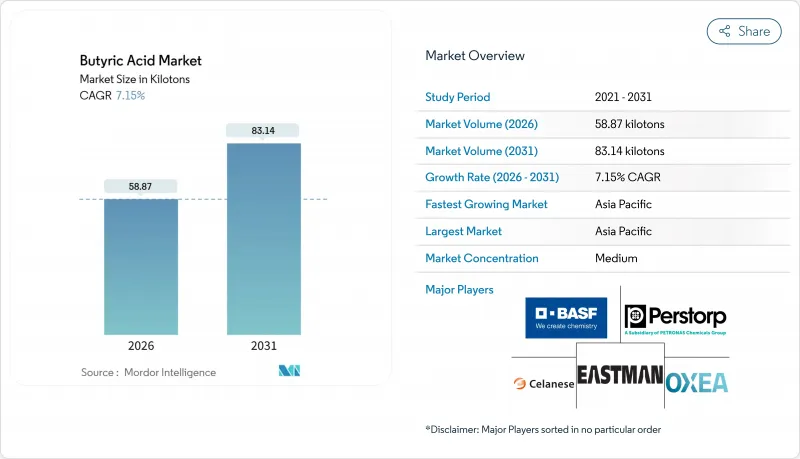
본 보고서는 공급원별(재생 가능 부티르산 및 합성 부티르산), 등급별(식품 등급, 산업용 등급, 기타), 용도별(화학 중간체, 동물사료, 의약품, 향수, 식품·향료, 기타), 지역별(아시아태평양, 북미, 유럽, 남미, 중동 및 아프리카)로 분류되어 있습니다. 시장 예측은 수량(톤) 기준으로 제시되어 있습니다.
세계의 부티르산 시장 동향 및 인사이트
사료용 장 건강 첨가제에서의 이용 확대
유럽의 성장 촉진용 항생제 규제 금지 및 북미의 자발적인 단계적 폐지에 따라, 장 장벽 기능과 미생물 군집의 균형을 개선하는 부틸레이트 나트륨과 트리부틸린으로의 전환이 가속화되고 있으며, 이로 인해 사료 전환율이 5%-8% 향상되고 있습니다. 정밀 사료 공급 플랫폼은 보호된 부틸레이트를 실시간으로 투여하여, 기존 고정 배합 사료에 비해 개체당 섭취량을 최대 15% 증가시키고 있습니다. 케민 인더스트리즈(Kemin Industries)는 새우 양식업자들이 항생제를 사용하지 않는 사망률 억제 방안을 모색함에 따라, 2025년 아시아 수산 양식용 보호형 부티르산 매출이 전년 대비 22% 증가했다고 발표했습니다. 중국 농업부는 2025년에 첨가물 등록 절차를 간소화했으며, 이에 따라 2027년 가동을 예정하고 있는 현지 발효 설비의 증설이 촉진되었습니다.
천연 향료 및 클린 라벨 방부제로서 수요
미국과 유럽연합(EU)의 식품 제조업체들은 투명한 표시 요구에 부응하기 위해 합성 디아세틸을 부티르산 에스테르로 계속 대체하고 있습니다. 미국 식품의약국(FDA)은 2024년, 향료로서의 해당 화합물에 대한 GRAS(일반적으로 안전하다고 인정되는) 지위를 재확인했으며, 유럽식품안전청(EFSA)은 2025년, 유제품 용도에서 부티르산 에스테르의 농도 상한선을 철폐했습니다. 제품 개발 담당자에 따르면, 부티르산의 온화한 항균 작용을 활용함으로써 소르빈산 칼륨 사용량을 30% 줄일 수 있어 비용과 표시 항목의 길이를 모두 줄일 수 있다고 합니다. 클린 라벨로의 포지셔닝 덕분에 2025년에는 북미와 유럽의 식품용 수요가 12% 증가했습니다.
변동이 심한 부탄올과 프로파일렌의 원료 가격
석유화학 경로에서는 생산 비용이 부탄올과 프로파일렌의 현물 가격에 연동되지만, 2025년 초 미국 멕시코만 연안과 중동의 정유시설 가동 중단을 배경으로 이들 가격이 25% 변동하여, 장기 계약을 체결하지 않은 생산자의 이익률을 압박했습니다. 무수 말레산을 원료로 하는 중국의 전해법에서도 국내 부탄 부족으로 인해 12%의 원가 상승이 나타났습니다. 발효법에 의한 비용 우위는 존재하지만, 현재의 분리 비용으로 인해 재생 가능 부티르산의 가격은 2025년 기술경제조업체에서 제시된 경쟁 가격대의 상한선 부근에 머물러 있습니다.
부문 분석
2025년에는 프로파일렌 산화 인프라가 성숙한 것을 반영하여 합성 채널이 총 생산량의 62.24%를 차지했습니다. 그럼에도 불구하고, 탄소 가격 책정 및 순환형 바이오 경제 목표에 따라 각 브랜드가 화석 원료에서 벗어나야 하는 압박을 받고 있어, 재생 가능한 부티르산은 연평균 성장률(CAGR) 8.92%로 증가하고 있습니다. 재생 가능한 원료를 이용한 부티르산 시장 규모는 2026년 22.2킬로톤에서 2031년까지 36.3킬로톤으로 확대될 것으로 예상되며, 이는 증가하는 수요의 44%에 해당합니다. 70g/L를 초과하는 발효 수율이 입증되었지만, 다운스트림 공정의 분리 비용은 여전히 총 비용의 약 60%를 차지하고 있습니다. 유럽의 탄소 관세와 중국의 보조금 프로그램이 예정대로 시행된다면, 합성 원료 기반 부티르산 시장 점유율은 2031년까지 55% 미만으로 떨어질 가능성이 있습니다.
재생 에너지 개발 기업들은 도시 폐기물 처리 업체들과의 제휴를 추진하고 있습니다. 그 일례로, 페르스토프(Perstorp)사가 스웨덴에 건설한 실증 플랜트에서는 분리 수거된 식품 폐기물을 발효시켜 의약품 등급의 부티르산을 생산하고 있습니다. 중국 공업정보화부는 2024-2027년까지의 ‘정밀화학 혁신 계획’에 부티르산을 포함시켰으며, 비식품계 바이오매스를 원료로 하는 제조 경로에 대해 세금 환급 및 시범 사업에 대한 자금 지원을 제공합니다. 산업용 등급 제품의 판매에 있어서는 합성 제조업체가 비용과 규모 면에서 여전히 우위를 점하고 있지만, 식품 및 제약 산업의 브랜드 소유주들은 현재 인증된 재생 가능 원료에 대해 15%-25%의 프리미엄을 지불하고 있습니다.
지역별 분석
아시아태평양은 2025년에 세계 수요의 38.82%를 차지한 것으로 평가되었으며, 2031년까지 연평균 성장률(CAGR) 8.14%를 기록할 전망입니다. 중국은 무수 말레산 및 부탄올과 같은 원료에 대한 지리적 근접성을 활용하여 전 세계 생산 능력의 거의 절반을 차지하고 있으며, 새로운 발효 프로젝트는 더욱 엄격해지는 지속가능성 목표 달성을 목표로 하고 있습니다. 인도의 가금류 산업 확대와 항생제 사용 제한 정책이 맞물리면서, 부티레이트 수요가 연간 1,200-1,500톤 증가하고 있습니다. 일본과 한국의 의약품 수입업체들은 도쿄화학공업 및 유럽 파트너 기업에서 공급하는 고순도 제품에 의존하고 있습니다. 중국 각 성이 탄소 거래 제도를 도입하고, 유럽이 국경 조정 조치를 적용함에 따라 재생 가능 자원으로의 단계적 전환이 예상됩니다.
이스트만 케미컬(Eastman Chemical) 등 미국 제조업체들은 임상시험 수요에 부응하기 위해 고효율 크로마토그래피 정제 기술에 투자하고 있으며, 향료 용도에 대한 FDA의 GRAS(일반적으로 안전하다고 인정됨) 지위 재확인을 활용하고 있습니다. 유럽의 순환 경제 지침에 따라 폐기물을 원료로 하는 발효 플랜트에 보조금이 지급되고 있으며, 그 대표적인 예가 페르스토프(Perstorp)사의 스웨덴 실증 플랜트입니다. 장 건강 바이오마커를 기반으로 부티르산을 조절하는 정밀 축산 플랫폼이 미국의 육계 및 양돈 부문에서 급속히 확대되고 있으며, 이는 사료용 부티르산의 연간 성장을 뒷받침하고 있습니다.
남미에서는 브라질의 육계 수출 확대 의지와 아르헨티나의 축산 투자 회복이 호재로 작용하고 있습니다. 생산자들은 유럽 수입업체들이 요구하는 ‘항생제 미사용’ 요건을 충족하기 위해 보호형 부티르산 사료 첨가제에 대한 시험을 진행하고 있습니다. 중동 및 아프리카에서는 사우디아라비아와 남아프리카공화국이 유제품 및 가금류 부문의 규모 확대를 추진하고 있습니다. 인프라 제약과 기후 요인으로 인해 다른 지역에 비해 보급 속도는 둔화되고 있지만, 의약품 수입은 계속해서 증가하고 있습니다.
기타 혜택
- 엑셀 형식 시장 예측(ME) 시트
- 3개월간의 애널리스트 지원
자주 묻는 질문
목차
제1장 서론
제2장 조사 방법
제3장 주요 요약
제4장 시장 구도
제5장 시장 규모 및 성장 예측
제6장 경쟁 구도
제7장 시장 기회 및 향후 전망
AJY 26.08.28According to Mordor Intelligence, the butyric acid market size is estimated at 58.87 kilotons in 2026, and is expected to reach 83.14 kilotons by 2031, at a CAGR of 7.15% during the forecast period (2026-2031).
This report is Segmented by Source (Renewable Butyric Acid and Synthetic Butyric Acid), Grade (Food Grade, Industrial Grade, and More), Application (Chemical Intermediates, Animal Feed, Pharmaceuticals, Perfumes, Food and Flavors, and Other), and Geography (Asia-Pacific, North America, Europe, South America, and the Middle East and Africa). The Market Forecasts are Provided in Terms of Volume (tons).
Global Butyric Acid Market Trends and Insights
Growing Utilization in Animal-Feed Gut-Health Additives
Regulatory bans on growth-promoting antibiotics in Europe and voluntary phase-outs in North America have accelerated the switch to sodium butyrate and tributyrin, which improve intestinal barrier function and microbiome balance, translating into 5%-8% stronger feed conversion ratios. Precision-feeding platforms dose protected butyrate in real time, lifting per-animal consumption by up to 15% over static rations. Kemin Industries disclosed a 22% year-over-year rise in protected butyrate sales into Asian aquaculture during 2025 as shrimp farmers sought antibiotic-free mortality control. China's Ministry of Agriculture streamlined additive registrations in 2025, triggering local fermentation capacity additions due online in 2027.
Demand as Natural Flavoring & Clean-Label Preservative
Food manufacturers in the United States and European Union continue to replace synthetic diacetyl with butyric acid esters to satisfy transparent-label expectations. The US Food and Drug Administration reaffirmed the compound's GRAS status for flavoring in 2024, and the European Food Safety Authority removed concentration caps on butyrate esters for dairy applications in 2025. Formulators report being able to cut potassium sorbate loadings by 30% when leveraging butyric acid's mild antimicrobial action, reducing both cost and label length. Clean-label positioning propelled a 12% jump in North American and European food-grade demand during 2025.
Volatile Butanol & Propylene Feedstock Prices
Petrochemical routes tie production costs to butanol and propylene spot prices, which swung 25% in early 2025 amid US Gulf Coast and Middle East refinery outages, squeezing margins for producers lacking long-term contracts. Chinese electrolytic pathways starting from maleic anhydride also experienced a 12% cost hike after domestic butane shortages. While fermentation insulation exists, current separation costs keep renewable butyric acid near the upper end of competitive price bands outlined in a 2025 techno-economic study.
Other drivers and restraints analyzed in the detailed report include:
- Pharma Interest in SCFA-Based Therapeutics & Pro-Drugs
- Adoption of Precision-Livestock Farming Enabling Butyrate-Based Productivity Tools
- Odor-Control & Handling Challenges Limiting Plant Adoption
For complete list of drivers and restraints, kindly check the Table Of Contents.
Segment Analysis
Synthetic pathways controlled 62.24% of total volume in 2025, reflecting mature propylene-oxidation infrastructure. Nevertheless, renewable butyric acid is rising at an 8.92% CAGR as carbon pricing and circular-bioeconomy targets push brands to decouple from fossil feedstocks. The butyric acid market size for renewable supply is projected to expand from 22.2 kilotons in 2026 to 36.3 kilotons by 2031, equating to 44% of incremental demand. Fermentation titers exceeding 70 g/L have been demonstrated, yet downstream separation still represents around 60% of total cost. The butyric acid market share for synthetic feedstock could slip below 55% by 2031 if European carbon tariffs and Chinese subsidy programs materialize as scheduled.
Renewable developers are forging partnerships with municipal waste processors, exemplified by Perstorp's Swedish demonstration plant that ferments sorted food waste to pharmaceutical-grade butyric acid. China's Ministry of Industry and Information Technology embedded butyric acid in its 2024-2027 Fine Chemical Innovation Plan, offering tax rebates and pilot funding for non-food biomass routes. Synthetic producers retain an edge on cost and scale for industrial-grade sales, but brand owners in food and pharma now pay premiums of 15%-25% for verified renewable material.
Complete Report Scope:
- By Source
- Renewable Butyric Acid
- Synthetic Butyric Acid
- By Grade
- Food Grade
- Industrial Grade
- Pharmaceutical Grade
- By Application
- Chemical Intermediates
- Animal Feed
- Pharmaceuticals
- Perfumes
- Food and Flavors
- Other Applications (Biofuel, Cosmetics, etc.)
- By Geography
- Asia-Pacific
- China
- India
- Japan
- South Korea
- Rest of Asia-Pacific
- North America
- United States
- Canada
- Mexico
- Europe
- Germany
- United Kingdom
- France
- Italy
- Rest of Europe
- South America
- Brazil
- Argentina
- Rest of South America
- Middle-East and Africa
- Saudi Arabia
- South Africa
- Rest of Middle-East and Africa
- Asia-Pacific
Geography Analysis
Asia-Pacific retained 38.82% of worldwide demand in 2025 and is on track for an 8.14% CAGR through 2031. China accounts for almost half of global capacity, leveraging proximity to maleic anhydride and butanol feedstocks, while new fermentation projects aim to meet tightening sustainability targets. India's poultry expansion, coupled with antibiotic-restriction policies, adds 1,200-1,500 tonnes per year of incremental butyrate demand. Japanese and South Korean pharmaceutical importers rely on high-purity products from Tokyo Chemical Industry and European partners. A gradual shift to renewable sourcing is expected as Chinese provinces implement carbon-trading schemes and Europe applies border adjustments.
US producers such as Eastman Chemical invest in high-chromatography purification to meet clinical-trial needs, leveraging the FDA's reaffirmed GRAS status for flavoring applications. Europe's circular-economy directives provide grants for waste-fed fermentation plants, epitomized by Perstorp's Swedish demo unit. Precision-livestock platforms that modulate butyrate based on gut-health biomarkers expand rapidly in the U.S. broiler and swine sectors, supporting annual feed-grade growth.
South America benefits from Brazil's broiler export ambitions and Argentina's recovery in animal husbandry investment. Producers test protected-butyrate feed additives to satisfy European importers' antibiotic-free requirements. In the Middle East and Africa, Saudi Arabia and South Africa are scaling the dairy and poultry sectors. Infrastructure constraints and climate factors slow adoption relative to other regions, yet pharmaceutical imports continue to rise.
- Axxence Aromatic GmbH
- BASF
- Beijing Huamaoyuan Fragrance Flavor Co.,Ltd
- Celanese Corporation
- Eastman Chemical Company
- Haihang Industry Co., Ltd.
- Kemin Industries, Inc.
- Merck
- OXEA GmbH
- Perstorp
- Snowco
- Spectrum Chemical
- Thermo Fisher Scientific Inc.
- Tokyo Chemical Industry Co., Ltd.
- Yufeng International Group Co., Ltd.
Additional Benefits:
- The market estimate (ME) sheet in Excel format
- 3 months of analyst support
TABLE OF CONTENTS
1 Introduction
- 1.1 Study Assumptions & Market Definition
- 1.2 Scope of the Study
2 Research Methodology
3 Executive Summary
4 Market Landscape
- 4.1 Market Overview
- 4.2 Market Drivers
- 4.2.1 Growing utilisation in animal-feed gut-health additives
- 4.2.2 Demand as natural flavouring & clean-label preservative
- 4.2.3 Pharma interest in SCFA-based therapeutics & pro-drugs
- 4.2.4 Adoption of precision-livestock farming enabling butyrate-based productivity tools
- 4.2.5 Circular bio-economy push: fermentation of ag-waste to butyrate
- 4.3 Market Restraints
- 4.3.1 Volatile butanol & propylene feedstock prices
- 4.3.2 Odour-control & handling challenges limiting plant adoption
- 4.3.3 Competition from propionic & valeric acids in feed and preservation
- 4.4 Value Chain Analysis
- 4.5 Porter's Five Forces
- 4.5.1 Bargaining Power of Suppliers
- 4.5.1.1 Bargaining Power of Buyers
- 4.5.1.2 Threat of New Entrants
- 4.5.1.3 Threat of Substitutes
- 4.5.1.4 Degree of Competition
- 4.5.1 Bargaining Power of Suppliers
5 Market Size and Growth Forecasts (Value and Volume)
- 5.1 By Source
- 5.1.1 Renewable Butyric Acid
- 5.1.2 Synthetic Butyric Acid
- 5.2 By Grade
- 5.2.1 Food Grade
- 5.2.2 Industrial Grade
- 5.2.3 Pharmaceutical Grade
- 5.3 By Application
- 5.3.1 Chemical Intermediates
- 5.3.2 Animal Feed
- 5.3.3 Pharmaceuticals
- 5.3.4 Perfumes
- 5.3.5 Food and Flavors
- 5.3.6 Other Applications (Biofuel, Cosmetics, etc.)
- 5.4 By Geography
- 5.4.1 Asia-Pacific
- 5.4.1.1 China
- 5.4.1.2 India
- 5.4.1.3 Japan
- 5.4.1.4 South Korea
- 5.4.1.5 Rest of Asia-Pacific
- 5.4.2 North America
- 5.4.2.1 United States
- 5.4.2.2 Canada
- 5.4.2.3 Mexico
- 5.4.3 Europe
- 5.4.3.1 Germany
- 5.4.3.2 United Kingdom
- 5.4.3.3 France
- 5.4.3.4 Italy
- 5.4.3.5 Rest of Europe
- 5.4.4 South America
- 5.4.4.1 Brazil
- 5.4.4.2 Argentina
- 5.4.4.3 Rest of South America
- 5.4.5 Middle-East and Africa
- 5.4.5.1 Saudi Arabia
- 5.4.5.2 South Africa
- 5.4.5.3 Rest of Middle-East and Africa
- 5.4.1 Asia-Pacific
6 Competitive Landscape
- 6.1 Market Concentration
- 6.2 Strategic Moves
- 6.3 Market Share (%)/Ranking Analysis
- 6.4 Company Profiles (includes Global level Overview, Market level overview, Core Segments, Financials as available, Strategic Information, Market Rank/Share for key companies, Products and Services, and Recent Developments)
- 6.4.1 Axxence Aromatic GmbH
- 6.4.2 BASF
- 6.4.3 Beijing Huamaoyuan Fragrance Flavor Co.,Ltd
- 6.4.4 Celanese Corporation
- 6.4.5 Eastman Chemical Company
- 6.4.6 Haihang Industry Co., Ltd.
- 6.4.7 Kemin Industries, Inc.
- 6.4.8 Merck
- 6.4.9 OXEA GmbH
- 6.4.10 Perstorp
- 6.4.11 Snowco
- 6.4.12 Spectrum Chemical
- 6.4.13 Thermo Fisher Scientific Inc.
- 6.4.14 Tokyo Chemical Industry Co., Ltd.
- 6.4.15 Yufeng International Group Co., Ltd.
7 Market Opportunities and Future Outlook
- 7.1 White-space and Unmet-Need Assessment
- 7.2 Expanding Bio-based Production
- 7.3 Growing Health Awareness