
|
시장보고서
상품코드
2114968
선박용 시트 시장 : 시장 점유율 분석, 업계 동향 및 통계, 성장 예측(2026-2031년)Marine Seats - Market Share Analysis, Industry Trends & Statistics, Growth Forecasts (2026 - 2031) |
||||||
 Mordor Intelligence
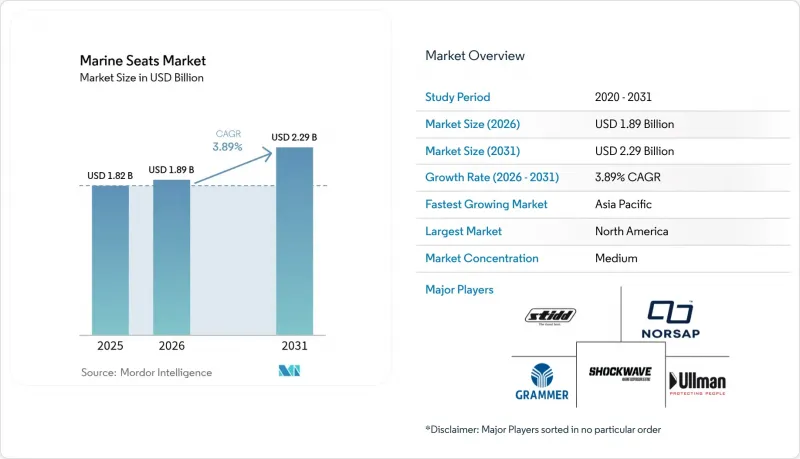
Mordor Intelligence에 의하면, 2026년 선박용 시트 시장 규모는 18억 9,000만 달러로 추정되고, 2025년 18억 2,000만 달러에서 확대해, 2031년에는 22억 9,000만 달러에 이를 것으로 예측됩니다.
2026-2031년 연평균 성장률(CAGR) 3.89%로 성장할 것으로 전망됩니다.
본 보고서는 선박 유형별(요트, 크루즈선, 기타), 부품 유형별(받침대, 스위블, 기타), 시트 기술별(수동 고정식, 수동 조절식, 기타), 시트 소재별(알루미늄, 스테인리스, 기타), 최종 사용자별(레저, 여객 수송, 기타), 지역별(북미, 남미, 기타)로 분류되어 있습니다. 시장 예측은 금액(달러) 기준으로 제시되어 있습니다.
세계의 선박용 시트 시장 동향 및 인사이트
크루즈선 개조 주기
각 운항사는 선령 중반의 대대적인 정비에 사상 최대 규모의 투자를 하고 있으며, 셀러브리티 크루즈는 다이닝 데크, 극장 데크, 수영장 데크의 좌석을 전면 교체하는 ‘솔스티스’급 업그레이드에 2억 5,000만 달러 이상을 투자하고 있습니다. 국제크루즈선협회(CLIA)에 따르면, 가맹 크루즈선의 2025년 승객 수는 9% 증가할 것으로 예측되며, 이러한 설비 투자 물결을 뒷받침함으로써 개조는 선박용 시트 시장에 있어 가장 확실한 단기 성장 요인이 되고 있습니다. 턴키 방식의 설계 및 설치 역량을 갖춘 공급업체들은 제한된 드라이독 기간에 맞추어 납품을 조정함으로써 시장에서 압도적인 점유율을 확보하고 있습니다.
IMO의 인체공학적 안전 규정
국제해사기구(IMO)는 ‘무손상 안정성에 관한 코드’에서 전신 진동 및 승무원 복지에 관한 기준을 확대하고 있으며, 이에 따라 선주들은 허리 지지 기능과 자동 높이 기억 기능을 갖춘 조절형 좌석을 지정하고 있습니다. 개정된 GMDSS 기준의 도입이 2028년까지 연기됨에 따라, 조선사는 통신 패널을 팔걸이에 통합할 수 있게 되어 선박용 시트 시장의 가치 제안이 더욱 풍부해질 것입니다.
선박용 합금의 가격 변동
알루미늄과 스테인리스의 급격한 가격 변동은 특히 고정 가격 입찰이 주류를 이루는 해군 및 페리 계약에서 이익률을 압박하고 있습니다. 각 조선사는 리스크를 완화하기 위해 다년간공급 계약을 체결하거나 복합 금속 하이브리드 소재를 시범 도입하고 있지만, 이러한 헤지 전략은 운전자금을 묶어두어 사양 변경을 지연시키는 요인이 되고 있습니다.
부문별 분석
2025년, 크루즈선은 선박용 좌석 시장의 29.12%를 차지했습니다. 이는 2억 5,000만 달러 규모의 개보수 프로그램을 통해 수천 석에 달하는 극장 및 수영장 데크의 좌석이 인체공학에 기반한 제품으로 교체되었기 때문입니다. 개조 일정에 따라 주문에서 설치까지의 리드타임이 짧게 확보되기 때문에 실적이 입증된 세계 물류 체계를 갖춘 공급업체가 유리합니다. 상업용 작업선은 해양 에너지 및 수산 양식 사업자들이 다중 교대 근무 중 피로를 줄이기 위해 충격 완화 시트를 채택하고 있어 6.78%라는 가장 높은 연평균 성장률(CAGR)을 기록하고 있습니다.
초계정, 수색구조(SAR)정, 해군 함정 부문에서는 영국 해양안전청(MCA) 등 규제 당국이 서스펜션 시트 채택을 의무화하고 있어, 이로 인해 방위 관련 프로그램은 선박용 시트 시장에서 프리미엄 부문으로 자리매김하고 있습니다. 요트 제조업체들은 맞춤 제작과 경량 프레임에 주력하고 있으며, 많은 경우 카본 프리프레그와 스티치 가공된 가죽을 조합하여 배수량을 고려한 무게이면서도 시각적인 매력을 확보하고 있습니다. 페리나 RoPax 선박의 경우, 일상적인 선회 중 다운타임을 최소화하기 위해 내파괴성이 뛰어난 실내 장식재와 신속하게 교체 가능한 커버에 중점을 두고 있습니다.
2025년 선박용 시트 시장 규모 중 페데스탈이 32.60%를 차지했습니다. 이는 모든 함교 및 승객용 좌석이 높이 및 회전 조절용 플랫폼에 의존하기 때문입니다. 그러나 서스펜션 시스템은 연평균 5.12%의 성장이 예상됩니다. 이는 선주가 승무원의 보상 청구 및 보험 규정 준수를 위해 G-포스 저감 증명을 요구하고 있기 때문입니다.
객실 및 조종석 좌석의 경우, 회전 및 슬라이드 기구가 여전히 중요하지만, OEM 업체들은 열대 기후 하에서 내구 수명을 연장하기 위해 내식성 폴리머를 적용하고 있습니다. 시트 커버 및 폼 공급업체들은 수지 공급 부족과 더욱 엄격해진 저발연·저독성 기준이라는 이중의 과제에 직면해 있으며, 이로 인해 확실한 납기를 필요로 하는 조선사들에게 수직 통합형 시트 제조업체의 매력이 높아지고 있습니다.
지역별 분석
북미는 2025년 전 세계 매출의 31.70%를 차지했습니다. 이는 성숙한 방위 조달 주기, 활기찬 고급 요트 조선소, 미국 동부 및 서부 해안의 밀집된 페리 네트워크를 활용한 결과입니다. 미국 해안경비대와 캐나다 교통부 간에 구명조끼 기준이 통일됨에 따라 시트 제조업체의 국경 간 장벽이 낮아졌으며, 해상 풍력 발전소의 확장으로 인해 승무원 수송선용 시트에 대한 새로운 수요가 발생하고 있습니다. 조선소는 현지에서 지원되는 인증 서비스를 중시하고 있으며, 이를 통해 선박용 시트 시장에서 공급업체와의 관계가 공고해지고 있습니다.
아시아태평양은 인도의 ‘마리타임 비전 2030’과 중국의 압도적인 조선 능력으로 인해 신조선 수주가 국내 조선소에 집중됨에 따라, 2031년까지 연평균 7.78%의 성장이 예상됩니다. 인건비에 대한 인식이 높아짐에 따라 선주들은 피로 경감을 위한 인체공학 기반 시트를 지정하고 있으며, 또한 지역 방위 예산의 확대로 인해 고속 초계정 및 미사일정 수요가 증가하고 있습니다. 지역에 조립 공장을 설립한 공급업체는 관세 측면에서 우위를 확보할 뿐만 아니라, 보증 대응을 신속하게 처리할 수도 있습니다.
유럽에서는 지속가능성과 엄격한 안전성이 우선시되고 있으며, 지중해의 크루즈 함대나 북해의 풍력 발전소 서비스 선박에서 꾸준한 개조 주기가 유지되고 있습니다. 런던에 위치한 IMO 본부와의 근접성은 규제에 대한 조기 대응을 촉진하고 있으며, EU의 ‘그린 딜(Green Deal)’ 이니셔티브에서는 재활용 가능한 시트에 대한 연구에 보조금이 제공되고 있습니다. 경쟁 구도에는 디자인의 전통과 첨단 재료 과학을 융합한 유서 깊은 브랜드들이 포함되어 있으며, 이들은 세계 시트 기준에 대한 유럽의 영향력을 강화하고 있습니다.
기타 혜택
- 엑셀 형식 시장 예측(ME) 시트
- 3개월간의 애널리스트 지원
자주 묻는 질문
목차
제1장 서론
제2장 조사 방법
제3장 주요 요약
제4장 시장 구도
제5장 시장 규모 및 성장 예측
제6장 경쟁 구도
제7장 시장 기회 및 향후 전망
AJY 26.08.28According to Mordor Intelligence, the marine seats size market size in 2026 is estimated at USD 1.89 billion, growing from 2025 value of USD 1.82 billion with 2031 projections showing USD 2.29 billion, growing at 3.89% CAGR over 2026-2031.
This report is Segmented by Ship Type (Yachts, Cruise Ships, and More), Component Type (Pedestals, Swivels, and More), Seat Technology (Manual Fixed, Manual Adjustable, and More), Seat Material (Aluminum, Stainless Steel, and More), End User (Recreational, Passenger Transport, and More), and Geography (North America, South America, and More). The Market Forecasts are Provided in Terms of Value (USD).
Global Marine Seats Market Trends and Insights
Cruise-Liner Refurbishment Cycles
Operators are spending record sums on mid-life overhauls, with Celebrity Cruises channeling more than USD 250 million into Solstice-class upgrades that include full seating replacements across dining, theater, and pool decks. According to Cruise Lines International Association (CLIA), member lines are anticipated to witness 9% rise in 2025 passenger counts, supporting these capex waves, making refurbishment the most reliable near-term catalyst for the marine seats market. Suppliers that possess turnkey design-install capabilities capture an outsized share by synchronizing deliveries with narrow dry-dock windows.
IMO Ergonomic Safety Regulations
The International Maritime Organization is broadening whole-body vibration and crew-welfare limits within its Code on Intact Stability, prompting owners to specify adjustable seats with lumbar support and automated height memory. A delayed roll-out of revised GMDSS standards until 2028 allows builders to integrate communication panels into armrests, further enriching the marine seats market value proposition.
Marine-Grade Alloy Price Volatility
Sudden price swings in aluminum and stainless steel squeeze margins, especially where fixed-price tenders dominate naval and ferry contracts. Builders are locking multi-year supply agreements and trialing composite-metal hybrids to curb exposure, yet these hedges tie up working capital and slow specification changes.
Other drivers and restraints analyzed in the detailed report include:
- Premium Yacht Production Boom
- Fast-Patrol and SAR Vessel Shock-Mitigation Mandates
- High Certification and Testing Costs
For complete list of drivers and restraints, kindly check the Table Of Contents.
Segment Analysis
Cruise Ships controlled 29.12% of the marine seats market in 2025, thanks to USD 250 million retrofit programs that swapped thousands of theaters and pool-deck seats for ergonomic replacements. Refurbishment schedules guarantee short lead times between order and installation, favoring suppliers with proven global logistics. Commercial Workboats deliver the highest 6.78% CAGR as offshore energy and aquaculture operators adopt shock-mitigation seats to lower fatigue during multishift operations.
Across patrol, SAR, and naval craft, regulators such as the UK MCA now require suspension seats, putting defense programs in the premium tier of the marine seats market. Yacht builders focus on customization and lightweight frames, often blending carbon prepregs with stitched leather to secure visual appeal at displacement-friendly mass. Ferries and RoPax vessels concentrate on vandal-resistant upholstery and quick-change covers that limit downtime during daily turnarounds.
Pedestals contributed 32.60% to the marine seats market size in 2025, as every bridge and passenger seat relies on height and swivel adjustment platforms. However, Suspension Systems are set to grow 5.12% annually because owners want documented G-force reduction for crew claims and insurance compliance.
Swivels and Slides stay relevant for cabin and cockpit seating, though OEMs integrate corrosion-proof polymers to extend service life in tropical climates. Upholstery and foam suppliers face the dual challenge of resin shortages and stricter low-smoke toxicity benchmarks, making vertically integrated seat makers more attractive to shipbuilders needing guaranteed delivery windows.
Complete Report Scope:
- By Ship Type
- Yachts
- Cruise Ships
- Ferries and RoPax
- Patrol, SAR, and Military Craft
- Commercial Workboats
- By Component Type
- Pedestals
- Swivels
- Slides and Seat Mounts
- Suspension Systems
- Upholstery and Foam
- By Seat Technology
- Manual Fixed
- Manual Adjustable
- Suspension
- Smart Sensor-Integrated
- By Seat Material
- Aluminum
- Stainless Steel
- Composites
- Others
- By End User
- Recreational
- Passenger Transport
- Commercial
- Military and Patrol
- By Geography
- North America
- United States
- Canada
- Rest of North America
- South America
- Brazil
- Argentina
- Rest of South America
- Europe
- Germany
- United Kingdom
- France
- Italy
- Spain
- Rest of Europe
- Asia-Pacific
- China
- Japan
- South Korea
- India
- Australia
- New Zealand
- Rest of Asia-Pacific
- Middle East and Africa
- Saudi Arabia
- United Arab Emirates
- Egypt
- Turkey
- South Africa
- Rest of Middle East and Africa
- North America
Geography Analysis
North America captured 31.70% of global revenue in 2025, leveraging a mature defense procurement cycle, vibrant luxury yacht yards, and a dense ferry network on the US East and West coasts. Harmonized lifejacket standards between the US Coast Guard and Transport Canada lower cross-border barriers for seat makers, and offshore wind farm expansions create fresh demand for crew-transfer-vessel seating. Shipyards value locally supported certification services, leading to sticky supplier relationships within the marine seats market.
Asia-Pacific is forecast to grow 7.78% annually through 2031 as India's Maritime Vision 2030 and China's dominant shipbuilding capacity funnel newbuild orders to domestic yards. Rising labor-cost awareness pushes owners to specify ergonomic seats for fatigue mitigation, and regional defense budgets add volume for fast-patrol and missile craft. Suppliers that establish regional assembly plants gain tariff advantages and quicker response times for warranty calls.
Europe prioritizes sustainability and stringent safety, maintaining a steady retrofit cycle among Mediterranean cruise fleets and North Sea wind-farm service vessels. Proximity to IMO headquarters in London encourages early compliance adoption, and EU Green Deal initiatives offer grants for recyclable seating research. The competitive landscape includes long-standing brands that pair design heritage with advanced material science, reinforcing Europe's influence on global seating standards.
List of Companies Covered in this Report:
- NorSap AS
- Stidd Systems Inc.
- Shockwave Seats
- Jiangsu Trasea Marine Seating Ltd
- ScotSeat Group
- Springfield Marine Company
- Grammer AG
- Ullman Dynamics
- Alu Design & Services AS
- Todd Marine
- Recaro Maritime (Sun Marine Seats B.V.)
- Tek Seating
- Vetus B.V.
- Besenzoni S.p.A.
- West Mekan
- Cleemann Chair-Systems
Additional Benefits:
- The market estimate (ME) sheet in Excel format
- 3 months of analyst support
TABLE OF CONTENTS
1 Introduction
- 1.1 Study Assumptions & Market Definition
- 1.2 Scope of the Study
2 Research Methodology
3 Executive Summary
4 Market Landscape
- 4.1 Market Overview
- 4.2 Market Drivers
- 4.2.1 Cruise-liner refurbishment cycles
- 4.2.2 IMO ergonomic safety regulations
- 4.2.3 Premium yacht production boom
- 4.2.4 Fast-patrol and SAR vessel shock-mitigation mandates
- 4.2.5 Embedded smart-sensor seating
- 4.2.6 3-D printed composite seat structures
- 4.3 Market Restraints
- 4.3.1 Marine-grade alloy price volatility
- 4.3.2 High certification and testing costs
- 4.3.3 Specialty foam supply interruptions
- 4.3.4 IMO fire-testing bottlenecks
- 4.4 Value / Supply-Chain Analysis
- 4.5 Regulatory Landscape
- 4.6 Technological Outlook
- 4.7 Porter's Five Forces Analysis
- 4.7.1 Threat of New Entrants
- 4.7.2 Bargaining Power of Buyers/Consumers
- 4.7.3 Bargaining Power of Suppliers
- 4.7.4 Threat of Substitutes
- 4.7.5 Intensity of Competitive Rivalry
5 Market Size & Growth Forecasts (Value in USD)
- 5.1 By Ship Type
- 5.1.1 Yachts
- 5.1.2 Cruise Ships
- 5.1.3 Ferries and RoPax
- 5.1.4 Patrol, SAR, and Military Craft
- 5.1.5 Commercial Workboats
- 5.2 By Component Type
- 5.2.1 Pedestals
- 5.2.2 Swivels
- 5.2.3 Slides and Seat Mounts
- 5.2.4 Suspension Systems
- 5.2.5 Upholstery and Foam
- 5.3 By Seat Technology
- 5.3.1 Manual Fixed
- 5.3.2 Manual Adjustable
- 5.3.3 Suspension
- 5.3.4 Smart Sensor-Integrated
- 5.4 By Seat Material
- 5.4.1 Aluminum
- 5.4.2 Stainless Steel
- 5.4.3 Composites
- 5.4.4 Others
- 5.5 By End User
- 5.5.1 Recreational
- 5.5.2 Passenger Transport
- 5.5.3 Commercial
- 5.5.4 Military and Patrol
- 5.6 By Geography
- 5.6.1 North America
- 5.6.1.1 United States
- 5.6.1.2 Canada
- 5.6.1.3 Rest of North America
- 5.6.2 South America
- 5.6.2.1 Brazil
- 5.6.2.2 Argentina
- 5.6.2.3 Rest of South America
- 5.6.3 Europe
- 5.6.3.1 Germany
- 5.6.3.2 United Kingdom
- 5.6.3.3 France
- 5.6.3.4 Italy
- 5.6.3.5 Spain
- 5.6.3.6 Rest of Europe
- 5.6.4 Asia-Pacific
- 5.6.4.1 China
- 5.6.4.2 Japan
- 5.6.4.3 South Korea
- 5.6.4.4 India
- 5.6.4.5 Australia
- 5.6.4.6 New Zealand
- 5.6.4.7 Rest of Asia-Pacific
- 5.6.5 Middle East and Africa
- 5.6.5.1 Saudi Arabia
- 5.6.5.2 United Arab Emirates
- 5.6.5.3 Egypt
- 5.6.5.4 Turkey
- 5.6.5.5 South Africa
- 5.6.5.6 Rest of Middle East and Africa
- 5.6.1 North America
6 Competitive Landscape
- 6.1 Market Concentration
- 6.2 Strategic Moves
- 6.3 Market Share Analysis
- 6.4 Company Profiles (Includes Global Level Overview, Market Level Overview, Core Segments, Financials as Available, Strategic Information, Market Rank/Share for Key Companies, Products and Services, SWOT Analysis, and Recent Developments)
- 6.4.1 NorSap AS
- 6.4.2 Stidd Systems Inc.
- 6.4.3 Shockwave Seats
- 6.4.4 Jiangsu Trasea Marine Seating Ltd
- 6.4.5 ScotSeat Group
- 6.4.6 Springfield Marine Company
- 6.4.7 Grammer AG
- 6.4.8 Ullman Dynamics
- 6.4.9 Alu Design & Services AS
- 6.4.10 Todd Marine
- 6.4.11 Recaro Maritime (Sun Marine Seats B.V.)
- 6.4.12 Tek Seating
- 6.4.13 Vetus B.V.
- 6.4.14 Besenzoni S.p.A.
- 6.4.15 West Mekan
- 6.4.16 Cleemann Chair-Systems
7 Market Opportunities & Future Outlook
- 7.1 White-space & Unmet-need Assessment


