

|
시장보고서
상품코드
2114969
북미의 자동차용 시트 시장 : 시장 점유율 분석, 업계 동향 및 통계, 성장 예측(2026-2031년)North America Automotive Seat - Market Share Analysis, Industry Trends & Statistics, Growth Forecasts (2026 - 2031) |
||||||
 Mordor Intelligence
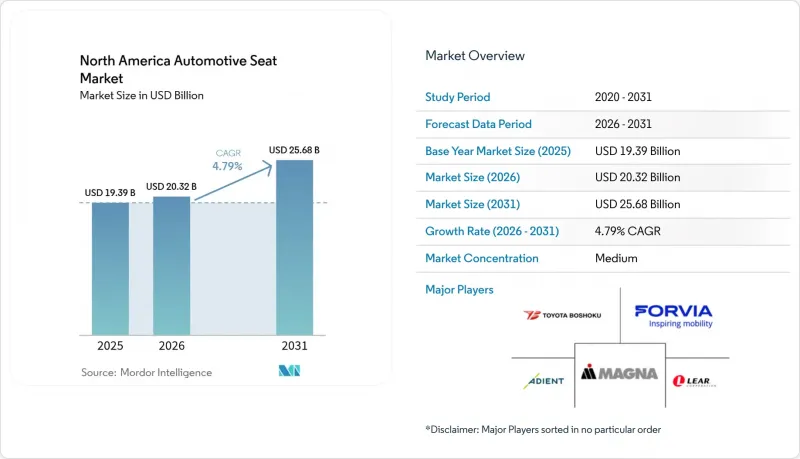
Mordor Intelligence에 의하면, 북미의 자동차용 시트 시장 규모는 2025년 193억 9,000만 달러로 평가되었고, 2026년에는 203억 2,000만 달러로 추정되고, 2026-2031년 CAGR 4.79%로 성장을 지속할 전망이며, 2031년에는 256억 8,000만 달러에 이를 것으로 예측됩니다.
본 보고서는 소재 유형별(가죽, 패브릭, 기타), 기술 유형별(표준 시트, 전동 시트, 기타), 차종별(승용차, 기타), 유통 채널별(OEM 및 애프터마켓), 파워트레인별(내연기관, 기타), 가격대별(저가, 중가, 고가), 지역별(미국, 기타)로 분류되어 있습니다. 시장 전망은 금액(달러) 기준으로 제시되어 있습니다.
북미의 자동차용 시트 시장 동향 및 인사이트
프리미엄 SUV 및 픽업 트럭으로의 전환이 전동 및 통기 기능이 탑재된 시트 수요를 끌어올리고 있습니다.
현재 트럭 기반 프리미엄 차종에는 30방향 조절 기능, 액티브 마사지 기능, 공조 제어 기능 등이 탑재되어 있으며, 이러한 기능들은 판매 가격 상승으로 이어지고 있습니다. 링컨의 ‘네비게이터’에 채택된 ‘퍼펙트 포지션’ 시트와 포드의 ‘액티브 모션’ 마사지 기능은 편안함의 혁신이 운전자의 피로를 줄여주는 좋은 예입니다. 북미 전역에서 풀사이즈 픽업 트럭의 등록 대수는 증가세를 이어가고 있으며, 주류 가격대에서 프리미엄 기능을 제공할 수 있는 공급업체에게 시트 관련 기능의 성장 기회가 더욱 확대되고 있습니다.
중형 부문 차량에 고급 편의 기능(온도 조절, 마사지) 통합
2025년 1분기에 GM과 공동으로 출시될 리아(Rear)사의 ‘ComfortMax’는 부품 수를 50% 줄이면서도 가열·냉각 속도를 40% 향상시켜, 모듈식 설계가 부품 원가를 절감할 수 있음을 입증하고 있습니다. 마그나(Magna)의 ‘FreeForm’ 트림은 이미 2025년형 신차 4개 차종에 채택이 결정되었으며, 깊은 오목한 형태를 갖추고 있고, 후면 패널에 50%의 재생 재료를 사용하고 있습니다. 비테스코는 48V 아키텍처와 PoE(Power-over-Ethernet) 하네스를, 부피가 큰 배선 없이 에너지 소비가 많은 시트 기능을 구현하는 핵심 요소로 꼽고 있습니다. 소비자들이 웰니스 및 모빌리티를 동일시하게 됨에 따라, 중저가 차량에서도 마사지 기능과 온도 조절 기능이 필수 불가결해지고 있습니다.
가죽과 석유화학제품의 가격 변동이 BOM 비용을 상승시키고 있다.
합성 가죽에는 석유 유래 원료로 제조된 폴리우레탄이 사용되므로, 시트 비용은 원유 가격 변동에 좌우됩니다. 천연 가죽은 가축의 생산 주기나 환경적 제약의 영향을 받습니다. OEM과의 가격 고정 계약으로 인해 공급업체는 가격 변동을 헤지하거나 그 영향을 흡수할 수밖에 없어, 이익률이 압박받고 있습니다. Rheom과 같은 스타트업은 투입 비용을 안정화하기 위해 바이오 가죽을 제공하고 있지만, 그 유효성 검증과 양산화가 여전히 과제로 남아 있습니다.
부문 분석
2025년 북미의 자동차용 시트 시장에서 합성 가죽은 41.83%라는 최대 점유율을 유지했으며, 비용 측면의 이점과 동물 유래가 아니라는 매력을 입증하고 있습니다. 그럼에도 불구하고 천연 가죽은 가장 빠르게 성장하는 소재로, 고급 SUV 및 픽업트럭 구매자들이 ‘진품’인 것을 지위의 상징으로 간주함에 따라 2031년 연평균 성장률(CAGR)은 7.38%를 나타낼 것으로 전망됩니다. 공급업체들은 PFAS 첨가제를 사용하지 않으면서도 내구성 기준을 충족하는 바이오 폴리머를 시범적으로 도입함으로써 가격 변동 위험을 헤지하고 있습니다. Rheom의 식물 유래 표면 소재는 지속가능성과 고급스러움이 어떻게 조화를 이룰 수 있는지를 보여주고 있습니다.
북미 자동차용 시트 시장에서 천연 가죽 관련 시장 규모는 해당 부문 내에서 가장 빠른 속도로 확대될 것으로 예측되며, 이에 따라 가죽 가공업체들은 USMCA(미국·멕시코·캐나다 협정)에 따라 마감 공정의 현지화를 추진하도록 촉진받고 있습니다. 패브릭은 여전히 보급형 모델과 상용 트럭에서 주류를 이루고 있지만, 폴리우레탄 폼은 캘리포니아주의 규제를 충족하기 위해 저VOC 배합으로 진화하고 있습니다. 마그나(Magna)의 ‘FreeForm’ 백 패널은 최대 50%의 재활용 플라스틱을 함유하고 있어, 소재 혁신이 디자인의 자유도와 규제 준수를 어떻게 뒷받침하고 있는지 잘 보여줍니다.
2025년 현재, 북미 자동차용 시트 시장에서 표준 수동식 유닛의 점유율은 61.85%를 차지했습니다. 차량 구매자들은 단순성과 가동 시간을 중요하게 생각합니다. 마사지 기능과 웰니스 기능을 갖춘 시트는 인구 통계학적 동향과 건강에 대한 인식 제고를 반영하여, 2031년까지 연평균 성장률(CAGR) 6.21%를 기록할 전망입니다. Rear사의 ‘ComfortMax’ 모듈은 반응성이 뛰어난 미기후 제어 기능과 마사지 노드를 융합하고, 중형 크로스오버 차량에도 장착될 수 있도록 패키지 크기를 소형화했습니다.
48V 네트워크의 보급에 따라 전동·히터·쿨러 기능을 갖춘 북미 자동차용 시트 시장 점유율이 확대되고 있으며, 이를 통해 OEM 각사는 굵은 게이지 배선을 피할 수 있게 됩니다. 비테스코(Vitesco)의 PoE(Power-over-Ethernet) 접근 방식은 하네스의 무게를 줄여 경량화 목표 달성에 기여합니다. 웰니스 기능이 보급됨에 따라, Tier 1 공급업체들은 무선(OTA)을 통한 기능 업그레이드가 가능한 소프트웨어 정의형 시트 컨트롤러로 전환하고 있으며, 이를 통해 애프터마켓 수익원이 개발되고 있습니다.
기타 혜택
- 엑셀 형식 시장 예측(ME) 시트
- 3개월간의 애널리스트 지원
자주 묻는 질문
목차
제1장 서론
제2장 조사 방법
제3장 주요 요약
제4장 시장 구도
제5장 시장 규모 및 성장 예측
제6장 경쟁 구도
제7장 시장 기회 및 향후 전망
AJY 26.08.28According to Mordor Intelligence, the north american automotive seat market size is expected to grow from USD 19.39 billion in 2025 to USD 20.32 billion in 2026 and is forecast to reach USD 25.68 billion by 2031 at 4.79% CAGR over 2026-2031.
This report is Segmented by Material Type (Leather, Fabric, and More), Technology Type (Standard Seats, Powered Seats, and More), Vehicle Type (Passenger Cars, and More), Sales Channel (OEM and Aftermarket), Powertrain (ICE, and More), Price Band (Economy, Mid-Range, and Luxury), and Geography (United States, and More). The Market Forecasts are Provided in Terms of Value (USD).
North America Automotive Seat Market Trends and Insights
Shift Toward Premium SUVs and Pickups Boosting Demand for Powered, Ventilated Seating
Premium truck-based nameplates now integrate 30-way adjustment, active massage, and climate-control features that command higher transaction values. Lincoln's Navigator Perfect Position seats and Ford's Active Motion massage illustrate how comfort innovation reduces driver fatigue. Full-size pickup registrations keep rising across North America, magnifying seat-content growth opportunities for vendors able to deliver premium functions at mainstream price points.
Integration of Advanced Comfort Functions in Mid-Segment Vehicles
Lear's ComfortMax, debuting with GM in Q1 2025, heats or cools 40% faster with 50% fewer parts, proving that modular design shrinks bill-of-material cost . Magna's FreeForm trim, already specified for four new 2025 models, delivers high concavity and 50% recycled back-panel content. Vitesco pinpoints 48V architectures and power-over-Ethernet harnesses as enablers for energy-intensive seat features without bulky wiring. As consumers equate wellness with mobility, massage and thermal functions become necessary in mid-price vehicles.
Leather and Petrochemical Price Volatility Inflating BOM Costs
Synthetic leather uses polyurethane derived from oil-based feedstocks, tying seat economics to crude swings. Genuine hides track livestock cycles and environmental constraints. OEM price-freeze contracts force suppliers to hedge or absorb volatility, tightening margins. Start-ups like Rheom offer bio-based leather to stabilize input costs, but validation and scale remain hurdles.
Other drivers and restraints analyzed in the detailed report include:
- OEM Lightweighting Targets Accelerating Adoption of Synthetic and Bio-Based Seat Materials
- Municipal EV Fleet Mandates Driving Demand for Ultralight Commercial-Vehicle Seats
- Semiconductor Shortages Limiting Powered-Seat Output
For complete list of drivers and restraints, kindly check the Table Of Contents.
Segment Analysis
Synthetic leather retained the largest 41.83% slice of the North America automotive seat market in 2025, underscoring its cost benefit and animal-free appeal. Nevertheless, genuine leather is the fastest-rising material, charting a 7.38% CAGR through 2031 as luxury SUV and pickup buyers equate authenticity with status. Suppliers hedge volatility by trialing bio-based polymers that meet durability metrics without PFAS additives. Rheom's plant-based surfaces illustrate how sustainability and premium cues can converge.
The North American automotive seat market size tied to genuine leather is projected to expand at the segment-leading pace, encouraging tanners to localize finishing operations under USMCA. Fabric remains prevalent in entry cars and vocational trucks, while polyurethane foams evolve toward low-VOC blends to satisfy California regulations. Magna's FreeForm back panels, embedding up to 50% recycled plastic, highlight how material innovation underpins design freedom and regulatory compliance.
Standard manual units hold 61.85% share of the North America automotive seat market in 2025; fleet buyers prize simplicity and uptime. Massage and wellness seats will clock a 6.21% CAGR to 2031, reflecting demographic trends and heightened health awareness. Lear's ComfortMax module fuses rapid-response micro-climate control with massage nodes, shrinking packaging to fit mid-size crossovers.
The North American automotive seat market share for powered, heated, and cooled configurations widens as 48V networks proliferate, letting OEMs avoid heavy-gauge wiring. Vitesco's power-over-Ethernet approach reduces harness mass, aiding lightweighting goals. As wellness features normalize, tier-one suppliers pivot toward software-defined seat controllers capable of over-the-air function upgrades, opening aftermarket revenue streams.
Complete Report Scope:
- By Material Type
- Leather
- Fabric
- Synthetic Leather
- Polyurethane Foam and Others
- By Technology Type
- Standard (Manual-Adjust) Seats
- Powered Seats
- Heated Seats
- Ventilated / Cooled Seats
- Massage and Wellness Seats
- By Vehicle Type
- Passenger Cars
- Light Commercial Vehicles
- Heavy Commercial Vehicles and Buses
- By Sales Channel
- Original Equipment Manufacturer (OEM)
- Aftermarket (Replacement / Retrofit / Customization)
- By Propulsion
- Internal-Combustion Engine (ICE)
- Hybrid Electric Vehicle (HEV)
- Plug-in Hybrid (PHEV)
- Battery Electric Vehicle (BEV)
- Fuel-Cell Electric Vehicle (FCEV)
- By Price Band (OEM Trim Alignment)
- Economy
- Mid-range
- Luxury
- By Country
- United States
- Canada
- Mexico
- Rest of North America
List of Companies Covered in this Report:
- Adient PLC
- Lear Corporation
- Faurecia SE (FORVIA)
- Magna International Inc.
- Toyota Boshoku Corporation
- TS TECH Co., Ltd.
- Aisin Corporation
- Grupo Antolin
- RECARO Automotive Italy S.r.l.
- H.O. Bostrom Company, Inc.
- Gentherm Inc.
- Brose Fahrzeugteile SE and Co.
- Kongsberg Automotive ASA
- Hyundai Transys Inc.
- Futuris Group
- Freedman Seating Company
- Katzkin Leather Interiors Inc.
- NHK Spring Co., Ltd.
- Toyo Seat Co., Ltd.
- Yanfeng International Automotive Technology Co. Ltd.
Additional Benefits:
- The market estimate (ME) sheet in Excel format
- 3 months of analyst support
TABLE OF CONTENTS
1 Introduction
- 1.1 Study Assumptions and Market Definition
- 1.2 Scope of the Study
2 Research Methodology
3 Executive Summary
4 Market Landscape
- 4.1 Market Overview
- 4.2 Market Drivers
- 4.2.1 Shift Toward Premium SUVs and Pickups Boosting Demand for Powered, Ventilated Seating
- 4.2.2 OEM Lightweighting Targets Accelerating Adoption of Synthetic and Bio-Based Seat Materials
- 4.2.3 Integration Of Advanced Comfort Functions (Thermal, Massage) In Mid-Segment Vehicles
- 4.2.4 USMCA Rules Spurring Near-Shoring of Seat Sub-Assemblies
- 4.2.5 AI-Enabled JIT Mass-Customized Seat Production Lines
- 4.2.6 Municipal EV Fleet Mandates Driving Demand for Ultralight Commercial?Vehicle Seats
- 4.3 Market Restraints
- 4.3.1 Leather and Petrochemical Price Volatility Inflating BOM Costs
- 4.3.2 Semiconductor/Actuator Shortages Limiting Powered-Seat Output
- 4.3.3 PFAS / VOC Regulations on Foams Raising Compliance Spend
- 4.3.4 Skilled-Labor Shortages and Wage Hikes at NA JIT Seat Plants
- 4.4 Value / Supply-Chain Analysis
- 4.5 Regulatory Landscape
- 4.6 Technological Outlook
- 4.7 Porter's Five Forces Analysis
- 4.7.1 Threat of New Entrants
- 4.7.2 Bargaining Power of Buyers / Consumers
- 4.7.3 Bargaining Power of Suppliers
- 4.7.4 Threat of Substitute Products
- 4.7.5 Intensity of Competitive Rivalry
5 Market Size and Growth Forecasts (Value (USD))
- 5.1 By Material Type
- 5.1.1 Leather
- 5.1.2 Fabric
- 5.1.3 Synthetic Leather
- 5.1.4 Polyurethane Foam and Others
- 5.2 By Technology Type
- 5.2.1 Standard (Manual-Adjust) Seats
- 5.2.2 Powered Seats
- 5.2.3 Heated Seats
- 5.2.4 Ventilated / Cooled Seats
- 5.2.5 Massage and Wellness Seats
- 5.3 By Vehicle Type
- 5.3.1 Passenger Cars
- 5.3.2 Light Commercial Vehicles
- 5.3.3 Heavy Commercial Vehicles and Buses
- 5.4 By Sales Channel
- 5.4.1 Original Equipment Manufacturer (OEM)
- 5.4.2 Aftermarket (Replacement / Retrofit / Customization)
- 5.5 By Propulsion
- 5.5.1 Internal-Combustion Engine (ICE)
- 5.5.2 Hybrid Electric Vehicle (HEV)
- 5.5.3 Plug-in Hybrid (PHEV)
- 5.5.4 Battery Electric Vehicle (BEV)
- 5.5.5 Fuel-Cell Electric Vehicle (FCEV)
- 5.6 By Price Band (OEM Trim Alignment)
- 5.6.1 Economy
- 5.6.2 Mid-range
- 5.6.3 Luxury
- 5.7 By Country
- 5.7.1 United States
- 5.7.2 Canada
- 5.7.3 Mexico
- 5.7.4 Rest of North America
6 Competitive Landscape
- 6.1 Market Concentration
- 6.2 Strategic Moves
- 6.3 Market Share Analysis
- 6.4 Company Profiles (Includes Global level Overview, Market level overview, Core Segments, Financials as available, Strategic Information, Market Rank/Share for key companies, Products and Services, and Recent Developments)
- 6.4.1 Adient PLC
- 6.4.2 Lear Corporation
- 6.4.3 Faurecia SE (FORVIA)
- 6.4.4 Magna International Inc.
- 6.4.5 Toyota Boshoku Corporation
- 6.4.6 TS TECH Co., Ltd.
- 6.4.7 Aisin Corporation
- 6.4.8 Grupo Antolin
- 6.4.9 RECARO Automotive Italy S.r.l.
- 6.4.10 H.O. Bostrom Company, Inc.
- 6.4.11 Gentherm Inc.
- 6.4.12 Brose Fahrzeugteile SE and Co.
- 6.4.13 Kongsberg Automotive ASA
- 6.4.14 Hyundai Transys Inc.
- 6.4.15 Futuris Group
- 6.4.16 Freedman Seating Company
- 6.4.17 Katzkin Leather Interiors Inc.
- 6.4.18 NHK Spring Co., Ltd.
- 6.4.19 Toyo Seat Co., Ltd.
- 6.4.20 Yanfeng International Automotive Technology Co. Ltd.


