

|
시장보고서
상품코드
2114975
광학 암호화 시장 : 시장 점유율 분석, 업계 동향 및 통계, 성장 예측(2026-2031년)Optical Encryption - Market Share Analysis, Industry Trends & Statistics, Growth Forecasts (2026 - 2031) |
||||||
 Mordor Intelligence
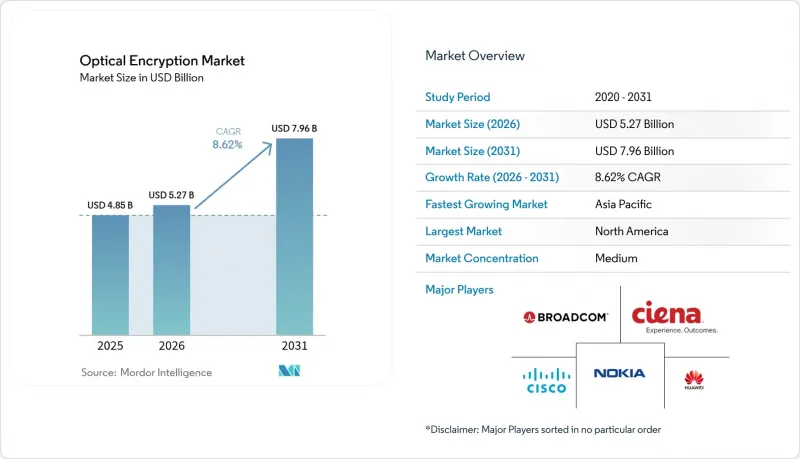
Mordor Intelligence에 의하면, 광학 암호화 시장 규모는 2025년에 48억 5,000만 달러로 평가되었고, 2026년 52억 7,000만 달러로 추정되고, 2031년까지 79억 6,000만 달러에 이를 것으로 예측되며, 예측 기간(2026-2031년) CAGR은 8.62%를 나타낼 전망입니다.
본 보고서는 암호화 계층별(레이어 1, 레이어 2, 레이어 3), 데이터 전송 속도별(10Gbps 이하, 10-40Gbps, 그 이상), 구성 요소별(하드웨어 암호화 어플라이언스, 기타), 배포 모드별(온프레미스, 클라우드/NaaS(Network-as-a-Service), 기타), 최종 사용자 산업별(데이터센터·클라우드, 은행, 금융서비스 및 보험(BFSI), 헬스케어, 에너지·유틸리티, 소매 및 전자상거래, 기타) 및 지역별로 분류되어 있습니다.
세계의 광학 암호화 시장 동향 및 인사이트
멀티테라비트 메트로 DCI 구축이 코히런트 기술 채택을 촉진
하이퍼스케일 사업자들은 분산형 AI 캠퍼스를 멀티 테라비트 메트로 링으로 상호 연결하고 있으며, 400G 및 800G에서 AES-256-GCM을 통합한 코히런트 광통신으로 전환하고 있습니다. Ciena의 WaveLogic 6 Extreme은 파장당 1.6Tbps를 실현하는 동시에 비트당 전력 소비를 50% 절감합니다. 데이터센터 내 광 회로 교환을 통해 구리선으로 인한 병목 현상이 해소되고, 암호화가 물리 계층에서 이루어짐으로써 모델 훈련 중 무손실 그라디언트 교환이 보장됩니다. 지역 통신사들은 이 모델을 응용하여 암호화된 대역폭 슬라이스를 제공함으로써 기존 다크 파이버를 수익화하고 있습니다. 그 결과 발생하는 규모의 경제 효과로 인해 보안이 보장된 비트당 비용이 절감되며, 코로케이션 시설 및 기업 캠퍼스 전체에서 레이어 1로의 확산이 가속화되고 있습니다.
제로 트러스트 의무화로 레이어 1 통합 가속화
현재 정부 프레임워크에서는 보안 침해를 전제로 하고 지속적인 검증이 요구되므로, 하드웨어 암호화는 추가 기능이 아닌 기본 기능이 되었습니다. 미국의 CNSA 2.0과 EU의 NIS2는 양자 내성 키를 직접 명시하고 있으며, 라인 속도로 투명하게 암호화하는 장치에 대한 예산 배분을 촉진하고 있습니다. Broadcom의 Emulex Secure Fibre Channel 어댑터는 전체 처리량을 유지하면서 하드웨어 텔레메트리 기능을 통해 랜섬웨어를 차단하는 메커니즘을 보여줍니다. 금융 기관들은 마이크로초 단위의 지연만으로도 수익을 날려버릴 수 있는 고빈도 거래에 대응하기 위해 유사한 설계를 채택하고 있습니다. 이러한 규정 준수 중심의 지출로 인해 수요는 일반적인 기술 갱신 주기와 분리되어, 인증된 광학 장비의 프리미엄 가격 책정이 유지되고 있습니다.
코히런트형 400G+ 광 디바이스의 높은 설비 투자액
코히런트형 트랜시버는 인듐 인화물(InP) PIC 및 고성능 DSP가 필요하기 때문에 여전히 직접 디텍트형 모듈보다 높은 가격을 유지하고 있습니다. 코히런트(Coherent)사의 6인치 InP 웨이퍼로의 전환은 다이 비용을 60% 절감하는 것을 목표로 하고 있지만, 상용 규모로 양산을 시작하기까지는 아직 18개월이 더 소요될 전망입니다. 갈륨 및 게르마늄에 대한 소재 수출 규제는 투입 비용을 더욱 상승시켜, 수직 통합을 실시하지 않는 공급업체의 이익률을 압박하고 있습니다. 소규모 통신 사업자들은 업그레이드를 미루거나 일괄 구매 대신 ‘대역폭 온디맨드’ 서비스를 채택할 가능성이 있어, 장기적인 경제성은 개선되고 있음에도 불구하고 단기적인 출하 대수는 억제될 전망입니다.
부문 분석
레이어 1은 2025년에 45.60%의 시장 점유율을 차지했고, 연평균 성장률(CAGR) 11.55%로 성장하고 있으며, 이는 모든 레이어 중 가장 높은 성장률입니다. PacketLight의 DWDM 포트폴리오는 FIPS 140-3 요건을 충족하면서 양자 키 배분이 코히런트 채널에 직접 통합되는 구조를 보여줍니다. 하이퍼스케일러가 800G 라인 카드를 채택함에 따라, 레이어 1 플랫폼용 광학 암호화 시장 규모는 꾸준히 확대될 것으로 예측됩니다. 하드웨어 기반의 키 저장, 변조 감지 기능, 결정론적 지연은 여전히 결정적인 우위를 차지하고 있습니다. 기업에서는 레거시 10-25G 링크용으로 레이어 2 MACsec 어플라이언스를 계속 채택하고 있지만, 성능 한계로 인해 그 도입은 정체 상태에 있습니다. 레이어 3 IPsec은 원시 속도보다 용도 인식이 우선시되는 틈새 WAN 시나리오에서 여전히 사용되고 있지만, 추가 지연으로 인해 마이크로초 단위의 결정성이 필요한 AI 훈련 클러스터에서의 도입은 저해되고 있습니다.
메트로 및 장거리 회선 구축에서 Ciena의 WaveLogic Encryption은 외부 셸프를 필요로 하지 않고 파장별 보호를 실현하여 랙 공간을 30% 절감합니다. 통신 사업자들은 DSP 펌웨어가 암호화 매개변수를 자동으로 협상하기 때문에 프로비저닝이 간소화되고 운영 민첩성이 향상되고 있다고 보고합니다. 광학 암호화 시장에서는 예산이 상위 OSI 계층에서 포토닉 플레인으로 계속 이동하고 있으며, 이로 인해 하드웨어 벤더의 가격 결정력은 강화되는 반면, 소프트웨어만 제공하는 공급업체의 부가가치는 축소되고 있습니다.
2025년에는 100G 코히런트 플러그어블이 양산 단계에 도달함에 따라, 40-100Gbps 부문이 광학 암호화 시장 규모의 37.35%를 차지했습니다. 기존 통신 사업자 네트워크에서는 메트로 집약 및 엣지 클라우드로의 온램프에 이러한 전송 속도가 활용되고 있습니다. Coherent Corp.의 산업용 온도 지원 100G ZR QSFP28-DCO는 가혹한 환경에 대한 적용 범위를 확대하여, 냉난방 설비 비용을 들이지 않고도 이동통신 기지국 허브에서 암호화를 가능하게 합니다. 그럼에도 불구하고, 하이퍼스케일러가 GPU 클러스터 상호 연결을 위해 400G 및 800G로 전환함에 따라 100Gbps를 초과하는 레인은 연평균 성장률(CAGR) 17.4%로 성장을 지속하고, 있습니다. Marvell의 COLORZ 800은 800G DCI 링크의 자본 비용을 최대 75% 절감하여, 과거 보급을 저해하던 가격 격차를 좁히고 있습니다.
10Gbps 이하의 링크는 트래픽 버스트가 여전히 미미한 브라운필드 제어 네트워크 및 산업용 IoT에서 계속 사용되고 있습니다. 10-40Gbps 대역은 캠퍼스 백본 및 25G PON을 지원하지만, AI 워크로드가 트래픽 프로파일을 재구성함에 따라 증분 수익은 상위 대역으로 이동하고 있습니다. 이에 따라 각 공급업체들은 3nm 공정 DSP 노드를 기반으로 한 1.6T 로드맵에 연구 개발 자원을 재분배하고 있으며, 이를 통해 고속화 추세가 더욱 가속화되고 있습니다.
지역별 분석
북미는 2025년에도 40.60%의 매출 점유율을 유지했습니다. 이는 연방 정부의 제로 트러스트 지침과 안전한 800G 파장을 필요로 하는 하이퍼스케일 AI 클러스터 구축에 힘입은 결과입니다. 국내 반도체 공급망에 대한 우대 조치로 인해 코패키지드 옵틱스의 채택이 가속화되어, DSP 밸류체인의 대부분이 국내에 정착하고 있습니다. 캐나다의 양자 통신 현장 테스트와 멕시코에서 확대되는 코로케이션 시장이 수요를 더욱 끌어올리고 있지만, 미국은 여전히 주요 구매처이자 연구개발 거점으로 자리 잡고 있습니다.
아시아태평양은 2031년까지 연평균 성장률(CAGR)이 9.62%로 가장 빠르게 성장하고 있는 지역입니다. 중국은 수십억 달러 규모의 국가 자금을 양자 보안 대응 백본 구축에 투입하고 있는 반면, 일본에서 402Tbps 광섬유 통신을 달성한 것은 이 지역의 포토닉스 연구가 얼마나 심도 있는지 증명하고 있습니다. 인도의 데이터센터용량은 2025년부터 2028년 사이에 2배 이상 확대되어, AES-256이 내장된 100G-ZR 플러그인 모듈의 조달을 촉진하고 있습니다. 한국은 암호화된 25G PON을 활용해 농촌 지역으로 5G 통신을 확대하고 있으며, 아세안(ASEAN)은 지역의 제조 역량을 활용하여 포토닉스 제품의 현지 조립을 추진하고 있습니다.
유럽은 세계 최고 수준의 연구 기관을 보유하고 있음에도 불구하고, 인증 제도의 파편화가 걸림돌이 되어 시장 점유율이 축소되고 있습니다. 핀란드의 Telia-VTT가 추진하는 양자 보안 네트워크와 같은 국가 차원의 시범 사업은 기술의 유효성을 입증하고 있지만, 유럽 전역에 걸친 합의에는 이르지 못하고 있습니다. EuroQCI 프로그램은 조달의 조화를 목표로 하고 있지만, 그 전개는 아시아나 북미의 동종 업계에 비해 뒤처져 있습니다. 중동의 성장률은 기반 규모는 작지만 유럽을 상회하고 있으며, GITEX 2024에서 아랍에미리트가 시연한 ‘파이버 투 위성(Fiber to Satellite)’ 양자 키 배포가 이를 뒷받침하고 있습니다. 사우디아라비아의 ‘비전 2030’에서는 주권 클라우드 암호화가 중요 인프라로 자리매김하고 있어, 아랍어로의 현지화 및 현지 키 관리 옵션을 제공하는 벤더에게 새로운 성장 기회가 열리고 있습니다.
기타 혜택
- 엑셀 형식 시장 예측(ME) 시트
- 3개월간의 애널리스트 지원
자주 묻는 질문
목차
제1장 서론
제2장 조사 방법
제3장 주요 요약
제4장 시장 구도
제5장 시장 규모 및 성장 예측
제6장 경쟁 구도
제7장 시장 기회 및 향후 전망
AJY 26.08.28According to Mordor Intelligence, the optical encryption market size was valued at USD 4.85 billion in 2025 and estimated to grow from USD 5.27 billion in 2026 to reach USD 7.96 billion by 2031, at a CAGR of 8.62% during the forecast period (2026-2031).
This report is Segmented by Encryption Layer ( Layer 1, Layer 2, and Layer 3), Data Rate ( Less Than 10 G, 10 G To 40 G, and More), Component (Hardware Encryption Appliances and More) Deployment Mode (On-Premise, Cloud / Network-As-A-Service, and More), End-User Vertical (Datacenter and Cloud, BFSI, Healthcare, Energy and Utilities, Retail and E-Commerce, and More), and Geography.
Global Optical Encryption Market Trends and Insights
Multi-terabit Metro DCI Build-outs Drive Coherent Adoption
Hyperscale operators interconnect distributed AI campuses with multi-terabit metro rings, shifting to coherent optics that embed AES-256-GCM at 400 G and 800 G. Ciena's WaveLogic 6 Extreme enables 1.6 Tbps per wavelength while trimming per-bit power use by 50%. Optical circuit switching inside data centers removes copper bottlenecks and hands encryption to the physical layer, ensuring loss-less gradient exchange during model training. Regional carriers replicate this model to monetize existing dark fiber by offering encrypted bandwidth slices. Resulting scale economics lower cost per secured bit and accelerate Layer 1 penetration across colocation and enterprise campuses.
Zero-trust Mandates Accelerate Layer-1 Integration
Government frameworks now presume breach and require continuous verification, making hardware encryption a default rather than an add-on. The U.S. CNSA 2.0 and the EU's NIS2 point directly at quantum-resistant keys, steering budgets toward devices that encrypt transparently at line rate. Broadcom's Emulex Secure Fibre Channel adapters illustrate how hardware telemetry blocks ransomware while maintaining full throughput. Financial institutions adopt similar designs to serve high-frequency trading where microsecond delays erase profits. This compliance-driven spending decouples demand from ordinary technology refresh cycles and sustains premium pricing for certified optical gear.
High Capex of Coherent 400 G+ Optics
Coherent transceivers still command premiums over direct-detect modules because they require indium phosphide PICs and advanced DSPs. Coherent Corp.'s move to 6-inch InP wafers aims for a 60% die-cost reduction, but commercial volumes remain 18 months away. Material export restrictions on gallium and germanium further elevate input costs, squeezing margins for suppliers that lack vertical integration. Smaller carriers may defer upgrades or adopt bandwidth-on-demand services instead of outright purchases, tempering near-term unit shipments even as long-term economics improve.
Other drivers and restraints analyzed in the detailed report include:
- MACsec Bottlenecks Push Layer-1 Upgrades
- Post-quantum Crypto-agile Transport Pilots
- Fragmented Regulatory Certification Requirements
For complete list of drivers and restraints, kindly check the Table Of Contents.
Segment Analysis
Layer 1 commanded 45.60% market share in 2025 and is growing at 11.55% CAGR, the strongest rate among all layers. PacketLight's DWDM portfolio shows how quantum key distribution integrates directly into coherent channels while staying within FIPS 140-3 boundaries. The optical encryption market size for Layer 1 platforms is projected to expand steadily as hyperscalers adopt 800 G line cards. Hardware-rooted key stores, tamper evidence, and deterministic latency remain decisive advantages. Enterprises retain Layer 2 MACsec appliances for legacy 10-25 G links, but those deployments plateau amid performance ceilings. Layer 3 IPsec persists in niche WAN scenarios where application awareness outweighs raw speed; nevertheless, its incremental latency discourages adoption in AI training clusters that demand microsecond determinism.
In metro and long-haul builds, Ciena's WaveLogic Encryption enables per-wavelength protection without external shelves, cutting rack space by 30%. Operators report simplified provisioning because DSP firmware automatically negotiates encryption parameters, boosting operational agility. The optical encryption market continues to shift budget from higher OSI layers to the photonic plane, reinforcing hardware vendors' pricing power while compressing value for software-only suppliers.
The 40-100 Gbps segment accounted for 37.35% of the optical encryption market size in 2025 as 100 G coherent pluggables reached volume production. Established telco networks use these rates for metro aggregation and edge cloud on-ramps. Coherent Corp.'s industrial-temperature 100 G ZR QSFP28-DCO extends reach into harsh environments, allowing encryption at cell-tower hubs without HVAC expense. Nonetheless, >100 Gbps lanes post an 17.4% CAGR as hyperscalers transition to 400 G and 800 G for GPU cluster interconnects. Marvell's COLORZ 800 reduces capital cost of 800 G DCI links by up to 75%, collapsing the price gap that once hampered uptake.
Under 10 Gbps links survive in brownfield control networks and industrial IoT where traffic bursts remain modest. The 10-40 Gbps tier addresses campus backbones and 25 G PON, but incremental revenue migrates upward as AI workloads reshape traffic profiles. Accordingly, suppliers reallocate R&D toward 1.6 T road-maps backed by DSP nodes at 3 nm, further tipping momentum toward higher speeds.
Complete Report Scope:
- By Encryption Layer
- Layer 1
- Layer 2
- Layer 3
- By Data Rate
- less than 10 Gbps
- 10 - 40 Gbps
- 40 - 100 Gbps
- above 100 Gbps
- By Component
- Hardware Encryption Appliances
- Coherent/Pluggable Modules and Optics
- Key-Management / Orchestration Software
- Managed Encryption Services
- By Deployment Mode
- On-Premise (Carrier-Owned)
- Cloud / Network-as-a-Service
- Edge / Remote-Site Appliances
- By End-user Vertical
- Datacenter and Cloud
- BFSI
- Government and Defense
- Healthcare
- Energy and Utilities
- Retail and E-commerce
- Other End-user Verticals
- By Geography
- North America
- United States
- Canada
- Mexico
- South America
- Brazil
- Argentina
- Rest of South America
- Europe
- Germany
- United Kingdom
- France
- Rest of Europe
- Asia Pacific
- China
- India
- Japan
- South Korea
- ASEAN
- Rest of Asia Pacific
- Middle East
- Saudi Arabia
- UAE
- Turkey
- Rest of Middle East
- Africa
- South Africa
- Rest of Africa
- North America
Geography Analysis
North America retained 40.60% revenue share in 2025, underpinned by federal zero-trust directives and hyperscale AI cluster builds that demand secure 800 G waves. Domestic chip supply-chain incentives hasten adoption of co-packaged optics, anchoring much of the DSP value chain onshore. Canada's quantum-communication field tests and Mexico's expanding colocation market add incremental demand, but the United States remains the dominant buyer and R&D hub.
Asia Pacific is the fastest-growing region at 9.62% CAGR through 2031. China channels multibillion-dollar state funding into quantum-secure backbone builds, while Japan's 402 Tbps fiber milestone proves regional depth in photonics research. India's data-center capacity more than doubles between 2025 and 2028, spurring procurement of 100 G-ZR pluggables with built-in AES-256. South Korea extends 5 G transport to rural areas using encrypted 25 G PON, and ASEAN nations leverage regional manufacturing capacity to localize photonic assembly.
Europe's share contracts despite world-class labs, penalized by fragmented certification regimes. National pilots such as Finland's Telia-VTT quantum-secure network validate technology but stop short of continent-wide consensus. The EuroQCI program aims to harmonize procurement, yet roll-out lags Asian and North American peers. Middle East growth outpaces Europe on a smaller base, buoyed by UAE's fiber-to-satellite quantum key distribution demo at GITEX 2024. Saudi Arabia's Vision 2030 earmarks sovereign-cloud encryption as critical infrastructure, creating fresh runway for vendors with Arabic localization and local-key-custody options.
- Nokia Corporation
- Cisco Systems Inc.
- Huawei Technologies Co. Ltd
- Broadcom Inc.
- Juniper Networks Inc.
- Ciena Corporation
- Ribbon Communications
- Infinera Corporation
- ADVA Optical Networking SE
- Arista Networks Inc.
- Acacia Communications
- Thales Group
- Fujitsu Ltd.
- Lumentum Holdings Inc.
- Marvell (Inphi)
- PacketLight Networks
- Microchip Technology Inc.
- LightRiver Technologies
- ID Quantique SA
Additional Benefits:
- The market estimate (ME) sheet in Excel format
- 3 months of analyst support
TABLE OF CONTENTS
1 INTRODUCTION
- 1.1 Study Assumptions and Market Definition
- 1.2 Scope of the Study
2 RESEARCH METHODOLOGY
3 EXECUTIVE SUMMARY
4 MARKET LANDSCAPE
- 4.1 Market Overview
- 4.2 Market Drivers
- 4.2.1 Multi-terabit metro DCI build-outs
- 4.2.2 Zero-trust mandates across critical infrastructure
- 4.2.3 MAC-sec bottlenecks pushing Layer-1 upgrades
- 4.2.4 Post-quantum "crypto-agile" transport pilots
- 4.2.5 AI/LLM GPU clusters demanding loss-less 800 G links
- 4.2.6 Sovereign cloud zones requiring in-flight key escrow
- 4.3 Market Restraints
- 4.3.1 High capex of coherent 400 G+ optics
- 4.3.2 Fragmented regulatory certification (FIPS 140-3, ETSI 012)
- 4.3.3 Scarcity of entropy sources at line-rate speeds
- 4.3.4 Supply-chain choke-points in ultra-low-jitter DSPs
- 4.4 Value Chain Analysis
- 4.5 Regulatory Landscape
- 4.6 Technological Outlook
- 4.7 Porter's Five Forces Analysis
- 4.7.1 Threat of New Entrants
- 4.7.2 Bargaining Power of Buyers
- 4.7.3 Bargaining Power of Suppliers
- 4.7.4 Threat of Substitutes
- 4.7.5 Competitive Rivalry
5 MARKET SIZE AND GROWTH FORECASTS (VALUE)
- 5.1 By Encryption Layer
- 5.1.1 Layer 1
- 5.1.2 Layer 2
- 5.1.3 Layer 3
- 5.2 By Data Rate
- 5.2.1 less than 10 Gbps
- 5.2.2 10 - 40 Gbps
- 5.2.3 40 - 100 Gbps
- 5.2.4 above 100 Gbps
- 5.3 By Component
- 5.3.1 Hardware Encryption Appliances
- 5.3.2 Coherent/Pluggable Modules and Optics
- 5.3.3 Key-Management / Orchestration Software
- 5.3.4 Managed Encryption Services
- 5.4 By Deployment Mode
- 5.4.1 On-Premise (Carrier-Owned)
- 5.4.2 Cloud / Network-as-a-Service
- 5.4.3 Edge / Remote-Site Appliances
- 5.5 By End-user Vertical
- 5.5.1 Datacenter and Cloud
- 5.5.2 BFSI
- 5.5.3 Government and Defense
- 5.5.4 Healthcare
- 5.5.5 Energy and Utilities
- 5.5.6 Retail and E-commerce
- 5.5.7 Other End-user Verticals
- 5.6 By Geography
- 5.6.1 North America
- 5.6.1.1 United States
- 5.6.1.2 Canada
- 5.6.1.3 Mexico
- 5.6.2 South America
- 5.6.2.1 Brazil
- 5.6.2.2 Argentina
- 5.6.2.3 Rest of South America
- 5.6.3 Europe
- 5.6.3.1 Germany
- 5.6.3.2 United Kingdom
- 5.6.3.3 France
- 5.6.3.4 Rest of Europe
- 5.6.4 Asia Pacific
- 5.6.4.1 China
- 5.6.4.2 India
- 5.6.4.3 Japan
- 5.6.4.4 South Korea
- 5.6.4.5 ASEAN
- 5.6.4.6 Rest of Asia Pacific
- 5.6.5 Middle East
- 5.6.5.1 Saudi Arabia
- 5.6.5.2 UAE
- 5.6.5.3 Turkey
- 5.6.5.4 Rest of Middle East
- 5.6.6 Africa
- 5.6.6.1 South Africa
- 5.6.6.2 Rest of Africa
- 5.6.1 North America
6 COMPETITIVE LANDSCAPE
- 6.1 Market Concentration
- 6.2 Strategic Moves
- 6.3 Market Share Analysis
- 6.4 Company Profiles (includes Overview, Core Segments, Financials, Strategy, Market Rank)
- 6.4.1 Nokia Corporation
- 6.4.2 Cisco Systems Inc.
- 6.4.3 Huawei Technologies Co. Ltd
- 6.4.4 Broadcom Inc.
- 6.4.5 Juniper Networks Inc.
- 6.4.6 Ciena Corporation
- 6.4.7 Ribbon Communications
- 6.4.8 Infinera Corporation
- 6.4.9 ADVA Optical Networking SE
- 6.4.10 Arista Networks Inc.
- 6.4.11 Acacia Communications
- 6.4.12 Thales Group
- 6.4.13 Fujitsu Ltd.
- 6.4.14 Lumentum Holdings Inc.
- 6.4.15 Marvell (Inphi)
- 6.4.16 PacketLight Networks
- 6.4.17 Microchip Technology Inc.
- 6.4.18 LightRiver Technologies
- 6.4.19 ID Quantique SA
7 MARKET OPPORTUNITIES AND FUTURE OUTLOOK
- 7.1 White-space and Unmet-need Assessment


