

|
시장보고서
상품코드
2114979
1,3-프로판디올(PDO) 시장 : 시장 점유율 분석, 업계 동향 및 통계, 성장 예측(2026-2031년)1,3-Propanediol (PDO) - Market Share Analysis, Industry Trends & Statistics, Growth Forecasts (2026 - 2031) |
||||||
 Mordor Intelligence
Mordor Intelligence에 의하면, 1,3-프로판디올 시장 규모는 2026년에 4억 3,512만 달러로 추정되고, 예측 기간(2026-2031년) CAGR 7.36%로 확대될 것으로 예상되며, 2031년에는 6억 2,061만 달러에 이를 전망입니다.
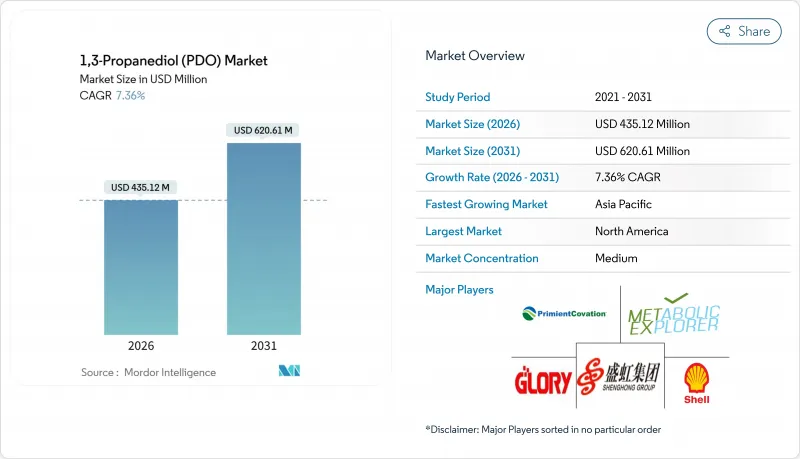
본 보고서는 공급원별(바이오 유래 PDO 및 석유화학 유래 PDO), 순도 등급별(산업용 등급 및 화장품·의약품 등급), 용도별(폴리트리메틸렌테레프탈레이트(PTT), 폴리우레탄, 기타), 최종 사용자 산업별(엔지니어링 플라스틱, 합성 의약품, 기타),지역별(아시아태평양, 북미, 기타)로 분류되어 있습니다. 시장 예측은 금액(달러) 기준으로 제시되어 있습니다.
세계의 1,3-프로판디올(PDO) 시장 동향 및 인사이트
바이오 폴리머에 대한 수요 급증
기업의 탈탄소화가 진행됨에 따라, 전체 수명 주기에서 감축 효과가 입증된 재생 가능 단량체에 대한 수요가 증가하고 있습니다. 듀폰(DuPont)사의 최신 지속가능성 감사에 따르면, Susterra PDO는 석유화학 기반 제조 공정에 비해 온실가스 배출을 61% 줄일 수 있는 것으로 나타났습니다. 유럽연합 집행위원회의 2024년 바이오 제품 전략에서는 다운스트림 공정에서 설비 변경이 필요 없는 PDO와 같은 드롭인 화학 물질이 우선시되고 있습니다. 중국의 ‘제14차 5개년 계획’에서는 발효 생산 능력 확충에 150억 위안(21억 달러)을 배정하고 있으며, PDO는 12가지 플랫폼 화학물질 중 하나로 꼽히고 있습니다. 규모의 경제와 탄소 가격 제도로 인해 그린 프리미엄은 한 자릿수 수준까지 축소되고 있습니다. 그 결과, 1,3-프로판디올(PDO) 시장은 얼리 어답터용 틈새 시장에서 비용 평등이 달성 가능한 주류 폴리머 용도로 전환되고 있습니다.
자동차 및 의류 부문에서 PTT 섬유의 채택 확대
전기차 경량화를 위한 노력에 힘입어 시트, 헤드라이너, 카펫에 PTT 섬유의 보급이 가속화되고 있습니다. 2025년, 자동차 산업용 솔로나(Solona) 섬유의 매출액은 전년 대비 22% 증가했으며, 그 증가분의 40%는 유럽 OEM 업체들이 차지했습니다. PTT 섬유의 염색 온도는 100℃인 반면, 폴리에스터는 130℃이므로 에너지 사용량을 30% 절감할 수 있으며, 향후 시행될 EU의 에코디자인 규정에도 부합합니다. 스포츠 의류 브랜드들은 PTT의 신축성 회복력을 높이 평가하고 있는 반면, 고급 홈 텍스타일 공급업체들은 이 섬유의 부드러운 촉감을 주요 판매 포인트로 내세우고 있습니다. 이러한 성능상의 이점은 PDO의 인수량을 확보하는 장기 공급 계약으로 이어지고 있으며, 범용 글리콜의 가격 변동으로부터 1,3-프로판디올(PDO) 시장을 보호하는 역할을 하고 있습니다.
원료 가격 변동
2024-2025년 옥수수 가격은 부셸당 4.20-5.80달러 사이에서 변동하여, 바이오 PDO의 현물 비용에 Kg당 최대 0.08달러의 변동을 초래했습니다. 재생 가능 디젤 연료 생산 확대에 따라 바이오디젤용 원료가 유출되면서, 조글리세롤 가격은 톤당 150-320달러 사이에서 급등락했습니다. 이러한 가격 변동은 특히 12-18개월간의 비용 확실성을 추구하는 자동차 산업의 1차 공급업체와의 장기 구매 계약을 저해하는 요인이 되고 있습니다. 1,3-프로판디올(PDO) 시장은 여전히 위험에 노출되어 있지만, 곡물 선물 계약을 통해 헤지하고 있는 통합 기업들은 가격 변동의 영향을 완화하고 있습니다.
부문 분석
바이오 유래 PDO는 2025년에 59.78%의 시장 점유율을 차지한 것으로 평가되었으며, 2031년까지 연평균 성장률(CAGR) 8.93%를 기록하며 전체 시장 성장률을 상회할 것으로 전망됩니다. 1,3-프로판디올(PDO) 시장은 현재 135g/L의 농도와 0.51g/g 포도당 이상의 수율을 달성하고 있는 듀폰(DuPont)사의 옥수수에서 PDO로 전환하는 제조 공정의 혜택을 받고 있습니다. 제노마티카(Genomatica)사의 아시아 내 4개 활성 라이선스 취득 기업은 2027년까지 80킬로톤의 생산 능력을 추가하여 전 세계 공급원의 다각화에 기여할 것입니다. 브렌트 원유 가격이 배럴당 70달러 전후로 형성되고 있는 상황에서 석유화학 유래 PDO는 여전히 가격 경쟁력을 유지하고 있지만, 특히 유럽에서는 탄소세 인상으로 인해 그 비용 우위가 압박받고 있습니다. 쉘(Shell)은 2024년에 싱가포르에서 석유 유래 PDO 생산을 완전히 철수했으며, 이는 화석 연료 유래 제조 경로가 직면한 구조적인 역풍을 여실히 보여줍니다.
PTT의 중합 공정을 통해 자체 수요에 따른 모노머를 조달함으로써, 통합형 바이오 기업은 현물 시장의 위험을 헤지하고 더 높은 마진을 확보할 수 있습니다. 한편, 중국의 글리세롤 채널 생산자들은 원료의 차익 거래를 활용하여 산업용 등급 제품을 두 자릿수 할인 가격으로 공급함으로써 호황을 누리고 있습니다. 이러한 동향은 1,3-프로판디올(PDO) 시장이 바이오 중심의 성장 궤도에 안착하고 있으며, 화석 유래 공급은 가격 주도형 틈새 시장으로 밀려나고 있음을 시사합니다.
2025년에는 산업용 등급이 총량의 71.35%를 차지했으나, 화장품용 및 의약품용 등급은 2031년까지 연평균 성장률(CAGR) 9.88%로 확대되고 있습니다. 개정된 유럽 약전(European Pharmacopoeia) 규격에서는 잔류 수분을 0.1% 이하, 개별 불순물을 50ppm 이하로 제한하고 있습니다. 이러한 기준을 충족하려면 1kg당 0.30-0.50달러의 추가 비용이 발생하지만, 40-60%의 가격 프리미엄을 얻을 수 있습니다. 로레알(L'Oreal)은 ‘클린 뷰티’라는 포지셔닝에 부합하기 위해 2025년에 120개의 SKU를 바이오 PDO를 사용하여 재처방했습니다. 미국 FDA의 비활성 성분 데이터베이스에는 현재 비경구 및 경구 용도 모두에 대해 PDO가 등재되어 있어 규제 장벽이 낮아졌습니다.
PTT 및 폴리우레탄 부문이 대량 수요를 흡수하고 있기 때문에 여전히 산업용 수요가 주류를 차지하고 있습니다. 특수 등급의 틈새 시장은 부가가치 증가분에서 매우 큰 비중을 차지할 것으로 예측됩니다. 브랜드 소유주들의 지속적인 수요 증가는 고순도 등급이 1,3-프로판디올(PDO) 시장의 가치 구성을 지속적으로 향상시킬 것임을 시사합니다.
지역별 분석
북미는 2025년 매출의 34.89%를 차지했으며, 이러한 위상은 듀폰(DuPont)사의 테네시주 바이오리파이너리와 옥수수 호황에 힘입은 것입니다. ‘인플레이션 감축법(IRA)’에 따른 세액 공제가 생산 비용을 절감시켜 북미의 경쟁력을 강화하고 있습니다. 캐나다 생산자들은 카놀라 유래 글리세롤을 원료로 하는 서스캐처원주 프로젝트를 검토하고 있습니다. 멕시코의 역할은 계속해서 하류 배합 부문에 국한되어 있습니다. 이러한 요인들로 인해 성장이 둔화되더라도 1,3-프로판디올(PDO) 시장은 북미를 핵심으로 유지될 것으로 확실시됩니다.
아시아태평양은 2031년까지 연평균 성장률(CAGR) 10.67%를 나타낼 것으로 예측되며, 지역별로는 가장 빠른 성장이 예상됩니다. 중국의 성홍그룹은 2024년에 50킬로톤 규모의 바이오 PDO 생산 설비를 가동하여 자사의 PTT 생산 라인에 공급하는 동시에 동남아시아 공장으로 수출하고 있습니다. 인도의 제약 수요는 주사용 제네릭 의약품 세계 시장 점유율 확대에 따라 연평균 18%의 속도로 증가하고 있습니다. 일본과 한국은 화장품 및 특수 폴리머에 중점을 둔 주요 수입국으로 자리매김하고 있습니다. 태국과 베트남은 의류 생산이 중국에서 이전됨에 따라 섬유 보조제 시장으로 부상하고 있습니다. 이러한 동향이 맞물리면서 아시아태평양의 1,3-프로판디올(PDO) 시장 규모는 확대되고 있습니다.
유럽은 수요의 일정 비율을 차지하고 있으며, 독일과 프랑스가 자동차 및 화장품 부문 수요를 주도하고 있습니다. ‘REPowerEU’ 보조금 및 REACH 규제로 인해 PDO의 채택이 가속화되고 있으며, 특히 석유화학 유래 글리콜에 대한 규제가 강화되고 있는 퍼스널케어 부문에서 두드러집니다. 스칸디나비아 국가들의 순환형 소재에 대한 집중이 그 보급을 더욱 뒷받침하고 있습니다. 남미, 중동 및 아프리카를 합친 점유율은 낮지만, 발효 비용이 낮아지면 브라질의 사탕수수 경제가 미래의 가능성을 가져다줄 것으로 보입니다. 전반적으로 지역적 다각화가 1,3-프로판디올(PDO) 시장의 안정적인 세계 성장을 뒷받침하고 있습니다.
기타 혜택
- 엑셀 형식 시장 예측(ME) 시트
- 3개월간의 애널리스트 지원
자주 묻는 질문
목차
제1장 서론
제2장 조사 방법
제3장 주요 요약
제4장 시장 구도
제5장 시장 규모 및 성장 예측
제6장 경쟁 구도
제7장 시장 기회 및 향후 전망
AJY 26.08.28According to Mordor Intelligence, the 1,3-Propanediol market size is estimated at USD 435.12 million in 2026, and is expected to reach USD 620.61 million by 2031, at a CAGR of 7.36% during the forecast period (2026-2031).
This report is Segmented by Source (Bio-Based PDO and Petrochemical-Based PDO), Purity Grade (Industrial Grade and Cosmetic/Pharma Grade), Application (Polytrimethylene Terephthalate, Polyurethane, and More), End-User Industry (Engineering Plastics, Synthetic Drugs, and More), and Geography (Asia-Pacific, North America, and More). The Market Forecasts are Provided in Terms of Value (USD).
Global 1,3-Propanediol (PDO) Market Trends and Insights
Surging Demand for Bio-Based Polymers
Corporate decarbonization is pushing buyers toward renewable monomers that carry verified life-cycle savings. DuPont's latest sustainability audit shows that Susterra PDO delivers a 61% greenhouse-gas reduction versus petrochemical routes. The European Commission's 2024 bio-based products strategy prioritizes drop-in chemicals such as PDO that avoid downstream retooling. China's 14th Five-Year Plan earmarked CNY 15 billion (USD 2.1 billion) for fermentation capacity with PDO listed among 12 platform chemicals. Scale economies and carbon-pricing schemes are narrowing the green premium to near single digits. As a result, the 1,3-propanediol (PDO) market is pivoting from early-adopter niches toward mainstream polymer applications where cost parity is within reach.
Growing PTT Fiber Adoption in Automotive and Apparel
Electric-vehicle lightweighting agendas are intensifying PTT fiber penetration into seating, headliners, and carpeting. Sorona fiber sales to automotive customers grew 22% year-over-year in 2025, with European OEMs responsible for 40% of incremental volume. PTT dyes at 100 °C versus 130 °C for polyester, trimming energy use by 30% and aligning with forthcoming EU eco-design rules. Athletic-apparel brands prize PTT's elastic recovery, while premium home-textile suppliers tout the fiber's softer hand. These performance advantages are translating into long-term supply contracts that lock in PDO offtake and buttress the 1,3-propanediol (PDO) market against price swings in commodity glycols.
Feedstock Price Volatility
Corn prices swung between USD 4.20-5.80 per bushel during 2024-2025, causing as much as USD 0.08 per kilogram variance in bio-PDO cash cost. Crude-glycerol values whipsawed between USD 150-320 per ton as renewable-diesel expansions diverted feedstock from biodiesel. Such swings deter long-term offtake agreements, particularly with automotive tier-ones that demand 12-18-month cost certainty. The 1,3-propanediol (PDO) market remains exposed, although integrated players with hedged grain contracts are cushioning volatility.
Other drivers and restraints analyzed in the detailed report include:
- Expansion of Polyurethane Foams and Insulation
- Government Incentives for Biomass-Based Chemicals
- Cheaper Glycols as Functional Substitutes
For complete list of drivers and restraints, kindly check the Table Of Contents.
Segment Analysis
Bio-based PDO held 59.78% market share in 2025 and is projected to outpace overall growth at an 8.93% CAGR through 2031. The 1,3-propanediol (PDO) market benefits from DuPont's corn-to-PDO pathway that now delivers titers of 135 g/L and yields above 0.51 g/g glucose. Genomatica's four active Asian licensees add 80 kilotons of capacity by 2027, diversifying global supply. Petrochemical PDO remains price competitive when Brent trades near USD 70 per barrel, yet mounting carbon levies are squeezing its cost advantage, particularly in Europe. Shell permanently exited petro-PDO production in Singapore in 2024, underscoring structural headwinds for fossil routes.
Captive monomer pull from PTT polymerization allows integrated bio-players to hedge spot risk and capture higher margins. Conversely, glycerol-route producers in China thrive on feedstock arbitrage, supplying industrial grades at double-digit discounts. These dynamics signal that the 1,3-propanediol (PDO) market is settling into a bio-centric growth arc with fossil supply relegated to price-driven niches.
Industrial grade accounted for 71.35% volume in 2025, yet cosmetic and pharmaceutical grades are expanding at 9.88% CAGR to 2031. Updated European Pharmacopoeia monographs cap residual water at 0.1% and individual impurities below 50 ppm. Meeting these targets adds USD 0.30-0.50 per kilogram but earns 40-60% price premiums. L'Oreal reformulated 120 SKUs with bio-PDO during 2025 to align with clean-beauty positioning. The U.S. FDA's inactive-ingredient database now lists PDO for both parenteral and oral applications, lowering regulatory barriers.
Industrial demand still dominates because PTT and polyurethane segments absorb bulk tonnage. Even so, the specialty-grade niche is forecast to supply an outsized share of incremental value. Sustained brand-owner pull suggests that high-purity grades will continue to elevate the value mix of the 1,3-propanediol (PDO) market.
Complete Report Scope:
- By Source
- Bio-based PDO
- Petrochemical-based PDO
- By Purity Grade
- Industrial Grade
- Cosmetic/Pharma Grade
- By Application
- Polytrimethylene Terephthalate (PTT)
- Polyurethane
- Personal Care Products
- Other Applications
- By End-user Industry
- Engineering Plastics
- Synthetic Drugs
- Textile Dyeing and Finishing
- Other End-User Industries (Cosmetics and Pharmaceutical)
- By Geography
- Asia-Pacific
- China
- India
- Japan
- South Korea
- ASEAN Countries
- Rest of Asia-Pacific
- North America
- United States
- Canada
- Mexico
- Europe
- Germany
- United Kingdom
- France
- Italy
- NORDIC Countries
- Rest of Europe
- South America
- Brazil
- Argentina
- Rest of South America
- Middle-East and Africa
- Saudi Arabia
- South Africa
- Rest of Middle-East and Africa
- Asia-Pacific
Geography Analysis
North America accounted for 34.89% of 2025 revenue, a position underpinned by DuPont's Tennessee biorefinery and favorable corn economics. Inflation Reduction Act credits shave production costs, reinforcing continental competitiveness. Canadian producers are exploring a Saskatchewan project that leverages canola-derived glycerol feedstock. Mexico's role remains downstream compounding. These factors ensure that the 1,3-propanediol (PDO) market retains a North American anchor even as growth moderates.
Asia-Pacific is projected to post a 10.67% CAGR to 2031, the fastest regional expansion. China's Sheng Hong Group commissioned 50 kilotons of bio-PDO in 2024, feeding its captive PTT lines and exporting to Southeast Asian mills. Indian pharmaceutical demand is scaling at 18% annually as injectable generics gain global share. Japan and South Korea remain premium importers focused on cosmetics and specialty polymers. Thailand and Vietnam are emerging textile-auxiliary markets as garment production migrates from China. Collectively, these trends enlarge the 1,3-propanediol (PDO) market footprint in Asia-Pacific.
Europe represents a moderate share of demand, with Germany and France leading automotive and cosmetic demand. REPowerEU grants and REACH restrictions accelerate PDO adoption, especially in personal care where petrochemical glycols face tighter scrutiny. Scandinavia's focus on circular materials further amplifies uptake. South America and the Middle East and Africa jointly represent a lower share, though Brazil's sugarcane economy offers future optionality if fermentation costs fall. Overall, regional diversification supports stable global growth for the 1,3-propanediol (PDO) market.
- BASF
- Cargill Inc.
- Connect Chemicals
- Dow Inc.
- DSM
- DuPont
- Eastman Chemical Company
- Genomatica
- LG Chem
- Merck KGaA
- METabolic Explorer SA
- MOJIABIO
- Primient Covation LLC
- Shell plc
- Sheng Hong Group Holdings Limited
- Sinopec
- Zhangjiagang Glory Biomaterial
Additional Benefits:
- The market estimate (ME) sheet in Excel format
- 3 months of analyst support
TABLE OF CONTENTS
1 Introduction
- 1.1 Study Assumptions and Market Definition
- 1.2 Scope of the Study
2 Research Methodology
3 Executive Summary
4 Market Landscape
- 4.1 Market Overview
- 4.2 Market Drivers
- 4.2.1 Surging Demand for Bio-Based Polymers
- 4.2.2 Growing PTT Fibre Adoption in Automotive and Apparel
- 4.2.3 Expansion of Polyurethane Foams and Insulation
- 4.2.4 Government Incentives for Biomass-Based Chemicals
- 4.2.5 Shift Toward PDO-Based High-Purity Heat-Transfer Fluids
- 4.3 Market Restraints
- 4.3.1 Feedstock (Corn/Glycerol) Price Volatility
- 4.3.2 Cheaper Glycols as Functional Substitutes
- 4.3.3 Biodiesel-Glycerol Supply Disruptions
- 4.4 Value Chain Analysis
- 4.5 Regulatory Landscape
- 4.6 Technological Outlook
- 4.7 Porter's Five Forces
- 4.7.1 Bargaining Power of Suppliers
- 4.7.2 Bargaining Power of Buyers
- 4.7.3 Threat of New Entrants
- 4.7.4 Threat of Substitute Products and Services
- 4.7.5 Degree of Competition
5 Market Size and Growth Forecasts (Value)
- 5.1 By Source
- 5.1.1 Bio-based PDO
- 5.1.2 Petrochemical-based PDO
- 5.2 By Purity Grade
- 5.2.1 Industrial Grade
- 5.2.2 Cosmetic/Pharma Grade
- 5.3 By Application
- 5.3.1 Polytrimethylene Terephthalate (PTT)
- 5.3.2 Polyurethane
- 5.3.3 Personal Care Products
- 5.3.4 Other Applications
- 5.4 By End-user Industry
- 5.4.1 Engineering Plastics
- 5.4.2 Synthetic Drugs
- 5.4.3 Textile Dyeing and Finishing
- 5.4.4 Other End-User Industries (Cosmetics and Pharmaceutical)
- 5.5 By Geography
- 5.5.1 Asia-Pacific
- 5.5.1.1 China
- 5.5.1.2 India
- 5.5.1.3 Japan
- 5.5.1.4 South Korea
- 5.5.1.5 ASEAN Countries
- 5.5.1.6 Rest of Asia-Pacific
- 5.5.2 North America
- 5.5.2.1 United States
- 5.5.2.2 Canada
- 5.5.2.3 Mexico
- 5.5.3 Europe
- 5.5.3.1 Germany
- 5.5.3.2 United Kingdom
- 5.5.3.3 France
- 5.5.3.4 Italy
- 5.5.3.5 NORDIC Countries
- 5.5.3.6 Rest of Europe
- 5.5.4 South America
- 5.5.4.1 Brazil
- 5.5.4.2 Argentina
- 5.5.4.3 Rest of South America
- 5.5.5 Middle-East and Africa
- 5.5.5.1 Saudi Arabia
- 5.5.5.2 South Africa
- 5.5.5.3 Rest of Middle-East and Africa
- 5.5.1 Asia-Pacific
6 Competitive Landscape
- 6.1 Market Concentration
- 6.2 Strategic Moves
- 6.3 Market Share/Ranking Analysis
- 6.4 Company Profiles (includes Global level Overview, Market level overview, Core Segments, Financials as available, Strategic Information, Products and Services, and Recent Developments)
- 6.4.1 BASF
- 6.4.2 Cargill Inc.
- 6.4.3 Connect Chemicals
- 6.4.4 Dow Inc.
- 6.4.5 DSM
- 6.4.6 DuPont
- 6.4.7 Eastman Chemical Company
- 6.4.8 Genomatica
- 6.4.9 LG Chem
- 6.4.10 Merck KGaA
- 6.4.11 METabolic Explorer SA
- 6.4.12 MOJIABIO
- 6.4.13 Primient Covation LLC
- 6.4.14 Shell plc
- 6.4.15 Sheng Hong Group Holdings Limited
- 6.4.16 Sinopec
- 6.4.17 Zhangjiagang Glory Biomaterial
7 Market Opportunities and Future Outlook
- 7.1 White-space and Unmet-Need Assessment
- 7.2 Growing Demand for Bio-based Products


