

|
시장보고서
상품코드
2114985
부틸하이드록시톨루엔 시장 : 시장 점유율 분석, 업계 동향 및 통계, 성장 예측(2026-2031년)Butylated Hydroxytoluene - Market Share Analysis, Industry Trends & Statistics, Growth Forecasts (2026 - 2031) |
||||||
 Mordor Intelligence
Mordor Intelligence에 의하면, 2026년 부틸하이드록시톨루엔(BHT) 시장 규모는 2억 7,874만 달러로 추정되고, 2025년 2억 6,411만 달러에서 확대해, 2031년에는 3억 6,455만 달러에 이를 것으로 예측됩니다.
2026-2031년 연평균 성장률(CAGR) 5.54%로 성장할 것으로 전망됩니다.
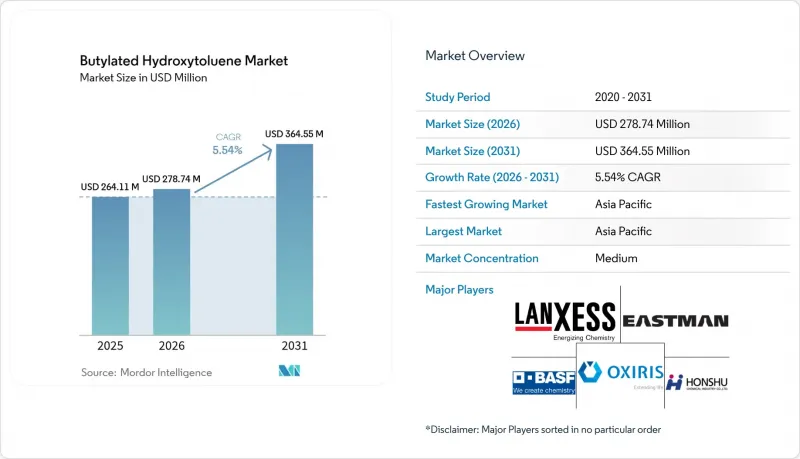
본 보고서는 등급별(식품 등급, 기술 등급), 최종 사용자 산업별(플라스틱 및 고무, 식음료, 퍼스널케어 및 화장품, 동물사료, 기타 최종 사용자 산업), 지역별(아시아태평양, 북미, 유럽, 남미, 중동 및 아프리카)로 분류되어 있습니다. 시장 전망은 금액(달러) 기준으로 제시되어 있습니다.
세계의 부틸하이드록시톨루엔(BHT) 시장 동향 및 인사이트
폴리머 가공 분야의 항산화제 수요 증가
고온에서의 폴리머 압출 성형, 사출 성형, 필름 블로우 성형에서는 사슬 절단으로 인해 기계적 강도가 저하되기 전에 자유 라디칼을 포획하는 산화 방지제가 필수적입니다. 부틸하이드록시톨루엔은 입체 장애가 있는 구조로 인해 착색된 부산물을 형성하지 않고 수소 원자를 신속하게 공급하기 때문에 이러한 역할을 수행합니다. 이를 통해 전자 기기 및 식품 포장에 사용되는 박막의 투명성이 유지됩니다. 아시아태평양에서는 2028년까지 폴리에틸렌, 폴리프로필렌, 엔지니어링 플라스틱의 생산 능력 증강이 지속됨에 따라 수요가 더욱 증가하고 있습니다. 이스트만(Eastman)사의 ‘테르미놀(Therminol)’ 열전달 유체(약 330℃ 부근에서 연속 운전용으로 설계됨)는 BHT가 활성을 유지해야 하는 공정 제어 범위가 얼마나 좁은지를 여실히 보여줍니다. 이러한 기술적 의존성으로 인해 타사로의 전환 의지가 억제되고, 기존 공급업체와의 장기 계약이 유지되고 있습니다. 포스파이트계 공동 안정제 수요가 서서히 증가하고 있는 것도 BHT의 사용량을 더욱 끌어올리고 있습니다. 이는 배합 업체들이 일반적으로 산화 유도 시간을 연장하기 위해 BHT를 2차 항산화제와 병용하고 있기 때문입니다.
고지방 식품에서의 사용량 증가
도시화에 따라 포장 스낵, 베이커리 믹스, 과자류의 세계 1인당 소비량이 증가하고 있으며, 이로 인해 제조업체는 유통 기한을 단축시키는 지질의 산패를 억제할 수밖에 없게 되었습니다. 부틸하이드록시톨루엔은 코덱스 식품 첨가물 일반 기준에 따라 베이커리 제품에서는 200mg/kg, 츄잉껌에서는 400mg/kg까지 사용이 승인되어 있어, 배합 개발자에게는 고지방 매트릭스를 위한 비용 대비 효과가 높은 선택지가 되고 있습니다. 이스트만의 ‘Tenox’ 제품군은 항산화제인 BHT에 프로파일 갈레이트 및 EDTA를 배합한 프리믹스 BHT 시스템을 제공하며, 시너지 효과를 통해 산화 방지 효과를 연장합니다. 클린 라벨화 추세에 따라 토코페롤이나 로즈마리 추출물의 시험적 도입이 진행되고 있지만, 비교 연구에 따르면 이러한 대체품은 더 많은 첨가량이 필요하며, 신흥 시장에서 일반적인 고온 보관 조건에서는 효과가 저하되는 것으로 나타났습니다. 그 결과, BHT는 가격을 중시하는 제품 라인에서 시장 점유율을 유지하고 있으며, 다층 포장용 접착제에 배합하는 것은 식품 안전성을 확보하기 위한 간접적인 수단이 되고 있습니다.
엄격한 독성 평가 및 표시 규제
EU의 ‘지속가능성을 위한 화학물질 전략’에서는 여러 제품 분류에 걸쳐 위험성에 따른 규제를 의무화할 가능성이 있는 범용적인 위험 평가가 도입되어, BHT는 다시 한번 면밀한 검토 대상이 되고 있습니다. 이와 병행하여, 영국의 지침에서는 화장품에 대한 배합 농도가 제한되고 있어 수출업체에게는 신속한 배합 재검토가 요구되고 있습니다. 제조업체는 독성학적 자료 작성, 라벨 재설계, 영유아용 제품 등 민감한 용도에서의 대체 항산화제 검증을 수행해야 하므로, 규정 준수 비용이 상승하고 있습니다. BHT는 IARC에 의해 그룹 3(발암성 분류 불가)로 분류되어 있지만, 유럽 및 북미 일부 지역의 예방 원칙에 따른 조치로 인해 시장 출시가 지연되고 있으며, 이는 단기적인 수요를 억제하고 있습니다.
부문 분석
2025년, 기술 등급은 비용 면에서 유리한 제조 공정과 고전단·고온 조건 하에서의 성능 신뢰성 덕분에 부틸하이드록시톨루엔 시장 점유율의 61.52%를 차지했습니다. 이 부문은 순도 사양이 그리 엄격하지 않은 폴리머 컴파운드 및 윤활유 배합에 깊이 정착되어 있습니다. 2025년에는 아시아의 수지 가공업체들이 처리량을 두 자릿수 성장률로 확대함에 따라, 이에 비례하여 BHT의 채택량도 증가했습니다. 자본 집약적인 반응 설비와 확립된 공급망을 통해 기존 기업들은 가격 결정력을 보유하고 있지만, 석유화학 원료 가격의 주기적인 변동이 이익률에 영향을 미칠 가능성이 있습니다.
식품 등급 시장은 규모는 작지만 연평균 성장률(CAGR) 5.78%를 달성할 것으로 예측되며, 예측 기간 동안 부틸하이드록시톨루엔 시장의 추가적인 성장에 크게 기여할 것으로 전망됩니다. 이러한 성장은 인도, 인도네시아, 나이지리아에서 가공식품의 보급률이 상승함에 기인합니다. 이들 국가에서는 콜드체인의 미비로 인해 항산화제를 통한 보호가 필수적입니다. 순도 요건으로 인해 tert-부틸 불순물의 저감이 요구되고 있으며, 이로 인해 가공 비용은 상승하지만 프리미엄 단가 책정이 가능해집니다. ‘클린 라벨’에 대한 압력이 높아지고 있지만, 신흥국의 엄격한 미생물 저감 기준과 비용 제약으로 인해 당분간은 합성 제품이 계속해서 선호될 전망입니다.
지역별 분석
2025년에 아시아태평양이 매출의 45.10%를 차지하였고, 연평균 성장률(CAGR)이 6.05%를 나타낼 것으로 예측되는 것은 해당 지역이 합성 물질의 생산자이자 소비자라는 두 가지 역할을 모두 수행하고 있음을 여실히 보여줍니다. 중국만으로도 전 세계 폴리에틸렌 생산 능력의 30% 이상을 차지하고 있으며, 산화 방지제는 국내에서 조달되고 있습니다. 식품 접촉에 관한 연구에 따르면, 내부 플라스틱 층에 포함된 BHT는 24mg/kg으로 기록되었습니다. BASF가 잔장(Zhanjiang)에 109억 달러를 투자한 프로젝트는 2025년에 가동을 시작하여 지속적인 공급을 뒷받침할 것이며, 이 회사의 재생 가능 전력 노력은 현지 탈탄소화 목표 달성에 기여할 것입니다. 일본과 한국에서는 전자제품용 고순도 등급이 소비되고 있는 반면, 인도의 포장 식품 부문은 해당 시장 규모를 확대되고 있습니다.
북미에서는 초기부터 규제가 명확해짐에 따라 수요가 정착되어 있습니다. FDA는 1954년에 BHT에 GRAS(일반적으로 안전하다고 인정되는) 인증을 부여하여 시리얼, 스낵 코팅, 폴리머 첨가제에서의 안정적인 사용을 촉진했습니다. 주요 공급업체들은 미국 멕시코만 연안에 통합형 공장을 운영하고 있으며, 경쟁력 있는 가격의 액화천연가스(LNG)의 혜택을 받고 있습니다. 클린 라벨로의 전환이 진행되고 있지만, 열악한 물류 환경 하에서 산화 안정성을 우선시하는 가치 브랜드나 산업용 제품의 경우, 그 전환은 선택적이며 속도도 느려지고 있습니다.
유럽은 가장 엄격한 규제 환경에 직면해 있습니다. 유럽식품안전청(EFSA)은 2012년에 1일 허용 섭취량을 체중 1kg당 0.25mg으로 설정했으나, 새로운 위험 기반 접근 방식에 따라 향후 허용되는 용도가 제한될 가능성이 있습니다. 영국의 2025년을 기한으로 하는 화장품 규제 개정이 라벨 표기 갱신에 반영됨에 따라 일부 화장품 브랜드는 혼합 항산화 시스템으로의 전환을 추진하고 있지만, 성능과 비용의 상충 관계를 고려할 때 완전한 단계적 폐지는 여전히 가능성이 낮은 것으로 보입니다. 이러한 불확실성으로 인해 생산 능력 확충을 위한 투자는 억제되고 있습니다.
남미와 중동 및 아프리카는 현재 전체 시장 규모에서 차지하는 비중은 작지만, 평균 이상의 성장이 예상됩니다. 브라질의 연질 필름 제조업체들은 열대 기후 하에서 운송 기간이 길어지는 것에 대응하기 위해 BHT 첨가량을 늘리고 있으며, 걸프협력회의(GCC) 회원국들은 석유 의존에서 벗어나 경제 다각화를 도모하기 위해 폴리머 파크 확장을 추진하고 있습니다. 그러나 규제 감독 체제의 차이 및 물류 인프라의 불균형으로 인해 리스크 프리미엄이 발생하고 있으며, 소규모 공급업체는 이러한 리스크를 회피할 가능성이 있습니다.
기타 혜택
- 엑셀 형식 시장 예측(ME) 시트
- 3개월간의 애널리스트 지원
자주 묻는 질문
목차
제1장 서론
제2장 조사 방법
제3장 주요 요약
제4장 시장 구도
제5장 시장 규모 및 성장 예측
제6장 경쟁 구도
제7장 시장 기회 및 향후 전망
AJY 26.08.28According to Mordor Intelligence, butylated hydroxytoluene market size in 2026 is estimated at USD 278.74 million, growing from 2025 value of USD 264.11 million with 2031 projections showing USD 364.55 million, growing at 5.54% CAGR over 2026-2031.
This report is Segmented by Grade (Food Grade, Technical Grade), End-User Industry (Plastics and Rubber, Food and Beverage, Personal Care and Cosmetics, Animal Feed, Other End-User Industries), and Geography (Asia-Pacific, North America, Europe, South America, Middle East and Africa). The Market Forecasts are Provided in Terms of Value (USD).
Global Butylated Hydroxytoluene Market Trends and Insights
Rising Demand for Antioxidants in Polymer Processing
High-temperature polymer extrusion, injection moulding, and film blowing depend on antioxidants that intercept free radicals before chain scission damages mechanical strength. Butylated Hydroxytoluene fulfils this role because its sterically hindered structure donates hydrogen atoms rapidly without forming coloured by-products, preserving clarity in thin films used for electronics and food packaging. Demand intensifies in Asia-Pacific, where capacity additions for polyethylene, polypropylene, and engineering plastics remain onstream through 2028. Eastman's Therminol heat-transfer fluids-designed for continuous operation near 330 °C-illustrate the narrow process-control windows in which BHT must remain active. The technical dependence reduces switching incentives, sustaining long contracts with established suppliers. Incremental gains in phosphite co-stabilisers further lift BHT volumes because formulators typically use it alongside secondary antioxidants to widen oxidative induction times.
Growing Usage in Fat-Rich Food Products
Global per-capita intake of packaged snacks, bakery mixes, and confectionery is rising in tandem with urbanisation, pushing manufacturers to curb lipid rancidity that shortens shelf life. Butylated Hydroxytoluene is authorised at 200 mg/kg in bakery wares and 400 mg/kg in chewing gum by the Codex General Standard for Food Additives, giving formulators a cost-efficient option for high-fat matrices. Eastman's Tenox portfolio supplies pre-blended BHT systems that combine the antioxidant with propyl gallate or EDTA, extending oxidative protection synergistically. While clean-label campaigns spur trials of tocopherol and rosemary extract, comparative studies show that those alternatives require higher loadings and struggle under elevated storage temperatures common in emerging markets. Consequently, BHT retains share within value-sensitive product lines, and its inclusion in multilayer packaging adhesives offers an indirect route for food safety assurance.
Stringent Toxicological and Labelling Regulations
The EU Chemicals Strategy for Sustainability introduces a generic risk assessment that could mandate hazard-based restrictions across multiple product classes, placing BHT under renewed scrutiny. Parallel UK guidance limits cosmetics concentrations, forcing rapid reformulation among exporters. Compliance costs rise as manufacturers must compile toxicological dossiers, redesign labels, and validate alternative antioxidants in sensitive applications such as infant care. While BHT is categorised by IARC as Group 3 (not classifiable as to carcinogenicity), precautionary policies in Europe and parts of North America impose speed-to-market delays that temper near-term demand.
Other drivers and restraints analyzed in the detailed report include:
- Expansion of Personal-Care Preservatives
- Surge in Animal-Feed Micronutrient Fortification
- Consumer Shift Toward Clean-Label Antioxidants
For complete list of drivers and restraints, kindly check the Table Of Contents.
Segment Analysis
Technical Grade accounted for 61.52% of Butylated Hydroxytoluene market share in 2025 owing to its cost-advantaged production route and performance reliability under high-shear, high-temperature conditions. The segment is deeply entrenched in polymer compounding and lubricating-oil formulations where purity specifications are less stringent. In 2025, Asian resin converters scaled throughput by double digits, translating into proportional BHT uptake. Capital-intensive reactors and established supply chains grant incumbents pricing power, although periodic swings in petrochemical feedstock prices can influence margins.
Food Grade, despite its smaller size, is projected to achieve a CAGR of 5.78%, significantly contributing to the incremental growth of the Butylated Hydroxytoluene market during the forecast period. Growth stems from rising packaged-food penetration in India, Indonesia and Nigeria, where cold-chain gaps make antioxidant protection indispensable. Purity requirements demand lower tert-butyl contaminants, pushing processing costs higher yet enabling premium unit pricing. Clean-label pressures loom, but strict microbial-reduction standards and cost constraints in emerging economies continue to support synthetic options for the foreseeable future.
Complete Report Scope:
- By Grade
- Food Grade
- Technical Grade
- By End-user Industry
- Plastics and Rubber
- Food and Beverage
- Personal Care and Cosmetics
- Animal Feed
- Other End-user Industries (Pharmaceuticals, etc.)
- By Geography
- Asia-Pacific
- China
- Japan
- India
- South Korea
- ASEAN Countries
- Rest of Asia-Pacific
- North America
- United States
- Canada
- Mexico
- Europe
- Germany
- United Kingdom
- France
- Italy
- Spain
- Russia
- NORDIC Countries
- Rest of Europe
- South America
- Brazil
- Argentina
- Rest of South America
- Middle East and Africa
- Saudi Arabia
- South Africa
- Rest of Middle East and Africa
- Asia-Pacific
Geography Analysis
Asia-Pacific's leading 45.10% revenue contribution in 2025, alongside a 6.05% CAGR outlook, highlights the region's dual role as producer and consumer of synthetics. China alone houses more than 30% of global polyethylene capacity and sources antioxidants domestically, with food-contact studies recording BHT at 24 mg/kg in inner plastic layers. BASF's USD 10.9 billion Zhanjiang investment, coming onstream in 2025, underpins sustained supply, and its renewable-electricity pledge addresses local decarbonisation targets. Japan and South Korea consume high-purity grades for electronics, while India's packaged-foods sector enlarges the addressable base.
North America maintains entrenched demand due to early regulatory clarity: the FDA granted GRAS status to BHT in 1954, facilitating stable utilisation in cereals, snack coatings and polymeric additives. Leading suppliers operate integrated plants along the US Gulf Coast, benefiting from competitively priced natural gas liquids. Clean-label conversion is occurring, yet the shift is selective and slower for value-brand and industrial products that prioritise oxidative stability under harsh logistics.
Europe faces the most stringent regulatory climate. The European Food Safety Authority set the acceptable daily intake at 0.25 mg/kg body weight in 2012, yet new hazard-based approaches may truncate future permissible uses. The UK's 2025 cosmetic limits visible in labelling updates have nudged some beauty brands toward mixed antioxidant systems, though complete phase-out remains unlikely given performance-cost trade-offs. Nonetheless, the uncertainty restrains investment in incremental capacity.
South America and the Middle East & Africa currently represent a small share of the total value but are expected to achieve above-average growth. Brazilian flexible-film producers increasingly add BHT for longer transit times in tropical climates, and Gulf Cooperation Council states expand polymer parks to diversify economies beyond oil. However, fragmented regulatory oversight and variable logistics infrastructure add risk premiums that smaller suppliers may avoid.
- Actylis
- Anmol Chemicals
- BASF SE
- Clean Fino-Chem Limited
- Dycon Chemicals
- Eastman Chemical Company
- Honshu Chemical Industry Co., Ltd.
- Kemin Industries, Inc.
- KH Chemicals
- LANXESS
- Merck KGaA
- Milestone Preservatives Pvt.
- Oxiris Chemicals S.A.
- Sasol
- VDH CHEM TECH PVT. LTD
Additional Benefits:
- The market estimate (ME) sheet in Excel format
- 3 months of analyst support
TABLE OF CONTENTS
1 Introduction
- 1.1 Study Assumptions and Market Definition
- 1.2 Scope of the Study
2 Research Methodology
3 Executive Summary
4 Market Landscape
- 4.1 Market Overview
- 4.2 Market Drivers
- 4.2.1 Rising demand for antioxidants from polymer processing
- 4.2.2 Growing usage in food and beverage fat-rich products
- 4.2.3 Expansion of personal-care and cosmetics preservatives
- 4.2.4 Surge in animal-feed micronutrient fortification
- 4.2.5 Adoption in smart flexible-electronics barrier coatings
- 4.3 Market Restraints
- 4.3.1 Stringent toxicological and labeling regulations
- 4.3.2 Consumer shift toward "clean-label" natural antioxidants
- 4.3.3 Low-phenol packaging directives in selected nations
- 4.4 Value Chain Analysis
- 4.5 Porter's Five Forces
- 4.5.1 Bargaining Power of Suppliers
- 4.5.2 Bargaining Power of Buyers
- 4.5.3 Threat of New Entrants
- 4.5.4 Threat of Substitutes
- 4.5.5 Degree of Competition
5 Market Size and Growth Forecasts (Value)
- 5.1 By Grade
- 5.1.1 Food Grade
- 5.1.2 Technical Grade
- 5.2 By End-user Industry
- 5.2.1 Plastics and Rubber
- 5.2.2 Food and Beverage
- 5.2.3 Personal Care and Cosmetics
- 5.2.4 Animal Feed
- 5.2.5 Other End-user Industries (Pharmaceuticals, etc.)
- 5.3 By Geography
- 5.3.1 Asia-Pacific
- 5.3.1.1 China
- 5.3.1.2 Japan
- 5.3.1.3 India
- 5.3.1.4 South Korea
- 5.3.1.5 ASEAN Countries
- 5.3.1.6 Rest of Asia-Pacific
- 5.3.2 North America
- 5.3.2.1 United States
- 5.3.2.2 Canada
- 5.3.2.3 Mexico
- 5.3.3 Europe
- 5.3.3.1 Germany
- 5.3.3.2 United Kingdom
- 5.3.3.3 France
- 5.3.3.4 Italy
- 5.3.3.5 Spain
- 5.3.3.6 Russia
- 5.3.3.7 NORDIC Countries
- 5.3.3.8 Rest of Europe
- 5.3.4 South America
- 5.3.4.1 Brazil
- 5.3.4.2 Argentina
- 5.3.4.3 Rest of South America
- 5.3.5 Middle East and Africa
- 5.3.5.1 Saudi Arabia
- 5.3.5.2 South Africa
- 5.3.5.3 Rest of Middle East and Africa
- 5.3.1 Asia-Pacific
6 Competitive Landscape
- 6.1 Market Concentration
- 6.2 Strategic Moves
- 6.3 Market Share(%)/Ranking Analysis
- 6.4 Company Profiles (includes Global level Overview, Market level overview, Core Segments, Financials as available, Strategic Information, Market Rank/Share for key companies, Products and Services, and Recent Developments)
- 6.4.1 Actylis
- 6.4.2 Anmol Chemicals
- 6.4.3 BASF SE
- 6.4.4 Clean Fino-Chem Limited
- 6.4.5 Dycon Chemicals
- 6.4.6 Eastman Chemical Company
- 6.4.7 Honshu Chemical Industry Co., Ltd.
- 6.4.8 Kemin Industries, Inc.
- 6.4.9 KH Chemicals
- 6.4.10 LANXESS
- 6.4.11 Merck KGaA
- 6.4.12 Milestone Preservatives Pvt.
- 6.4.13 Oxiris Chemicals S.A.
- 6.4.14 Sasol
- 6.4.15 VDH CHEM TECH PVT. LTD
7 Market Opportunities and Future Outlook
- 7.1 White-space and Unmet-need Assessment


