
|
시장보고서
상품코드
2115012
폴리우레아 코팅 시장 : 점유율 분석, 업계 동향과 통계, 성장 예측(2026-2031년)Polyurea Coatings - Market Share Analysis, Industry Trends & Statistics, Growth Forecasts (2026 - 2031) |
||||||
 Mordor Intelligence
Mordor Intelligence에 의하면, 2026년 폴리우레아 코팅 시장 규모는 13억 6,000만 달러로 추정되고 있어 2025년 12억 6,000만 달러에서 확대해, 2031년에는 19억 8,000만 달러에 이를 것으로 예측됩니다.
2026년부터 2031년까지의 연평균 성장률(CAGR)은 7.82%가 될 것으로 전망됩니다.
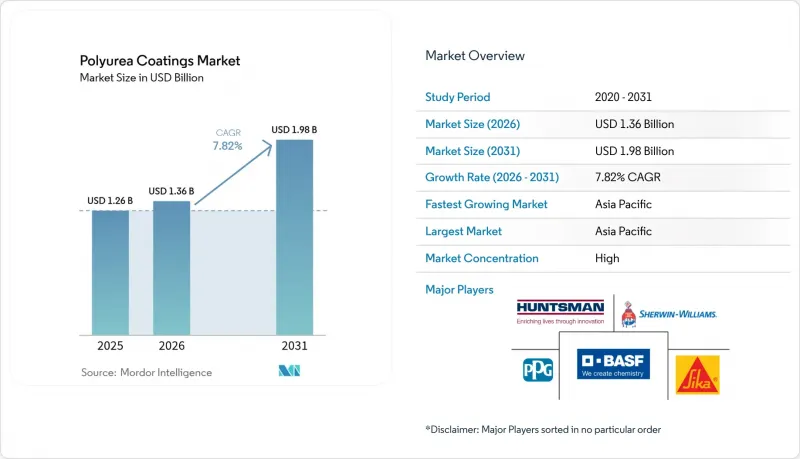
본 보고서는 유형(퓨어 및 하이브리드), 기술(분사 도포, 주입, 수동 혼합), 용도(건축 및 건설, 산업, 운송, 기타 용도) 및 지역(아시아태평양, 북미, 유럽, 남미, 중동 및 아프리카)별로 분류되어 있습니다. 시장 전망은 금액(달러) 단위로 표시되어 있습니다.
세계 폴리우레아 코팅 시장 동향 및 인사이트
건설 활동의 확대
부동산 투자, 인프라 메가 프로젝트, 도시화의 진전으로 인해 폴리우레아 소비가 가속화되고 있습니다. 이는 건설업자들이 몇 분 만에 경화되고 광범위한 온도 범위를 견디는 코팅을 선호하기 때문입니다. 지붕 보수, 포디움 방수, 이음매 실링의 경우, 400%의 성장률 덕분에 지진이나 온도 변화가 심한 지역에서 균열이 확대되는 것을 억제할 수 있다는 이점이 있습니다. 현재, 조립식 모듈에는 공장에서 폴리우레아 층이 도포되어 현장에 완전히 경화된 상태로 반입되므로 필요한 노동력이 절감되고 있습니다. 아시아태평양이 수요의 대부분을 차지하고 있습니다. 이는 중국의 교통 회랑이나 인도의 스마트 시티 계획에서 내구성이 높은 막재가 지정되어 있는 반면, 중동의 복합 용도 시설에서는 엄격한 건설 일정을 단기간에 소화하기 위해 폴리우레아가 채택되고 있기 때문입니다.
VOC 및 HAP 배출 규제의 강화
미국 국가 VOC 배출 기준에서는 산업용 유지보수용 도료의 VOC 함량을 450 g/L로 제한하고 있으며, 캘리포니아주에서는 100-250 g/L를 시행하고 있어, 배합 제조업체들은 고형분 100%의 폴리우레아 기술로 전환해야 하는 상황에 직면해 있습니다. EPA가 제안한 폴리에테르 폴리올 NESHAP(유해 대기 오염 물질 배출 방지 기준) 개정안은 유해 대기 오염 물질을 연간 157톤 감축하고, 업스트림 공급 품질에 대한 규제가 강화될 것입니다. EU와 한국의 유사한 규제로 인해 지역별 규정 준수상의 장벽이 발생하고 있으며, 강력한 규제 대응 능력을 갖춘 공급업체가 유리한 입지를 점하고 있습니다. 대기업들은 BASF가 북미 주요 거점에서 재생에너지 100% 전환을 실현한 사례와 같이, 그린 에너지 전환을 활용하고 저탄소 발자국을 강조함으로써 VOC 규제가 적용되는 입찰에서 수주에 성공하고 있습니다.
원자재 가격의 급격한 변동
이소시아네이트와 폴리아민의 원료 가격은 원유 가격 변동에 연동되어 있어, 공급이 부족해지면 이익률이 압박받게 됩니다. 바이오 유래 폴리THF나 재생 PET 폴리올은 장래에 가격 안정화가 기대되지만, 현 시점에서는 중소규모의 도급업체가 감당하기 어려울 정도로 가격이 비쌉니다. 인도네시아 등 신흥 시장은 가격 급등에 특히 민감하여, 이로 인해 프로젝트 수주가 정체되고 있습니다.
부문별 분석
2025년 매출은 퓨어 시스템이 주도했으며, 빠른 겔화 시간과 동급 최고의 인장 특성을 강점으로 수요의 66.12%를 차지했습니다. 폐수 처리, 화학 처리, 해양 분야의 자산 소유자들은 400%의 성장률과 수십 년에 달하는 수명을 확보하기 위해 퓨어 폴리우레아의 채택을 점점 더 지정하고 있습니다. 이소시아네이트 비율을 최적화하는 연구를 통해 성능의 한계가 지속적으로 높아지고 있으며, 미션 크리티컬한 환경에서 순수 등급에 대한 고객의 선호도가 더욱 강해지고 있습니다.
하이브리드 등급은 기계적 특성 면에서는 순수 폴리우레아에 미치지 못하지만, 폴리올 부문을 통합함으로써 뛰어난 경제성을 제공하며, 그 결과 연평균 성장률(CAGR) 9.07%로 주거용 방수 및 경공업용 바닥재 시장에 침투하고 있습니다. 각 공급업체는 원자재 비용을 절감하면서도 ASTM C836 방수 규격을 충족하는 균형 잡힌 배합을 중시하고 있습니다. 이러한 실용적인 접근 방식을 통해 비용 제약이 있는 사용자층의 잠재 수요를 확대하는 동시에, 순수 폴리우레아 시스템의 견고한 시장 기반을 훼손하지 않으면서 시장 점유율을 확대되고 있습니다.
지역별 분석
아시아태평양은 2025년에 40.85%의 점유율을 차지하며, 2031년까지 연평균 성장률(CAGR) 9.31%라는 가장 높은 성장률을 기록하고 있습니다. 중국의 ‘일대일로’ 회랑과 인도의 지하철 연장 프로젝트에서는 터널 및 고가교 방수재로 폴리우레아가 지정되어 있는 반면, 일본에서는 염분 안개 부식의 영향을 받기 쉬운 해양 터미널에 이 소재가 채택되고 있습니다. 인도네시아의 코팅 시장은 연평균 6.47%의 성장률을 기록하며 이 지역의 성장세를 뒷받침하고 있습니다.
북미에서는 교량 상판 보수, 산업용 바닥재, 그리고 엄격한 VOC 규제를 배경으로 시장이 성숙해 가고 있음에도 불구하고 견조한 수요를 보이고 있습니다. 캘리포니아주의 VOC 제한치(100-250 g/L)와 2027년 1월로 다가온 에어로졸 도료 규제 준수 기한으로 인해 100% 고형분 시스템으로의 전환이 가속화되고 있습니다.
유럽에서는 안정적인 보수 주기와 엄격한 환경 규제 대응 요구 간의 균형이 잘 잡혀 있습니다. 자산 소유주들은 EN 1504 지침에 따라 주차장 및 식수 저수지의 수명을 연장하기 위해 폴리우레아 오버레이에 투자하고 있습니다. 남미, 중동 및 아프리카는 모두 낮은 수준에서 성장을 이어가고 있습니다. 정부 주도의 주택 건설 및 해수 담수화 프로젝트가 기회를 창출하고 있으나, 시공사 교육이 미흡하고 환율 변동이 심하기 때문에 당분간 사업 규모 확대는 제한되고 있습니다.
기타 혜택:
- 엑셀 형식 시장 예측(ME) 시트
- 3개월간 애널리스트 지원
자주 묻는 질문
목차
제1장 서론
제2장 조사 방법
제3장 주요 요약
제4장 시장 구도
제5장 시장 규모와 성장 예측
제6장 경쟁 구도
제7장 시장 기회와 향후 전망
JHS 26.08.26According to Mordor Intelligence, polyurea coatings market size in 2026 is estimated at USD 1.36 billion, growing from 2025 value of USD 1.26 billion with 2031 projections showing USD 1.98 billion, growing at 7.82% CAGR over 2026-2031.
This report is Segmented by Type (Pure and Hybrid), Technology (Spraying, Pouring, and Hand Mixing), Application (Building and Construction, Industrial, Transportation, and Other Applications), and Geography (Asia-Pacific, North America, Europe, South America, and Middle-East and Africa). The Market Forecasts are Provided in Terms of Value (USD).
Global Polyurea Coatings Market Trends and Insights
Expanding Construction Activity
Real-estate spending, infrastructure megaprojects, and urbanization are accelerating polyurea consumption as contractors prioritize coatings that cure within minutes and tolerate wide temperature ranges. Roof restoration, podium waterproofing, and joint sealing benefit from 400% elongation that mitigates crack propagation in seismic and thermal-cycling zones. Prefabricated modules now receive factory-applied polyurea layers, arriving on-site fully cured and reducing labor requirements. Asia Pacific dominates volume because China's transport corridors and India's smart-city schemes specify durable membranes, while Middle East mixed-use complexes adopt polyurea for rapid turnaround on tight construction schedules.
Stricter VOC and HAP Emission Regulations
The US National VOC Emission Standards cap industrial-maintenance coatings at 450 g/L, with California enforcing 100-250 g/L, pressuring formulators toward 100%-solids polyurea technologies. EPA's proposed amendments to polyether-polyol NESHAP are poised to trim hazardous air pollutants by 157 tons annually, tightening upstream supply quality. Similar directives in the EU and South Korea create region-specific compliance hurdles that reward suppliers with robust regulatory affairs capacity. Large enterprises are leveraging green-energy transitions, such as BASF's full renewable-electricity adoption at key North American sites, to present lower-carbon footprints and win VOC-constrained bids.
High Raw-Material Cost Volatility
Isocyanate and polyamine feedstocks track oil-price swings, compressing margins when supply tightens. Bio-based polyTHF and recycled-PET polyols promise eventual relief, yet currently command premiums that smaller contractors cannot absorb. Emerging markets such as Indonesia are particularly sensitive to price spikes that stall project awards.
Other drivers and restraints analyzed in the detailed report include:
- Shift from Epoxy/PU to Higher-Performance Polyurea Systems
- Rapid-Cure Aliphatic Polyurea for Emergency Infrastructure Repairs
- Requirement for Specialized Plural-Component Spray Equipment and Skills
For complete list of drivers and restraints, kindly check the Table Of Contents.
Segment Analysis
Pure systems dominated 2025 revenue, claiming 66.12% of demand on the strength of rapid gel times and best-in-class tensile properties. Asset owners in wastewater, chemical processing, and marine sectors increasingly specify pure polyurea to secure 400% elongation and multi-decade service life. Research optimizing isocyanate ratios continues to push performance ceilings, reinforcing customer preference for pure grades in mission-critical environments.
Hybrid grades, while lagging in mechanical attributes, offer compelling economics by incorporating polyol segments and are therefore penetrating residential waterproofing and light industrial flooring at 9.07% CAGR. Suppliers emphasize balanced formulations that meet ASTM C836 waterproofing standards while trimming raw-material spend. This pragmatic approach broadens addressable demand among cost-constrained users without cannibalizing pure-system strongholds.
Complete Report Scope:
- By Type
- Pure
- Hybrid
- By Technology
- Spraying
- Pouring
- Hand Mixing
- By Application
- Building and Construction
- Industrial
- Transportation
- Other Applications
- By Geography
- Asia-Pacific
- China
- India
- Japan
- South Korea
- Rest of Asia-Pacific
- North America
- United States
- Canada
- Mexico
- Europe
- Germany
- United Kingdom
- France
- Italy
- Rest of Europe
- South America
- Brazil
- Argentina
- Rest of South America
- Middle-East and Africa
- Saudi Arabia
- United Arab Emirates
- South Africa
- Egypt
- Rest of Middle-East and Africa
- Asia-Pacific
Geography Analysis
Asia Pacific held a 40.85% share in 2025 and records the fastest 9.31% CAGR to 2031. China's Belt-and-Road corridors and India's metro-rail extensions specify polyurea for waterproofing tunnels and viaducts, while Japan deploys the material for marine terminals vulnerable to salt-fog corrosion. Indonesia's coatings market advancing at 6.47% annually underscores regional momentum.
North America shows a mature yet resilient appetite anchored in bridge-deck rehabilitation, industrial flooring, and stringent VOC legislation. California's 100-250 g/L VOC limits and upcoming aerosol-coatings compliance deadline of January 2027 intensify migration toward 100%-solids systems.
Europe balances stable renovation cycles with advanced environmental compliance demands. Asset owners invest in polyurea overlays for parking structures and potable-water reservoirs to extend service life under EN 1504 guidelines. South America, and the Middle East and Africa collectively advance from a low base; government-led housing and desalination projects create opportunities, but limited contractor training and volatile foreign-exchange conditions temper immediate scaling.
- Armorthane
- BASF
- Chemline
- DELTA Coatings International
- Graco Inc.
- Huntsman International LLC
- KUKDO Chemical Co., Ltd.
- Line-X LLC
- MARVEL COATINGS
- Nukote Coating Systems
- Polycoat Products
- PPG Industries Inc.
- Rhino Linings
- Rhino Linings
- Sika AG
- Specialty Products Inc.
- Teknos Group
- The Sherwin-Williams Company
- Ultimate Linings
- VIP Coatings Europe GmbH
Additional Benefits:
- The market estimate (ME) sheet in Excel format
- 3 months of analyst support
TABLE OF CONTENTS
1 Introduction
- 1.1 Study Assumptions and Market Definition
- 1.2 Scope of the Study
2 Research Methodology
3 Executive Summary
4 Market Landscape
- 4.1 Market Overview
- 4.2 Market Drivers
- 4.2.1 Expanding Building and Construction Activities
- 4.2.2 Stricter VOC and HAP Emission Regulations
- 4.2.3 Shift From Epoxy/PU to Higher-Performance Polyurea Systems
- 4.2.4 Industrial Flooring Upgrades in Food and Beverage and Pharma
- 4.2.5 Rapid-Cure Aliphatic Polyurea for Emergency Infrastructure Repairs
- 4.3 Market Restraints
- 4.3.1 High Raw-Material Cost Volatility
- 4.3.2 Requirement For Specialized Plural-Component Spray Equipment and Skills
- 4.3.3 Poor Color Stability on Exposure to UV Light
- 4.4 Value Chain Analysis
- 4.5 Porter's Five Forces
- 4.5.1 Bargaining Power of Suppliers
- 4.5.2 Bargaining Power of Buyers
- 4.5.3 Threat of New Entrants
- 4.5.4 Threat of Substitutes
- 4.5.5 Degree of Competition
5 Market Size and Growth Forecasts (Value)
- 5.1 By Type
- 5.1.1 Pure
- 5.1.2 Hybrid
- 5.2 By Technology
- 5.2.1 Spraying
- 5.2.2 Pouring
- 5.2.3 Hand Mixing
- 5.3 By Application
- 5.3.1 Building and Construction
- 5.3.2 Industrial
- 5.3.3 Transportation
- 5.3.4 Other Applications
- 5.4 By Geography
- 5.4.1 Asia-Pacific
- 5.4.1.1 China
- 5.4.1.2 India
- 5.4.1.3 Japan
- 5.4.1.4 South Korea
- 5.4.1.5 Rest of Asia-Pacific
- 5.4.2 North America
- 5.4.2.1 United States
- 5.4.2.2 Canada
- 5.4.2.3 Mexico
- 5.4.3 Europe
- 5.4.3.1 Germany
- 5.4.3.2 United Kingdom
- 5.4.3.3 France
- 5.4.3.4 Italy
- 5.4.3.5 Rest of Europe
- 5.4.4 South America
- 5.4.4.1 Brazil
- 5.4.4.2 Argentina
- 5.4.4.3 Rest of South America
- 5.4.5 Middle-East and Africa
- 5.4.5.1 Saudi Arabia
- 5.4.5.2 United Arab Emirates
- 5.4.5.3 South Africa
- 5.4.5.4 Egypt
- 5.4.5.5 Rest of Middle-East and Africa
- 5.4.1 Asia-Pacific
6 Competitive Landscape
- 6.1 Market Concentration
- 6.2 Strategic Moves
- 6.3 Market Share (%)/ Ranking Analysis
- 6.4 Company Profiles (includes Global level Overview, Market level overview, Core Segments, Financials as available, Strategic Information, Market Rank/Share for key companies, Products and Services, and Recent Developments)
- 6.4.1 Armorthane
- 6.4.2 BASF
- 6.4.3 Chemline
- 6.4.4 DELTA Coatings International
- 6.4.5 Graco Inc.
- 6.4.6 Huntsman International LLC
- 6.4.7 KUKDO Chemical Co., Ltd.
- 6.4.8 Line-X LLC
- 6.4.9 MARVEL COATINGS
- 6.4.10 Nukote Coating Systems
- 6.4.11 Polycoat Products
- 6.4.12 PPG Industries Inc.
- 6.4.13 Rhino Linings
- 6.4.14 Rhino Linings
- 6.4.15 Sika AG
- 6.4.16 Specialty Products Inc.
- 6.4.17 Teknos Group
- 6.4.18 The Sherwin-Williams Company
- 6.4.19 Ultimate Linings
- 6.4.20 VIP Coatings Europe GmbH
7 Market Opportunities and Future Outlook
- 7.1 White-space and Unmet-Need Assessment