

|
시장보고서
상품코드
2115019
IDaaS(Identity-as-a-Service) 시장 : 시장 점유율 분석, 업계 동향 및 통계, 성장 예측(2026-2031년)Identity As A Service - Market Share Analysis, Industry Trends & Statistics, Growth Forecasts (2026 - 2031) |
||||||
 Mordor Intelligence
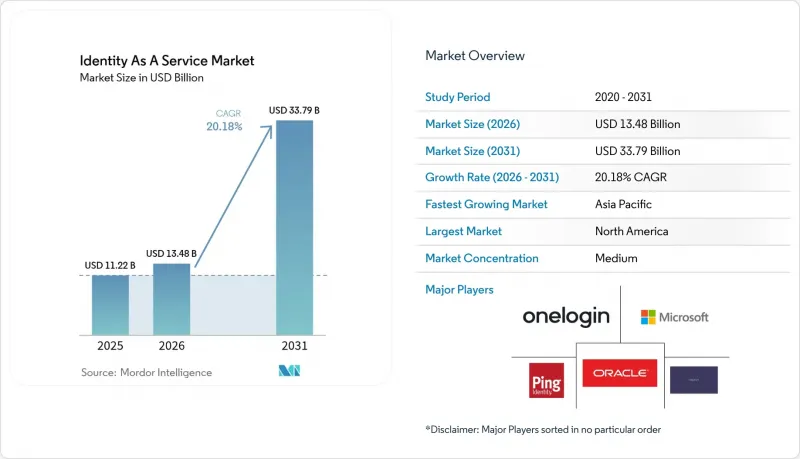
Mordor Intelligence에 의하면, IDaaS(Identity-as-a-Service) 시장 규모는 2025년 112억 2,000만 달러로 평가되었고, 2026년에는 134억 8,000만 달러로 추정되고, 2026-2031년 CAGR 20.18%로 성장을 지속할 전망이며, 2031년에는 337억 9,000만 달러에 이를 것으로 예측됩니다.
본 보고서는 구성 요소별(프로비저닝, 디렉터리 서비스 등), 인증 유형별(단일 요소 인증, 다중 요소 인증 등), 배포 모드별(퍼블릭 클라우드 등), 사용자 유형별(직원 ID 등), 조직 규모별(대기업 등), 최종 사용자 산업별(은행, 금융서비스 및 보험(BFSI), 통신 및 IT 등), 지역별로 분류되어 있습니다. 시장 예측은 금액(달러) 기준으로 제시되어 있습니다.
세계의 IDaaS(Identity-as-a-Service) 시장 동향 및 인사이트
미국 규제 대상 부문에서의 클라우드 네이티브 제로 트러스트 도입
대통령령 제14028호는 미국 연방 기관에 제로 트러스트 아키텍처 도입을 의무화하고 있으며, 신원 확인을 제1 방어선으로 삼고 있습니다. NIST(미국 국립표준기술연구소)의 실무 가이드 초안은 민간 및 공공 이해관계자의 도입 위험을 줄이는 상호 운용 가능한 청사진을 제시합니다. 병원, 보험사, 자본 시장 기업들은 이 지침을 활용하여 경계 제어에서 지속적인 신원 확인으로 전환하고 있으며, IaaS(Identity-as-a-Service) 시장의 구독을 필수 운영 비용으로 전환하고 있습니다.
CI/CD의 ID 제어가 필요한 API 기반 마이크로서비스의 확산
유럽에서 마이크로서비스의 보급은 기존의 IAM(신원 및 접근 관리) 기능의 대응 능력을 뛰어넘고 있습니다. EU의 디지털 신원 규정에 따라 회원국은 2026년까지 국경을 초월한 디지털 지갑을 발급해야 하며, 인증을 위한 통합된 API가 마련될 예정입니다. DevOps 팀은 현재 각 CI/CD 실행 시 토큰을 자동으로 프로비저닝하는 플랫폼이 필요하며, 이에 따라 머신 아이덴티티 거버넌스를 전문으로 하는 IDaaS(Identity-as-a-Service) 시장의 제공업체들은 비약적인 성장이 예상됩니다.
Tier 1 은행의 레거시 메인프레임 보유 현황
Tier-1 금융 기관은 최신 IDaaS 플랫폼과의 통합이 어려운 메인프레임 시스템으로 인해 막대한 기술적 부채에 직면해 있으며, 그 마이그레이션 일정은 일반 기업의 도입 주기를 넘어 길어지고 있습니다. ING의 150만 줄에 달하는 COBOL 코드 마이그레이션 사례는 코어 뱅킹 시스템 내에 갇혀 있는 IAM 로직을 분리하는 것이 얼마나 복잡한지를 여실히 보여줍니다(softwaremining.com). 메인프레임과의 하이브리드 공존은 테스트 주기를 장기화시켜, 세계 은행의 IDaaS(Identity-as-a-Service) 시장 확대를 둔화시키고 있습니다.
부문 분석
2025년, 프로비저닝 분야는 IaaS(Identity-as-a-Service) 시장 매출의 29.12%를 차지했으며, 전체 하이브리드 클라우드 환경에서 '입사·전근·퇴사' 워크플로우 자동화에 대한 보편적인 요구를 부각시켰습니다. 디렉터리 서비스와 싱글 사인온(SSO)은 여전히 필수 요건이지만, 현재 도입은 인간 및 기계 주체 모두의 라이프사이클 관리를 조율하는 제품군에 집중되어 있습니다.
다중 요소 인증 및 비밀번호 없는 인증 서비스는 피싱 공격에 대한 내성을 갖춘 체계가 규제 당국의 지침에서 권장되고 있기 때문에 연평균 21.96%의 성장률이 예상됩니다. CyberArk와 같은 벤더들은 16억 6,000만 달러에 Venafi를 인수한 후 생체 인증 패스키 오케스트레이션 기능을 통합하고 있으며, 이는 통합형 제품군이 단독 툴셋보다 투자자들의 관심을 더 많이 끌게 될 것임을 시사합니다.
2025년에도 단일 요소 인증 방식은 매출 점유율의 45.62%를 차지했으나, 이는 주로 최신 프로토콜을 아직 지원하지 못하는 레거시 워크로드가 존재하기 때문입니다. 그러나 FIDO2 인증이 규제 대상 산업에서 필수 요건이 됨에 따라, 비밀번호 없는 인증 메커니즘은 연평균 성장률(CAGR) 21.34%로 성장하며, IDaaS(Identity-as-a-Service) 시장을 능가하는 성장세를 보일 것으로 전망됩니다. 보스턴 연방준비은행은 2024년 사기 피해액 350억 달러의 원인이 합성 신원 정보에 있다고 지적했으며, 이 통계를 바탕으로 기업들은 지속적인 생체 인증 및 행동 인증을 우선시하고 있습니다.
다중 요소 인증 도구는 일시적인 안전 장치로 기능하지만, 이사회 수준의 리스크 위원회는 현재 공유 비밀 키를 완전히 배제하는 패스키를 지지하고 있습니다. 이러한 전환은 단편적인 신원 확인에서 지속적인 신원 확인으로의 구조적 변화를 촉진하고 있습니다.
지역별 분석
2025년, 북미는 IaaS(Identity-as-a-Service) 시장 매출의 38.35%를 차지했습니다. 연방 정부의 제로 트러스트 지침과 주요 은행들의 조기 비밀번호 없는 인증 도입이 지출의 모멘텀을 유지하고 있습니다. 캐나다의 ‘클라우드 퍼스트’ 프로그램과 멕시코의 국경 간 무역 플랫폼이 수요를 더욱 끌어올리고 있으며, 이 모든 것은 성숙한 하이퍼스케일러의 인프라에 의해 뒷받침되고 있습니다.
아시아태평양은 연평균 성장률(CAGR) 23.02%로 가장 빠르게 성장하고 있는 지역입니다. 각국의 디지털 ID 프레임워크에 더해, 인도네시아, 인도, 베트남에서의 퍼블릭 클라우드 도입 가속화가 맞물리면서 직원 및 시민의 이용 사례가 확대되고 있습니다. 기업들은 정부에서 발급한 인증 정보를 활용하여 직원 및 계약업체를 연계함으로써 온보딩 시간을 단축하고 KYC 비용을 절감하고 있습니다.
유럽에서는 회원국들에게 2026년까지 상호 운용 가능한 디지털 지갑 도입을 의무화하는 ‘EU 디지털 ID 규정’을 계기로 꾸준한 확대가 나타나고 있습니다. 독일의 EUDI 시범 사업과 프랑스의 의료 데이터 현지화 규정에 따라, 정부 부처와 기업 간의 공동 조달 모델이 추진되고 있습니다. 지역 내 데이터 상주성을 보장하면서도 국경을 초월한 워크플로우를 통합할 수 있는 제공업체가 시장에서 확고한 입지를 다질 것입니다.
기타 혜택 :
- 엑셀 형식 시장 예측(ME) 시트
- 3개월간의 애널리스트 지원
자주 묻는 질문
목차
제1장 서론
제2장 조사 방법
제3장 주요 요약
제4장 시장 구도
제5장 시장 규모 및 성장 예측
제6장 경쟁 구도
제7장 시장 기회 및 향후 전망
AJY 26.08.28According to Mordor Intelligence, the identity-as-a-Service market size is expected to grow from USD 11.22 billion in 2025 to USD 13.48 billion in 2026 and is forecast to reach USD 33.79 billion by 2031 at 20.18% CAGR over 2026-2031.
This report is Segmented by Component (Provisioning, Directory Services, and More), Authentication Type (Single-Factor, Multi-Factor, and More), Deployment Mode (Public Cloud, and More), User Type (Workforce Identity, and More), Organization Size (Large Enterprise, and More), End-User Vertical (BFSI, Telecom and IT, and More), and by Geography. The Market Forecasts are Provided in Terms of Value (USD).
Global Identity As A Service Market Trends and Insights
Cloud-native zero-trust adoption in regulated U.S. sectors
Executive Order 14028 requires U.S. federal agencies to implement zero-trust architectures, making identity verification the first line of defense. NIST's draft practice guide codifies an interoperable blueprint that cuts deployment risk for private and public stakeholders.Hospitals, insurers, and capital-markets firms are leveraging the guidance to shift from perimeter controls to continuous verification, turning Identity-as-a-Service market subscriptions into essential operating expenditure.
Proliferation of API-based micro-services requiring CI/CD identity controls
European adoption of micro-services has outpaced legacy IAM capabilities. The EU Digital Identity Regulation obliges Member States to issue cross-border digital wallets by 2026, creating uniform APIs for authentication. DevOps teams now require platforms that auto-provision tokens during each CI/CD run, positioning Identity-as-a-Service market providers that specialize in machine-identity governance for outsized growth.
Legacy mainframe entanglement in Tier-1 banks
Tier-1 financial institutions face significant technical debt from mainframe systems that resist integration with modern IDaaS platforms, creating migration timelines that extend beyond typical enterprise deployment cycles. ING's migration of 1.5 million COBOL lines illustrates the complexity of decoupling IAM logic trapped inside core banking systems softwaremining.com. Hybrid coexistence with mainframes prolongs testing cycles, tempering Identity-as-a-Service market acceleration among global banks.
Other drivers and restraints analyzed in the detailed report include:
- Asia-Pacific digital public-goods programs (eKYC, Aadhaar, Singpass)
- Enterprise-wide passwordless FIDO2 roll-outs in financial services
- Fragmented Middle-East data-residency statutes
For complete list of drivers and restraints, kindly check the Table Of Contents.
Segment Analysis
The provisioning segment generated 29.12% of Identity-as-a-Service market revenue in 2025, underlining the universal need for automated joiner-mover-leaver workflows across hybrid cloud estates. Directory services and single sign-on remain table stakes, yet adoption now concentrates on suites that orchestrate lifecycle controls for both human and machine principals.
Multi-factor and passwordless authentication services are forecast to grow 21.96% annually as regulatory guidance rewards phishing-resistant mechanisms. Vendors such as CyberArk are integrating biometric passkey orchestration following the USD 1.66 billion Venafi acquisition, signaling that unified suites will outpace isolated toolsets investors.
Single-factor methods retained 45.62% revenue share in 2025, largely due to legacy workloads that cannot yet support modern protocols. Passwordless mechanisms, however, are set to outgrow the Identity-as-a-Service market at a 21.34% CAGR as FIDO2 certification becomes table stakes for regulated industries. The Federal Reserve Bank of Boston attributes USD 35 billion in 2024 fraud losses to synthetic identities, a statistic that spurs enterprises to prioritize continuous biometric and behavioral authentication.
Multi-factor tools serve as transitional safeguards, but board-level risk committees now favor passkeys that eliminate shared secrets entirely. This pivot reinforces a structural shift from occasional to continuous identity assurance.
Complete Report Scope:
- By Component
- Provisioning
- Directory Services
- Single Sign-On (SSO)
- Password Management
- Advanced / Multi-factor Authentication
- Access Governance and Compliance
- By Authentication Type
- Single-Factor (Password-based)
- Multi-Factor (Token, OTP, Mobile Push)
- Passwordless (Biometric, FIDO2)
- By Deployment Mode
- Public Cloud
- Private Cloud
- Hybrid Cloud
- By User Type
- Workforce Identity
- Customer / Consumer Identity (CIAM)
- By Organization Size
- Large Enterprise
- Small and Medium Enterprise (SME)
- By End-User Vertical
- BFSI
- Telecom and IT
- Public Sector and Government
- Healthcare and Life-Sciences
- Energy and Utilities
- Manufacturing
- Retail and E-commerce
- Education
- Others
- By Geography
- North America
- United States
- Canada
- Mexico
- South America
- Brazil
- Argentina
- Rest of South America
- Europe
- Germany
- United Kingdom
- France
- Nordic Countries
- Rest of Europe
- Asia Pacific
- China
- India
- Japan
- South Korea
- Australia
- New Zealand
- Rest of Asia Pacific
- Middle East and Africa
- Middle East
- Africa
- North America
Geography Analysis
North America accounted for 38.35% of Identity-as-a-Service market revenue in 2025. Federal zero-trust edicts and early passwordless roll-outs among tier-one banks sustain spending momentum. Canada's cloud-first program and Mexico's cross-border trade platforms add incremental demand, all underpinned by mature hyperscaler infrastructure.
Asia-Pacific is the fastest-growing region at 23.02% CAGR. National digital ID frameworks, coupled with accelerated public-cloud adoption in Indonesia, India, and Vietnam, multiply workforce and citizen-access use cases. Enterprises leverage government-issued credentials to bind employees and contractors, compressing onboarding time and reducing KYC costs.
Europe exhibits steady expansion, catalyzed by the EU Digital Identity Regulation that obliges members to deploy interoperable wallets by 2026. Germany's EUDI pilot and France's health-data localization rules drive joint procurement models between ministries and enterprises. Providers able to guarantee regional data residency while integrating cross-border workflows will consolidate gains.
- Microsoft Corporation
- Okta Inc.
- Ping Identity Corporation
- IBM Corporation
- IDaptive LLC
- CyberArk Software Ltd.
- SailPoint Technologies
- ForgeRock Inc.
- One Identity LLC
- Oracle Corporation
- Amazon Web Services (AWS Cognito)
- Google LLC (Cloud Identity)
- Thales Group (Gemalto)
- SAP SE
- Cisco Systems Duo Security
- Auth0 (now Okta)
- OneLogin Inc.
- Saviynt
- Simeio Solutions
- Entrust Corporation
- Transmit Security
Additional Benefits:
- The market estimate (ME) sheet in Excel format
- 3 months of analyst support
TABLE OF CONTENTS
1 INTRODUCTION
- 1.1 Study Assumptions and Market Definition
- 1.2 Scope of the Study
2 RESEARCH METHODOLOGY
3 EXECUTIVE SUMMARY
4 MARKET LANDSCAPE
- 4.1 Market Overview
- 4.2 Market Drivers
- 4.2.1 Cloud-native Zero-Trust Adoption in U.S.-Centric Highly Regulated Sectors
- 4.2.2 Proliferation of API-based Micro-Services Accelerating CI/CD IDaaS Demand in Europe
- 4.2.3 Asia's Digital Public Goods (eKYC, Aadhaar, Singpass) Triggering Country-wide Workforce IDaaS Roll-outs
- 4.2.4 Passwordless FIDO2 Pilots Converting to Enterprise-wide Licences in Financial Services
- 4.2.5 Vendor-bundled IAM Analytics Using Generative-AI for Real-time Risk Scoring
- 4.2.6 MandA-Driven Horizontal Suite-Building by Hyperscalers (Azure, AWS) Boosting Integrated IDaaS Uptake
- 4.3 Market Restraints
- 4.3.1 Legacy Mainframe Entanglement Slowing IDaaS Migration in Tier-1 Banks
- 4.3.2 Fragmented Data-Residency Statutes in the Middle East Inflating Compliance Costs
- 4.3.3 High Latency Concerns Among IIoT Users for Cloud-hosted Authentication
- 4.3.4 Vendor-lock-in Fears around Proprietary SSO Protocol Extensions
- 4.4 Value / Supply-Chain Analysis
- 4.5 Regulatory Landscape
- 4.6 Technological Outlook
- 4.7 Porter's Five Forces
- 4.7.1 Threat of New Entrants
- 4.7.2 Bargaining Power of Buyers
- 4.7.3 Bargaining Power of Suppliers
- 4.7.4 Threat of Substitutes
- 4.7.5 Intensity of Competitive Rivalry
5 MARKET SIZE AND GROWTH FORECASTS (VALUE)
- 5.1 By Component
- 5.1.1 Provisioning
- 5.1.2 Directory Services
- 5.1.3 Single Sign-On (SSO)
- 5.1.4 Password Management
- 5.1.5 Advanced / Multi-factor Authentication
- 5.1.6 Access Governance and Compliance
- 5.2 By Authentication Type
- 5.2.1 Single-Factor (Password-based)
- 5.2.2 Multi-Factor (Token, OTP, Mobile Push)
- 5.2.3 Passwordless (Biometric, FIDO2)
- 5.3 By Deployment Mode
- 5.3.1 Public Cloud
- 5.3.2 Private Cloud
- 5.3.3 Hybrid Cloud
- 5.4 By User Type
- 5.4.1 Workforce Identity
- 5.4.2 Customer / Consumer Identity (CIAM)
- 5.5 By Organization Size
- 5.5.1 Large Enterprise
- 5.5.2 Small and Medium Enterprise (SME)
- 5.6 By End-User Vertical
- 5.6.1 BFSI
- 5.6.2 Telecom and IT
- 5.6.3 Public Sector and Government
- 5.6.4 Healthcare and Life-Sciences
- 5.6.5 Energy and Utilities
- 5.6.6 Manufacturing
- 5.6.7 Retail and E-commerce
- 5.6.8 Education
- 5.6.9 Others
- 5.7 By Geography
- 5.7.1 North America
- 5.7.1.1 United States
- 5.7.1.2 Canada
- 5.7.1.3 Mexico
- 5.7.2 South America
- 5.7.2.1 Brazil
- 5.7.2.2 Argentina
- 5.7.2.3 Rest of South America
- 5.7.3 Europe
- 5.7.3.1 Germany
- 5.7.3.2 United Kingdom
- 5.7.3.3 France
- 5.7.3.4 Nordic Countries
- 5.7.3.5 Rest of Europe
- 5.7.4 Asia Pacific
- 5.7.4.1 China
- 5.7.4.2 India
- 5.7.4.3 Japan
- 5.7.4.4 South Korea
- 5.7.4.5 Australia
- 5.7.4.6 New Zealand
- 5.7.4.7 Rest of Asia Pacific
- 5.7.5 Middle East and Africa
- 5.7.5.1 Middle East
- 5.7.5.2 Africa
- 5.7.1 North America
6 COMPETITIVE LANDSCAPE
- 6.1 Market Concentration
- 6.2 Strategic Moves (MandA, Alliances, Funding)
- 6.3 Market Share Analysis
- 6.4 Company Profiles {(includes Global level Overview, Market level overview, Core Segments, Financials as available, Strategic Information, Market Rank/Share for key companies, Products and Services, and Recent Developments)}
- 6.4.1 Microsoft Corporation
- 6.4.2 Okta Inc.
- 6.4.3 Ping Identity Corporation
- 6.4.4 IBM Corporation
- 6.4.5 IDaptive LLC
- 6.4.6 CyberArk Software Ltd.
- 6.4.7 SailPoint Technologies
- 6.4.8 ForgeRock Inc.
- 6.4.9 One Identity LLC
- 6.4.10 Oracle Corporation
- 6.4.11 Amazon Web Services (AWS Cognito)
- 6.4.12 Google LLC (Cloud Identity)
- 6.4.13 Thales Group (Gemalto)
- 6.4.14 SAP SE
- 6.4.15 Cisco Systems Duo Security
- 6.4.16 Auth0 (now Okta)
- 6.4.17 OneLogin Inc.
- 6.4.18 Saviynt
- 6.4.19 Simeio Solutions
- 6.4.20 Entrust Corporation
- 6.4.21 Transmit Security
7 MARKET OPPORTUNITIES AND FUTURE OUTLOOK
- 7.1 White-space and Unmet Need Analysis


