

|
시장보고서
상품코드
2115025
나노로보틱스 시장 : 점유율 분석, 업계 동향과 통계, 성장 예측(2026-2031년)Nanorobotics - Market Share Analysis, Industry Trends & Statistics, Growth Forecasts (2026 - 2031) |
||||||
 Mordor Intelligence
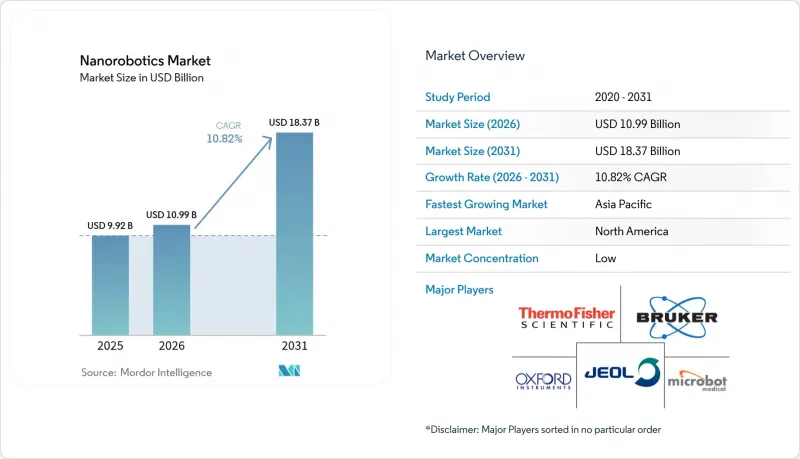
Mordor Intelligence에 의하면, 2026년 나노로보틱스 시장 규모는 109억 9,000만 달러로 추정되고 있어 2025년 99억 2,000만 달러에서 확대해, 2031년에는 183억 7,000만 달러에 이를 것으로 예측됩니다.
2026년부터 2031년까지 연평균 성장률(CAGR) 10.82%로 성장할 것으로 전망됩니다.
본 보고서는 제조 유형(나노 매니퓰레이터, 바이오 나노로봇 등), 추진 방식(자기식, 화학식 등), 구성 부품(나노 센서, 제어·통신 모듈 등), 용도(약물 전달, 의료용 영상 진단 등), 최종 사용자(병원·외과 센터 등) 및 지역별로 분류되어 있습니다. 시장 예측은 금액(달러) 기준으로 제시되어 있습니다.
세계 나노로보틱스 시장 동향 및 인사이트
미국 및 EU 병원에서 MRI 유도 하의 자기 구동과 AI의 융합
현재 미국 및 유럽의 병원에서는 실시간 MRI 영상과 AI를 활용한 자기 유도 기술을 결합하여, 나노로봇이 구불구불한 혈관 내를 이동할 수 있도록 유도하고 있습니다. 임상시험 결과, 간암 치료 시 간동맥에 대한 표적 정확도가 2.6배 향상되었으며, 알고리즘 호환성이 95%에 달한 것으로 보고되었습니다. 기존 MRI 장비에서는 대규모 하드웨어 업그레이드가 필요하지 않아 도입 비용을 절감할 수 있어 도입이 가속화되고 있습니다. AI를 활용한 경로 계획으로 시술 시간 단축과 조영제 노출 감소가 실현되어, 도입의 경제적 이점이 커지고 있습니다. 그 결과 치료 성과가 향상됨에 따라, 이 요인은 나노로보틱스 시장의 성장을 이끄는 핵심 요소가 되고 있습니다.
DARPA 및 EU의 국방 분야 마이크로 스웜 지원금이 군사 정찰용 나노봇 개발을 가속화하고 있습니다.
DARPA의 최신 프로그램에서는 마침표보다 작은 1만 개의 프로그래밍 가능한 마이크로로봇 무리가 출입 금지 구역을 항해할 수 있도록 자금을 지원하고 있습니다. 이와 병행하여 진행 중인 EU의 공모에서는 분산형 센싱과 자율적인 협력이 중시되고 있습니다. 초기 야외 시험에서는 리더-팔로워형 알고리즘을 통해 미로 같은 지형에서의 임무 성공률이 40% 향상된 것으로 나타났으나, 자율형 무기의 치명성에 대한 공적인 논의는 격화되고 있습니다. 윤리적 검토를 통해 수출 규제가 재구성될 가능성은 있으나, 자금 조달의 급증으로 인해 민간 검사 및 재난 구호 시장으로 전용 가능한 이중 용도 기술의 파이프라인이 확고해지고 있습니다.
세포 독성 및 면역원성에 대한 우려로 인해 FDA/EMA의 승인이 제한되고 있습니다.
규제 당국은 주로 수동적인 나노 의약품에 대해 승인을 내주고 있지만, 능동적이고 자율적인 나노 로봇에 대해서는 장기적인 생체 분포 및 장기에 대한 축적과 관련하여 더 엄격한 심사가 이루어지고 있습니다. 안전성 데이터 부족으로 인해 승인까지의 기간이 길어지고, 개발 비용이 증가하고 있습니다. 특히, 철저한 독성 시험에 자금을 투입할 자본력이 없는 중소기업의 경우 그 영향이 두드러집니다.
부문 분석
2025년, 나노 매니퓰레이터는 나노로보틱스 시장 점유율의 31.12%를 차지하며, 원자 분해능 수준의 핸들링이 필수적인 반도체 계측 라인을 주축으로 하고 있습니다. MRI 호환성을 강점으로 하는 자기 유도형 나노봇은 2031년까지 연평균 성장률(CAGR) 12.05%로 성장하여 나노로보틱스 시장 전체 규모를 상회할 것으로 예측됩니다.
나노 매니퓰레이터의 성숙한 툴 기반은 장비 서비스를 통한 지속적인 수익을 확보하고 있지만, 자기 유도형 플랫폼은 특히 표적 지향형 암 치료 분야에서 새로운 의료 예산을 유치하고 있습니다. 3D 프린팅을 통한 하이브리드 구조체와 박테리아 기반 로봇은 생태계를 다양화하고 있지만, 높은 단위 비용과 규제상의 불확실성으로 인해 여전히 틈새 시장으로 남아 있습니다.
2025년에는 병원이 영상 진단과 추진 모두에 기존 MRI 장비를 활용함에 따라, 자기 구동 방식이 나노로보틱스 시장 규모의 41.55%를 차지했습니다. 화학·촉매 시스템은 방광암 치료에서 요소 등 생체 내 연료원을 활용함으로써 연평균 성장률(CAGR) 13.55%를 나타낼 것으로 예측됩니다.
초음파를 이용한 음향 구동 및 광활성화 메커니즘은 심부 조직으로의 침투나 온디맨드 작동 등 용도에 따른 이점을 제공합니다. 구동 방식의 구성은 앞으로도 다양성을 유지할 전망이며, 솔루션 설계자는 이동의 물리적 특성과 이용 사례의 제약 조건을 적절히 조화시킬 수 있게 될 것입니다.
지역별 분석
북미는 2025년 시점에서 31.65%의 점유율을 유지하고 있으며, CRISPR 나노로보틱스에 대한 DARPA의 보조금 및 벤처 자금 덕분에 이 지역은 계속해서 혁신의 최전선에 위치하고 있습니다. 미국의 나노의료 부문만 해도 2033년까지 2,796억 9,000만 달러에 달할 것으로 예측됩니다. 캐나다의 연구 생태계는 유전자 편집 전달 플랫폼과 종양학에 초점을 맞춘 프로토타입을 통해 이러한 강점을 보완하고 있습니다.
아시아태평양은 중국의 보조금 제도와 일본의 현미경 기술의 정밀도에 힘입어 연평균 성장률(CAGR) 14.46%로 가장 빠르게 성장하고 있는 지역입니다. 보조금을 받은 제조 시설 덕분에 비용 장벽이 낮아지면서, 이 지역의 기업들은 모기만한 크기의 드론이나 고해상도 주사전자현미경(SEM) 도구 등을 개발하여 세계 공급망에 기여하고 있습니다. 규제 체계는 유럽 및 미국의 기준에는 미치지 못하지만, 특히 의료기기 분야에서 엄격화가 진행되고 있습니다.
유럽에서는 엄격한 감독 체계와 넉넉한 연구개발(R&D) 자금 지원 간의 균형이 잘 잡혀 있습니다. ‘NanoRem’과 같은 프로젝트는 환경적 요구가 토양 및 지하수 정화를 위한 자금 지원을 받는 실증 실험으로 어떻게 이어지고 있는지를 보여줍니다. 독일과 영국은 각각 정밀 계측 기기와 생명공학 분야의 틈새 시장을 선도하고 있는 반면, 프랑스와 스칸디나비아 국가들은 세계적 규범을 형성할 가능성이 있는 윤리에 중점을 둔 체계를 추진하고 있습니다.
기타 혜택:
- 엑셀 형식 시장 예측(ME) 시트
- 3개월간의 애널리스트 지원
자주 묻는 질문
목차
제1장 서론
제2장 시장 구도
제3장 시장 규모와 성장 예측
제4장 경쟁 구도
제5장 시장 기회와 향후 전망
JHS 26.08.26According to Mordor Intelligence, nanorobotics market size in 2026 is estimated at USD 10.99 billion, growing from 2025 value of USD 9.92 billion with 2031 projections showing USD 18.37 billion, growing at 10.82% CAGR over 2026-2031.
This report is Segmented by Manufacturing Type (Nanomanipulators, Bio-Nanorobots, and More), Propulsion Method (Magnetic, Chemical, and More), Component (Nanosensors, Control and Communication Modules, and More), Application (Drug Delivery, Medical Imaging and Diagnostics, and More), End-User (Hospitals and Surgical Centers, and More), and Geography. The Market Forecasts are Provided in Terms of Value (USD).
Global Nanorobotics Market Trends and Insights
Convergence of MRI-guided magnetic actuation with AI in U.S. and EU hospitals
Hospitals in the United States and Europe now combine real-time MRI imaging with AI-enhanced magnetic steering to guide nanorobots through tortuous blood vessels. Clinical trials report a 2.6-fold gain in hepatic-artery targeting accuracy and 95% algorithm compatibility during liver-cancer treatments. Deployment accelerates because existing MRI suites require no major hardware upgrades, lowering onboarding costs for hospital systems. AI path-planning reduces procedure time and contrast-agent exposure, strengthening the economic case for adoption. The resulting improvement in therapeutic outcomes places this driver at the center of the nanorobotics market growth narrative.
DARPA and EU defense micro-swarm grants accelerating military reconnaissance nanobots
DARPA's latest programs fund swarms of 10,000 programmable micro-robots smaller than a period for navigating denied environments. Parallel EU calls emphasise distributed sensing and autonomous coordination. Early field tests show leader-follower algorithms boosting mission success in maze-like terrains by 40%, but public debate over autonomous lethality is intensifying. While ethical scrutiny could reshape export rules, the funding surge is cementing a pipeline of dual-use technologies transferable to civilian inspection and disaster-relief markets.
Cytotoxicity and immunogenicity concerns limiting FDA / EMA approvals
Regulators grant clearances mainly to passive nanomedicines; active, autonomous nanorobots face tougher scrutiny over long-term biodistribution and organ accumulation. Safety data gaps extend approval timelines and raise developer costs, especially for SMEs lacking the capital to fund exhaustive toxicology studies.
Other drivers and restraints analyzed in the detailed report include:
- Chinese 14th Five-Year Plan subsidies for nano-manufacturing equipment
- Rapid drop in DNA-origami synthesis cost enabling mass bio-nanorobot prototyping
- Ultra-cleanroom infrastructure costs hindering scale-up
For complete list of drivers and restraints, kindly check the Table Of Contents.
Segment Analysis
Nanomanipulators captured 31.12% of nanorobotics market share in 2025, anchored in semiconductor metrology lines where atomic-resolution handling is indispensable. Magnetically guided nanobots, aided by MRI compatibility, are forecast to grow at 12.05% CAGR, outpacing the overall nanorobotics market size through 2031.
The mature tooling base of nanomanipulators secures recurring revenue from equipment services, yet magnetically guided platforms attract fresh healthcare budgets, especially for targeted oncology procedures. Hybrid 3D-printed constructs and bacteria-based bots diversify the ecosystem but remain niche owing to higher unit costs and regulatory uncertainties.
Magnetic actuation commanded 41.55% of the nanorobotics market size in 2025 as hospitals leverage existing MRI suites for both imaging and propulsion. Chemical/catalytic systems are projected to post 13.55% CAGR by exploiting in-vivo fuel sources such as urea in bladder-cancer therapy.
Ultrasound-based acoustic propulsion and light-activated mechanisms supply application-specific advantages such as deep-tissue penetration or on-demand activation. The propulsion mix is likely to remain heterogeneous, allowing solution designers to match locomotion physics to use-case constraints.
Complete Report Scope:
- By Manufacturing Type
- Nanomanipulators
- Bio-Nanorobots
- Magnetically Guided Nanobots
- Bacteria-based Nanobots
- 3-D Printed Nanorobots
- Other Manufacturing Types
- By Propulsion / Actuation Method
- Magnetic Actuation
- Chemical / Catalytic
- Acoustic (Ultrasound)
- Light-Driven
- Bio-Hybrid / Flagellar
- By Component
- Nanosensors
- Nanoactuators and Motors
- Nanomanipulation Systems
- Control and Communication Modules
- By Application
- Drug Delivery
- Medical Imaging and Diagnostics
- Minimally-Invasive Surgery and Cell Repair
- Health-Monitoring Sensors and Replicators
- Environmental Remediation
- Precision Electronics and Semiconductor Metrology
- Military and Reconnaissance
- By End-User
- Hospitals and Surgical Centers
- Pharmaceutical and Biotech Companies
- Academic and Government Research Institutes
- Semiconductor Foundries
- Defense Organizations
- By Geography
- North America
- United States
- Canada
- Mexico
- Europe
- United Kingdom
- Germany
- France
- Italy
- Rest of Europe
- Asia-Pacific
- China
- Japan
- India
- South Korea
- Rest of Asia-Pacific
- Middle East and Africa
- Middle East
- Saudi Arabia
- United Arab Emirates
- Turkey
- Rest of Middle East
- Africa
- South Africa
- Egypt
- Rest of Africa
- Middle East
- South America
- Brazil
- Argentina
- Rest of South America
- North America
Geography Analysis
North America retained 31.65% share in 2025 as DARPA grants and venture funding for CRISPR-nanorobotics kept the region at the innovation frontier. The U.S. nanomedicine segment alone is set to reach USD 279.69 billion by 2033. Canada's research ecosystem complements this strength with gene-editing delivery platforms and oncology-focused prototypes.
Asia-Pacific is the quickest-expanding theatre at 14.46% CAGR, pulled by China's subsidy conveyor and Japan's microscopy precision. Subsidised fabs reduce cost barriers, and regional players demonstrate mosquito-scale drones and high-resolution SEM tools that feed global supply chains. Regulatory regimes lag Western benchmarks but are tightening, especially around medical devices.
Europe balances stringent oversight with generous R&D funding. Projects like NanoRem show how environmental imperatives translate into funded pilots for soil and groundwater cleanup. Germany and the UK dominate precision instrumentation and biotech niches, respectively, while France and Scandinavia advance ethics-focused frameworks that could shape global norms.
- Bruker Corporation
- Thermo Fisher Scientific Inc.
- JEOL Ltd.
- Oxford Instruments Plc
- Microbot Medical Inc.
- Imina Technologies SA
- EV Group (EVG)
- Ginkgo Bioworks Inc.
- Zymergen Inc.
- Illumina Inc.
- Nanoics Imaging Ltd.
- Synthace Ltd.
- Toronto Nano Instrumentation Inc.
- Klocke Nanotechnik GmbH
- Park Systems Corp.
- Nanosurf AG
- Nanoscribe GmbH
- Bruker Alicona
- Micronit BV
- DNA Script SA
Additional Benefits:
- The market estimate (ME) sheet in Excel format
- 3 months of analyst support
TABLE OF CONTENTS
1 INTRODUCTION
- 1.1 Study Assumptions and Market Definition
- 1.2 Scope of the Study
- 1.3 Research Methodology
- 1.4 Executive Summary
2 MARKET LANDSCAPE
- 2.1 Market Overview
- 2.2 Market Drivers
- 2.2.1 Convergence of MRI-guided magnetic actuation with AI in U.S. and EU hospitals
- 2.2.2 DARPA and EU defence micro-swarm grants accelerating military recon nanobots
- 2.2.3 China's 14th Five-Year Plan subsidies for nano-manufacturing equipment
- 2.2.4 Rapid drop in DNA-origami synthesis cost enabling mass bio-nanorobot prototyping
- 2.2.5 Venture funding spike for CRISPR-enabled nanorobotic drug-delivery start-ups
- 2.2.6 Sub-5-nm semiconductor metrology demand boosting nanomanipulator robotics market
- 2.3 Market Restraints
- 2.3.1 Cytotoxicity and immunogenicity concerns limiting FDA/EMA approvals
- 2.3.2 Ultra-cleanroom infrastructure costs hindering scale-up
- 2.3.3 Absence of sub-100-nm swarm-communication standards
- 2.3.4 Public ethical backlash to military nano-swarm deployment in Middle-East
- 2.4 Industry Supply-Chain Analysis
- 2.5 Regulatory Outlook
- 2.6 Porter's Five Forces Analysis
- 2.6.1 Threat of New Entrants
- 2.6.2 Bargaining Power of Buyers/Consumers
- 2.6.3 Bargaining Power of Suppliers
- 2.6.4 Threat of Substitute Products
- 2.6.5 Intensity of Competitive Rivalry
- 2.7 Technology Snapshot
- 2.8 Impact of Macroeconomic Factors on the Market
3 MARKET SIZE AND GROWTH FORECASTS (VALUE)
- 3.1 By Manufacturing Type
- 3.1.1 Nanomanipulators
- 3.1.2 Bio-Nanorobots
- 3.1.3 Magnetically Guided Nanobots
- 3.1.4 Bacteria-based Nanobots
- 3.1.5 3-D Printed Nanorobots
- 3.1.6 Other Manufacturing Types
- 3.2 By Propulsion / Actuation Method
- 3.2.1 Magnetic Actuation
- 3.2.2 Chemical / Catalytic
- 3.2.3 Acoustic (Ultrasound)
- 3.2.4 Light-Driven
- 3.2.5 Bio-Hybrid / Flagellar
- 3.3 By Component
- 3.3.1 Nanosensors
- 3.3.2 Nanoactuators and Motors
- 3.3.3 Nanomanipulation Systems
- 3.3.4 Control and Communication Modules
- 3.4 By Application
- 3.4.1 Drug Delivery
- 3.4.2 Medical Imaging and Diagnostics
- 3.4.3 Minimally-Invasive Surgery and Cell Repair
- 3.4.4 Health-Monitoring Sensors and Replicators
- 3.4.5 Environmental Remediation
- 3.4.6 Precision Electronics and Semiconductor Metrology
- 3.4.7 Military and Reconnaissance
- 3.5 By End-User
- 3.5.1 Hospitals and Surgical Centers
- 3.5.2 Pharmaceutical and Biotech Companies
- 3.5.3 Academic and Government Research Institutes
- 3.5.4 Semiconductor Foundries
- 3.5.5 Defense Organizations
- 3.6 By Geography
- 3.6.1 North America
- 3.6.1.1 United States
- 3.6.1.2 Canada
- 3.6.1.3 Mexico
- 3.6.2 Europe
- 3.6.2.1 United Kingdom
- 3.6.2.2 Germany
- 3.6.2.3 France
- 3.6.2.4 Italy
- 3.6.2.5 Rest of Europe
- 3.6.3 Asia-Pacific
- 3.6.3.1 China
- 3.6.3.2 Japan
- 3.6.3.3 India
- 3.6.3.4 South Korea
- 3.6.3.5 Rest of Asia-Pacific
- 3.6.4 Middle East and Africa
- 3.6.4.1 Middle East
- 3.6.4.1.1 Saudi Arabia
- 3.6.4.1.2 United Arab Emirates
- 3.6.4.1.3 Turkey
- 3.6.4.1.4 Rest of Middle East
- 3.6.4.2 Africa
- 3.6.4.2.1 South Africa
- 3.6.4.2.2 Egypt
- 3.6.4.2.3 Rest of Africa
- 3.6.4.1 Middle East
- 3.6.5 South America
- 3.6.5.1 Brazil
- 3.6.5.2 Argentina
- 3.6.5.3 Rest of South America
- 3.6.1 North America
4 COMPETITIVE LANDSCAPE
- 4.1 Market Concentration
- 4.2 Strategic Moves
- 4.3 Market Share Analysis
- 4.4 Company Profiles
- 4.4.1 Bruker Corporation
- 4.4.2 Thermo Fisher Scientific Inc.
- 4.4.3 JEOL Ltd.
- 4.4.4 Oxford Instruments Plc
- 4.4.5 Microbot Medical Inc.
- 4.4.6 Imina Technologies SA
- 4.4.7 EV Group (EVG)
- 4.4.8 Ginkgo Bioworks Inc.
- 4.4.9 Zymergen Inc.
- 4.4.10 Illumina Inc.
- 4.4.11 Nanoics Imaging Ltd.
- 4.4.12 Synthace Ltd.
- 4.4.13 Toronto Nano Instrumentation Inc.
- 4.4.14 Klocke Nanotechnik GmbH
- 4.4.15 Park Systems Corp.
- 4.4.16 Nanosurf AG
- 4.4.17 Nanoscribe GmbH
- 4.4.18 Bruker Alicona
- 4.4.19 Micronit BV
- 4.4.20 DNA Script SA
5 MARKET OPPORTUNITIES AND FUTURE OUTLOOK
- 5.1 White Space and Unmet Need Assessment


