
|
시장보고서
상품코드
2115046
AI 컴퓨팅 하드웨어 시장 : 점유율 분석, 업계 동향과 통계, 성장 예측(2026-2031년)AI Computing Hardware - Market Share Analysis, Industry Trends & Statistics, Growth Forecasts (2026 - 2031) |
||||||
 Mordor Intelligence
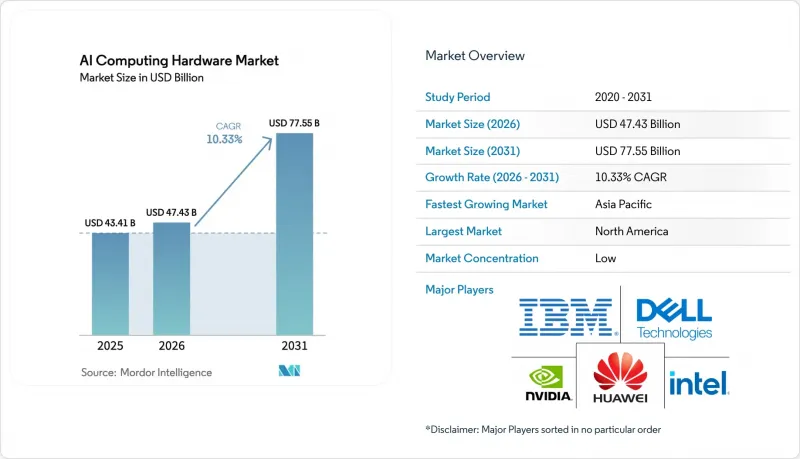
Mordor Intelligence에 의하면, AI 컴퓨팅 하드웨어 시장 규모는 2025년 434억 1,000만 달러에서 2026년에는 474억 3,000만 달러로 확대되어 2031년까지 775억 5,000만 달러에 이를 것으로 예측되며, 2026년부터 2031년까지 CAGR 10.33%로 성장할 전망입니다.
본 보고서는 컴퓨팅 실리콘의 유형(GPU 가속기 등), 시스템 폼 팩터(AI 서버,액셀러레이터 카드 및 모듈 등), 도입 장소(클라우드 데이터센터 등), 워크로드 유형(훈련, 추론 등), 최종 사용자 산업(하이퍼스케일 기업 및 클라우드 서비스 제공업체 등), 그리고 지역별로 분류되어 있습니다. 시장 예측은 금액(미 달러) 기준으로 제시되어 있습니다.
세계 AI 컴퓨팅 하드웨어 시장 동향 및 인사이트
하이퍼스케일러의 AI 인프라에 대한 자본 투자 확대가 가속기 수요를 견인
하이퍼스케일러의 자본 투자 프로그램은 계속 확대되고 있으며, 2026년의 총 지출액은 수천억 달러에 달하고, 전년 대비 30%대 중반의 성장률을 유지하고 있습니다. 이러한 성장세는 가속기가 탑재된 서버, 고속 네트워크 패브릭, 랙당 고밀도를 실현하는 수냉식 랙 설계 등 AI 전용 인프라에 집중되고 있습니다. 멀티 기가와트 규모의 시스템 도입을 약속하는 대규모 전개는 훈련 및 추론 이용 사례에 걸친 사업자 수요 규모와 지속성을 더욱 뒷받침하고 있습니다. 플랫폼 벤더 간의 전략적 제휴도, AI 클러스터에서의 스케일아웃 전개를 효율화하는 CPU 플랫폼 연동을 포함하여 통합 솔루션에 대한 투자를 집중시키고 있습니다. 액체 냉각 및 랙 스케일 어셈블리의 채택 확대는 고TDP 가속기를 위한 열 관리 및 전원 서브시스템을 사전에 통합함으로써 도입 장벽을 낮추고 있습니다. AI 컴퓨팅 하드웨어 시장은 파일럿 프로젝트에서 여러 지역에 걸친 대규모 프로덕션 환경으로의 전환에 따라 이러한 설비 투자의 가속화 혜택을 누리고 있습니다.
추론 워크로드의 전환이 데이터센터의 경제성을 재정의
연산 사이클의 균형이 추론 쪽으로 이동하고 있으며, 이는 주기적인 소비 패턴을 촉진하고 서비스 제공 성능을 시스템 설계의 핵심 제약 조건으로 바꾸고 있습니다. 이러한 변화로 인해 토큰당 비용, 낮은 지연 시간, 효율적인 메모리 계층에 최적화된 가속기 및 시스템이 유리해집니다. 이는 훈련에 최적화된 프로파일과는 다릅니다. 메모리 용량과 대역폭은 신속한 토큰 생성에 매우 중요해졌으며, 첫 번째 토큰 생성까지의 시간을 단축하는 새로운 메모리 모듈은 프로덕션 환경에서 메모리가 풍부한 설계의 가치를 더욱 높이고 있습니다. 추론을 사용자에게 더 가까운 곳에 배치해야 할 필요성으로 인해, 신뢰성을 저해하지 않으면서 지연 시간과 전력 공급의 균형을 맞추는 소규모 지역 배포의 매력도 높아지고 있습니다. 현재 통신사들의 전략은 안정적인 워크로드를 처리하기 위해 훈련 클러스터와 병행하여 추론 처리 용량을 일관되게 구축하는 것을 우선시하고 있습니다. AI 컴퓨팅 하드웨어 시장에서는 실리콘 로드맵과 연산, 메모리, 네트워크, 냉각 기능을 통합한 랙 솔루션 모두에서 이러한 우선순위가 반영되고 있습니다.
전력 및 송전망 제약으로 인해 도입 속도 저해
전력 공급 상황과 상호 연결 일정은 통신 사업자가 AI 처리 능력을 어디에, 어떻게 구축할지를 결정하는 요인이 되며, 주요 대도시권의 제약으로 인해 대규모 캠퍼스의 가동 시작 일정이 지연되고 있습니다. 고밀도화 및 지속적인 부하 프로파일에 대응하기 위해 통신 사업자들은 높은 TDP를 가진 가속기 로드맵에 맞추어 액체 냉각 및 모듈식 전원 아키텍처를 채택하고 있습니다. 또한, 코패키지드 옵틱스(copackaged optics)와 같은 네트워크 기술 혁신도 비트당 전력 소비를 줄이는 데 도움이 되어, 간접적으로 시설 규모의 에너지 예산을 소폭 완화하고 있습니다. 이러한 대책은 입지 관련 과제를 해결해 주지는 않지만, 훈련 및 추론 클러스터 모두에서 와트당 성능 향상에 기여하고 있습니다. 따라서 AI 컴퓨팅 하드웨어 시장은 지역 전력망 동향에 민감하며, 일관된 열적·전기적 거동을 확보하기 위해 통합형 액체 냉각 랙을 중심으로 한 표준화가 요구되고 있습니다. AI 플랫폼 주요 기업들의 대규모 구매 계약은 다양한 입지 선택과 단계적 확장을 통해 전력망의 병목 현상을 완화하기 위한 장기적인 용량 계획이 진행되고 있음을 시사합니다.
부문 분석
GPU 가속기는 성숙한 소프트웨어 스택과 전환 비용을 높게 유지하는 숙련된 엔지니어 인력에 힘입어 2025년에는 64%라는 최대 점유율을 차지할 것으로 예측됩니다. 반면, AI ASIC은 주요 사업자들이 프로덕션 환경에서의 추론에서 토큰당 효율성과 워크로드의 보다 엄격한 정합성을 우선시하고 있기 때문에 2031년까지 연평균 성장률(CAGR) 10.6%로 가장 빠른 성장을 이룰 것으로 전망됩니다. AI 컴퓨팅 하드웨어 시장 전체에서 하이퍼스케일러가 설계한 칩은 상용 실리콘에 대한 의존도를 낮추고, 랙 스케일에서 전력, 메모리, 네트워크의 최적화를 지원합니다. FPGA는 안전성 및 자동화 분야에서 결정론적 지연 시간과 현장 재구성 가능성이 요구되는 엣지 환경에서 여전히 중요한 역할을 수행하고 있습니다. 클라이언트 디바이스에 내장된 NPU는 더욱 엄격한 열 및 전력 예산 제약 하에서 디바이스 상의 작업에 대한 개인정보 보호 및 지연 시간 문제를 해결하고 있습니다. CPU는 제어 플레인 업무, 스토리지 오케스트레이션 및 범용 작업의 기반으로서의 역할을 계속 수행하는 동시에, 부하가 높은 행렬 연산 워크로드는 연결된 가속기에 맡기고 있습니다.
ASIC의 성장세와 GPU의 기존 우위는 소프트웨어 생태계로서 공존하고 있으며, 개발자가 익숙한 환경과 벤더의 툴체인이 플랫폼 선정에 계속해서 영향을 미치고 있습니다. 패브릭 및 네트워크의 상호 운용성 표준은 구매자가 벤더 종속성과 비용, 가용성, 성능을 저울질하는 과정에서 중요한 차별화 요소가 되고 있습니다. AI 컴퓨팅 하드웨어 시장에서는 뉴로모픽 프로세서나 포토닉 프로세서와 같은 신흥 아키텍처에 대한 관심도 높아지고 있지만, 이러한 노력은 아직 초기 단계에 있습니다. 메모리 집약적인 추론의 경우, 처리량을 유지하기 위해 높은 대역폭의 메모리 용량과 메모리 대역폭이 제품 선정의 핵심 요소가 되고 있습니다. 그 결과, 플랫폼 선정 시 피크 시의 연산 능력과 실시간 서비스 제공과 관련된 메모리, 네트워크, 열적 특성 간의 균형을 맞추는 방향으로 나아가고 있습니다. 주요 벤더의 AI 가속기는 연산, 패브릭, 냉각을 통합한 랙 스케일 설계에서 이러한 결정의 기반이 되고 있습니다.
2025년에는 AI 서버가 78%라는 압도적인 점유율을 차지했으며, 통합형 랙 스케일 솔루션은 연평균 성장률(CAGR) 10.7%로 가장 빠른 성장세를 기록했습니다. GPU의 업데이트 주기, 메모리 요구 사항 및 열 설계 전력(TDP) 제약으로 인해 사업자들은 예측 가능한 성능을 제공하고 수냉 환경에서의 도입을 간소화하는 사전 통합형 랙을 채택하고 있습니다. 2025년부터 2026년까지 여러 벤더들이 가속기, 네트워크, 냉각을 표준화된 구성 요소로 통합하여 용량 확장을 효율화하는 랙 스케일 플랫폼을 추진했습니다. 이러한 접근 방식을 통해 통합 위험을 줄이면서 사이트 수준의 전기적 및 기계적 제약 조건을 충족할 수 있게 되었습니다. AI 컴퓨팅 하드웨어 시장에서 랙 레벨 아키텍처는 맞춤형 시스템 구성에 비해 유지보수성을 향상시키고 배선 복잡성을 줄여줍니다.
고밀도 랙으로의 전환이 아직 완료되지 않은 시설의 개조나 단계적 업그레이드에서는 가속기 카드와 모듈이 여전히 중요한 역할을 수행하고 있습니다. 엣지 디바이스와 게이트웨이는 낮은 전력 소비와 콤팩트한 설치 면적이 필수적인, 지연 시간에 민감한 역할을 담당하고 있습니다. AI 컴퓨팅 하드웨어 시장은 레퍼런스 디자인, 검증된 패브릭, 랙 수준 운영에 최적화된 냉각 솔루션을 포함한 벤더 생태계의 혜택을 받고 있습니다. 이러한 플랫폼이 성숙해짐에 따라 구매자들은 장기적인 도입 환경을 보호하는 상호 운용성과 표준화에 대한 참여를 점점 더 중요하게 여기고 있습니다. 각 벤더는 제품 세대를 넘어 예측 가능한 성능을 보장하기 위해 실리콘 로드맵과 액체 냉각 및 패브릭 전략을 연계하고 있습니다. 데이터 전송 속도가 향상되고 통신 사업자들이 비트당 전력 소비에 주력함에 따라, 코패키지형 광모듈은 랙 상단 및 스파인 계층에서 점점 더 중요한 역할을 수행하게 될 것입니다.
지역별 분석
2025년에는 북미가 매출 점유율의 35.7%를 차지할 것으로 전망됩니다. 이는 전 세계 하이퍼스케일러 기업들이 본사, 플랫폼 엔지니어링 및 첨단 설계 파트너십을 이 지역에 집중하고 있기 때문입니다. 아시아태평양은 소버린 클라우드 이니셔티브와 지역적 디지털 서비스로 인해 현지 컴퓨팅 실적이 확대됨에 따라 2031년까지 연평균 성장률(CAGR) 11.0%라는 가장 빠른 성장세를 기록할 전망입니다. AI 컴퓨팅 하드웨어 시장에서는 북미의 성장이 몇몇 1급 대도시권의 전력 및 상호 연결 제약으로 인해 억제되고 있으며, 인접 시장으로의 다각화가 진행되고 있습니다. 유럽에서는 데이터 상주 요건과 전력 공급 가능성의 균형이 잘 잡혀 있어, 통신 사업자들은 부지, 송전망 용량, 재생에너지 조달원을 제공할 수 있는 지역으로 사업을 분산하고 있습니다. 중동에서는 서유럽의 기술 스택을 보완하는 대규모 AI 인프라에 대한 투자가 계속되고 있습니다.
수출 규제는 미·중 회랑에서의 조달 및 도입 의사 결정에 영향을 미치고 있으며, 이로 인해 국경을 넘는 용량 배분 및 칩 가용성에 관한 계획이 복잡해지고 있습니다. 이에 대응하여 통신 사업자들은 여러 지역에서 단계적인 구축을 추진하는 한편, 가속기 및 구성 요소에 대한 장기 조달 계약을 체결함으로써 대응하고 있습니다. 아시아태평양에서는 지역 내 모델 서빙에 대한 수요가 증가함에 따라, 지연 시간과 전력 공급의 균형을 중시하는 엣지 사이트에 대한 투자가 강화되고 있습니다. 따라서 AI 컴퓨팅 하드웨어 시장은 시설 등급별로 훈련과 서빙을 구분하는 분산형 배포를 통해 확대되고 있습니다. 대규모 시스템 도입을 보장하는 파트너십은 훈련 및 추론에 걸친 향후 확장이 지역 전체에서 대규모로 이루어질 것임을 시사합니다. 전반적으로, 급속한 성장을 유지하기 위해 지역 전략은 수냉식 랙 스케일 시스템과 고속 패브릭으로 수렴하고 있습니다.
기타 혜택:
- 엑셀 형식 시장 예측(ME) 시트
- 3개월간의 애널리스트 지원
자주 묻는 질문
목차
제1장 서론
제2장 조사 방법
제3장 주요 요약
제4장 시장 구도
제5장 시장 규모와 성장 예측
제6장 경쟁 구도
제7장 시장 기회와 향후 전망
JHS 26.08.26According to Mordor Intelligence, the AI computing hardware market size is expected to increase from USD 43.41 billion in 2025 to USD 47.43 billion in 2026 and reach USD 77.55 billion by 2031, growing at a CAGR of 10.33% over 2026-2031.
This report is Segmented by Compute Silicon Type (GPU Accelerators, and More), System Form Factor (AI Servers, Accelerator Cards and Modules, and More), Deployment Location (Cloud Data Centers, and More), Workload Type (Training, Inference, and More), End-User Industry (Hyperscale's and Cloud Service Providers, and More), and Geography. The Market Forecasts are Provided in Terms of Value (USD).
Global AI Computing Hardware Market Trends and Insights
Hyperscaler AI Infrastructure Capex Expansion Fuels Accelerator Demand
Hyperscaler capital programs continue to scale, with aggregate outlays crossing into the hundreds of billions for 2026 and growing year on year in the mid-thirties percent range. Momentum is centered on AI-specific infrastructure that includes servers with accelerators, high-speed networking fabrics, and liquid-cooled rack designs that sustain higher density per rack. Mega-deployments that commit to multi-gigawatt system footprints further validate the scale and durability of operator demand across training and inference use cases. Strategic alliances between platform vendors also concentrate investment in integrated solutions, including CPU platform collaborations that streamline scale-out deployments in AI clusters. Broadening adoption of liquid cooling and rack-scale assemblies reduces deployment friction by pre-integrating thermal and power subsystems for high-TDP accelerators. The AI computing hardware market benefits from this acceleration in capital spending, as it transitions from pilot projects to scaled production footprints across multiple regions.
Inference Workload Shift Redefines Data Center Economics
The balance of compute cycles is shifting toward inference, which drives recurring consumption patterns and turns serving performance into the central design constraint for fleets. This change favors accelerators and systems tuned for cost per token, low latency, and efficient memory hierarchies, which differs from training-optimized profiles. Memory footprints and bandwidth become critical for rapid token generation, and new memory modules that shorten time to first token reinforce the value of memory-rich designs in production environments. The need to place inference closer to users also increases the attractiveness of smaller, regional deployments that balance latency and power availability without compromising reliability. Operator strategies now prioritize consistent rollouts of inference-capable capacity alongside training clusters to serve steady workloads. The AI computing hardware market reflects these priorities in both silicon roadmaps and integrated rack offerings that consolidate compute, memory, networking, and cooling.
Power and Grid Constraints Throttle Deployment Velocity
Power availability and interconnection timelines shape where and how operators deploy AI capacity, and constraints in key metros are extending commissioning schedules for large campuses. To manage higher density and sustained load profiles, operators adopt liquid cooling and modular power architectures that align with higher-TDP accelerator roadmaps. Networking innovations such as co-packaged optics also help reduce the power penalty per bit, which indirectly eases facility-scale energy budgets at the margins. These measures do not remove siting challenges, yet they improve the performance-per-watt envelope for both training and inference clusters. The AI computing hardware market is therefore sensitive to regional grid dynamics and seeks standardization around integrated, liquid-cooled racks to ensure consistent thermal and electrical behavior. Large offtake commitments by AI platform leaders signal that long-term capacity planning is underway to mitigate grid bottlenecks through diversified siting and staged buildouts.
Other drivers and restraints analyzed in the detailed report include:
- Rapid GPU and Rack-Scale Product Cadence Compresses Refresh Cycles
- Accelerated Server Architectures Dominate AI Infrastructure Spending
- HBM and Advanced Packaging Supply Chain Bottlenecks Constrain Scaling
For complete list of drivers and restraints, kindly check the Table Of Contents.
Segment Analysis
GPU accelerators are expected to account for the largest share in 2025 at 64%, supported by mature software stacks and trained engineering talent that keep switching costs high. AI ASICs post the fastest growth at a 10.6% CAGR through 2031 as large operators prioritize per-token efficiency and tighter workload alignment for production inference. Across the AI computing hardware market, hyperscaler-designed chips reduce reliance on merchant silicon and support optimization of power, memory, and networking at rack scale. FPGAs remain relevant at the edge for deterministic latency and field reconfigurability in safety and automation settings. NPUs embedded in client devices address privacy and latency for on-device tasks within tighter thermal and power budgets. CPUs continue to anchor control-plane duties, storage orchestration, and general-purpose tasks while handing heavy matrix workloads to attached accelerators.
ASIC momentum and GPU incumbency coexist as software ecosystems, with developer familiarity and vendor toolchains continuing to influence platform decisions. Interoperability standards in fabrics and networks have become important differentiators as buyers weigh vendor lock-in against cost, availability, and performance. The AI computing hardware market is also seeing interest in emerging architectures such as neuromorphic and photonic processors, though these efforts remain nascent. For memory-intensive inference, product choices emphasize high-bandwidth memory capacity and memory bandwidth to sustain throughput. As a result, platform selection now balances peak compute against memory, networking, and thermal characteristics that are relevant to real-time serving. AI accelerators from leading vendors anchor these decisions within rack-scale blueprints that unify compute, fabric, and cooling.
AI servers held the dominant 2025 share at 78%, and integrated rack-scale solutions record the fastest growth at a 10.7% CAGR. GPU refresh cadence, memory requirements, and thermal envelopes push operators toward pre-integrated racks that deliver predictable performance and simplify commissioning in liquid-cooled environments. In 2025 to 2026, multiple vendors advanced rack-scale platforms that consolidate accelerators, networking, and cooling into standardized building blocks to streamline capacity additions. This approach reduces integration risk while aligning with site-level electrical and mechanical constraints. Within the AI computing hardware market, rack-level architectures also improve serviceability and reduce cabling complexity relative to bespoke system combinations.
Accelerator cards and modules remain important for retrofits and incremental upgrades in facilities that have yet to migrate to high-density racks. Edge devices and gateways fill latency-sensitive roles where low power budgets and compact footprints are essential. The AI computing hardware market benefits from vendor ecosystems that include reference designs, validated fabrics, and cooling solutions tuned to rack-level operation. As these platforms mature, purchasers value interoperability and standards participation that protect long-lived deployments. Vendors are pairing silicon roadmaps with liquid cooling and fabric strategies to ensure predictable performance across product generations. Co-packaged optics will play a growing role in top-of-rack and spine layers as data rates increase and operators focus on power per bit.
Complete Report Scope:
- By Compute Silicon Type
- GPU Accelerators
- AI ASICs
- FPGAs
- CPUs
- NPUs (Edge)
- Other Compute Silicon Types
- By System Form Factor
- AI Servers
- Accelerator Cards and Modules (PCIe, OAM, SXM)
- Integrated Systems and Appliances
- Edge Devices and Gateways
- Other System Form Factors
- By Deployment Location
- Cloud Data Centers
- Enterprise and On-Premises Data Centers
- Edge and Endpoint
- Other Deployment Locations
- By Workload Type
- Training
- Inference
- Other Workload Types
- By End-user Industry
- Hyperscalers and Cloud Service Providers
- Technology and Internet Companies
- Financial Services
- Healthcare and Life Sciences
- Automotive and Manufacturing
- Telecommunications
- Retail and Consumer
- Public Sector
- Other End-user Industries
- By Geography
- North America
- United States
- Canada
- Mexico
- South America
- Brazil
- Argentina
- Chile
- Rest of South America
- Europe
- Germany
- United Kingdom
- France
- Italy
- Spain
- Netherlands
- Russia
- Rest of Europe
- Asia-Pacific
- China
- Japan
- South Korea
- India
- Australia
- Singapore
- Taiwan
- Rest of Asia-Pacific
- Middle East
- United Arab Emirates
- Saudi Arabia
- Turkey
- Israel
- Rest of Middle East
- Africa
- South Africa
- Egypt
- Nigeria
- Rest of Africa
- North America
Geography Analysis
North America accounts for a 35.7% revenue share in 2025 as global hyperscalers concentrate headquarters, platform engineering, and advanced design partnerships in the region. Asia-Pacific posts the fastest expansion at an 11.0% CAGR through 2031 as sovereign cloud initiatives and regional digital services increase local compute footprints. Within the AI computing hardware market, North American growth is tempered by power and interconnection constraints in several Tier 1 metros, prompting diversification to adjacent markets. Europe balances data residency and power availability, and operators distribute deployments across regions that can provide land, grid capacity, and renewable sourcing. The Middle East continues to invest in large-scale AI infrastructure that complements Western technology stacks.
Export controls shape sourcing and deployment decisions along the U.S.-China corridor, which introduces planning complexity for cross-border capacity allocation and chip availability. Operators respond by staging multi-region builds and by pursuing longer-term procurement commitments for accelerators and components. In Asia-Pacific, growing demand for regional model serving reinforces investments in edge sites that balance latency and power access. The AI computing hardware market therefore expands through a distributed footprint that segments training and serving across facility classes. Partnerships that secure large system deployments illustrate the region-wide scale of future buildouts across training and inference. In aggregate, regional strategies converge on liquid-cooled rack-scale systems and high-speed fabrics to sustain rapid growth.
- NVIDIA Corporation
- Advanced Micro Devices, Inc.
- Intel Corporation
- Huawei Technologies Co., Ltd.
- International Business Machines Corporation
- Dell Technologies Inc.
- Hewlett Packard Enterprise Company
- Super Micro Computer, Inc.
- Lenovo Group Limited
- Inspur Electronic Information Industry Co., Ltd.
- Amazon.com, Inc.
- Google LLC
- Microsoft Corporation
- Baidu, Inc.
- Alibaba Group Holding Limited
- Tencent Holdings Limited
- Cerebras Systems Inc.
- Graphcore Limited
- Tenstorrent, Inc.
- Groq, Inc.
- SambaNova Systems, Inc.
- Qualcomm Incorporated
- Arm Holdings plc
- Ampere Computing LLC
Additional Benefits:
- The market estimate (ME) sheet in Excel format
- 3 months of analyst support
TABLE OF CONTENTS
1 INTRODUCTION
- 1.1 Study Assumptions and Market Definition
- 1.2 Scope of the Study
2 RESEARCH METHODOLOGY
3 EXECUTIVE SUMMARY
4 MARKET LANDSCAPE
- 4.1 Market Overview
- 4.2 Market Drivers
- 4.2.1 Hyperscaler AI Infrastructure Capex Expansion
- 4.2.2 Shift From Training To Inference Increases Compute Volume
- 4.2.3 Rapid Product Cadence In High-End AI GPUs and Rack-Scale Systems
- 4.2.4 Accelerated Servers Dominate AI Infrastructure Spending
- 4.2.5 Co-Packaged Optics Adoption For High-Bandwidth Interconnects
- 4.2.6 Liquid Cooling Penetration Unlocks Higher-TDP AI Systems
- 4.3 Market Restraints
- 4.3.1 Power and Grid Constraints For AI Data Centers
- 4.3.2 Supply Constraints In HBM and Advanced Packaging
- 4.3.3 Export Controls and Tech Fragmentation
- 4.3.4 Serviceability and Ecosystem Complexity For Advanced Cooling
- 4.4 Industry Value / Supply-Chain Analysis
- 4.5 Regulatory Landscape
- 4.6 Technological Outlook
- 4.7 Impact of Macroeconomic Factors on the Market
- 4.8 Porter's Five Forces Analysis
- 4.8.1 Threat of New Entrants
- 4.8.2 Bargaining Power of Suppliers
- 4.8.3 Bargaining Power of Buyers
- 4.8.4 Threat of Substitutes
- 4.8.5 Industry Rivalry
5 MARKET SIZE AND GROWTH FORECASTS (Value and Volume)
- 5.1 By Compute Silicon Type
- 5.1.1 GPU Accelerators
- 5.1.2 AI ASICs
- 5.1.3 FPGAs
- 5.1.4 CPUs
- 5.1.5 NPUs (Edge)
- 5.1.6 Other Compute Silicon Types
- 5.2 By System Form Factor
- 5.2.1 AI Servers
- 5.2.2 Accelerator Cards and Modules (PCIe, OAM, SXM)
- 5.2.3 Integrated Systems and Appliances
- 5.2.4 Edge Devices and Gateways
- 5.2.5 Other System Form Factors
- 5.3 By Deployment Location
- 5.3.1 Cloud Data Centers
- 5.3.2 Enterprise and On-Premises Data Centers
- 5.3.3 Edge and Endpoint
- 5.3.4 Other Deployment Locations
- 5.4 By Workload Type
- 5.4.1 Training
- 5.4.2 Inference
- 5.4.3 Other Workload Types
- 5.5 By End-user Industry
- 5.5.1 Hyperscalers and Cloud Service Providers
- 5.5.2 Technology and Internet Companies
- 5.5.3 Financial Services
- 5.5.4 Healthcare and Life Sciences
- 5.5.5 Automotive and Manufacturing
- 5.5.6 Telecommunications
- 5.5.7 Retail and Consumer
- 5.5.8 Public Sector
- 5.5.9 Other End-user Industries
- 5.6 By Geography
- 5.6.1 North America
- 5.6.1.1 United States
- 5.6.1.2 Canada
- 5.6.1.3 Mexico
- 5.6.2 South America
- 5.6.2.1 Brazil
- 5.6.2.2 Argentina
- 5.6.2.3 Chile
- 5.6.2.4 Rest of South America
- 5.6.3 Europe
- 5.6.3.1 Germany
- 5.6.3.2 United Kingdom
- 5.6.3.3 France
- 5.6.3.4 Italy
- 5.6.3.5 Spain
- 5.6.3.6 Netherlands
- 5.6.3.7 Russia
- 5.6.3.8 Rest of Europe
- 5.6.4 Asia-Pacific
- 5.6.4.1 China
- 5.6.4.2 Japan
- 5.6.4.3 South Korea
- 5.6.4.4 India
- 5.6.4.5 Australia
- 5.6.4.6 Singapore
- 5.6.4.7 Taiwan
- 5.6.4.8 Rest of Asia-Pacific
- 5.6.5 Middle East
- 5.6.5.1 United Arab Emirates
- 5.6.5.2 Saudi Arabia
- 5.6.5.3 Turkey
- 5.6.5.4 Israel
- 5.6.5.5 Rest of Middle East
- 5.6.6 Africa
- 5.6.6.1 South Africa
- 5.6.6.2 Egypt
- 5.6.6.3 Nigeria
- 5.6.6.4 Rest of Africa
- 5.6.1 North America
6 COMPETITIVE LANDSCAPE
- 6.1 Market Concentration
- 6.2 Strategic Moves
- 6.3 Market Share Analysis
- 6.4 Company Profiles
- 6.4.1 NVIDIA Corporation
- 6.4.2 Advanced Micro Devices, Inc.
- 6.4.3 Intel Corporation
- 6.4.4 Huawei Technologies Co., Ltd.
- 6.4.5 International Business Machines Corporation
- 6.4.6 Dell Technologies Inc.
- 6.4.7 Hewlett Packard Enterprise Company
- 6.4.8 Super Micro Computer, Inc.
- 6.4.9 Lenovo Group Limited
- 6.4.10 Inspur Electronic Information Industry Co., Ltd.
- 6.4.11 Amazon.com, Inc.
- 6.4.12 Google LLC
- 6.4.13 Microsoft Corporation
- 6.4.14 Baidu, Inc.
- 6.4.15 Alibaba Group Holding Limited
- 6.4.16 Tencent Holdings Limited
- 6.4.17 Cerebras Systems Inc.
- 6.4.18 Graphcore Limited
- 6.4.19 Tenstorrent, Inc.
- 6.4.20 Groq, Inc.
- 6.4.21 SambaNova Systems, Inc.
- 6.4.22 Qualcomm Incorporated
- 6.4.23 Arm Holdings plc
- 6.4.24 Ampere Computing LLC
7 MARKET OPPORTUNITIES AND FUTURE OUTLOOK
- 7.1 White-space and unmet-need assessment