

|
시장보고서
상품코드
2115072
지향성 에너지 무기 시장 : 점유율 분석, 업계 동향과 통계, 성장 예측(2026-2031년)Directed Energy Weapons - Market Share Analysis, Industry Trends & Statistics, Growth Forecasts (2026 - 2031) |
||||||
 Mordor Intelligence
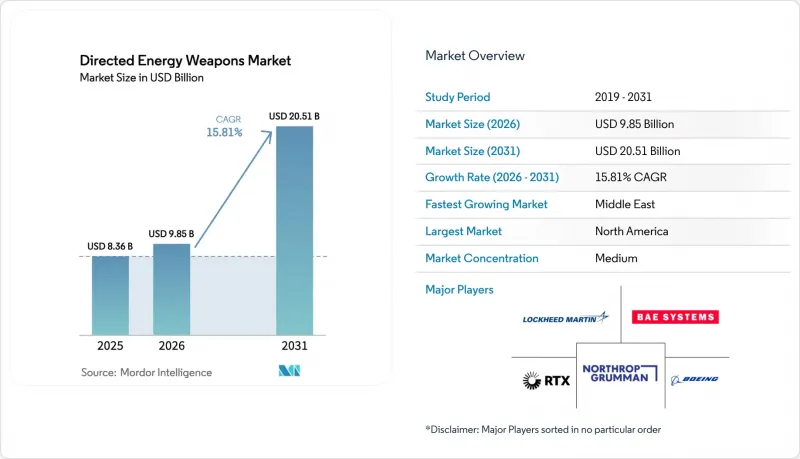
Mordor Intelligence에 의하면, 지향성 에너지 무기 시장 규모는 2025년 83억 6,000만 달러에서 2026년에는 98억 5,000만 달러로 확대되어 2026년부터 2031년까지 CAGR 15.81%로 성장을 지속하여, 2031년에는 205억 1,000만 달러에 이를 것으로 예측됩니다.
본 보고서는 유형(고에너지 레이저, 고출력 마이크로파, 입자 빔), 플랫폼(육상, 항공, 해군, 우주), 치사성(치사성, 비치사성),출력 등급(50kW 미만, 50kW 이상), 최종 사용자(육군 등), 지역(북미, 유럽, 아시아태평양, 남미, 중동 및 아프리카)별로 분류되어 있습니다. 시장 전망은 금액(달러) 기준으로 제시되어 있습니다.
전 세계 지향성 에너지 무기 시장 동향 및 인사이트
요격 미사일에 비해 HEL의 ‘발당 비용’ 측면에서의 우위
영국의 ‘드래곤파이어’ 레이저는 교전 1회당 약 10파운드(13달러)의 비용이 드는 반면, 씨 바이퍼 미사일은 100만 파운드(13억 5,000만 달러) 이상이 소요됩니다. 이 10만 배에 달하는 차이는 군함의 탄약 탑재량과 수명 주기 전반에 걸친 유지 비용에 큰 영향을 미칩니다. 2024년 홍해 순찰 작전에서 미 해군은 저비용 드론에 대응하기 위한 탄약에 10억 달러 가까이를 지출했습니다. 이는 물리적 파괴에만 의존하는 방어 전략의 경제적 지속가능성이 낮음을 여실히 보여줍니다. 현재 함대 설계 담당자들은 레이저와 요격 시스템을 병용하여 미사일을 고가치 위협 대응에 한정하도록 하고 있습니다. GaN 파워 모듈 덕분에 150kW 설계가 기존 구축함의 전력 시스템에 대응 가능한 크기로 소형화되어, 개조 결정이 가속화되고 있습니다. 실탄 시험을 통해 높은 살상 능력이 반복적으로 입증됨에 따라, 조달 당국은 고에너지 레이저를 실험 단계에서 양산 계약 단계로 전환하고 있습니다. 단기적으로는 해군에서의 도입이 가장 빠르게 진행되고 있지만, 비용 측면에 대한 검토가 진행됨에 따라 지상 및 항공 플랫폼도 그 혜택을 받게 될 것입니다.
대(對) UAS 및 초음속 위협의 확산
드론 떼는 제한된 미사일 비축량을 압도하는 한편, 극초음속 활공체는 반응 시간을 단축시키고 예측 불가능한 궤적을 교묘하게 활용합니다. 미국 공군의 THOR 고출력 마이크로파 시스템은 2024년 아프리카 작전에서 여러 대의 소형 UAS를 무력화함으로써, 광범위한 소프트 킬 능력의 확장성을 입증했습니다. 록히드 마틴사와 미사일방어국은 활공 단계에서의 요격을 목적으로 한 레이저 요격 장치를 공동 개발하고 있으며, 이는 부스트-글라이드형 무기에 대응해야 할 시급성이 높아지고 있음을 반영합니다. 중국의 ‘사일런트 헌터’ 및 ‘LW-30’ 프로그램은 유사한 능력을 공개적으로 실전 배치하고 있어, 선구자 우위를 축소시키고 전 세계적인 경쟁을 가속화하고 있습니다. 각국 군은 진화하는 위협 스펙트럼에 대응하기 위해 재장전 없이 하드 킬과 소프트 킬 효과를 전환할 수 있는 다목적 플랫폼을 점점 더 요구하고 있습니다. 교전 범위가 다양해짐에 따라 지향성 에너지는 다층적 방공 교리에서 필수적인 요소가 되고 있습니다.
대기에 의한 감쇠와 열 번짐
미국 해군 연구소가 2024년에 실시한 시험에 따르면, 습도, 먼지, 난기류는 레이저 빔의 성능을 저하시키며, 열대 연안 지역에서는 5km 거리에서 출력이 최대 50% 감소하는 것으로 밝혀졌습니다. 열 블룸은 고온 다습한 공기 속에서 빔 품질을 더욱 저하시키기 때문에 설계자들은 레이저 출력을 과대 설정하거나 치사 사거리의 단축을 감수할 수밖에 없습니다. 적응형 광학 기술은 왜곡을 어느 정도 완화하지만, 비용과 복잡성을 증가시킵니다. 이러한 취약성은 드론이나 로켓에 의한 위협의 대부분이 저고도에서 발생하는 동남아시아나 걸프 지역에서 특히 심각합니다. 따라서 지휘관들은 기상 조건으로 인해 빔 품질이 저하되더라도 사정거리를 유지할 수 있도록 레이저와 운동 에너지 요격 장치를 결합하고 있습니다. 빔 제어 소프트웨어의 지속적인 개선을 통해 물리적 한계는 완화되지만, 완전히 해소되지는 않습니다.
부문 분석
2025년, 고에너지 레이저 시스템은 지향성 에너지 무기 시장의 61.45%를 차지했습니다. 이는 파이버 레이저 및 확장 가능한 출력 모듈의 성숙과 드론, 로켓, 소형 선박에 대한 치사성 입증에 기인한 것입니다. 지향성 에너지 무기 시장에서는 통합 시험이 실전 배치로 전환됨에 따라 고체 아키텍처의 채택이 빠르게 진행되고 있습니다. 록히드 마틴이 2024년에 실시한 ‘ATHENA’ 사격 실험에서는 트럭의 엔진을 정지시키는 데 성공하여, 실험실 수준의 정밀도를 전술적으로 유효한 효과로 전환했습니다. 대조적으로, 고출력 마이크로파(HPM) 플랫폼은 단일 펄스로 물리적 파괴 없이 무리 전체를 무력화할 수 있는 전자 장비 이용 사례에 힘입어 2031년까지 연평균 성장률(CAGR) 17.50%를 나타낼 것으로 예측됩니다. ‘THOR’의 아프리카 배치에서는 레이저로는 실현할 수 없는 광범위한 커버리지가 입증되었으며, 두 시스템의 임무 프로파일이 서로 보완한다는 점이 부각되었습니다.
규제 측면의 명확성이라는 점에서는 현재로서는 레이저가 유리합니다. IEC 60825 표준에서는 안전 기준이 분류되어 있고 라이선스 발급 절차가 규정되어 있지만, HPM에 관한 동등한 표준은 여전히 존재하지 않아 국제 거래가 지연되고 있습니다. 각국 군이 교리를 정교화함에 따라, 조달 방침은 임무의 성격에 따라 나뉘고 있습니다. 즉, 정밀한 하드 킬에는 레이저가, 소프트 킬의 포화 공격에는 마이크로파가 사용되는 형태입니다. Epirus와 같은 스타트업은 펄스를 실시간으로 재구성하는 소프트웨어 정의 파형을 활용하여 이러한 격차를 메우고, HPM을 기동성이 뛰어난 대안으로 자리매김하고 있습니다. 예측 기간 동안 두 방식 모두 성장을 지속할 것으로 보이며, 레이저는 확립된 산업 공급망과 명확한 인증 절차를 바탕으로 매출에서 선두를 유지함으로써 지향성 에너지 무기 시장에서 장기적인 시장 점유율을 확보할 것으로 전망됩니다.
2025년에는 지상 시스템이 매출의 45.10%를 차지했습니다. 이는 육군이 기동형 단거리 방공을 위해 스트라이커(Striker) 및 복서(Boxer) 차량에 50kW급 레이저를 장착하고 있음을 반영합니다. 저출력 장비가 기동 여단이나 고정 기지에 보급됨에 따라 지상 플랫폼용 지향성 에너지 무기 시장 규모는 계속 확대될 것이며, 지휘관은 미사일 보급에 의존하지 않고 탄약고 재고량에 따라 사격이 가능해집니다. 해군에서의 도입은 USS 프레블 및 HMS 드래곤파이어의 성공에 힘입어 가속화되고 있습니다. 이를 통해 함정의 전력 시스템이 보조 발전기 없이도 연속적인 빔 사격을 유지할 수 있음이 입증되었습니다. 항공기 탑재형 레이저는 실용화를 향해 착실히 진전되고 있으며, SHiELD 포드를 장착한 AC-130J 건쉽은 2024년 비행 시험에서 위협을 격퇴하는 데 성공하여, 자기방어 캡슐의 실전 배치가 한 걸음 더 가까워졌습니다.
우주 기반 아키텍처는 아직 초기 단계에 있지만,DARPA의 ‘메도우랜즈’ 계획이 레이저 센서를 우주개발청(SDA)의 분산형 콘스텔레이션에 연결하여 2027년까지 전 세계적인 미사일 추적망 구축을 목표로 하고 있는 만큼, 연평균 성장률(CAGR) 18.55%를 기록할 전망입니다. 궤도상 시스템은 대기권에 의한 감쇠를 피하고 장거리 정밀 공격을 가능하게 하는 한편, 진공 상태에서의 발전 능력 한계나 열 방산 문제에 직면해 있습니다. 노스롭 그루먼사의 레이저 통신 분야 실적은 무기화를 위한 기술적 격차를 줄이는 중요한 광학 부품을 제공합니다. 방향성의 분기가 명확해지고 있습니다. 지상 시스템이 단기적인 수익을 견인하는 한편, 우주 콘셉트는 시제품 단계를 거쳐 발전하고 있으며, 2030년 이후 지향성 에너지 무기 시장에서 획기적인 시장 점유율 확대가 예상됩니다.
지역별 분석
2025년, 북미는 매출의 45.60%를 차지했습니다. 이는 미국 정부의 7억 8,970만 달러 규모의 연방 지향성 에너지 예산 배분과 록히드 마틴, RTX, 노스롭 그루먼, 제너럴 아토믹스로 구성된 산업 기반에 힘입은 결과입니다. USS 프레블호에 HELIOS를 배치하고, 육군의 DE M-SHORAD를 소량 생산함에 따라 운용 단계로의 전환이 확실해졌으며, 기술에서 실전 배치까지의 격차가 좁혀지고 있음을 보여줍니다. 캐나다는 공동 시험에 참여하고 있으며, 멕시코는 비살상형 국경 경비 용도를 연구하고 있지만, 지역 전체의 매출은 여전히 미국을 중심으로 이루어지고 있습니다. 2024년에 설립된 ‘지향성 에너지 공동 전환 사무국(Directed Energy Joint Transition Office)’에 의한 규제 개혁은 조달 주기의 단축을 목표로 하고 있으며, 이 지역의 주도적 지위를 더욱 공고히 하고 있습니다.
유럽은 각국의 노력을 통해 자율성을 추구하고 있습니다. 영국의 3억 1,600만 파운드(4억 2,657만 달러) 규모의 ‘드래곤파이어(Dragonfire)’ 양산 계약으로 2027년까지 호위함에의 통합이 확정되었습니다. 독일의 라인메탈사가 ‘복서’ 장갑차에 탑재한 레이저는 2025년 시험에서 NATO와의 상호운용성을 입증했으나, 프랑스와 이탈리아는 소규모 시제품 프로그램을 계속하고 있습니다. 러시아는 대위성 레이저 ‘페레즈베트’를 공개했으나, 실전 성능에 관한 공개 데이터는 극히 적습니다. 다양한 요건에 예산이 분산되어 있어 전반적인 규모는 제한적입니다. 그러나 유럽연합(EU)의 방위산업 이니셔티브에 따라 2027년 이후에는 수요가 통합되어, 유럽이 지향성 에너지 무기 시장의 제2의 성장 거점으로 자리매김할 가능성이 있습니다.
아시아태평양에서는 한국의 30kW ‘블록 I’ 배치와 2024년부터 2029년에 걸친 군비 증강 계획의 틀 내에서 자금을 지원받은 일본의 트럭 탑재형 레이저 시제기를 계기로 그 기세가 가속화되고 있습니다. 중국의 ‘사일런트 헌터’는 수출 의도를 보이고 있지만, 국산 대위성 레이저에 대해서는 여전히 대부분이 기밀로 분류되어 있습니다. 호주가 우메라에서 미국과 공동으로 실시한 시험과 인도의 ‘KALI’ 프로젝트는 이 지역에서 진행되고 있는 다양한 실험적 노력을 보여줍니다.
중동 및 아프리카에서는 이스라엘의 ‘아이언 빔’과 UAE의 대드론 장비 조달에 힘입어, 2026년부터 2031년까지 17.65%라는 가장 높은 연평균 성장률(CAGR)을 보일 것으로 예측됩니다. 사우디아라비아는 ‘비전 2030’에 따른 현대화의 일환으로 지향성 에너지 무기 입찰을 검토하고 있으며, 아프리카에서는 미국의 THOR 시스템이 운용되고 있어 보다 광범위한 도입을 위한 개념 증명을 제공합니다. 남미에서의 도입은 여전히 초기 단계에 있으며, 브라질과 아르헨티나는 국경 경비 방안을 검토하고 있으나 예산상의 우선순위로 인해 제약을 받고 있습니다.
기타 혜택:
- 엑셀 형식 시장 예측(ME) 시트
- 3개월간의 애널리스트 지원
자주 묻는 질문
목차
제1장 서론
제2장 조사 방법
제3장 주요 요약
제4장 시장 구도
제5장 시장 규모와 성장 예측
제6장 경쟁 구도
제7장 시장 기회와 향후 전망
JHS 26.08.26According to Mordor Intelligence, the directed energy weapons market size is expected to grow from USD 8.36 billion in 2025 to USD 9.85 billion in 2026 and is forecasted to reach USD 20.51 billion by 2031 at a 15.81% CAGR over 2026-2031.
This report is Segmented by Type (High-Energy Laser, High-Power Microwave, and Particle Beam), Platform (Land, Airborne, Naval, and Space), Lethality (Lethal, and Non-Lethal), Power Class (Less Than 50 KW, and More), End-User (Army, and More), and Geography (North America, Europe, Asia-Pacific, South America, and Middle East and Africa). The Market Forecasts are Provided in Terms of Value (USD).
Global Directed Energy Weapons Market Trends and Insights
Cost-Per-Shot Advantage of HEL Over Interceptors
The UK's DragonFire laser costs roughly GBP 10 (USD 13) per engagement compared with more than GBP 1 million (USD 1.35 billion) for a Sea Viper missile. This 100,000-fold delta transforms warship magazine depth and through-life sustainment costs. During the 2024 Red Sea patrols, the US Navy spent nearly USD 1 billion on munitions to counter low-cost drones, underscoring the unsustainable economics of a kinetic-only defense. Fleet architects now layer lasers with interceptors, reserving missiles for high-value incoming threats. GaN power modules shrink 150 kW designs into footprints compatible with existing destroyer power grids, accelerating retrofit decisions. As live-fire trials demonstrate repeatable lethality, acquisition authorities are moving high-energy lasers from experimentation into production contracts. Near-term adoption is sharpest in navies, while land and air platforms benefit as cost cases mature.
Counter-UAS and Hypersonic Threat Proliferation
Drone swarms overwhelm finite missile inventories, while hypersonic glide vehicles reduce reaction time and exploit unpredictable trajectories. The US Air Force's THOR high-power microwave system neutralized multiple small UAS in Africa during 2024 operations, proving wide-area soft-kill scalability. Lockheed Martin and the Missile Defense Agency are co-developing laser interceptors for glide-phase defeat, reflecting rising urgency to counter boost-glide vehicles. China's Silent Hunter and LW-30 programs openly field capabilities that are similar, narrowing first-mover advantages and accelerating global competition. Militaries are increasingly specifying multi-mission platforms that toggle between hard-kill and soft-kill effects without reloading, aligning with the evolving threat spectrums. As engagement envelopes diversify, directed energy becomes indispensable in layered air-defense doctrine.
Atmospheric Attenuation and Thermal Blooming
Humidity, dust, and turbulence degrade laser beams, reducing power by up to 50% at 5 km in tropical littorals, according to 2024 trials conducted by the US Naval Research Laboratory. Thermal blooming further degrades beam quality in hot, moist air, forcing designers to oversize lasers or accept shorter lethal ranges. Adaptive optics alleviates some distortion but adds cost and complexity. The vulnerability is acute in Southeast Asia and the Gulf regions, where most drone and rocket threats occur at lower altitudes. Consequently, commanders pair lasers with kinetic interceptors to maintain coverage when the weather degrades beam quality. Continuous improvement in beam-control software eases but does not eliminate the physics limits.
Other drivers and restraints analyzed in the detailed report include:
- Defense-Budget Growth and Multi-Domain Modernization
- Jammer-Immune Beams Suit Contested Electromagnetic Warfare
- Protracted Acquisition Milestones Delay Industrial Revenues
For complete list of drivers and restraints, kindly check the Table Of Contents.
Segment Analysis
High-energy laser systems captured 61.45% of the directed energy weapons market share in 2025, reflecting the maturity of fiber lasers, scalable power modules, and validated lethality against drones, rockets, and small craft. The directed energy weapons market is witnessing brisk adoption of solid-state architectures as integration tests transition into frontline deployments. Lockheed Martin's 2024 ATHENA shot disabled a truck engine, translating laboratory precision into a tactically relevant effect. In contrast, high-power microwave (HPM) platforms are projected to grow at a 17.50% CAGR through 2031, driven by counter-electronics use cases in which single pulses can disable entire swarms without physical destruction. THOR's Africa deployment demonstrated wide-area coverage that lasers cannot match, highlighting complementary mission profiles.
Regulatory clarity favors lasers for now; IEC 60825 classifies safety thresholds and outlines export licensing procedures, whereas a parallel standard for HPM remains absent, which delays international deals. As militaries refine doctrines, procurement divides along mission lines: lasers for precision hard-kill, microwaves for soft-kill saturation. Start-ups like Epirus exploit the gap with software-defined waveforms that reshape pulses in real time, positioning HPM as an agile alternative. Over the forecast horizon, both modalities expand, with lasers maintaining a revenue lead due to entrenched industrial supply chains and clearer certification pathways, thereby securing a long-term share in the directed energy weapons market.
Land systems accounted for 45.10% of revenue in 2025, reflecting armies equipping Stryker and Boxer vehicles with 50-kW-class lasers for mobile short-range air defense. The directed energy weapons market size for land platforms will continue rising as low-power units proliferate across maneuver brigades and fixed bases, offering commanders magazine-depth independent of missile resupply. Naval adoption accelerates after the successes of the USS Preble and HMS DragonFire, which proved that ship electrical grids can sustain continuous beam fire without auxiliary generators. Airborne lasers are edging toward maturity; an AC-130J gunship equipped with the SHiELD pod successfully defeated threats in 2024 flight tests, inching self-protection capsules closer to operational service.
Space-based architectures, although still in their embryonic stage, boast an 18.55% CAGR outlook as DARPA's Meadowlands links laser sensors to the Space Development Agency's proliferated constellation, targeting global missile-tracking layers by 2027. Orbital systems bypass atmospheric attenuation, promising long-range precision, yet confront power generation limits and heat rejection in a vacuum. Northrop Grumman's laser communications heritage supplies critical optics that shorten the technology bridge toward weaponization. The directional split crystallizes: terrestrial systems dominate near-term revenue while space concepts progress through prototyping, positioning the domain for disruptive share gains after 2030 in the directed energy weapons market.
Complete Report Scope:
- By Type
- High-Energy Laser
- High-Power Microwave
- Particle Beam
- By Platform
- Land
- Airborne
- Naval
- Space
- By Lethality
- Lethal
- Non-Lethal
- By Power Class
- Less than 50 kW
- 51 to 150 kW
- Greater than 150 kW
- By End-User
- Army
- Air Force
- Navy/Coast Guard
- Homeland Security and Others
- By Geography
- North America
- United States
- Canada
- Mexico
- Europe
- United Kingdom
- Germany
- France
- Italy
- Russia
- Rest of Europe
- Asia-Pacific
- China
- Japan
- India
- South Korea
- Australia
- Rest of Asia-Pacific
- South America
- Brazil
- Argentina
- Rest of South America
- Middle East and Africa
- Middle East
- Israel
- Turkey
- Saudi Arabia
- United Arab Emirates
- Rest of Middle East
- Africa
- South Africa
- Rest of Africa
- Middle East
- North America
Geography Analysis
North America retained 45.60% of the revenue in 2025, anchored by the US's USD 789.7 million federal directed-energy allocation and an industrial base comprising Lockheed Martin, RTX, Northrop Grumman, and General Atomics. USS Preble's HELIOS deployment and Army DE M-SHORAD low-rate production confirm operational transition, reducing the technology-to-fielding gap. Canada participates in joint trials, and Mexico studies non-lethal border applications, yet overall regional revenue remains US-centric. Regulatory reform through the Directed Energy Joint Transition Office, formed in 2024, aims to shorten acquisition cycles, further entrenching the region's lead.
Europe pursues autonomy through national efforts. The UK's GBP 316 million (USD 426.57 million) DragonFire production award secures frigate integration by 2027. Germany's Rheinmetall laser on Boxer vehicles proved NATO interoperability in 2025 trials, while France and Italy continue smaller prototype programs. Russia publicizes the Peresvet anti-satellite laser, but with minimal open data on field performance. Budget dispersion across disparate requirements tempers collective scale; however, European Union defense-industrial initiatives could consolidate demand post-2027, positioning Europe as a secondary growth pole inside the directed energy weapons market.
Asia-Pacific momentum builds on South Korea's 30 kW Block-I deployment and Japan's truck-mounted laser prototypes funded within the 2024-2029 buildup. China's Silent Hunter showcases export intent, while indigenous anti-satellite lasers remain broadly classified. Australia's joint US testing at Woomera and India's KALI project illustrate the region's diverse experimentation.
The Middle East and Africa are expected to register the highest CAGR of 17.65% from 2026 to 2031, driven by Israel's Iron Beam and the UAE's counter-drone procurements. Saudi Arabia evaluates directed-energy bids as part of its Vision 2030 modernization, and US THOR systems operate in Africa, providing proof of concept for broader adoption. South American uptake remains nascent, with Brazil and Argentina studying border security options but constrained by budget priorities.
- Lockheed Martin Corporation
- RTX Corporation
- Northrop Grumman Corporation
- BAE Systems plc
- The Boeing Company
- Rheinmetall AG
- MBDA
- Rafael Advanced Defense Systems Ltd.
- Honeywell International Inc.
- L3Harris Technologies, Inc.
- Elbit Systems Ltd.
- QinetiQ Group
- General Atomics
- Thales Group
- Leonardo S.p.A
- Kratos Defense & Security Solutions, Inc.
- Dynetics (Leidos, Inc.)
Additional Benefits:
- The market estimate (ME) sheet in Excel format
- 3 months of analyst support
TABLE OF CONTENTS
1 INTRODUCTION
- 1.1 Study Assumptions and Market Definition
- 1.2 Scope of the Study
2 RESEARCH METHODOLOGY
3 EXECUTIVE SUMMARY
4 MARKET LANDSCAPE
- 4.1 Market Overview
- 4.2 Market Drivers
- 4.2.1 Cost-per-shot advantage of HEL over interceptors
- 4.2.2 Counter-UAS and hypersonic threat proliferation
- 4.2.3 Defense-budget growth and multi-domain modernization
- 4.2.4 Jammer-immune beams suit contested electromagnetic warfare
- 4.2.5 GaN electronics enable compact 150-kilowatt weapons
- 4.2.6 Successful naval tests accelerate laser procurement cycles
- 4.3 Market Restraints
- 4.3.1 Atmospheric attenuation and thermal blooming
- 4.3.2 Protracted acquisition milestones delay industrial revenues
- 4.3.3 Legal ambiguities constrain export and battlefield deployment
- 4.3.4 Rare-earth supply shocks escalate optical component costs
- 4.4 Value Chain Analysis
- 4.5 Regulatory Landscape
- 4.6 Technological Outlook
- 4.7 Porter's Five Forces Analysis
- 4.7.1 Bargaining Power of Suppliers
- 4.7.2 Bargaining Power of Buyers/Consumers
- 4.7.3 Threat of New Entrants
- 4.7.4 Threat of Substitute Products
- 4.7.5 Intensity of Competitive Rivalry
5 MARKET SIZE AND GROWTH FORECASTS (VALUE)
- 5.1 By Type
- 5.1.1 High-Energy Laser
- 5.1.2 High-Power Microwave
- 5.1.3 Particle Beam
- 5.2 By Platform
- 5.2.1 Land
- 5.2.2 Airborne
- 5.2.3 Naval
- 5.2.4 Space
- 5.3 By Lethality
- 5.3.1 Lethal
- 5.3.2 Non-Lethal
- 5.4 By Power Class
- 5.4.1 Less than 50 kW
- 5.4.2 51 to 150 kW
- 5.4.3 Greater than 150 kW
- 5.5 By End-User
- 5.5.1 Army
- 5.5.2 Air Force
- 5.5.3 Navy/Coast Guard
- 5.5.4 Homeland Security and Others
- 5.6 By Geography
- 5.6.1 North America
- 5.6.1.1 United States
- 5.6.1.2 Canada
- 5.6.1.3 Mexico
- 5.6.2 Europe
- 5.6.2.1 United Kingdom
- 5.6.2.2 Germany
- 5.6.2.3 France
- 5.6.2.4 Italy
- 5.6.2.5 Russia
- 5.6.2.6 Rest of Europe
- 5.6.3 Asia-Pacific
- 5.6.3.1 China
- 5.6.3.2 Japan
- 5.6.3.3 India
- 5.6.3.4 South Korea
- 5.6.3.5 Australia
- 5.6.3.6 Rest of Asia-Pacific
- 5.6.4 South America
- 5.6.4.1 Brazil
- 5.6.4.2 Argentina
- 5.6.4.3 Rest of South America
- 5.6.5 Middle East and Africa
- 5.6.5.1 Middle East
- 5.6.5.1.1 Israel
- 5.6.5.1.2 Turkey
- 5.6.5.1.3 Saudi Arabia
- 5.6.5.1.4 United Arab Emirates
- 5.6.5.1.5 Rest of Middle East
- 5.6.5.2 Africa
- 5.6.5.2.1 South Africa
- 5.6.5.2.2 Rest of Africa
- 5.6.5.1 Middle East
- 5.6.1 North America
6 COMPETITIVE LANDSCAPE
- 6.1 Market Concentration
- 6.2 Strategic Moves
- 6.3 Market Share Analysis
- 6.4 Company Profiles (includes Global level Overview, Market level overview, Core Segments, Financials, Strategic Info, Market Rank/Share, Products and Services, Recent Developments)
- 6.4.1 Lockheed Martin Corporation
- 6.4.2 RTX Corporation
- 6.4.3 Northrop Grumman Corporation
- 6.4.4 BAE Systems plc
- 6.4.5 The Boeing Company
- 6.4.6 Rheinmetall AG
- 6.4.7 MBDA
- 6.4.8 Rafael Advanced Defense Systems Ltd.
- 6.4.9 Honeywell International Inc.
- 6.4.10 L3Harris Technologies, Inc.
- 6.4.11 Elbit Systems Ltd.
- 6.4.12 QinetiQ Group
- 6.4.13 General Atomics
- 6.4.14 Thales Group
- 6.4.15 Leonardo S.p.A
- 6.4.16 Kratos Defense & Security Solutions, Inc.
- 6.4.17 Dynetics (Leidos, Inc.)
7 MARKET OPPORTUNITIES AND FUTURE OUTLOOK
- 7.1 White-space and Unmet-Need Assessment


