

|
시장보고서
상품코드
2115142
디지털 그래픽 인쇄 시장 : 점유율 분석, 업계 동향과 통계, 성장 예측(2026-2031년)Digital Graphic Printing - Market Share Analysis, Industry Trends & Statistics, Growth Forecasts (2026 - 2031) |
||||||
 Mordor Intelligence
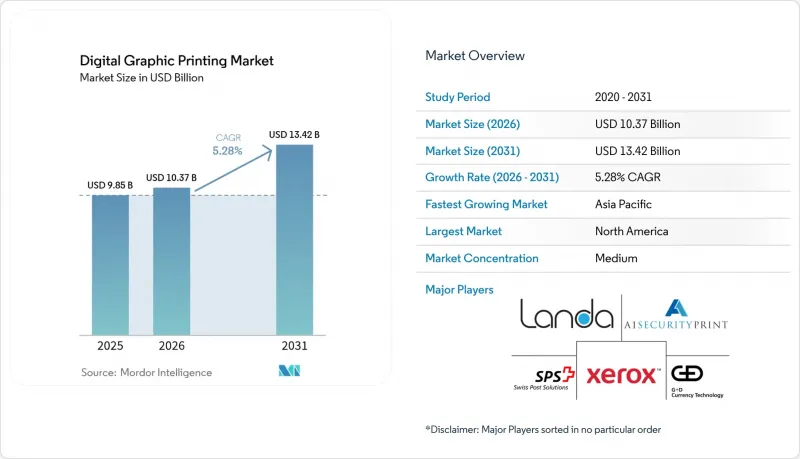
Mordor Intelligence에 의하면, 디지털 그래픽 인쇄 시장 규모는 2025년 98억 5,000만 달러에서 2026년에는 103억 7,000만 달러로 확대되어 2026년부터 2031년까지 CAGR 5.28%로 성장을 지속하여, 2031년에는 134억 2,000만 달러에 이를 것으로 예측됩니다.
본 보고서는 인쇄 공정(잉크젯, 전자사진법, 승화형),용도(광고 인쇄, 트랜잭션 인쇄, 보안 인쇄, 패키징 등), 잉크 유형(UV 경화 잉크, 수성 잉크, 용제 잉크, 라텍스 잉크, 승화형 잉크 등), 인쇄 소재(종이 등), 지역별로 분류되어 있습니다. 시장 예측은 금액(미 달러) 단위로 제시되어 있습니다.
세계 디지털 그래픽 인쇄 시장 동향 및 인사이트
소량 포장 수요 증가
이커머스 및 D2C(소비자 직접 판매) 브랜드로 인해 접이식 상자 및 연포장재의 경제적 최소 주문 수량이 감소하고 있으며, 500개 미만의 주문에서는 디지털 인쇄가 유일하게 비용 대비 효과가 높은 방법이 되고 있습니다. 란다(Randa)사의 ‘S11 Nanographic’ 인쇄기는 옵션인 인라인 코팅 기능을 통해 시간당 11,200매의 생산 능력을 실현하고 있으며, 이를 통해 가공 업체는 기존의 아날로그 라인으로는 경쟁할 수 없는 마이크로 배치에서 수익을 창출할 수 있게 되었습니다. 한정판 출시에는 신속한 디자인 반복과 시장 테스트가 요구됨에 따라, 수성이며 식품 안전 기준을 충족하는 잉크를 사용하고 월간 생산 능력 100만 B1 시트 이상을 목표로 하는 Durst사의 VariJET 106과 같은 인쇄기의 도입이 확대되고 있습니다. 또한 소매업체들은 재고 관리 기준을 엄격화하고 있으며, 공급업체들에게 과잉 재고를 창고에 보관하지 말고 주문형 생산을 실시할 것을 요구하고 있습니다. 유럽연합(EU)의 ‘포장 및 포장 폐기물에 관한 규정 2025/40’은 컨버터에게 재활용 가능성 기준을 달성할 것을 의무화하고 있어, 지속 가능하고 적시 생산(JIT) 방식에서 디지털 기술의 적합성이 더욱 높아지고 있습니다.
잉크젯 기술의 보급 확대
새로운 잉크가 코팅된 기판에 직접 고정되어 고가의 프라이머가 불필요해짐에 따라, 산업용 잉크젯이 주류가 되었습니다. SCREEN사의 ‘Truepress JET 560HDX’는 고밀도 SC2 잉크와 560mm 웹을 결합하여 분당 150미터의 처리량을 유지하면서도 오프셋 인쇄에 필적하는 품질을 실현하고 있습니다. 2024년에 출시된 캐논의 ‘varioPRESS iV7’은 시간당 3,000장의 B2 사이즈 시트를 처리할 수 있어, 접이식 상자 인쇄 업체는 생산성을 저하시키지 않고 아날로그 설비의 생산 능력을 대체할 수 있게 되었습니다. 코니카미놀타의 ‘AccurioJet 60000’은 하이브리드 워크플로우에 원활하게 통합되어, 장폭 작업은 오프셋 인쇄로, 단폭 작업은 디지털 인쇄로 분배함으로써 최적의 총 소유 비용을 실현합니다. 후지필름의 ‘REVORIA PRESS GC12500’은 특수한 메탈릭 컬러와 형광색을 추가함으로써 토너 기반의 선택지를 확대되고 있습니다. 이는 잉크젯이 여전히 뒤처져 있는 틈새 분야입니다. 구매자들이 화학적 특성, 소재와의 호환성, 자동화를 신중하게 검토하는 가운데, 경쟁의 초점은 단순한 처리 속도에서 워크플로우 전반의 효율성으로 이동하고 있습니다.
높은 초기 투자 비용
B1 규격의 잉크젯 인쇄기는 200만 달러를 초과하는 경우도 있어, 안정적인 인쇄 물량을 확보하기 어려운 중소규모 가공업체에게는 장벽이 되고 있습니다. 7색 세트와 11K 스피드 모듈을 탑재한 란다(Randa)사의 ‘S11P’는 자본 집약형의 전형적인 예라고 할 수 있습니다. 소유자는 워크플로우 소프트웨어, 색상 관리 및 교육에도 자금을 투자해야 하며, 이로 인해 총 소유 비용이 20-30% 더 추가되기 때문입니다. 하이브리드 방식을 통한 사후 도입이 부담을 덜어주고 있습니다. 도미노사의 ‘N610i-R’은 풀 프레스 비용의 불과 몇 분의 1로 기존 아날로그 라인에 잉크젯 기능을 통합할 수 있습니다. 하이델베르크사의 ‘Jetfire’ 유닛은 Speedmaster 플랫폼에 직접 장착할 수 있어, 인쇄업자는 기존 설비를 폐기하지 않고도 소량 생산에 대응할 수 있습니다. 출력 기반의 리스 모델은 지출을 자본 지출에서 운영비로 전환하지만, 북미 및 서유럽 이외 지역에서의 도입은 여전히 제한적입니다.
부문 분석
2025년, 잉크젯은 디지털 그래픽 인쇄 시장의 62.88% 점유율을 차지하며 상업 인쇄, 라벨, 패키징 각 부문에서 우위를 차지했습니다. 스크린(Screen)사의 ‘Truepress JET 560HDX’와 캐논(Canon)사의 ‘varioPRESS iV7’이 경쟁력 있는 속도로 코팅지에 직접 인쇄를 가능하게 함에 따라, 잉크젯 인쇄기를 이용한 디지털 그래픽 인쇄 시장 규모는 꾸준히 확대될 것으로 예측됩니다. 이러한 플랫폼은 전환 작업을 효율화하여, 컨버터가 오프셋 인쇄에 일반적으로 수반되는 설정 비용을 부담하지 않고도 SKU 증가에 대응할 수 있게 해줍니다. 현재 생산 경제성 측면에서는 5,000매 미만의 인쇄 로트에서 잉크젯이 유리하며, 이 범위의 주문이 총 인쇄 수주량에서 차지하는 비중이 증가하고 있습니다. 또한, 작업자들은 인라인 품질 관리 카메라와 자동 노즐 보정 기능을 높이 평가하고 있으며, 이러한 기능들은 폐기물 감소와 가동률 향상에 기여하고 있습니다.
승화형 인쇄는 텍스타일 및 소프트 사이니지에 대한 수요에 힘입어 2031년까지 연평균 성장률(CAGR) 6.18%라는 견실한 성장세를 보이고 있습니다. 엡손의 ‘SureColor F11070H’는 6색 고밀도 잉크와 재순환식 프린트 헤드를 채택하여 시간당 255제곱미터의 처리 능력을 실현하고 있습니다. 이를 통해 의류 제조업체는 재고를 최소화하면서 패스트 패션의 사이클에 대응할 수 있게 됩니다. 미마키의 ‘TRAPIS’는 전사지 제조와 승화 인쇄를 하나의 본체에 통합하여, 소규모 매장에서도 설치 공간과 광열비를 절감할 수 있게 해줍니다. 전자사진 기술은 특수 토너 효과(메탈릭, 형광, 흰색 등)가 고급 팸플릿이나 화장품 상자와 같은 고부가가치 용도를 주도하는 분야에서 여전히 중요한 역할을 하고 있습니다. 후지필름의 ‘REVORIA PRESS GC12500’은 토너의 색 영역을 확대하여 잉크젯이 가진 풍부한 그래픽 표현이라는 강점에 대항하는 동시에, 더 두꺼운 미디어까지 지원합니다.
패키징은 소비자에게 직접 배송하는 추세와 추적 가능한 온디맨드 라벨을 의무화하는 엄격한 식품 안전 규제의 뒷받침을 받아 연평균 성장률(CAGR) 6.62%를 기록하며 가장 빠르게 성장하는 용도로 부상하고 있습니다. 각 컨버터 업체들은 수성 잉크젯과 인라인 플렉소닉스를 통합한 Durst사의 ‘VariJET 106’과 같은 하이브리드 라인을 도입하여, 소량 생산의 경제성과 고출력에서의 신뢰성을 모두 활용하고 있습니다. EFI사의 ‘Nozomi 14000 AQ’는 싱글 패스 인쇄 기능을 골판지 포장에 확장하여, 폭 최대 1.4미터의 기판에 분당 300상자를 인쇄합니다. 이러한 발전은 운송 비용을 절감하고 완충재를 제거하는 ‘적정 크기 포장’에 대한 소매업체의 관심과 부합합니다.
광고 인쇄는 2025년에 28.10%의 점유율을 차지했으나, 각 브랜드가 예산을 디지털 미디어로 전환함에 따라 그 성장세는 정체되고 있습니다. 다이나믹 LED 스크린이 와이드 포맷 배너나 POS 디스플레이를 대체하고 있지만, 물리적 존재감이 필요한 단기 캠페인에서는 와이드 포맷 잉크젯이 여전히 필수적입니다. 라텍스 잉크와 UV 잉크는 가스 방출이 없고 신속한 설치가 가능해 실내 소매 환경에서 강점을 발휘합니다. 보안 인쇄는 틈새 시장이지만, 디지털 기술의 가변 데이터 인쇄 기능을 통해 위조를 방지하고 있습니다. 쾨니히 앤 바우어(Konig & Bauer)사의 ‘STEGANO’ 워터마크 기술은 화폐나 신분증에 기계 판독이 가능한 코드를 도입하고 있습니다. 거래 명세서는 금융 기관이 종이 명세서 제공을 의무화하고 있기 때문에 계속해서 사용되고 있으며, 현재는 맞춤형 제안이 포함되어 규정 준수 및 마케팅 목표가 융합되고 있습니다.
지역별 분석
2025년, 북미는 디지털 그래픽 인쇄 시장 매출의 39.70%를 차지하고 있으며, 이는 HP, 캐논, 제록스의 확고한 도입 기반에 힘입은 것입니다. 미국의 컨버터들은 재무제표, 직접 메일,단기 납기 접이식 상자에 가변 데이터 기능을 활용하는 반면, 캐나다와 멕시코의 공장들은 국경을 넘는 공급망을 지원하기 위해 라벨 생산 능력을 확대되고 있습니다. 많은 대형 인쇄업체들이 대량 생산 부문에서 아날로그에서 디지털로의 전환을 완료함에 따라 성장은 둔화되고 있습니다. 제록스가 2024년에 iGen5 토너 생산에서 철수하고 스크린(Screen)사의 잉크젯 기술로 전환한 것은 장당 비용 절감과 더 폭넓은 소재 대응을 위한 전략적 전환을 여실히 보여줍니다.
아시아태평양은 2031년까지 연평균 성장률(CAGR) 7.68%를 나타낼 것으로 예측되며, 이는 다른 어느 지역보다 빠른 속도입니다. ‘China Print 2025’에서 HP는 ‘Indigo 120K HD’를 발표하며, 중국 및 인도의 컨버터들이 생산 능력을 확충할 수 있을 것이라는 자신감을 나타냈습니다. 중국 연안 지역의 인건비 급등으로 인해 AI를 활용한 자동화가 주목받고 있는 반면, 인도의 소비재 시장 확대는 하이브리드형 잉크젯·플렉소 라인이 확보할 수 있는 패키징 수요를 견인하고 있습니다. 국내 인쇄량이 감소하고 있는 일본의 인쇄업체들은 틈새 시장인 수출용 소량 생산에 대응하기 위해 디지털 인쇄와 오프셋 인쇄를 융합하고 있으며, 코니카미놀타의 ‘AccurioJet 60000’은 워크플로우와의 원활한 통합을 목적으로 설계되었습니다. 한국과 호주에서는 패스트 패션의 주기에 대응하고 물 사용량을 줄이기 위해 원단에 직접 인쇄(DTP) 시스템이 도입되고 있습니다.
유럽에서는 ‘포장 및 포장 폐기물에 관한 규정 2025/40’ 등 더욱 엄격한 지속가능성 관련 규제의 영향으로 발전이 이루어지고 있습니다. 이 규정은 주문형 생산과 재활용 가능한 소재를 권장하고 있습니다. 독일, 영국, 프랑스, 이탈리아, 스페인은 라벨, 골판지, 보안 인쇄에 대한 수요가 높아 이들 국가가 시장을 독점하고 있습니다. 하이델베르크의 ‘Prinect Touch Free’ 워크플로는 오프셋과 디지털 간 작업을 자동으로 배분함으로써 혼합 설비군 전체의 자산 활용률을 향상시킵니다. 가공업체들은 환경 표시 관련 유럽 지침 2024/825를 준수하는 수성 잉크 및 라텍스 잉크로의 전환을 추진하고 있습니다. 남미, 중동 및 아프리카 시장 규모는 작지만 성장하고 있으며, 브라질에서는 음료 브랜드를 대상으로 디지털 라벨 인쇄기가 도입되고, 아랍에미리트에서는 보안 여권 생산에 투자가 이루어지고 있습니다.
기타 혜택:
- 엑셀 형식 시장 예측(ME) 시트
- 3개월간의 애널리스트 지원
자주 묻는 질문
목차
제1장 서론
제2장 조사 방법
제3장 주요 요약
제4장 시장 구도
제5장 시장 규모와 성장 예측
제6장 경쟁 구도
제7장 시장 기회와 향후 전망
JHS 26.08.26According to Mordor Intelligence, the digital graphic printing market size is expected to grow from USD 9.85 billion in 2025 to USD 10.37 billion in 2026 and is forecast to reach USD 13.42 billion by 2031 at 5.28% CAGR over 2026-2031.
This report is Segmented by Printing Process (Inkjet, Electrophotography, Dye-Sublimation), Application (Advertising Print, Transactional Printing, Security Printing, Packaging, and More), Ink Type (UV-Cured Ink, Aqueous Ink, Solvent Ink, Latex Ink, Dye-Sublimation Ink, and More), Substrate Material (Paper, and More), and Geography. The Market Forecasts are Provided in Terms of Value (USD).
Global Digital Graphic Printing Market Trends and Insights
Growing Demand for Short-Run Packaging
E-commerce and direct-to-consumer brands have reduced the economic run length for folding cartons and flexible packaging, making digital the only cost-effective method for orders below 500 units. Landa's S11 Nanographic press reaches 11,200 sheets per hour with optional in-line coating, allowing converters to profit from micro-batches that analog lines cannot serve competitively. Limited-edition launches now require rapid design iterations and market testing, boosting adoption of presses such as Durst's VariJET 106, which uses water-based, food-safe inks and targets monthly capacities exceeding 1 million B1 sheets. Retailers are also tightening inventory mandates, pushing suppliers to manufacture on demand rather than warehouse excess stock. The European Union's Packaging and Packaging Waste Regulation 2025/40 obliges converters to hit recyclability metrics, reinforcing digital's suitability for sustainable, just-in-time production.
Rising Adoption of Inkjet Technology
Industrial inkjet has become mainstream as new inks bond directly to coated substrates, eliminating the need for costly primers. SCREEN's Truepress JET 560HDX pairs high-density SC2 inks with a 560mm web to rival offset quality while maintaining a throughput of 150 meters per minute. Canon's varioPRESS iV7, launched in 2024, delivers 3,000 B2 sheets per hour, enabling folding-carton printers to replace analog capacity without compromising productivity.. Konica Minolta's AccurioJet 60000 integrates seamlessly into hybrid workflows, routing long jobs to offset and short jobs to digital for optimal cost of ownership. Fujifilm's REVORIA PRESS GC12500 broadens toner-based options by adding specialty metallic and fluorescent colors, a niche where inkjet still trails. As buyers weigh chemistry, substrate compatibility, and automation, the competitive playing field is shifting from raw speed to holistic workflow efficiency.
High Initial Capital Investment
A B1-format inkjet press can exceed USD 2 million, deterring small and mid-size converters that lack assured volume commitments. Landa's S11P, equipped with a seven-color set and 11K speed module, typifies capital intensity because owners must also fund workflow software, color management, and training, adding another 20-30% to ownership cost. Hybrid retrofits are easing the burden, Domino's N610i-R inserts inkjet into existing analog lines at a fraction of full-press cost. Heidelberg's Jetfire units bolt onto Speedmaster platforms, letting printers tackle short runs without scrapping legacy equipment. Output-based leasing models shift spending from capital to operating expense, yet adoption is still limited outside North America and Western Europe.
Other drivers and restraints analyzed in the detailed report include:
- Shift Toward Personalization in Marketing Materials
- Increasing Use of UV-Cured Inks in Label Printing
- Volatility in Raw Material Prices for Specialty Inks
For complete list of drivers and restraints, kindly check the Table Of Contents.
Segment Analysis
Inkjet captured 62.88% of the Digital Graphic Printing market share in 2025, illustrating its dominance across commercial, label, and packaging segments. The Digital Graphic Printing market size attributed to inkjet presses is projected to climb steadily as SCREEN's Truepress JET 560HDX and Canon's varioPRESS iV7 promote direct printing on coated substrates at competitive speeds. These platforms streamline changeovers, enabling converters to manage SKU proliferation without incurring the setup costs typically associated with offset printing. Production economics now favor inkjet for runs under 5,000 sheets, a range that accounts for an increasing share of total print orders. Operators also appreciate inline quality control cameras and automated nozzle compensation, which reduce waste and improve uptime.
Dye-sublimation is advancing at a robust 6.18% CAGR through 2031, driven by demand for textiles and soft signage. Epson's SureColor F11070H utilizes six-color high-density inks and recirculating printheads to achieve a throughput of 255 square meters per hour, enabling apparel makers to fulfill fast-fashion cycles with minimal inventory. Mimaki's TRAPIS consolidates transfer-paper production and sublimation into one chassis, shrinking footprint and utility consumption for smaller shops. Electrophotography remains relevant where specialty toner effects, metallic, fluorescent, white, drive high-value applications such as premium brochures and cosmetics cartons. Fujifilm's REVORIA PRESS GC12500 extends toner's color gamut, contesting inkjet's edge in graphic richness while offering thicker media support.
Packaging emerged as the fastest-growing application, with a 6.62% CAGR outlook, driven by direct-to-consumer shipping dynamics and stringent food safety regulations that require traceable, on-demand labeling. Converters are installing hybrid lines, such as Durst's VariJET 106, which integrates water-based inkjet and inline flexo varnish, to exploit both short-run economics and high-output reliability. EFI's Nozomi 14000 AQ extends single-pass capability to corrugated packaging, printing 300 boxes per minute on substrates up to 1.4 meters wide. These advances align with retailers' interest in right-sized packaging that cuts freight cost and eliminates void fill.
Advertising print commanded a 28.10% share in 2025 but is plateauing as brands reallocate budgets to digital media. Dynamic LED screens are replacing wide-format banners and point-of-purchase displays, yet wide-format inkjet remains critical for short-lived campaigns where physical presence is necessary. Latex and UV inks enable quick installation without off-gassing, an edge for indoor retail environments. Security printing is a niche where digital's variable-data capability thwarts counterfeiting; Koenig and Bauer's STEGANO watermarking introduces machine-readable codes into currency and ID documents. Transactional statements persist because financial institutions must provide hard-copy bills, and they now embed personalized offers, merging compliance with marketing goals.
Complete Report Scope:
- By Printing Process
- Inkjet
- Electrophotography
- Dye-Sublimation
- By Application
- Advertising Print
- Transactional Printing
- Security Printing
- Packaging
- Other Applications
- By Ink Type
- UV-Cured Ink
- Aqueous Ink
- Solvent Ink
- Latex Ink
- Dye-Sublimation Ink
- Other Ink Types
- By Substrate Material
- Paper
- Plastic / Film
- Fabric / Textile
- Other Substrate Materials
- By Geography
- North America
- United States
- Canada
- Mexico
- South America
- Brazil
- Argentina
- Chile
- Rest of South America
- Europe
- United Kingdom
- Germany
- France
- Italy
- Spain
- Rest of Europe
- Asia-Pacific
- China
- Japan
- India
- South Korea
- Australia and New Zealand
- Rest of Asia-Pacific
- Middle East and Africa
- Middle East
- United Arab Emirates
- Saudi Arabia
- Turkey
- Rest of Middle East
- Africa
- South Africa
- Kenya
- Nigeria
- Rest of Africa
- Middle East
- North America
Geography Analysis
North America held 39.70% of Digital Graphic Printing market revenue in 2025, anchored by established installed bases from HP, Canon, and Xerox. U.S. converters leverage variable-data capability for financial statements, direct mail, and short-run folding cartons while Canadian and Mexican plants expand label capacity to service cross-border supply chains. Growth is moderating because many large printers have completed analog-to-digital conversions in high-volume segments. Xerox's 2024 exit from iGen5 toner production and pivot to Screen inkjet technology illustrates the strategic shift toward lower cost per impression and broader substrate compatibility.
Asia-Pacific is forecast to advance at an 7.68% CAGR to 2031, the fastest of any region. China Print 2025 saw HP unveil the Indigo 120K HD, signaling confidence in Chinese and Indian converters upgrading capacity. Rising labor costs in coastal China make AI-driven automation attractive, while India's consumer-goods expansion fuels packaging demand that hybrid inkjet-flexo lines can capture. Japan's printers, facing shrinking domestic volumes, are blending digital and offset to serve niche export runs, with Konica Minolta's AccurioJet 60000 designed for seamless workflow integration. South Korea and Australia are deploying direct-to-fabric textile systems to meet fast-fashion cycles and reduce water consumption.
Europe is advancing under stricter sustainability mandates such as Packaging and Packaging Waste Regulation 2025/40, which favors on-demand production and recyclable materials. Germany, the United Kingdom, France, Italy, and Spain collectively dominate because of high demand for labels, cartons, and security printing. Heidelberg's Prinect Touch Free workflow automatically routes jobs between offset and digital, improving asset utilization across mixed fleets. Converters are shifting toward water-based and latex inks that meet European Directive 2024/825 on green claims. South America, the Middle East, and Africa are smaller but growing, with Brazil adopting digital label presses for beverage brands and the United Arab Emirates investing in secure passport production.
- Canon Inc.
- Xerox Holdings Corporation
- HP Inc.
- Ricoh Company Ltd.
- Konica Minolta Inc.
- Fujifilm Holdings Corporation
- Seiko Epson Corporation
- Durst Phototechnik AG
- Electronics For Imaging Inc.
- Agfa-Gevaert NV
- Landa Corporation Ltd.
- Screen Holdings Co. Ltd.
- Inca Digital Printers Ltd.
- Heidelberg Druckmaschinen AG
- Koenig and Bauer AG
- Kyocera Document Solutions Inc.
- Giesecke+Devrient Currency Technology GmbH
- A1 Security Print Ltd.
- Madras Security Printers Private Limited
- Swiss Post Solutions AG
Additional Benefits:
- The market estimate (ME) sheet in Excel format
- 3 months of analyst support
TABLE OF CONTENTS
1 INTRODUCTION
- 1.1 Study Assumptions and Market Definition
- 1.2 Scope of the Study
2 RESEARCH METHODOLOGY
3 EXECUTIVE SUMMARY
4 MARKET LANDSCAPE
- 4.1 Market Overview
- 4.2 Market Drivers
- 4.2.1 Growing Demand for Short-Run Packaging
- 4.2.2 Rising Adoption of Inkjet Technology
- 4.2.3 Shift Toward Personalization in Marketing Materials
- 4.2.4 Increasing Use of UV-Cured Inks in Label Printing
- 4.2.5 Emergence of Hybrid Analog-Digital Press Retrofits
- 4.2.6 Brand Mandates for Carbon Footprint Reporting on Printed Goods
- 4.3 Market Restraints
- 4.3.1 High Initial Capital Investment
- 4.3.2 Volatility in Raw Material Prices for Specialty Inks
- 4.3.3 Competitive Price Pressures From Offset Printing in High Volume Runs
- 4.3.4 Rising Regulatory Scrutiny on Nanoparticle Emissions From Inkjet Nozzles
- 4.4 Industry Value Chain Analysis
- 4.5 Regulatory Landscape
- 4.6 Technological Outlook
- 4.7 Impact of Macroeconomic Factors on the Market
- 4.8 Porter's Five Forces Analysis
- 4.8.1 Threat of New Entrants
- 4.8.2 Bargaining Power of Buyers/Consumers
- 4.8.3 Bargaining Power of Suppliers
- 4.8.4 Threat of Substitute Products
- 4.8.5 Intensity of Competitive Rivalry
5 MARKET SIZE AND GROWTH FORECASTS (VALUE)
- 5.1 By Printing Process
- 5.1.1 Inkjet
- 5.1.2 Electrophotography
- 5.1.3 Dye-Sublimation
- 5.2 By Application
- 5.2.1 Advertising Print
- 5.2.2 Transactional Printing
- 5.2.3 Security Printing
- 5.2.4 Packaging
- 5.2.5 Other Applications
- 5.3 By Ink Type
- 5.3.1 UV-Cured Ink
- 5.3.2 Aqueous Ink
- 5.3.3 Solvent Ink
- 5.3.4 Latex Ink
- 5.3.5 Dye-Sublimation Ink
- 5.3.6 Other Ink Types
- 5.4 By Substrate Material
- 5.4.1 Paper
- 5.4.2 Plastic / Film
- 5.4.3 Fabric / Textile
- 5.4.4 Other Substrate Materials
- 5.5 By Geography
- 5.5.1 North America
- 5.5.1.1 United States
- 5.5.1.2 Canada
- 5.5.1.3 Mexico
- 5.5.2 South America
- 5.5.2.1 Brazil
- 5.5.2.2 Argentina
- 5.5.2.3 Chile
- 5.5.2.4 Rest of South America
- 5.5.3 Europe
- 5.5.3.1 United Kingdom
- 5.5.3.2 Germany
- 5.5.3.3 France
- 5.5.3.4 Italy
- 5.5.3.5 Spain
- 5.5.3.6 Rest of Europe
- 5.5.4 Asia-Pacific
- 5.5.4.1 China
- 5.5.4.2 Japan
- 5.5.4.3 India
- 5.5.4.4 South Korea
- 5.5.4.5 Australia and New Zealand
- 5.5.4.6 Rest of Asia-Pacific
- 5.5.5 Middle East and Africa
- 5.5.5.1 Middle East
- 5.5.5.1.1 United Arab Emirates
- 5.5.5.1.2 Saudi Arabia
- 5.5.5.1.3 Turkey
- 5.5.5.1.4 Rest of Middle East
- 5.5.5.2 Africa
- 5.5.5.2.1 South Africa
- 5.5.5.2.2 Kenya
- 5.5.5.2.3 Nigeria
- 5.5.5.2.4 Rest of Africa
- 5.5.5.1 Middle East
- 5.5.1 North America
6 COMPETITIVE LANDSCAPE
- 6.1 Market Concentration
- 6.2 Strategic Moves
- 6.3 Market Share Analysis
- 6.4 Company Profiles (includes Global level Overview, Market level overview, Core Segments, Financials as available, Strategic Information, Market Rank/Share for key companies, Products and Services, and Recent Developments)
- 6.4.1 Canon Inc.
- 6.4.2 Xerox Holdings Corporation
- 6.4.3 HP Inc.
- 6.4.4 Ricoh Company Ltd.
- 6.4.5 Konica Minolta Inc.
- 6.4.6 Fujifilm Holdings Corporation
- 6.4.7 Seiko Epson Corporation
- 6.4.8 Durst Phototechnik AG
- 6.4.9 Electronics For Imaging Inc.
- 6.4.10 Agfa-Gevaert NV
- 6.4.11 Landa Corporation Ltd.
- 6.4.12 Screen Holdings Co. Ltd.
- 6.4.13 Inca Digital Printers Ltd.
- 6.4.14 Heidelberg Druckmaschinen AG
- 6.4.15 Koenig and Bauer AG
- 6.4.16 Kyocera Document Solutions Inc.
- 6.4.17 Giesecke+Devrient Currency Technology GmbH
- 6.4.18 A1 Security Print Ltd.
- 6.4.19 Madras Security Printers Private Limited
- 6.4.20 Swiss Post Solutions AG
7 MARKET OPPORTUNITIES AND FUTURE OUTLOOK
- 7.1 White-space and Unmet-Need Assessment


