
|
시장보고서
상품코드
2115159
미국의 통관 중개 시장 : 시장 점유율 분석, 업계 동향 및 통계, 성장 예측(2026-2031년)US Customs Brokerage - Market Share Analysis, Industry Trends & Statistics, Growth Forecasts (2026 - 2031) |
||||||
 Mordor Intelligence
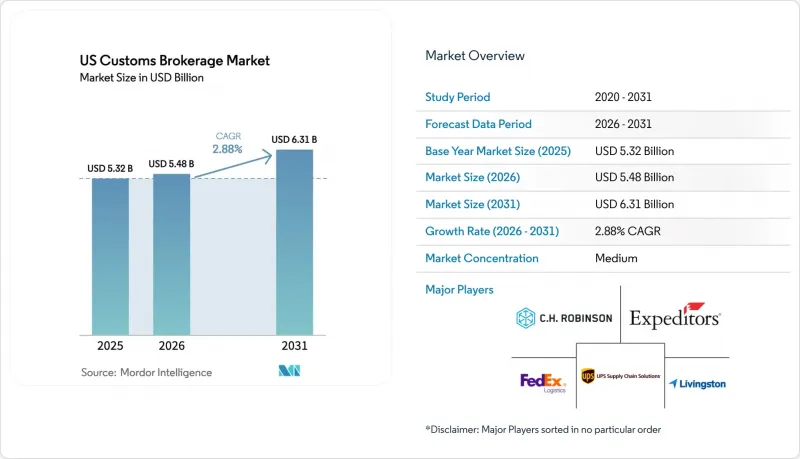
Mordor Intelligence에 의하면, 미국의 통관 중개 시장 규모는 2026년에 54억 8,000만 달러로 추정되고, 예측 기간(2026-2031년) CAGR 2.88%로 성장을 지속할 전망이며, 2031년에는 63억 1,000만 달러에 이를 전망입니다.
미국의 통관 서비스 시장 동향 및 인사이트
통관 프로세스의 디지털화 및 자동화
‘자동화된 상업 환경(ACE)’의 도입률은 98%에 달하며, 연간 3,500만 건 이상의 공식 통관 신고를 처리하고 있습니다. 제휴 기관과의 협력을 통해 통관 처리 주기가 며칠에서 몇 시간으로 단축되었습니다. 주요 통관 업체들은 95% 이상의 코드 할당 정확도를 달성하는 머신러닝 기반 분류 도구를 도입하여 수작업 프로세스를 줄이고, 직원을 컨설팅 업무에 투입할 수 있게 되었습니다. CBP(미국 세관·국경보호국)의 2024-2028년 IT 로드맵에서는 블록체인 시범 사업과 AI 기반 리스크 스코어링에 18억 달러가 배정되어, 시장 진출기업들에 대한 기술적 장벽이 더욱 높아지고 있습니다.
빈번한 통관 절차가 필요한 전자상거래 소액 수입업체의 부상
2025년에는 40만 개 이상의 미국 기업이 상품을 수입하여 2019년 대비 60% 증가했습니다. 그중 마이크로 수입업체가 전체의 38%를 차지하고 있습니다. 이에 대응하여 디지털 브로커 각사는 투명한 가격 책정을 원하는 창업자들에게 어필하는 셀프 서비스형 포털과 정액 요금제를 도입하고 있습니다. Amazon Global Logistics와 같은 플랫폼은 국경 간 주문 처리(fulfillment)를 효율화하고 있지만, 많은 소규모 화주들은 화물을 잘못 분류하거나 표시 규정을 간과함으로써 규정 준수 위험을 높이고 있습니다. 자동화와 적극적인 교육의 균형을 맞추고 있는 브로커들은 이러한 분산된 고객층으로부터 신뢰를 얻고 있습니다.
자격 있는 통관 중개자 부족이 임금 상승을 초래
2025년 10월 통관 중개자 면허 시험 합격률은 15% 미만을 기록한 반면, 통관 중개자의 평균 연령은 43세를 넘었습니다. 중견 자격을 갖춘 전문가의 급여는 2022년 수준보다 20-30% 높아졌습니다. 자동화에 투자할 예산이 없는 소규모 기업에서는 베테랑 직원이 은퇴함에 따라 서비스 제공에 제약이 발생하고 있습니다.
부문 분석
2025년, 수입업체들이 비용 효율적인 컨테이너 운송을 선호함에 따라 해상 운송은 미국 통관 중개 시장 점유율의 58.63%를 차지했습니다. 전자상거래 및 시간 엄수가 요구되는 산업이 속도를 우선시하는 가운데, 항공 화물 관련 미국 통관 서비스 시장 규모는 2031년까지 연평균 성장률(CAGR) 4.09%로 확대될 것으로 예측됩니다. 익스프레스 통합 사업자들은 통합 통관을 활용하여 사이클 타임을 단축하고 있는 반면, 남서부 회랑에서는 육로 국경을 경유하는 트럭 및 철도를 통한 수입이 탄력을 받고 있습니다.
팬데믹으로 인한 혼란 이후 컨테이너 운송의 신뢰성이 향상되면서 해상 운송의 비용적 우위가 더욱 강화되고 있지만, 반복되는 노사 분쟁과 슬롯 할당 제약으로 인해 일부 화주들은 운임이 비싸짐에도 불구하고 고가 상품을 항공 운송으로 전환하고 있습니다. 다중 운송 방식에 대한 전문 지식을 갖춘 통관 업체는 계절적 수요 주기를 통해 속도와 비용의 균형을 맞추는 고객을 확보하는 데 가장 유리한 위치에 있습니다.
2025년에는 포워더와 연계된 사업자나 3PL과 통합된 사업자가 65.46%의 점유율을 차지했습니다. 이는 화주들이 통관, 운송, 창고 보관을 묶은 ‘단일 청구서’ 형태의 물류 솔루션을 선호하는 경향을 반영한 것입니다. 한편, FDA 규제 대상 품목이나 대외무역지구 운영과 같은 복잡한 부문에서 전문 지식이 요구되는 가운데, 순수 통관 업체는 연평균 성장률(CAGR) 3.51%를 기록하며 성장했습니다.
2025년 2월, Purolator가 Livingston International을 6억 8,440만 달러에 인수한 것은 통합형 사업자들이 높은 수준의 규정 준수 역량을 추구하는 가운데, 업계 재편의 기세를 여실히 보여주고 있습니다. 이에 반해, 틈새 시장 통관 업체들은 대규모 네트워크에서는 재현하기 어려운 산업 특화 전문 지식과 세심한 서비스에 집중함으로써 대응하고 있습니다.
기타 혜택
- 엑셀 형식 시장 예측(ME) 시트
- 3개월간의 애널리스트 지원
자주 묻는 질문
목차
제1장 서론
제2장 조사 방법
제3장 주요 요약
제4장 시장 구도
제5장 시장 규모 및 성장 예측
제6장 경쟁 구도
제7장 시장 기회 및 향후 전망
AJY 26.08.28According to Mordor Intelligence, the US customs brokerage market size is estimated at USD 5.48 billion in 2026, and is expected to reach USD 6.31 billion by 2031, at a CAGR of 2.88% during the forecast period (2026-2031).
This report is Segmented by Mode of Transport (Ocean / Sea, Air, and More), by Broker Type (Pure Customs Brokers and More), by Importer Size (Large Enterprises and More), by Digital Adoption (Traditional Brokerages and More), by End-Use Industry (Retail and E-Commerce and More), by Region (West, Southwest, and More). The Market Forecasts are Provided in Terms of Value (USD).
US Customs Brokerage Market Trends and Insights
Digitization and Automation of Customs Processes
Automated Commercial Environment adoption stands at 98%, handling above 35 million formal entries annually. Integration with partner agencies has compressed clearance cycles from days to hours. Leading brokers deploy machine-learning classification tools that achieve more than 95% code-assignment accuracy, cutting manual touchpoints and freeing staff for advisory work. CBP's 2024-2028 IT roadmap earmarks USD 1.8 billion for blockchain pilots and AI-based risk scoring, further raising the technology bar for market participants.
Rise of E-commerce Micro-Importers Requiring High-Frequency Clearances
More than 400,000 US businesses imported goods in 2025, up 60% since 2019, with micro-importers representing 38% of the total. Digital brokers have responded with self-service portals and flat-fee models that appeal to entrepreneurs seeking transparent pricing. Platforms such as Amazon Global Logistics streamline cross-border fulfillment, yet many small shippers misclassify goods or overlook labeling rules, amplifying compliance risk. Brokers balancing automation with proactive education win loyalty in this dispersed client base.
Shortage of Licensed Customs Brokers Driving Wage Inflation
The October 2025 Customs Broker License Exam posted a sub-15% pass rate, while the average broker age exceeds 43 years. Mid-level licensed professionals now command salaries 20-30% higher than 2022 levels. Smaller firms without automation budgets face service constraints as veteran staff retire.
Other drivers and restraints analyzed in the detailed report include:
- Monetization of ACE Data into Value-Added Analytics Services
- CBP "21st Century Customs Framework" Unlocking New Broker Roles
- Expansion of DIY Self-Filing Software Eroding Fee Margins
For complete list of drivers and restraints, kindly check the Table Of Contents.
Segment Analysis
Ocean freight held 58.63% of the United States customs brokerage market share in 2025 as importers favored cost-efficient containerized shipping. The United States customs brokerage market size tied to air cargo is projected to grow at a 4.09% CAGR through 2031 as e-commerce and time-sensitive industries prioritize speed. Express integrators leverage integrated clearance to shorten cycle times, while land-border truck and rail entries gain ground in the Southwest corridor.
Container reliability improvements following pandemic disruption have reinforced the ocean's cost advantage, yet recurring labor actions and slot allocation constraints spur some shippers to shift high-value goods to air despite the premium freight cost. Brokers with multi-modal expertise are best positioned to capture clients that balance speed and cost across seasonal demand cycles.
Forwarder-linked and 3PL-integrated operators controlled a 65.46% share in 2025, reflecting shippers' preference for single-invoice logistics solutions that bundle clearance, carriage, and warehousing. Pure customs brokers grew at a 3.51% CAGR as complex verticals such as FDA-regulated goods and foreign-trade-zone operations demanded specialized knowledge.
The acquisition of Livingston International by Purolator for USD 684.4 million in February 2025 underlines consolidation momentum as integrated operators seek deep compliance capabilities. Niche brokers respond by doubling down on vertical intelligence and personalized service that larger networks struggle to replicate.
Complete Report Scope:
- By Service Type
- Customs Clearance
- Trade Compliance Advisory
- Duty Drawback & Refund Services
- Freight Forwarding-Linked Brokerage
- By Mode of Transport
- Ocean
- Air
- Truck
- Rail
- By End-user Industry
- Consumer Goods & Retail
- Automotive
- Electronics & Hi-Tech
- Agriculture & Food
- Pharmaceuticals & Healthcare
- By Client Size
- Enterprise Importers (more than $50 M annual imports)
- Mid-market Importers ($5-50 M)
- Small & Micro Importers (less than $5 M)
- By Geography
- Northeast
- Midwest
- Southeast
- Southwest
- West
List of Companies Covered in this Report:
- Expeditors International of Washington, Inc.
- C.H. Robinson Worldwide, Inc.
- UPS Supply Chain Solutions
- FedEx Logistics
- Livingston International (acquired by Purolator)
- DHL Global Forwarding
- Kuehne + Nagel Inc.
- DSV (incl. DB Schenker)
- A.N. Deringer, Inc.
- Flexport, Inc.
- CEVA Logistics (Acquired by CMA CGM)
- OEC Group
- BDP International
- SEKO Logistics
- Kerry Logistics (USA)
- Nippon Express
- GEODIS USA
- C.H. Powell Co.
- Alba Wheels Up International
- GHY USA Inc.
Additional Benefits:
- The market estimate (ME) sheet in Excel format
- 3 months of analyst support
TABLE OF CONTENTS
1 Introduction
- 1.1 Study Assumptions & Market Definition Scope of the Study
2 Research Methodology
3 Executive Summary
4 Market Landscape
- 4.1 Market Overview
- 4.2 Market Drivers
- 4.2.1 Growth in U.S. import volumes rebounding post-pandemic
- 4.2.2 Complexity stemming from shifting tariff & trade-agreement rules
- 4.2.3 Digitization & automation of customs processes (ACE, PGA portals)
- 4.2.4 Rise of e-commerce micro-importers requiring high-frequency clearances
- 4.2.5 Monetization of ACE data into value-added analytics services
- 4.2.6 CBP "21st Century Customs Framework" unlocking new broker value-added roles
- 4.3 Market Restraints
- 4.3.1 Heightened trade-policy volatility creating forecasting risk
- 4.3.2 Rising compliance costs for forced-labor & ESG documentation
- 4.3.3 Shortage of licensed customs brokers driving wage inflation
- 4.3.4 Expansion of DIY self-filing software eroding broker fee margins
- 4.4 Value / Supply-Chain Analysis
- 4.5 Regulatory Landscape
- 4.6 Technological Outlook
- 4.7 Porter's Five Forces
- 4.7.1 Threat of New Entrants
- 4.7.2 Bargaining Power of Buyers
- 4.7.3 Bargaining Power of Suppliers
- 4.7.4 Threat of Substitutes
- 4.7.5 Competitive Rivalry
5 Market Size & Growth Forecasts (Value, USD)
- 5.1 By Service Type
- 5.1.1 Customs Clearance
- 5.1.2 Trade Compliance Advisory
- 5.1.3 Duty Drawback & Refund Services
- 5.1.4 Freight Forwarding-Linked Brokerage
- 5.2 By Mode of Transport
- 5.2.1 Ocean
- 5.2.2 Air
- 5.2.3 Truck
- 5.2.4 Rail
- 5.3 By End-user Industry
- 5.3.1 Consumer Goods & Retail
- 5.3.2 Automotive
- 5.3.3 Electronics & Hi-Tech
- 5.3.4 Agriculture & Food
- 5.3.5 Pharmaceuticals & Healthcare
- 5.4 By Client Size
- 5.4.1 Enterprise Importers (more than $50 M annual imports)
- 5.4.2 Mid-market Importers ($5-50 M)
- 5.4.3 Small & Micro Importers (less than $5 M)
- 5.5 By Geography
- 5.5.1 Northeast
- 5.5.2 Midwest
- 5.5.3 Southeast
- 5.5.4 Southwest
- 5.5.5 West
6 Competitive Landscape
- 6.1 Market Concentration
- 6.2 Strategic Moves
- 6.3 Market Share Analysis
- 6.4 Company Profiles (includes Global level Overview, Market level overview, Core Segments, Financials as available, Strategic Information, Market Rank/Share for key companies, Products & Services, and Recent Developments)
- 6.4.1 Expeditors International of Washington, Inc.
- 6.4.2 C.H. Robinson Worldwide, Inc.
- 6.4.3 UPS Supply Chain Solutions
- 6.4.4 FedEx Logistics
- 6.4.5 Livingston International (acquired by Purolator)
- 6.4.6 DHL Global Forwarding
- 6.4.7 Kuehne + Nagel Inc.
- 6.4.8 DSV (incl. DB Schenker)
- 6.4.9 A.N. Deringer, Inc.
- 6.4.10 Flexport, Inc.
- 6.4.11 CEVA Logistics (Acquired by CMA CGM)
- 6.4.12 OEC Group
- 6.4.13 BDP International
- 6.4.14 SEKO Logistics
- 6.4.15 Kerry Logistics (USA)
- 6.4.16 Nippon Express
- 6.4.17 GEODIS USA
- 6.4.18 C.H. Powell Co.
- 6.4.19 Alba Wheels Up International
- 6.4.20 GHY USA Inc.