

|
시장보고서
상품코드
2115162
폴리에틸렌 푸라노에이트(PEF) 시장 : 점유율 분석, 업계 동향과 통계, 성장 예측(2026-2031년)Polyethylene Furanoate (PEF) - Market Share Analysis, Industry Trends & Statistics, Growth Forecasts (2026 - 2031) |
||||||
 Mordor Intelligence
Mordor Intelligence에 의하면, 폴리에틸렌 푸라노에이트 시장 규모는 2025년 2.28 킬로톤에서 2026년에는 2.73 킬로톤으로 확대되어 2031년까지 6.82 킬로톤에 이를 것으로 예상되고 있어 2026년부터 2031년까지 CAGR 20.11%로 성장할 전망입니다.
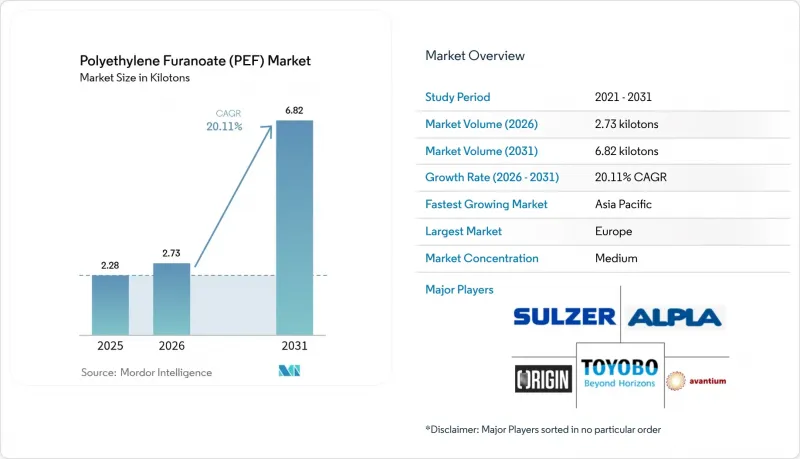
본 보고서는 용도별(병, 필름, 섬유), 최종 사용자 산업별(음료 포장, 식품 포장, 퍼스널케어 및 화장품, 섬유 및 의류, 산업용), 지역별(아시아태평양, 북미, 유럽, 남미, 중동 및 아프리카)로 분류되어 있습니다. 시장 전망은 수량(톤) 기준으로 제시되어 있습니다.
세계 폴리에틸렌 푸라노에이트(PEF) 시장 동향 및 인사이트
지속 가능한 음료 포장재에 대한 수요 증가
각 브랜드 소유 기업들은 미래를 위한 공약을 다년간공급 계약으로 구체화하고 있으며, 그 총량은 연간 병 생산량을 상회하고 있습니다. 이러한 움직임은 생산자들에게 자신감을 심어주며 상업용 플랜트 건설을 촉진하고 있습니다. PEF는 화석 연료 유래 PET에 비해 온실가스 배출량이 적다는 특징이 있습니다. 이러한 장점 덕분에 음료 제조업체는 재활용 소재에만 의존하지 않고도 ‘과학 기반 목표(Science-Based Targets)’를 달성할 수 있습니다. 2025년 7월에 출시된 칼스버그의 ‘그린 파이버 병’은 성형 섬유 속에 얇은 PEF 차단층을 통합하고 있습니다. 이 혁신은 이전에는 가스 투과성 문제로 인해 제한되었던 하이브리드 형태의 실현을 가능하게 하는 PEF의 잠재력을 보여줍니다. 또한, EU의 보증금 반환 제도는 사용 후 성능으로 수익을 창출함으로써 이러한 추세를 뒷받침하고 있습니다. 이러한 동향들이 맞물리면서 포장 분야에서의 폴리에틸렌 푸라노에이트 채택이 가속화되고 있습니다.
섬유 및 텍스타일 분야에서의 채택 확대
폴리에스터는 전 세계 섬유 생산량에서 압도적인 점유율을 차지하고 있습니다. 그러나 이에 비해 바이오 폴리에스터의 점유율은 여전히 극히 미미합니다. 이러한 상황이 PEF(폴리에틸렌 푸라노에이트)가 중요한 대체 소재로 진입할 수 있는 토대를 마련해 주고 있습니다. PEF 텍스타일 커뮤니티 회원들은 용융 방적 시험을 실시했습니다. 그 결과, PEF 원사는 기존의 PET보다 높은 유리전이온도와 탄성률을 자랑하는 것으로 나타났습니다. 이러한 특성 덕분에 특히 고온에서의 염색 공정에서 원단의 안정성이 향상됩니다. 독일에서는 파일럿 라인을 통해 멀티필라멘트 생산 검증을 성공적으로 마쳤습니다. 그러나 상업적 규모의 생산을 실현하기 위해서는 수지의 순도를 일정하게 유지하고, 수 톤 규모의 시험 배치 생산이 시급한 과제로 대두되고 있습니다. 그 결과, 섬유 분야의 PEF 시장은 매출이 급증할 것으로 예상되지만, 이는 2028년 이후가 될 전망입니다.
rPET 및 PLA 대체재와의 경쟁
재활용 PET는 한 세기에 걸쳐 확립된 인프라에 힘입어 현재 폴리에스터 섬유 수요의 일부를 충족시키고 있습니다. 이로 인해 폐쇄형 순환형 PET에 자본이 꾸준히 유입되고 있어, 신규 폴리머에 대한 투자를 가리고 있습니다. PLA는 PEF에 비해 진입 비용이 낮으며, EU와 미국 양쪽에서 식품 접촉 적합 인증을 획득했습니다. 화학 재활용 공장이 rPET의 탄소 발자국 감축에 주력함에 따라, PEF의 수명 주기상 우위는 점차 약화되고 있습니다. 이는 재활용률이 높고 가격에 민감한 아시아 시장에서 특히 두드러집니다.
부문 분석
2025년에는 병이 폴리에틸렌 푸라노에이트 시장의 74.57%를 차지하고, 2031년까지 연평균 성장률(CAGR) 20.56%로 성장할 것으로 전망됩니다. 이는 가공업체들이 PEF의 CO2 투과성이 31분의 1 수준으로 낮다는 특성을 활용하여 고급 음료의 탄산을 유지하기 때문입니다. 카를스버그사의 섬유 기반 병은 PEF 층이 어떻게 혁신적인 하이브리드 형태를 가능하게 하는지 보여주고 있으며, 폴리에틸렌 푸라노에이트 시장 내에서 새로운 수요 기반을 창출하고 있습니다.
필름 분야는 여전히 개념 증명(PoC) 단계의 틈새 시장에 머물러 있습니다. 이는 기존의 블로우 필름 생산 라인에서는 PEF의 낮은 용융 온도에 대응하기 위해 설비 개조가 필요하기 때문입니다. 아반티움(Avantium)과 암콜(Amcor)은 신선 식품용 파우치에 대한 공압출 구조 시험을 진행 중이며, 유통 기한 연장을 통해 수지의 높은 단가를 상쇄할 수 있을 것으로 시사되고 있습니다. 이는 접착성 문제가 해결된다면, 향후 폴리에틸렌 푸라노에이트 시장 규모가 확대될 가능성을 시사합니다. 섬유 분야는 현재로서는 아직 미미한 존재이지만, 장기적인 성장 기회를 내포하고 있습니다. Swicofil사가 발표한 초기 원사 및 DITF의 시험 결과에 따르면, PEF의 높은 탄성률 덕분에 기능성 의류에서 뛰어난 드레이프 유지력을 얻을 수 있는 것으로 나타나고 있으며, 섬유 분야는 폴리에틸렌 푸라노에이트 업계에 있어 중기적인 사업 다각화 분야로 자리매김하고 있습니다.
지역별 분석
2025년 생산량의 46.89%를 유럽이 차지하고 있으며, 이는 아반티움(Avantium)사의 델프자일(Delft)에 위치한 주력 공장과 화석 유래 폴리머에 벌금을 부과하는 정책 체계에 힘입은 것으로, 폴리에틸렌 푸라노에이트 시장에서 해당 지역의 주도적 지위를 공고히 하고 있습니다. 독일과 네덜란드의 보증금 환불 제도는 사용 후 제품 처리 비용을 내부화함으로써 브랜드들의 도입을 가속화하고 있습니다. 한편, 덴마크에서는 칼스버그사의 종이 병을 통해 소매 시장에 첫 출시가 이루어졌습니다. 프랑스와 영국에서는 지자체별 시스템이 분산되어 있어 진전이 더딘 편이지만, 현지 프리미엄 주스 및 유제품 브랜드들은 여전히 시범 생산을 진행하고 있습니다. 이탈리아의 바이오폴리머 추진은 컨버터들이 산소에 민감한 생수용 PEF 병을 시험하고 있다는 점에서 경쟁과 협력 모두의 기회를 가져다주고 있습니다.
아시아태평양은 연평균 20.98%의 성장률이 예상되며, 2031년까지 폴리에틸렌 푸라노에이트 시장에서 가장 큰 증가분을 가져올 것으로 예측됩니다. 저장성에 위치한 중국의 FDCA 시범 시설과 인도의 BioE3 보조금 제도는 원료 비용을 절감해 주는 풍부한 사탕수수 잔여물을 바탕으로 두 가지 활동의 거점이 되고 있습니다. 도요보(TOYOBO)와 같은 일본 기업들은 자동차 내장재용 PEF 섬유를 목표로 하고 있는 반면, 한국의 가공업체들은 EU 수출을 목적으로 PEF 병 개발을 추진하고 있습니다. 지역별 성장세는 현지 승인 상황에 달려 있지만, 여러 정부가 프랑계 폴리에스테르를 명시적으로 언급한 바이오경제 로드맵을 지지하며, 공급에 앞서 규제 체계를 정비하고 있습니다.
북미는 생산량 면에서 유럽이나 아시아태평양에 뒤처져 있지만, 오리진 머티리얼즈(Origin Materials)의 사니아 공장과 아반티움(Avantium)이 플라스티팩(Plastipack)사와 체결한 미국 내 식품 접촉 용도 공급 계약의 혜택을 받고 있습니다. FDA의 승인이 중요한 관문으로 대두되고 있으며, 이해관계자들은 2026년 말까지 결정이 내려질 것으로 전망하고 있습니다. 캐나다는 임업 잔여물을 활용하여 바이오매스 원료의 허브로서의 입지를 확립해 가고 있으며, 멕시코는 미국 브랜드 소유주들에게 저비용 병 성형 능력을 제공합니다. 라틴아메리카에서의 보급은 브라질과 아르헨티나에서 AmBev사의 사업 전개에 좌우되지만, 중동 및 아프리카에서는 화석 연료에 대한 보조금과 폐기물 관리 인프라 부족으로 인해 고가의 바이오폴리머의 가치 제안이 약화되고 있어, 여전히 보급은 제한적입니다.
기타 혜택:
- 엑셀 형식 시장 예측(ME) 시트
- 3개월간의 애널리스트 지원
자주 묻는 질문
목차
제1장 서론
제2장 조사 방법
제3장 주요 요약
제4장 시장 구도
제5장 시장 규모와 성장 예측
제6장 경쟁 구도
제7장 시장 기회와 향후 전망
JHS 26.08.26According to Mordor Intelligence, the polyethylene furanoate market size is expected to increase from 2.28 kilotons in 2025 to 2.73 kilotons in 2026 and reach 6.82 kilotons by 2031, growing at a CAGR of 20.11% over 2026-2031.
This report is Segmented by Application (Bottles, Films, and Fibers), End-User Industry (Beverage Packaging, Food Packaging, Personal Care and Cosmetics, Textiles and Apparel, and Industrial), and Geography (Asia-Pacific, North America, Europe, South America, and Middle-East and Africa). Market Forecasts are Provided in Terms of Volume (Tons).
Global Polyethylene Furanoate (PEF) Market Trends and Insights
Growing Demand for Sustainable Beverage Packaging
Brand owners have transformed their aspirational pledges into multi-year supply agreements, collectively surpassing an annual volume of bottles. This move instills confidence in producers, prompting them to commission commercial plants. PEF boasts a smaller greenhouse gas footprint compared to fossil PET. This advantage aids beverage companies in achieving Science-Based Targets, without relying solely on recycled streams. Carlsberg's Green Fibre Bottle, launched in July 2025, incorporates a thin PEF barrier layer within molded fiber. This innovation demonstrates PEF's potential to enable hybrid formats, a feat previously restricted by gas transmission challenges. Additionally, EU deposit-return schemes enhance this momentum by monetizing end-of-life performance. Collectively, these dynamics accelerate the adoption of Polyethylene Furanoate in the packaging sector.
Rising Adoption in Textile and Fiber Applications
Polyester holds a dominant share of the global fiber volume. However, biobased polyester remains negligible in comparison. This sets the stage for PEF's (Polyethylene Furanoate) entry as a significant material substitution opportunity. Members of the PEF Textile Community are conducting melt-spinning trials. Their findings indicate that PEF yarns boast a higher glass-transition temperature and modulus than conventional PET. This characteristic enhances fabric stability, especially during high-heat dyeing processes. In Germany, a pilot line has successfully validated the production of multifilaments. However, for commercial volumes to materialize, there's a pressing need for consistent resin purity and multi-ton trial batches. As a result, the PEF market in textiles is eyeing a revenue surge, but only post-2028.
Competition from rPET and PLA Substitutes
Recycled PET now satisfies a portion of the demand for polyester fibers, bolstered by a century's worth of established infrastructure. This has led to a steady influx of capital into closed-loop PET, overshadowing investments in novel polymers. PLA, with a more accessible entry cost compared to PEF, boasts food-contact approvals in both the EU and the U.S. As chemical-recycling plants work to reduce rPET's carbon footprint, the life-cycle advantage of PEF diminishes. This is particularly evident in price-sensitive Asian markets, where recycling rates are high.
Other drivers and restraints analyzed in the detailed report include:
- Regulatory Tailwinds for Bio-Based Polymers
- Integration into Multilayer E-Commerce Packaging
- High Cost and Limited Scale of FDCA Feedstock
For complete list of drivers and restraints, kindly check the Table Of Contents.
Segment Analysis
Bottles captured 74.57% of the Polyethylene Furanoate market share in 2025 and are projected to grow at a 20.56% CAGR through 2031 as converters leverage PEF's 31-fold lower CO2 permeability to safeguard carbonation in premium beverages. Carlsberg's fiber-based bottle illustrates how PEF layers can enable novel hybrid formats, sparking new demand pockets within the Polyethylene Furanoate market.
Films remain a proof-of-concept niche because conventional blown-film lines require retooling to accommodate PEF's lower melt temperature. Avantium and Amcor test co-extruded structures for fresh produce pouches where shelf-life extension offsets resin premiums, hinting at future Polyethylene Furanoate market size growth once adhesion challenges are solved. Fibers, though currently marginal, represent a long-tail opportunity. Early yarns listed by Swicofil and trials at DITF suggest PEF's higher modulus can deliver better drape retention in technical apparel, positioning textiles as a medium-term diversification play for the Polyethylene Furanoate industry.
Complete Report Scope:
- By Application
- Bottles
- Films
- Fibers
- By End-user Industry
- Beverage Packaging
- Food Packaging
- Personal Care and Cosmetics
- Textiles and Apparel
- Industrial (Electronics, Automotive)
- By Geography
- Asia-Pacific
- China
- Japan
- India
- South Korea
- Rest of Asia-Pacific
- North America
- United States
- Canada
- Mexico
- Europe
- Germany
- United Kingdom
- France
- Italy
- Rest of Europe
- South America
- Brazil
- Argentina
- Rest of South America
- Middle-East and Africa
- Saudi Arabia
- South Africa
- Rest of Middle-East and Africa
- Asia-Pacific
Geography Analysis
Europe accounted for 46.89% of 2025 volume, underwritten by Avantium's Delfzijl flagship and policy frameworks that penalize fossil polymers, reinforcing the region's leadership in the Polyethylene Furanoate market. Deposit-return schemes in Germany and the Netherlands internalize end-of-life costs, accelerating brand adoption, while Denmark showcased the first retail launch through Carlsberg's paper bottle. France and the United Kingdom progress more slowly due to fragmented municipal systems, but premium juice and dairy brands there still run pilot batches. Italy's biopolymer push offers both competition and partnership opportunities as converters test PEF bottles for oxygen-sensitive mineral water. the
Asia-Pacific is projected to grow at 20.98% and will add the largest incremental Polyethylene Furanoate market size by 2031. China's pilot FDCA facilities in Zhejiang and India's BioE3 subsidies create dual hubs of activity, supported by abundant sugarcane residues that lower feedstock costs. Japanese firms such as TOYOBO target PEF fibers for automotive interiors, while South Korean processors explore PEF bottles aimed at EU exports. Regional momentum hinges on local approvals, yet multiple governments endorse bioeconomy roadmaps that explicitly mention furan-based polyesters, laying regulatory tracks ahead of supply.
North America trails Europe and Asia-Pacific in volume but benefits from Origin Materials' Sarnia plant and Avantium's offtake deal with Plastipak for U.S. food-contact applications. FDA approval is the key gate, and stakeholders expect a decision by late 2026. Canada positions itself as a biomass feedstock hub, leveraging forestry residues, and Mexico offers low-cost bottle molding capacity for U.S. brand owners. Latin American adoption rides on AmBev's rollout in Brazil and Argentina, whereas the Middle East and Africa remain marginal due to fossil-petroleum subsidies and limited waste-management infrastructure that weakens the value proposition of a higher-priced biopolymer.
- ALPLA
- AVA Biochem AG
- Avantium
- Origin Materials
- Sulzer Ltd
- Swicofil AG
- TOYOBO CO., LTD.
- Zhejiang Sugar Energy Technology Co., Ltd.
Additional Benefits:
- The market estimate (ME) sheet in Excel format
- 3 months of analyst support
TABLE OF CONTENTS
1 Introduction
- 1.1 Study Assumptions and Market Definition
- 1.2 Scope of the Study
2 Research Methodology
3 Executive Summary
4 Market Landscape
- 4.1 Market Overview
- 4.2 Market Drivers
- 4.2.1 Growing Demand for Sustainable Beverage Packaging
- 4.2.2 Rising Adoption in Textile and Fiber Applications
- 4.2.3 Regulatory Tailwinds for Bio-Based Polymers
- 4.2.4 Integration into Multilayer E-Commerce Packaging
- 4.2.5 Niche Use in Heat-Resistant Electronics Housings
- 4.3 Market Restraints
- 4.3.1 Competition from Rpet and PLA Substitutes
- 4.3.2 High Cost and Limited Scale of FDCA Feedstock
- 4.3.3 Collection-Stream Incompatibility for Recycling
- 4.4 Value Chain Analysis
- 4.5 Porter's Five Forces
- 4.5.1 Bargaining Power of Suppliers
- 4.5.2 Bargaining Power of Buyers
- 4.5.3 Threat of New Entrants
- 4.5.4 Threat of Substitutes
- 4.5.5 Degree of Competition
5 Market Size and Growth Forecasts
- 5.1 By Application
- 5.1.1 Bottles
- 5.1.2 Films
- 5.1.3 Fibers
- 5.2 By End-user Industry
- 5.2.1 Beverage Packaging
- 5.2.2 Food Packaging
- 5.2.3 Personal Care and Cosmetics
- 5.2.4 Textiles and Apparel
- 5.2.5 Industrial (Electronics, Automotive)
- 5.3 By Geography
- 5.3.1 Asia-Pacific
- 5.3.1.1 China
- 5.3.1.2 Japan
- 5.3.1.3 India
- 5.3.1.4 South Korea
- 5.3.1.5 Rest of Asia-Pacific
- 5.3.2 North America
- 5.3.2.1 United States
- 5.3.2.2 Canada
- 5.3.2.3 Mexico
- 5.3.3 Europe
- 5.3.3.1 Germany
- 5.3.3.2 United Kingdom
- 5.3.3.3 France
- 5.3.3.4 Italy
- 5.3.3.5 Rest of Europe
- 5.3.4 South America
- 5.3.4.1 Brazil
- 5.3.4.2 Argentina
- 5.3.4.3 Rest of South America
- 5.3.5 Middle-East and Africa
- 5.3.5.1 Saudi Arabia
- 5.3.5.2 South Africa
- 5.3.5.3 Rest of Middle-East and Africa
- 5.3.1 Asia-Pacific
6 Competitive Landscape
- 6.1 Market Concentration
- 6.2 Strategic Moves
- 6.3 Market Share (%)/Ranking Analysis
- 6.4 Company Profiles (includes Global level Overview, Market level overview, Core Segments, Financials as available, Strategic Information, Products and Services, and Recent Developments)
- 6.4.1 ALPLA
- 6.4.2 AVA Biochem AG
- 6.4.3 Avantium
- 6.4.4 Origin Materials
- 6.4.5 Sulzer Ltd
- 6.4.6 Swicofil AG
- 6.4.7 TOYOBO CO., LTD.
- 6.4.8 Zhejiang Sugar Energy Technology Co., Ltd.
7 Market Opportunities and Future Outlook
- 7.1 White-space and Unmet-need Assessment


