

|
시장보고서
상품코드
2115217
페로실리콘 시장 : 점유율 분석, 업계 동향과 통계, 성장 예측(2026-2031년)Ferrosilicon - Market Share Analysis, Industry Trends & Statistics, Growth Forecasts (2026 - 2031) |
||||||
 Mordor Intelligence
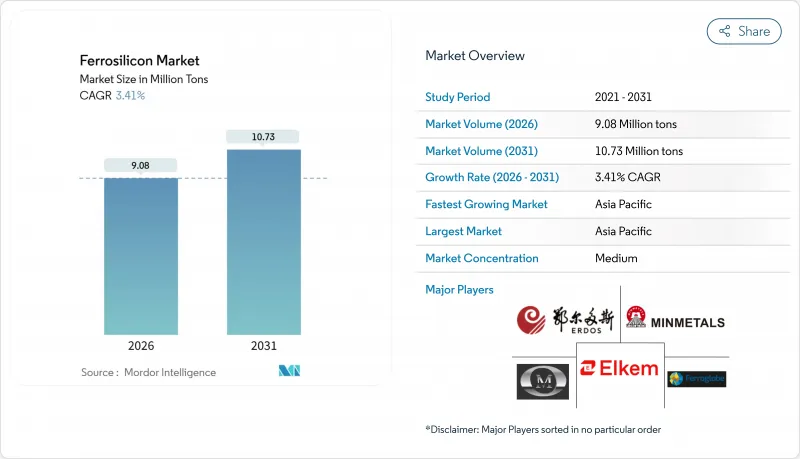
Mordor Intelligence에 의하면, 페로실리콘 시장 규모는 2026년에 908만 톤과 추산 되고 있어 예측 기간(2026-2031년)에서 CAGR 3.41%로 성장을 지속하여, 2031년까지 1,073만 톤에 이른다고 전망되고 있습니다.
본 보고서는 등급(FeSi 45-75% Si, FeSi 75-90% Si, 90% Si를 초과하는 고순도 FeSi), 형태(덩어리, 분말, 브리켓, 기타),용도(야금, 반도체, 태양광 발전, 화학 처리, 기타 용도), 지역(아시아태평양, 북미, 유럽 등)별로 분류되어 있습니다. 시장 예측은 수량(톤) 기준으로 제시되어 있습니다.
세계 페로실리콘 시장 동향 및 인사이트
아시아태평양의 철강 생산 능력 증가
2025년부터 2027년까지, OECD 데이터에 따르면 새로운 제철 능력 증설 계획이 밝혀졌으며, 그 대부분이 아시아태평양에 집중되어 있습니다. 2025 회계연도에는 인도의 조강 생산 능력이 예상을 상회했습니다. 인도의 철스크랩에 대한 수입 관세 제로 정책과 특수강 생산 연동형 인센티브 제도가 맞물리면서, 해당 국가의 통합 제철소에서 탈산제 수요가 증가하고 있습니다. 중국은 2026년까지 조강 생산량의 연간 성장을 목표로 하고 있지만, 내몽골과 닝샤의 에너지 규제로 인해 구식 석탄 연소 고로가 간헐적으로 가동 중단되고 있습니다. 이로 인해 사업자들은 더 새롭고 에너지 효율이 높은 서브머지 아크로를 도입할 수밖에 없는 상황입니다. 2024년에 열연 코일 가격이 하락했음에도 불구하고, 철강 제조업체들은 조강 1톤당 페로실리콘 사용량을 유지하여 기준 소비량을 안정화시켰습니다. 그 결과, 해당 지역에서는 중급 합금에 대한 수요가 증가하고 있습니다.
전동화가 EV 모터용 전자강판 수요를 견인
실리콘이 포함된 철·실리콘 시트인 전자강판은 미국 에너지부(DOE)에 의해 구동 모터에 필수적인 소재로 간주됩니다. 배터리식 전기차(EV) 1대당 이 소재로 만들어진 라미네이션이 필요합니다. 확대되는 EV 시장을 내다보며, 포스코, 바오우(Baowu),JFE 스틸은 2026년까지 생산을 본격화할 예정인 새로운 결정립 배향형 및 비결정립 배향형 생산 라인을 도입했습니다. 이들 제철소는 자기 코어 손실을 최소화하기 위해 고순도 페로실리콘을 채택하고 있습니다. 국제에너지기구(IEA)는 향후 몇 년간 전 세계 전기차 판매 대수가 급증할 것으로 전망하고 있습니다. 또한, 재생에너지의 전력망 연계를 위한 송전 변압기 설치가 증가함에 따라, 특히 승압 변압기에 필수적인 방향성 전기강판에 대한 수요가 높아지고 있습니다. 전자강판공급은 중국, 일본, 한국, 독일에 집중되어 있지만, 이러한 주요 지역 수요는 일반 탄소강 용도에 비해 경기 변동의 영향을 덜 받는 경향이 있습니다. 이 합금강 수요 안정성은 건설용 강재 수요가 부진한 상황에서도 유지되고 있습니다.
변동이 심한 석영암과 전력 비용
실리콘 1톤을 생산하는 데는 다량의 전력이 필요하기 때문에 에너지 비용은 제련소 경비의 거의 절반을 차지합니다. 에스콤(Eskom)의 매년 요금 인상에 따라 글렌코어(Glencore)는 음푸말랑가 주에서 용광로 가동을 조정했습니다. 동시에 페로글로브(Ferroglobe)는 유럽의 다음 날 전력 가격 급등에 대응하여 스페인과 프랑스에서의 가동을 중단할 수밖에 없었습니다. 석영암 원료의 경우, 높은 SiO₂ 함량이 필수적입니다. 그러나 홍해와 파나마 운하에서의 혼란으로 인해 운송 비용이 급등하고 있습니다. 중국의 ‘이중 관리’ 정책으로 인해 내몽골과 닝샤에서 겨울철 전력 공급이 제한되면서 가동률이 하락하고, 합금 현물 가격이 상승하고 있습니다. 수력 발전이 풍부한 노르웨이와 파라과이에서는 비용 측면에서 완화되는 양상이 보이지만, 전력 요금이 높은 지역의 많은 제련소에서는 특히 페로실리콘 가격이 하락 압력을 받고 있는 상황에서 손익분기점에 도달하기가 어려워지고 있습니다.
부문별 분석
FeSi 45-75% 등급은 2025년 공급량의 65.44%를 차지하며, 연평균 성장률(CAGR) 4.06%로 다른 어떤 등급보다 빠르게 확대될 것으로 예측됩니다. 이 등급은 탄소강 래디언이나 주철의 접종에 쉽게 통합될 수 있으며, 과도한 열을 발생시키지 않으면서 높은 실리콘 회수율을 실현합니다. 조강 생산량 증가를 목표로 한 중국의 시책이 수요 증가를 뒷받침하고 있으며, 인도의 생산 능력 확충도 수요를 견인하고 있습니다. 표준 75% 등급 제품은 전기 아크로 및 파운드리에서 사용되지만, 스크랩을 많이 사용하는 용해 공정에서는 고로에 비해 필요한 재료량이 적기 때문에 성장 속도는 비교적 완만합니다. 실리콘 함량 90%를 초과하는 고순도 등급은 반도체 및 태양전지 웨이퍼 규격을 충족합니다. 생산자들은 폴리실리콘 가격이 전환을 정당화할 수 있는 상황에서 기존의 합금용 실리콘과 야금용 실리콘 생산을 전환하고 있습니다. 가격 차이가 이러한 선택을 정당화하고 있으며, 기동성이 높은 제련소에는 태양전지 사이클의 정점을 노리기 위한 이익 유인이 발생하고 있습니다. 재활용된 태양광 발전용 실리콘은 향후 순환형 공급의 기반이 될 가능성이 있지만, 산업 규모의 회수·정제 인프라는 여전히 초기 단계에 머물러 있습니다.
지역별 분석
아시아태평양은 2025년에 페로실리콘 시장 점유율의 58.81%를 차지하고, 2031년까지 연평균 성장률(CAGR) 4.53%라는 최고 수준을 기록할 것으로 전망됩니다. 에너지 정책으로 인해 내몽골과 닝샤에 있는 일부 구형 용광로가 가동을 중단하게 되었음에도 불구하고, 중국은 여전히 최대 생산국으로서의 지위를 굳건히 지키고 있습니다. 인도에서는 특수강 장려책과 고철의 무관세 수입으로 인해 합금 수요가 국내 공급업체와 부탄의 타시 그룹으로 향하고 있습니다. 한편, 일본과 한국은 합쳐서 연간 상당한 양을 수입하고 있으며, 포스코(POSCO)의 전기강판 생산 확대에 따라 수요가 더욱 증가할 것으로 예측됩니다.
세계 수요의 상당 부분을 차지하는 북미에서는 미국이 5개의 제철소(그중 1곳은 가동 중단 중)에 의존하는 한편, 브라질, 캐나다, 말레이시아로부터의 수입도 이루어지고 있었습니다. 초당적 인프라법 덕분에 교량 및 철도 프로젝트에 철강이 공급됨에 따라 연간 수요 증가가 예상됩니다. 캐나다는 중요 광물 확보를 추진하고 수력 발전소 건설을 제안하고 있지만(다만, 허가 취득 지연으로 인해 2030년대까지 미뤄질 전망입니다), 멕시코에서는 니어쇼어링 추세가 강화되면서 가전제품 및 자동차용 평강 수요가 증가하고 있습니다. 그러나 이 지역이 페로실리콘 수입에 의존하고 있다는 사실은 양국 간의 상호 의존 관계가 매우 강함을 여실히 보여줍니다.
연간 소비량이 막대한 유럽에서는 전력 가격 급등으로 어려움을 겪고 있습니다. 페로글로브(FerroGlobe)사는 스페인과 프랑스의 제련소 가동을 축소했으나, 노르웨이는 수력발전을 활용하여 경쟁력 있는 원가를 유지하고 있습니다. 또한, 노르웨이는 헤로야에 위치한 태양광 등급 실리콘 복합 시설에 막대한 투자를 하고 있습니다. 남미는 주로 브라질의 수력발전을 활용한 생산 능력에 힘입어 미국과 유럽 양측으로 대량의 제품을 수출하고 있습니다. 중동 및 아프리카에서는 남아프리카공화국이 중심적인 역할을 하고 있습니다. 그러나 에스콤(Eskom)의 요금 인상 및 계획 정전 문제로 인해 설비 가동률은 여전히 제한되고 있습니다. 그럼에도 불구하고 사우디아라비아의 인프라 프로젝트가 완만한 수요 증가를 시사하고 있어 한 줄기 희망이 보입니다.
기타 혜택:
- 엑셀 형식 시장 예측(ME) 시트
- 3개월간의 애널리스트 지원
자주 묻는 질문
목차
제1장 서론
제2장 조사 방법
제3장 주요 요약
제4장 시장 구도
제5장 시장 규모와 성장 예측
제6장 경쟁 구도
제7장 시장 기회와 향후 전망
JHS 26.08.26According to Mordor Intelligence, the ferrosilicon market size is estimated at 9.08 million tons in 2026 and is expected to reach 10.73 million tons by 2031, at a CAGR of 3.41% during the forecast period (2026-2031).
This report is Segmented by Grade (FeSi 45-75% Si, Fesi 75-90% Si, and High-Purity FeSi Greater Than 90% Si), Form (Lumps, Powder, and Briquettes and Others), Application (Metallurgy, Semiconductors, Photovoltaic Solar Energy, Chemical Processing, and Other Applications), and Geography (Asia-Pacific, North America, Europe, and More). The Market Forecasts are Provided in Terms of Volume (Tons).
Global Ferrosilicon Market Trends and Insights
Rising Steel-Capacity Additions Across Asia-Pacific
Between 2025 and 2027, OECD data reveals plans for new steelmaking capacity, with a significant portion concentrated in the Asia-Pacific region. In fiscal 2025, India's finished-steel capacity surpassed expectations. India's zero-import-duty policy on ferrous scrap, coupled with a Production-Linked Incentive scheme for specialty steel, is driving heightened demand for deoxidizers at its integrated mills. While China aims for annual growth in crude steel through 2026, energy restrictions in Inner Mongolia and Ningxia have led to intermittent shutdowns of older coal-fired furnaces. This has pushed operators to adopt newer, energy-efficient submerged-arc units. Even as hot-rolled coil prices dipped in 2024, steelmakers maintained the use of ferrosilicon per ton of crude steel, stabilizing baseline consumption. Consequently, the region sees an increase in medium-grade alloy demand.
Electrification Spurring Electrical-Steel Demand for EV Motors
Electrical steel, an iron-silicon sheet with silicon content, is deemed critical for traction motors by the U.S. Department of Energy. Each battery electric vehicle (EV) requires laminations made from this material. In anticipation of the growing EV market, POSCO, Baowu, and JFE Steel have introduced new grain-oriented and non-oriented production lines, set to ramp up by 2026. These mills are also opting for higher-purity ferrosilicon to minimize magnetic-core losses. The International Energy Agency projects a surge in global EV sales in the coming years. Additionally, as grid-transformer installations for renewable energy interconnections grow, there's a heightened demand for grain-oriented electrical steel, especially since step-up transformers depend on it. While the supply of electrical steel is concentrated in China, Japan, South Korea, and Germany, these regional hotspots experience less cyclicality compared to bulk carbon-steel uses. This stability in alloy offtake persists even when there's a downturn in construction steel.
Volatile Quartzite and Electricity Costs
Producing a ton of silicon consumes significant electricity, making energy costs account for nearly half of a smelter's expenses. Due to annual Eskom tariff hikes, Glencore adjusted its furnace operations in Mpumalanga. Simultaneously, Ferroglobe had to halt operations in Spain and France, reacting to high European day-ahead electricity prices. For quartzite feedstock, a high SiO2 content is essential. However, disruptions in the Red Sea and Panama Canal have led to a spike in shipping costs. China's dual-control policy is tightening winter electricity supplies in Inner Mongolia and Ningxia, reducing utilization rates and driving up spot alloy prices. While hydropower-abundant Norway and Paraguay present some cost relief, many smelters in regions with high tariffs find it challenging to break even, especially when ferrosilicon prices remain under pressure.
Other drivers and restraints analyzed in the detailed report include:
- Infrastructure Stimulus in North America and India
- Hydrogen-Ready DRI Mills Adopting Higher-Silicon Blends
- Tightening CO2-Emission Regulations on Smelters
For complete list of drivers and restraints, kindly check the Table Of Contents.
Segment Analysis
The FeSi 45-75% slice held 65.44% of 2025 volume and is forecast to expand faster than any other grade at a 4.06% CAGR. This grade integrates effortlessly into carbon-steel ladles and cast-iron inoculation, delivering high silicon recoveries without excessive heat. Chinese measures aimed at increasing crude steel production underpin incremental offtake, and India's capacity additions amplify the pull. Standard 75% material serves electric-arc furnaces and foundries but grows more slowly because scrap-heavy melting requires less material compared to blast furnaces. High-purity grades over 90% silicon meet semiconductor and solar wafer standards; producers toggle furnaces between traditional alloy and metallurgical-grade silicon when polysilicon prices justify the switch. Pricing spreads validate that choice, giving agile smelters the margin incentive to chase solar-cycle peaks. Recycled photovoltaic silicon may eventually seed a circular supply, yet industrial-scale collection and refining infrastructure is still embryonic.
Complete Report Scope:
- By Grade
- FeSi 45-75% Si
- FeSi 75-90% Si
- High-purity FeSi greater than 90% Si
- By Form
- Lumps
- Powder
- Briquettes and Others
- By Application
- Metallurgy
- Semiconductors
- Photovoltaic Solar Energy
- Chemical Processing
- Other Applications
- By Geography
- Asia-Pacific
- China
- India
- Japan
- South Korea
- Rest of Asia-Pacific
- North America
- United States
- Canada
- Mexico
- Europe
- Germany
- United Kingdom
- France
- Italy
- Rest of Europe
- South America
- Brazil
- Argentina
- Rest of South America
- Middle-East and Africa
- Saudi Arabia
- South Africa
- Rest of Middle-East and Africa
- Asia-Pacific
Geography Analysis
Asia-Pacific owned 58.81% of the ferrosilicon market share in 2025 and is projected to clock the highest 4.53% CAGR through 2031. Despite energy policies causing some legacy furnaces in Inner Mongolia and Ningxia to idle, China stands firm as the leading producer. India is channeling increased alloy demand to its domestic suppliers and Bhutan's Tashi Group, thanks to its specialty-steel incentive scheme and zero-duty scrap imports. Meanwhile, Japan and South Korea, collectively importing substantial quantities annually, see an added boost from POSCO's electrical-steel expansion, potentially increasing demand further.
North America, accounting for a notable portion of global demand, saw the U.S. rely on five smelters, one of which was idled, alongside imports from Brazil, Canada, and Malaysia. Thanks to the Bipartisan Infrastructure Law, an annual uptick is anticipated as steel tonnage flows into bridge and rail projects. While Canada pushes for critical minerals and proposes hydro-powered plants (albeit with permitting delays into the 2030s), Mexico's near-shoring trend is driving up flat-steel demand for appliances and automotive. However, the region's reliance on imports for ferrosilicon underscores a significant interdependence.
Europe, with a substantial annual consumption, grapples with high power prices. While Ferroglobe has curtailed operations in Spanish and French furnaces, Norway capitalizes on hydropower to maintain competitive costs. Furthermore, Norway is channeling significant investment into a solar-grade silicon complex at Heroya. South America, primarily driven by Brazil's hydro-advantaged capacity, finds itself shipping significant quantities to both the U.S. and Europe. In the Middle East and Africa, South Africa takes center stage. However, with Eskom's tariff hikes and load-shedding challenges, capacity utilization remains restricted. Yet, there's a glimmer of hope with Saudi infrastructure projects hinting at modest incremental demand.
- Anyang Huatuo Metallurgy Co., Ltd
- China Minmetals Corporation
- Elkem ASA
- Erdos Group
- Eurasian Resources Group
- Ferro Alloys Corporation Ltd.(FACOR)
- Ferroglobe
- Finnfjord AS
- Glencore Ferroalloys
- Henan Xinxin Silicon Alloy Co.,Ltd
- Mechel PAO
- Nikopol Ferroalloy Plant
- OM Holdings Ltd.
- Shanghai Shenjia Ferroalloys Co. Ltd.
- SKP Merchants
- Tashi Group
Additional Benefits:
- The market estimate (ME) sheet in Excel format
- 3 months of analyst support
TABLE OF CONTENTS
1 Introduction
- 1.1 Study Assumptions and Market Definition
- 1.2 Scope of the Study
2 Research Methodology
3 Executive Summary
4 Market Landscape
- 4.1 Market Overview
- 4.2 Market Drivers
- 4.2.1 Rising steel-capacity additions across Asia-Pacific
- 4.2.2 Electrification spurring electrical-steel demand for EV motors
- 4.2.3 Infrastructure stimulus in North America and India
- 4.2.4 Hydrogen-ready DRI mills adopting higher-Si alloy blends
- 4.2.5 Growth of dense-media recycling using atomised FeSi powders
- 4.3 Market Restraints
- 4.3.1 Volatile quartzite and electricity costs
- 4.3.2 Tightening CO2-emission regulations on smelters
- 4.3.3 Shift to Al-Si master-alloys in auto castings
- 4.4 Value Chain Analysis
- 4.5 Porter's Five Forces
- 4.5.1 Bargaining Power of Suppliers
- 4.5.2 Bargaining Power of Buyers
- 4.5.3 Threat of New Entrants
- 4.5.4 Threat of Substitutes
- 4.5.5 Degree of Competition
5 Market Size and Growth Forecasts (Volume)
- 5.1 By Grade
- 5.1.1 FeSi 45-75% Si
- 5.1.2 FeSi 75-90% Si
- 5.1.3 High-purity FeSi greater than 90% Si
- 5.2 By Form
- 5.2.1 Lumps
- 5.2.2 Powder
- 5.2.3 Briquettes and Others
- 5.3 By Application
- 5.3.1 Metallurgy
- 5.3.2 Semiconductors
- 5.3.3 Photovoltaic Solar Energy
- 5.3.4 Chemical Processing
- 5.3.5 Other Applications
- 5.4 By Geography
- 5.4.1 Asia-Pacific
- 5.4.1.1 China
- 5.4.1.2 India
- 5.4.1.3 Japan
- 5.4.1.4 South Korea
- 5.4.1.5 Rest of Asia-Pacific
- 5.4.2 North America
- 5.4.2.1 United States
- 5.4.2.2 Canada
- 5.4.2.3 Mexico
- 5.4.3 Europe
- 5.4.3.1 Germany
- 5.4.3.2 United Kingdom
- 5.4.3.3 France
- 5.4.3.4 Italy
- 5.4.3.5 Rest of Europe
- 5.4.4 South America
- 5.4.4.1 Brazil
- 5.4.4.2 Argentina
- 5.4.4.3 Rest of South America
- 5.4.5 Middle-East and Africa
- 5.4.5.1 Saudi Arabia
- 5.4.5.2 South Africa
- 5.4.5.3 Rest of Middle-East and Africa
- 5.4.1 Asia-Pacific
6 Competitive Landscape
- 6.1 Market Concentration
- 6.2 Strategic Moves
- 6.3 Market Share (%)/Ranking Analysis
- 6.4 Company Profiles (includes Global level Overview, Market level overview, Core Segments, Financials as available, Strategic Information, Market Rank/Share for key companies, Products and Services, and Recent Developments)
- 6.4.1 Anyang Huatuo Metallurgy Co., Ltd
- 6.4.2 China Minmetals Corporation
- 6.4.3 Elkem ASA
- 6.4.4 Erdos Group
- 6.4.5 Eurasian Resources Group
- 6.4.6 Ferro Alloys Corporation Ltd.(FACOR)
- 6.4.7 Ferroglobe
- 6.4.8 Finnfjord AS
- 6.4.9 Glencore Ferroalloys
- 6.4.10 Henan Xinxin Silicon Alloy Co.,Ltd
- 6.4.11 Mechel PAO
- 6.4.12 Nikopol Ferroalloy Plant
- 6.4.13 OM Holdings Ltd.
- 6.4.14 Shanghai Shenjia Ferroalloys Co. Ltd.
- 6.4.15 SKP Merchants
- 6.4.16 Tashi Group
7 Market Opportunities and Future Outlook
- 7.1 White-space and Unmet-Need Assessment


