

|
시장보고서
상품코드
2115237
군유전체학 시장 : 점유율 분석, 업계 동향과 통계, 성장 예측(2026-2031년)Metagenomics - Market Share Analysis, Industry Trends & Statistics, Growth Forecasts (2026 - 2031) |
||||||
 Mordor Intelligence
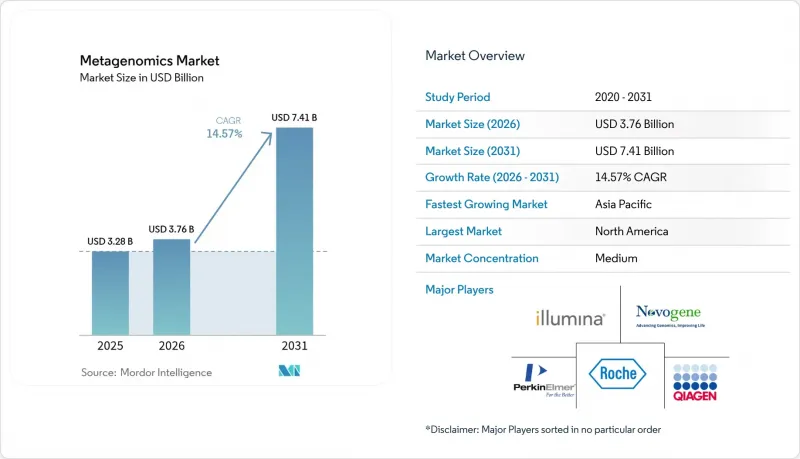
Mordor Intelligence에 의하면, 2026년 군유전체학 시장 규모는 37억 6,000만 달러로 추정되고 있어 2025년 32억 8,000만 달러에서 확대해, 2031년에는 74억 1,000만 달러에 이를 것으로 예측됩니다.
2026년부터 2031년까지의 연평균 성장률(CAGR)은 14.57%가 될 것으로 전망됩니다.
본 보고서는 제품별(시퀀싱 및 데이터 분석 서비스 등), 기술별(시퀀싱 주도형, 기능 주도형 등), 용도별(인간 건강, 환경 모니터링 등), 최종 사용자별(학술 기관, 임상 진단실험실 등), 지역별(북미, 유럽, 아시아태평양 등)로 분류되어 있습니다. 시장 규모 및 전망은 금액(달러)으로 표시되어 있습니다.
세계 군유전체학 시장 동향 및 인사이트
군유전체학 분야의 연구개발비 증가
미생물을 표적으로 한 신약 개발 프로그램이 점점 더 중요해짐에 따라, 제약 및 생명공학 기업들은 군유전체학에 대한 투자를 확대되고 있습니다. 서모피셔 사이언티픽(Thermo Fisher Scientific)은 군유전체학 관련 역량을 강화하기 위한 인수에 400억-500억 달러를 할당하고 있으며, 차세대 치료법에는 마이크로바이옴을 중심으로 한 데이터가 필수적이라는 경영진의 확신을 보여주고 있습니다. 미국 국립보건원(NIH)의 ‘인간 비롬 프로그램’은 2026년까지 도구 개발에 약 250만 달러를 투자하여, 임상 적용을 가속화할 산학 협력을 촉진하고 있습니다. 또한, 2025 회계연도에 3,200만 달러의 예산이 배정된 미국 국립과학재단(NSF)의 ‘감염병의 생태학과 진화’ 이니셔티브와 같은 정부 보조금은 군유전체학와 계산 모델링을 결합하는 학제간 연구를 뒷받침하고 있습니다.
고속 시퀀싱 비용의 하락
전체 유전체 시퀀싱 가격은 2024년에 600달러까지 급락하여 임상 현장에서 광범위한 도입이 가능해졌습니다. Ultima Genomics사는 Q60 정확도로 100달러의 유전체 시퀀싱을 실현하며 업계의 상식을 다시 한번 뒤집었습니다. 이로 인해 기존 기업들은 이익률을 낮추고 제품 주기를 가속화할 수밖에 없게 되었습니다. 미네소타 대학교의 Element AVITI 플랫폼 등을 통한 추가적인 가격 인하로 인해, 동등한 처리량 기준에서 차세대 시퀀싱 가격은 일루미나(Illumina)사의 주력 제품인 NovaSeq보다 낮은 수준으로 떨어졌습니다. 설비 투자에서 생물정보학 전문 지식으로의 예산 배분 전환에 따라, 실험실의 비용 구조는 재편되고 있습니다.
종합적인 메타유전체 분석 워크플로우의 높은 총비용
시퀀싱 자체의 비용은 낮아지고 있지만, 컴퓨팅 인프라, 스토리지, 인증 비용을 포함하면 총 소유 비용은 여전히 높은 수준을 유지하고 있습니다. 미국 국방부의 파일럿 프로젝트에서는 샘플 풀링 및 가상화 기술이 더욱 성숙해지지 않는 한, 일상적인 운영에서 일일 메타유전체 생물 모니터링 비용이 여전히 10-100배나 너무 높다는 결론을 내렸습니다. 저·중소득 지역에서는 물류비와 관세로 인해 소모품 가격이 상승하고 있어, 유전체 1개당 최대 4,500달러의 비용이 소요됩니다.
부문 분석
키트 및 시약은 2025년 매출의 44.60%를 차지했습니다. 이는 시퀀싱을 수행할 때마다 재현 가능한 결과를 보장하는 표준화된 소모품이 소비되기 때문입니다. 반면, 시퀀싱 및 데이터 분석 서비스는 연평균 성장률(CAGR) 17.85%로 확대되고 있으며, 이는 연구소가 계산 부하가 높은 공정을 전문 업체에 위탁하는 것을 선호하는 경향을 반영합니다. 서비스 분야의 군유전체학 시장 규모는 2031년까지 3배 이상 확대될 것으로 예측됩니다. 장비 및 소모품의 경우 안정적인 교체 수요가 유지되는 반면, 클라우드를 통해 제공되는 소프트웨어 파이프라인은 자원이 제한적인 시설의 진입 장벽을 낮추고 있습니다.
규제 당국이 소규모 연구소가 자체적으로 구축하기 어려운 감사 가능한 파이프라인을 요구함에 따라 아웃소싱의 기세는 더욱 강해지고 있습니다. QIAGEN이 주요 클라우드 벤더와 맺은 ‘Digital Insights’ 파트너십은 서비스 생태계가 어떻게 지속적인 수익을 확보하고 있는지를 보여주고 있으며, 한편 Novogene의 고처리량 모델은 학술 컨소시엄을 대상으로 경쟁력 있는 가격대를 제공합니다. 규정 준수 부담과 생물정보학 인력 부족이 맞물리면서, 예측 기간 동안 관리형 서비스의 두 자릿수 성장이 지속될 것으로 예측됩니다.
2025년에는 시퀀싱 주도 워크플로가 메타유전체 시장 점유율의 62.10%를 차지했지만, 3세대 롱 리드 플랫폼은 연평균 성장률(CAGR) 20.90%로 확대되고 있습니다. 롱 리드는 미생물의 전체 유전체을 조립하고, 플라스미드 유래의 내성 유전자를 밝혀내며, 후성유전학적 변형을 실시간으로 정량화합니다. 기능 주도형 프로토콜은 여전히 틈새 영역에 머물러 있지만, 바이오프로세스 최적화에는 필수적인 반면, 앰플리콘 기반 접근법은 비용 효율성을 중시하는 감시 분야에서 계속해서 채택되고 있습니다. 롱 리드 응용 분야의 메타지놈학 시장 규모는 병원 감염 관리 프로그램과 대규모 환경 프로젝트를 뒷받침으로 2031년까지 22억 8,000만 달러를 넘어설 것으로 예측됩니다.
실시간 나노포어 시퀀싱을 통해 국경 검문소나 외딴 지역의 농장 등에서 현장 기반 진단이 가능해집니다. 롱 리드 DNA 및 RNA 시퀀싱을 결합한 연구자들은 현재 활성 유전자 발현과 유전체 컨텍스트 간의 상관관계를 규명하고 있으며, 이러한 능력을 통해 새로운 항감염 표적이 밝혀질 것으로 기대됩니다. 한편, 각 플랫폼 공급업체들은 하이브리드 어셈블리에서 숏 리드의 심도와 롱 리드의 맥락을 융합하기 위해 표준 조화를 도모하고 있습니다.
지역별 분석
북미는 확립된 시퀀싱 인프라, 밀집된 생명공학 클러스터, 그리고 유리한 보험 환급 제도 덕분에 2025년에는 전 세계 매출의 46.20%를 차지했습니다. 미국의 NIH ‘All of Us’ 연구 프로그램과 같은 연방 프로젝트는 마이크로바이옴을 중점적으로 다루는 프로토콜에 대한 자금 지원을 지속하며 국내 수요를 뒷받침하고 있습니다. 캐나다의 ‘정밀 건강 이니셔티브(Precision Health Initiative)’는 이 지역의 시퀀싱 처리량을 더욱 끌어올리고 있습니다.
유럽은 ‘호라이즌 유럽(Horizon Europe)’의 자금 지원과 실제 환경에서 수집된 마이크로바이옴 데이터에 대한 유럽의약품청(EMA)의 지지적인 태도의 혜택을 받아 견고한 입지를 유지하고 있습니다. 국경을 넘는 임상시험에서 메타유전체 평가 지표의 채택이 증가하고 있으며, 유럽 전역의 참조 실험실에서 데이터 파이프라인의 표준화가 촉진되고 있습니다. 또한, 이 지역에는 플랫폼을 전 세계로 수출하고 있는 주요 바이오정보학 소프트웨어 공급업체가 여러 곳 존재합니다.
아시아태평양은 2031년까지 연평균 성장률(CAGR)이 16.20%로 가장 빠르게 성장하는 지역입니다. 중국의 ‘국가 유전자 은행’ 확장 및 인도의 ‘유전체 인디아(Genome India)’ 이니셔티브는 기존 인프라를 획기적으로 개선하는 것을 목표로 하는 정부 자금 지원 프로그램의 대표적인 사례입니다. BGI와 같은 국내 기업들은 DNBSEQ-T7과 같은 비용 효율적인 플랫폼을 활용하여 현지 보급을 추진하는 동시에, 아프리카와 라틴아메리카로 솔루션을 수출하고 있습니다. 싱가포르와 한국은 AI를 활용한 정밀의료 시범 사업에 막대한 투자를 하고 있으며, 이 광범위한 지역을 종단간 군유전체학 생태계의 시험장으로 자리매김하고 있습니다. 중동 및 아프리카에서는 공중보건 기관들이 감염병 조기 경보를 위해 폐수 모니터링을 도입함에 따라, 아직 초기 단계이긴 하지만 관심이 높아지고 있습니다. 한편, 남미에서는 유럽의 연구소와 제휴하여 프로토콜을 이전하고, 현지 인재 양성 체계를 구축하고 있습니다.
기타 혜택:
- 엑셀 형식 시장 예측(ME) 시트
- 3개월간의 애널리스트 지원
자주 묻는 질문
목차
제1장 서론
제2장 조사 방법
제3장 주요 요약
제4장 시장 구도
제5장 시장 규모와 성장 예측
제6장 경쟁 구도
제7장 시장 기회와 향후 전망
JHS 26.08.26According to Mordor Intelligence, metagenomics market size in 2026 is estimated at USD 3.76 billion, growing from 2025 value of USD 3.28 billion with 2031 projections showing USD 7.41 billion, growing at 14.57% CAGR over 2026-2031.
This report is Segmented by Product (Sequencing & Data Analytics Services, and More), Technology (Sequencing-Driven, Function-Driven, and More), Application (Human Health, Environmental Monitoring, and More), End User (Academic, Clinical Diagnostic Laboratories, and More), and Geography (North America, Europe, Asia Pacific, and More). The Market Sizes and Forecasts are Provided in Terms of Value (USD).
Global Metagenomics Market Trends and Insights
Increasing R&D Expenditure in Metagenomics
Pharmaceutical and biotechnology enterprises amplify metagenomics investments because microbial targets increasingly underpin novel drug discovery programs. Thermo Fisher Scientific earmarked USD 40-50 billion for acquisitions that strengthen metagenomics-adjacent capabilities, signaling boardroom conviction that next-generation therapeutics demand microbiome-centric data. The NIH's Human Virome Program directs roughly USD 2.5 million toward 2026 tool development, fostering academic-industry alliances that accelerate clinical translation.Government grants such as the NSF Ecology and Evolution of Infectious Diseases initiative, with a USD 32 million budget for FY 2025, encourage multidisciplinary research linking metagenomics with computational modeling.
Declining Cost of High-Throughput Sequencing
Whole-genome sequencing prices plunged to USD 600 in 2024, unlocking widespread clinical deployment. Ultima Genomics further disrupted norms by achieving a USD 100 genome at Q60 accuracy, forcing incumbents to compress margins and accelerate product cycles. Additional price cuts, such as the University of Minnesota's Element AVITI platform, now position next-generation sequencing below Illumina's flagship NovaSeq for comparable throughput. Budgetary shifts away from capital equipment toward bioinformatics expertise reshape laboratory cost structures.
High Overall Cost of Comprehensive Metagenomic Workflows
Although sequencing itself is cheaper, total ownership costs remain high once computational infrastructure, storage, and accreditation are included. A Pentagon pilot concluded that daily metagenomic biosurveillance remains 10-100 times too costly for routine use unless sample pooling and virtualization mature further. Low- and middle-income regions pay up to USD 4,500 per genome because logistics and customs fees inflate consumable prices.
Other drivers and restraints analyzed in the detailed report include:
- Continuous Improvements in Library-Prep & Bioinformatics Pipelines
- Emergence of Ultra-Long-Read Sequencing Enabling Strain-Level Insights
- Shortage of Skilled Bioinformaticians for Data Interpretation
For complete list of drivers and restraints, kindly check the Table Of Contents.
Segment Analysis
Kits & reagents retained 44.60% of 2025 revenue because every sequencing run consumes standardized consumables that ensure reproducible results. However, sequencing & data analytics services are scaling at an 17.85% CAGR, reflecting laboratories' preference to outsource compute-intensive steps to specialized providers. The metagenomics market size for services is projected to increase more than threefold by 2031. Instruments & consumables maintain steady replacement demand, whereas cloud-delivered software pipelines lower barriers for resource-constrained facilities.
Outsourcing momentum intensifies as regulators demand auditable pipelines that small laboratories rarely build in-house. QIAGEN's Digital Insights partnership with major cloud vendors illustrates how service ecosystems capture recurring fees, while Novogene's high-throughput model offers competitive pricing tiers for academic consortia. This combination of compliance burden and bioinformatics talent shortage should sustain double-digit growth for managed services over the forecast horizon.
Sequencing-driven workflows represented 62.10% of the metagenomics market share in 2025, yet third-generation long-read platforms are expanding at 20.90% CAGR. Long reads assemble complete microbial genomes, reveal plasmid-borne resistance genes, and quantify epigenetic modifications in real time. Function-driven protocols remain niche but essential for bioprocess optimization, while amplicon-based approaches persist in cost-sensitive surveillance. The metagenomics market size for long-read applications should surpass USD 2.28 billion by 2031, catalyzed by hospital infection-control programs and large-scale environmental projects.
Real-time nanopore sequencing enables field-deployable diagnostics at border checkpoints and remote farms. Researchers combining long-read DNA and RNA sequencing now correlate active gene expression with genomic context, a capability expected to unlock new anti-infective targets. Meanwhile, platform vendors seek standards harmonization so that hybrid assemblies merge the depth of short reads with the context of long ones.
Complete Report Scope:
- By Product
- Sequencing & Data Analytics Services
- Kits & Reagents
- Instruments & Consumables
- Software & Pipeline Tools
- Others
- By Technology
- Sequencing-Driven Metagenomics
- Function-Driven Metagenomics
- Third-Generation Long-Read Sequencing
- Amplicon-Based Targeted Sequencing
- Metatranscriptomics
- By Application
- Human Health
- Environmental Monitoring & Bioremediation
- Agriculture & Food Safety Testing
- Others
- By End-User
- Academic & Research Institutes
- Pharmaceutical & Biotechnology Companies
- Clinical Diagnostic Laboratories
- Environmental & Food Testing Labs
- CROs & Service Providers
- By Geography
- North America
- United States
- Canada
- Mexico
- Europe
- Germany
- United Kingdom
- France
- Italy
- Spain
- Rest of Europe
- Asia Pacific
- China
- Japan
- India
- South Korea
- Australia
- Rest of Asia Pacific
- Middle East and Africa
- GCC
- South Africa
- Rest of Middle East and Africa
- South America
- Brazil
- Argentina
- Rest of South America
- North America
Geography Analysis
North America controlled 46.20% of global revenue in 2025 due to established sequencing infrastructure, dense biotech clusters, and favorable reimbursement. Federal projects such as the NIH All of Us Research Program continue to channel funding into microbiome-heavy protocols, sustaining domestic demand. Canada's Precision Health Initiative further bolsters regional sequencing volumes.
Europe maintains a robust position, benefiting from the Horizon Europe funding stream and the European Medicines Agency's supportive stance on real-world microbiome data. Cross-border clinical trials increasingly incorporate metagenomic endpoints, encouraging standardized data pipelines across European reference labs. The region also houses several leading bioinformatics software vendors that export platforms globally.
Asia Pacific represents the fastest-growing geography at 16.20% CAGR through 2031. China's National GeneBank expansion and India's Genome India initiative exemplify government-funded programs that aim to leapfrog legacy infrastructure. Domestic players such as BGI leverage cost-efficient platforms like DNBSEQ-T7 to drive local adoption while exporting solutions to Africa and Latin America. Singapore and South Korea invest heavily in AI-enabled precision medicine pilots, positioning the broader region as a testbed for end-to-end metagenomics ecosystems. The Middle East and Africa show nascent but rising interest as public-health agencies embrace wastewater surveillance for early outbreak alerts-South America partners with European labs to transfer protocols and build local talent pipelines.
- Illumina
- Thermo Fisher Scientific
- QIAGEN
- Roche
- BGI
- Novogene Co., Ltd.
- PerkinElmer
- Eurofins
- Oxford Nanopore Technologies plc
- Pacific Bioscience
- Agilent Technologies
- Bio-Rad Laboratories
- Promega
- Merck
- Takara Bio
- Zymo Research
- Genewiz (Azenta Life Sciences)
- CosmosID Inc.
- Genscript Biotech Corporation
- Brooks Life Sciences (Cell & Gene Solutions)
Additional Benefits:
- The market estimate (ME) sheet in Excel format
- 3 months of analyst support
TABLE OF CONTENTS
1 Introduction
- 1.1 Study Assumptions & Market Definition
- 1.2 Scope of the Study
2 Research Methodology
3 Executive Summary
4 Market Landscape
- 4.1 Market Overview
- 4.2 Market Drivers
- 4.2.1 Increasing R&D Expenditure In Metagenomics
- 4.2.2 Declining Cost Of High-Throughput Sequencing
- 4.2.3 Continuous Improvements In Library-Prep & Bioinformatics Pipelines
- 4.2.4 Emergence Of Ultra-Long-Read Sequencing Enabling Strain-Level Insights
- 4.2.5 AI-Powered Point-Of-Care Infectious-Disease Metagenomics Platforms
- 4.2.6 National Microbiome Data-Commons Initiatives Releasing Open Datasets
- 4.3 Market Restraints
- 4.3.1 High Overall Cost Of Comprehensive Metagenomic Workflows
- 4.3.2 Shortage Of Skilled Bioinformaticians For Data Interpretation
- 4.3.3 Data-Privacy & Ethical Concerns Over Incidental Human Genomic Findings
- 4.3.4 Export-Control Risks Disrupting Enzyme & Reagent Supply Chains
- 4.4 Supply-Chain Analysis
- 4.5 Regulatory Landscape
- 4.6 Technological Outlook
- 4.7 Porter's Five Forces Analysis
- 4.7.1 Threat of New Entrants
- 4.7.2 Bargaining Power of Buyers
- 4.7.3 Bargaining Power of Suppliers
- 4.7.4 Threat of Substitutes
- 4.7.5 Intensity of Competitive Rivalry
5 Market Size & Growth Forecasts (Value)
- 5.1 By Product
- 5.1.1 Sequencing & Data Analytics Services
- 5.1.2 Kits & Reagents
- 5.1.3 Instruments & Consumables
- 5.1.4 Software & Pipeline Tools
- 5.1.5 Others
- 5.2 By Technology
- 5.2.1 Sequencing-Driven Metagenomics
- 5.2.2 Function-Driven Metagenomics
- 5.2.3 Third-Generation Long-Read Sequencing
- 5.2.4 Amplicon-Based Targeted Sequencing
- 5.2.5 Metatranscriptomics
- 5.3 By Application
- 5.3.1 Human Health
- 5.3.2 Environmental Monitoring & Bioremediation
- 5.3.3 Agriculture & Food Safety Testing
- 5.3.4 Others
- 5.4 By End-User
- 5.4.1 Academic & Research Institutes
- 5.4.2 Pharmaceutical & Biotechnology Companies
- 5.4.3 Clinical Diagnostic Laboratories
- 5.4.4 Environmental & Food Testing Labs
- 5.4.5 CROs & Service Providers
- 5.5 By Geography
- 5.5.1 North America
- 5.5.1.1 United States
- 5.5.1.2 Canada
- 5.5.1.3 Mexico
- 5.5.2 Europe
- 5.5.2.1 Germany
- 5.5.2.2 United Kingdom
- 5.5.2.3 France
- 5.5.2.4 Italy
- 5.5.2.5 Spain
- 5.5.2.6 Rest of Europe
- 5.5.3 Asia Pacific
- 5.5.3.1 China
- 5.5.3.2 Japan
- 5.5.3.3 India
- 5.5.3.4 South Korea
- 5.5.3.5 Australia
- 5.5.3.6 Rest of Asia Pacific
- 5.5.4 Middle East and Africa
- 5.5.4.1 GCC
- 5.5.4.2 South Africa
- 5.5.4.3 Rest of Middle East and Africa
- 5.5.5 South America
- 5.5.5.1 Brazil
- 5.5.5.2 Argentina
- 5.5.5.3 Rest of South America
- 5.5.1 North America
6 Competitive Landscape
- 6.1 Market Concentration
- 6.2 Market Share Analysis
- 6.3 Company Profiles (includes Global level Overview, Market level overview, Core Segments, Financials as available, Strategic Information, Market Rank/Share for key companies, Products & Services, and Recent Developments)
- 6.3.1 Illumina Inc.
- 6.3.2 Thermo Fisher Scientific Inc.
- 6.3.3 QIAGEN N.V.
- 6.3.4 F. Hoffmann-La Roche Ltd
- 6.3.5 BGI Group
- 6.3.6 Novogene Co., Ltd.
- 6.3.7 PerkinElmer Inc.
- 6.3.8 Eurofins Scientific SE
- 6.3.9 Oxford Nanopore Technologies plc
- 6.3.10 Pacific Biosciences of California, Inc.
- 6.3.11 Agilent Technologies, Inc.
- 6.3.12 Bio-Rad Laboratories, Inc.
- 6.3.13 Promega Corporation
- 6.3.14 Merck KGaA
- 6.3.15 Takara Bio Inc.
- 6.3.16 Zymo Research Corporation
- 6.3.17 Genewiz (Azenta Life Sciences)
- 6.3.18 CosmosID Inc.
- 6.3.19 Genscript Biotech Corporation
- 6.3.20 Brooks Life Sciences (Cell & Gene Solutions)
7 Market Opportunities & Future Outlook
- 7.1 White-space & Unmet-Need Assessment


