

|
시장보고서
상품코드
2115825
인지 데이터 관리 : 시장 점유율 분석, 업계 동향 및 통계, 성장 예측(2026-2031년)Cognitive Data Management - Market Share Analysis, Industry Trends & Statistics, Growth Forecasts (2026 - 2031) |
||||||
 Mordor Intelligence
Mordor Intelligence에 의하면, 인지 데이터 관리 시장 규모는 2025년에 278억 달러로 평가되었습니다. 2026년 327억 4,000만 달러에서 2031년까지 739억 2,000만 달러에 이를 것으로 예상되며, 예측 기간(2026-2031년) CAGR은 17.72%를 나타낼 전망입니다.
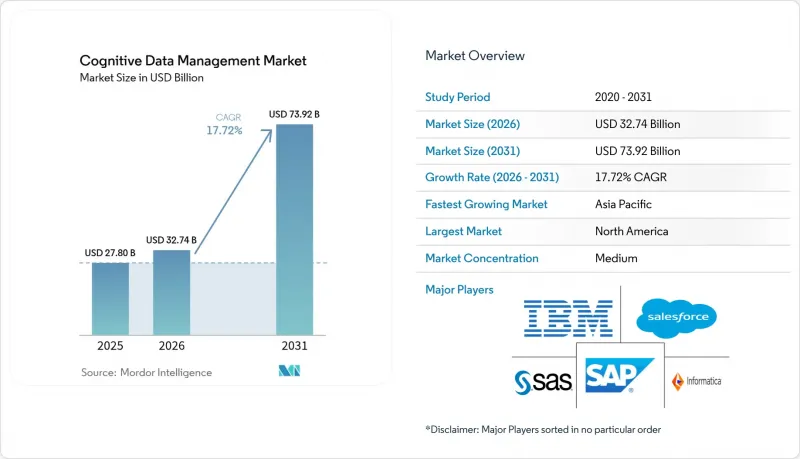
본 보고서는 구성 요소(솔루션, 서비스), 도입 형태(On-Premise, 클라우드), 산업 분야(은행, 금융서비스 및 보험(BFSI), 제조, IT 및 통신 등) 및 지역별로 분류되어 있습니다. 시장 예측은 금액(달러) 기준으로 제시되어 있습니다.
세계의 인지 데이터 관리 시장 동향 및 인사이트
IoT로 인한 데이터의 홍수
제조 공장, 커넥티드카, 의료용 웨어러블 기기는 현재 매일 테라바이트 규모의 텔레메트리 데이터를 생성하고 있습니다. 인지 데이터 관리 플랫폼은 실시간으로 데이터를 수집·분류하고 이상을 감지함으로써, 데이터가 엣지 측에서 실용 가능한 상태를 유지하도록 보장하면서 통합적인 거버넌스를 유지합니다. 테슬라(Tesla) 등의 자동차 차량군은 매달 1.6페타바이트 이상의 주행 데이터를 생성하고 있으며, 이로 인해 인지 데이터 관리 시장은 자율주행 모델에 데이터를 공급하는 고처리량 파이프라인을 제공해야 하는 압박을 받고 있습니다. 엣지에서의 로컬 처리를 통해 지연 시간이 감소하는 한편, 클라우드를 통한 오케스트레이션으로 규정 준수 및 모델 훈련을 위한 통합된 거버넌스 계층이 유지됩니다.
하이퍼스케일 분석 및 생성형 AI 도입
대규모 언어 모델(LLM) 프로그램은 지능형 카탈로그화 및 품질 평가 엔진에 의해 뒷받침될 경우, 데이터에서 인사이트를 도출하기까지의 주기를 40-60% 단축합니다. 인지 플랫폼은 대규모 데이터 레이크 내의 데이터 발견을 자동화하고, 벡터 스토어에 연결하여 검색 강화 생성(RAG)을 실현하는 동시에, 모델의 설명 가능성을 위해 완전한 데이터 계보를 유지합니다. 파이프라인의 자동 최적화를 통해 계산 비용이 절감되며, 이는 기업이 점점 더 대규모 모델을 학습시키는 데 있어 중요한 이점이 됩니다.
복잡한 분석 워크플로우
기업들은 AWS, Azure, Google Cloud에 걸친 멀티클라우드 환경을 운영하고 있으며, 76%가 혼합 환경을 운영하고 있습니다. 인지 데이터 관리 플랫폼은 성능을 저하시키지 않으면서 데이터 마이그레이션을 조정하고, 일관된 정책을 적용하며, 메인프레임의 피드를 통합해야 합니다. 맞춤형 커넥터와 실시간 요구 사항은 비용을 증가시키고 도입 주기를 길게 만들어 즉각적인 성장을 저해합니다.
부문별 분석
2025년 매출 중 솔루션이 63.25%를 차지했으며, 이는 카탈로그화, 데이터 계보, 정책 적용을 자동화하는 소프트웨어 제품군의 정착을 반영합니다. 조직들이 고급 AI 거버넌스를 위한 자문, 통합 및 관리형 운영 지원을 요구함에 따라, 서비스 부문은 2031년까지 연평균 성장률(CAGR) 24.1%로 확대될 것으로 전망됩니다. 서비스 부문의 인지 데이터 관리 시장 규모는 사내에 필요한 인력이 부족한 대규모 디지털 전환(DX) 프로그램과 연동하여 추이할 것으로 예측됩니다. 현재는 전문 서비스가 주류를 이루고 있지만, 규제가 엄격한 업계에서는 매니지드 서비스에 대한 수요가 가장 빠르게 증가하고 있습니다.
구축 파트너는 고객의 인프라 모델 통합, 익명화 프레임워크 구축, 레거시 데이터 소스와의 연동을 지원하여 가치 창출까지 걸리는 시간을 단축합니다. AI 대응 엔지니어링 분야의 인력 부족으로 인해 기업들은 아웃소싱을 선택할 수밖에 없으며, 리스크가 관리된 구축 과정에서 서비스는 매우 중요한 역할을 수행하고 있습니다. 각 벤더는 지속적인 모델 큐레이션 서비스와 규정 준수 보고를, 예측 가능한 비용을 보장하는 구독 모델로 패키지화하고 있습니다.
지역별 분석
2025년, 북미는 전 세계 매출의 41.20%를 차지했으며, 이는 성숙한 클라우드 생태계, 집중된 기술 전문 지식, 그리고 BFSI(은행 및 금융 및 보험) 및 헬스케어 분야에서의 적극적인 엔터프라이즈 AI 도입에 의해 뒷받침되고 있습니다. Snowflake가 실리콘밸리에 2억 달러 규모의 AI 허브를 구축하는 등 지속적인 투자가 이 지역의 혁신 리더십을 강화하고 있습니다. 명확한 규제와 풍부한 숙련된 인력이 안정적인 성장을 뒷받침하고 있지만, 전문 AI 엔지니어링 직종에서의 인력 부족은 여전히 지속되고 있습니다.
아시아태평양(APAC)은 2031년까지 연평균 성장률(CAGR)이 20.85%로 가장 빠른 성장 궤도를 보이고 있습니다. 일본의 ‘Society 5.0’ 구상, 싱가포르의 ‘Smart Nation’ 프로그램, 중국의 ‘Sovereign-AI’ 의제에 힘입어 인지 데이터 관리에 대한 지출이 가속화되고 있습니다. 현지 제조업의 디지털화와 5G 확대로 인해 데이터 양에 대한 과제가 심화되고 있으며, 지역 거버넌스 모델이 자동화된 주거 관리에 대한 수요를 창출하고 있습니다. 인도의 IT 서비스 부문은 전 세계에 인지 기능을 제공하는 매니지드 서비스 제공을 확대되고 있습니다.
유럽에서는 GDPR(EU 개인정보보호규정) 시행과 EU AI법으로 인해 규정 준수 압박이 높아지는 가운데, 꾸준한 성장이 예상됩니다. 기업들은 연방 학습(federated learning)과 차등 프라이버시(differential privacy)를 활용한 프라이버시 보호형 분석을 우선시하고 있으며, 이러한 기술들은 인지 플랫폼과 높은 친화성을 가지고 있습니다. 독일은 제조업 분야의 도입을 주도하고 있으며, 영국은 금융 서비스 분야의 활용 사례를 추진하고, 북유럽 국가들은 지속가능성 지표를 통합하여 데이터 거버넌스와 병행하여 AI 인프라의 탄소 발자국을 추적하고 있습니다.
중동, 아프리카 및 남미는 새로운 기회를 내포하고 있습니다. 각국 정부는 디지털 경제 이니셔티브를 출범시켰으며, 통신 사업자들은 AI 지원 데이터 패브릭을 활용해 네트워크 현대화를 추진하고 있습니다. 인프라 격차와 기술 인력 부족이 단기적인 성장을 저해하고 있지만, 지역별 규제와 클라우드 리전 구축이 향후 확장을 위한 기반을 마련하고 있습니다.
기타 혜택 :
- 엑셀 형식 시장 예측(ME) 시트
- 3개월간의 애널리스트 지원
자주 묻는 질문
목차
제1장 서론
제2장 조사 방법
제3장 개요
제4장 시장 구도
제5장 시장 규모 및 성장 예측
제6장 경쟁 구도
제7장 시장 기회 및 향후 전망
KTH 26.08.31According to Mordor Intelligence, the cognitive data management market size was valued at USD 27.80 billion in 2025 and estimated to grow from USD 32.74 billion in 2026 to reach USD 73.92 billion by 2031, at a CAGR of 17.72% during the forecast period (2026-2031).
This report is Segmented by Component (Solutions and Services), Deployment Type (On-Premises and Cloud), Industry Vertical (BFSI, Manufacturing, IT and Telecommunications, and More), and Geography. The Market Forecasts are Provided in Terms of Value (USD).
Global Cognitive Data Management Market Trends and Insights
IoT-Linked Data Deluge
Manufacturing plants, connected vehicles, and healthcare wearables now produce terabytes of telemetry every day. Cognitive data management platforms ingest, classify, and flag anomalies in real time, ensuring data is actionable at the edge while remaining governed centrally. Automotive fleets such as Tesla's generate more than 1.6 petabytes of driving data each month, compelling the cognitive data management market to offer high-throughput pipelines that feed autonomous-driving models. Local processing at the edge reduces latency, yet cloud orchestration preserves a unified governance layer for compliance and model training.
Hyper-Scale Analytics and Generative-AI Adoption
Large language model programs shorten the data-to-insight cycle by 40-60% when underpinned by intelligent cataloging and quality-assessment engines. Cognitive platforms automate data discovery inside massive lakes, connect to vector stores for retrieval-augmented generation, and maintain complete lineage for model explainability. Automated pipeline optimization lowers computation spending, a key benefit as enterprises train ever-larger models.
Complex Analytical Workflows
Enterprises run multi-cloud estates that span AWS, Azure, and Google Cloud, with 76% operating mixed environments.Cognitive data management platforms must orchestrate data movement, enforce consistent policies, and integrate mainframe feeds-all without performance loss. Custom connectors and real-time requirements add cost and lengthen implementation cycles, which dampens immediate growth.
Other drivers and restraints analyzed in the detailed report include:
- Mandatory Data-Governance Regulations
- Foundation-Model-Driven Metadata Enrichment
- Persistent Data-Security Gaps
For complete list of drivers and restraints, kindly check the Table Of Contents.
Segment Analysis
Solutions accounted for 63.25% of 2025 revenue, reflecting the entrenched adoption of software suites that automate cataloging, lineage, and policy enforcement. Services expand at 24.1% CAGR to 2031 as organizations seek advisory, integration, and managed operations support for advanced AI governance. The cognitive data management market size for services is projected to move in tandem with large digital-transformation programs that lack in-house talent. Professional services dominate today, while managed services show the fastest pick-up in regulated verticals.
Implementation partners help clients embed foundation models, build anonymization frameworks, and connect legacy sources, reducing time-to-value. The talent gap in AI-ready engineering pushes enterprises toward outsourcing, making services pivotal for risk-controlled deployments. Vendors package ongoing model-curation services and compliance reporting into subscription models that promise predictable costs.
Complete Report Scope:
- By Component
- Solutions
- Services
- By Deployment Type
- On-Premises
- Cloud
- By Industry Vertical
- BFSI
- Healthcare and Pharmaceuticals
- IT and Telecommunication
- Manufacturing
- Other Verticals
- By Geography
- North America
- South America
- Europe
- Asia Pacific
- Middle East and Africa
Geography Analysis
North America accounts for 41.20% of global revenue in 2025, upheld by mature cloud ecosystems, concentrated tech expertise, and aggressive enterprise AI rollouts in BFSI and healthcare. Ongoing investments, such as Snowflake's USD 200 million AI hub in Silicon Valley, reinforce the region's innovation leadership. Regulatory certainty and a large skilled workforce support stable growth, though talent shortages persist in specialty AI engineering roles.
APAC exhibits the swiftest trajectory with a 20.85% CAGR through 2031. Japan's Society 5.0 framework, Singapore's Smart Nation program, and China's sovereign-AI agenda accelerate spending on cognitive data management. Local manufacturing digitization and 5G expansion intensify data-volume challenges, and regional governance models spark demand for automated residency controls. India's IT services sector expands managed offerings that deliver cognitive capabilities worldwide.
Europe grows steadily as GDPR enforcement and the EU AI Act heighten compliance pressures. Enterprises prioritize privacy-preserving analytics using federated learning and differential privacy, which align well with cognitive platforms. Germany leads manufacturing adoption, the UK propels financial services use cases, and Nordic countries integrate sustainability metrics, tracking the carbon footprint of AI infrastructure alongside data governance.
Middle East and Africa and South America represent emerging opportunities. Governments launch digital-economy initiatives, and telcos modernize networks with AI-ready data fabrics. Infrastructure gaps and skills deficits temper near-term growth, yet localized regulations and cloud-region buildouts lay groundwork for future expansion.
- IBM
- Microsoft
- SAP
- Oracle
- Informatica
- Salesforce
- SAS Institute
- AWS
- Collibra
- Talend (Qlik)
- Snowflake
- Databricks
- Denodo
- Alteryx
- VAST Data
- Ataccama
- Immuta
- Reltio
- SnapLogic
Additional Benefits:
- The market estimate (ME) sheet in Excel format
- 3 months of analyst support
TABLE OF CONTENTS
1 INTRODUCTION
- 1.1 Study Assumptions and Market Definition
- 1.2 Scope of the Study
2 RESEARCH METHODOLOGY
3 EXECUTIVE SUMMARY
4 MARKET LANDSCAPE
- 4.1 Market Overview
- 4.2 Market Drivers
- 4.2.1 IoT-linked data deluge
- 4.2.2 Hyper-scale analytics and Gen-AI adoption
- 4.2.3 Mandatory data-governance regulations
- 4.2.4 Foundation-model-driven metadata enrichment
- 4.2.5 Rise of privacy-preserving data clean rooms
- 4.2.6 Cloud-native data-fabric services from hyperscalers
- 4.3 Market Restraints
- 4.3.1 Complex analytical workflows
- 4.3.2 Persistent data-security gaps
- 4.3.3 Scarcity of data engineering talent
- 4.3.4 High carbon footprint of AI-grade infra
- 4.4 Industry Value Chain Analysis
- 4.5 Regulatory Landscape
- 4.6 Technological Outlook
- 4.7 Porter's Five Forces Analysis
- 4.7.1 Bargaining Power of Suppliers
- 4.7.2 Bargaining Power of Consumers
- 4.7.3 Threat of New Entrants
- 4.7.4 Threat of Substitutes
- 4.7.5 Intensity of Competitive Rivalry
5 Market Size and Growth Forecasts (Value (USD))
- 5.1 By Component
- 5.1.1 Solutions
- 5.1.2 Services
- 5.2 By Deployment Type
- 5.2.1 On-Premises
- 5.2.2 Cloud
- 5.3 By Industry Vertical
- 5.3.1 BFSI
- 5.3.2 Healthcare and Pharmaceuticals
- 5.3.3 IT and Telecommunication
- 5.3.4 Manufacturing
- 5.3.5 Other Verticals
- 5.4 By Geography
- 5.4.1 North America
- 5.4.2 South America
- 5.4.3 Europe
- 5.4.4 Asia Pacific
- 5.4.5 Middle East and Africa
6 COMPETITIVE LANDSCAPE
- 6.1 Market Concentration
- 6.2 Strategic Moves
- 6.3 Market Share Analysis
- 6.4 Company Profiles (includes Global level Overview, Market level overview, Core Segments, Financials as available, Strategic Information, Market Rank/Share for key companies, Products and Services, and Recent Developments)
- 6.4.1 IBM
- 6.4.2 Microsoft
- 6.4.3 SAP
- 6.4.4 Oracle
- 6.4.5 Informatica
- 6.4.6 Salesforce
- 6.4.7 SAS Institute
- 6.4.8 AWS
- 6.4.9 Google
- 6.4.10 Collibra
- 6.4.11 Talend (Qlik)
- 6.4.12 Snowflake
- 6.4.13 Databricks
- 6.4.14 Denodo
- 6.4.15 Alteryx
- 6.4.16 VAST Data
- 6.4.17 Ataccama
- 6.4.18 Immuta
- 6.4.19 Reltio
- 6.4.20 SnapLogic
7 MARKET OPPORTUNITIES AND FUTURE OUTLOOK
- 7.1 White-space and Unmet-need Assessment


