

|
시장보고서
상품코드
2115865
유럽의 항공기 조명 : 시장 점유율 분석, 업계 동향과 통계, 성장 예측(2026-2031년)Europe Aircraft Lighting - Market Share Analysis, Industry Trends & Statistics, Growth Forecasts (2026 - 2031) |
||||||
 Mordor Intelligence
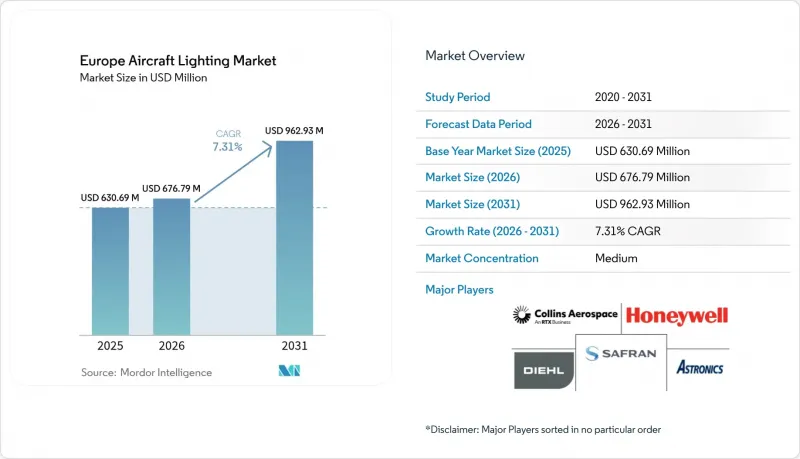
Mordor Intelligence에 따르면 유럽의 항공기 조명 시장 규모는 2025년에 6억 3,069만 달러로 평가되며, 2026년 6억 7,679만 달러에서 2031년까지 9억 6,293만 달러에 달할 것으로 예측되며, 예측 기간(2026-2031년) 동안 CAGR은 7.31%가 될 전망입니다.
본 보고서는 조명 유형(실내 조명 및 실외 조명), 항공기 유형(협폭기, 광폭기, 리저널 제트, 비즈니스 제트 등), 설치 형태(라인핏 및 레트로핏), 기술(LED, 형광등 등), 및 지역(영국, 프랑스, 독일, 스페인,이탈리아, 러시아 등)별로 분류되어 있습니다. 시장 예측은 금액(달러) 기준으로 제시되어 있습니다.
유럽 항공기 조명 시장의 동향 및 인사이트
기단 현대화 및 LED 도입
독일, 프랑스, 영국의 항공사들은 연료 소비량 감축과 승객 편의성 향상을 위해 기체 교체를 가속화하고 있습니다. 백열등이나 할로겐등을 LED 키트로 교체함으로써 최대 75%의 에너지 절감 효과와 50,000시간을 넘는 부품 수명을 실현할 수 있습니다. 모듈식 개조 제품을 통해 항공사는 정기 점검 시 업그레이드를 실시할 수 있어 장시간의 지상 대기 시간을 피할 수 있습니다. 색온도를 조절할 수 있는 객실용 LED는 항공사가 걸프 지역 경쟁사들에 필적하는 프리미엄 기내 분위기를 제공할 수 있게 해줍니다. A320neo 계열 기종의 꾸준한 생산으로 인해 OEM의 수요는 지속적으로 예상되는 한편, 성숙기에 접어든 기체의 개조 주기가 짧아짐에 따라 애프터마켓의 수익원도 확대되고 있습니다.
기분을 북돋우는 기내 분위기에 대한 승객의 수요
유럽의 승객들은 여행 중 웰빙과 브랜드 이미지를 더욱 중요하게 여기고 있습니다. 낮 동안의 빛 변화를 모방한 역동적인 조명 연출은 장거리 노선에서 생체 리듬 조절을 돕고, 시차로 인한 불편을 완화합니다. 프리미엄 항공사들은 기내를 서로 다른 색조로 구역별로 구분함으로써 기업 정체성과 부문 간 차별화를 강화하고 있습니다. STG Aerospace는 자사의 saf-Tglo 비상 조명용 친환경 패키지를 도입하여, 항공사가 미관뿐만 아니라 지속가능성에도 주력하고 있음을 강조하고 있습니다. 비즈니스 제트기에는 구조적 개조 없이도 소유자가 분위기를 맞춤 설정할 수 있는, 완전히 프로그래밍 가능한 LED 스트립이 탑재되어 있습니다.
높은 인증 및 규정 준수 비용
EASA의 철저한 시험 체계에서는 수천 시간에 걸친 진동, 전자기, 온도 사이클 시험이 의무화되어 있어, 제품 인증 예산에 수백만 유로의 추가 비용이 발생하고 있습니다. 소규모 혁신 기업들은 이 전체 과정에 필요한 자금 조달에 어려움을 겪고 있어, 획기적인 아이디어가 항공사에 전달되기까지의 속도가 둔화되고 있습니다. 방대한 문서 작성은 각 변형마다 간접비를 증가시켜, 고도로 맞춤화된 솔루션의 도입을 저해하고 있습니다. 기존 Tier 1 공급업체조차도 진화하는 사이버 보안 및 화재 안전 조항에 대응하기 위해 제품군 전체에 대한 재인증을 진행하면서 엔지니어링 팀의 부담이 증가하고 있습니다.
부문 분석
2025년, 유럽 항공기 조명 시장에서 인테리어 시스템은 54.65%의 점유율을 차지했습니다. 이는 지속적인 객실 개조 프로그램과 구형 협폭기(narrow-body) 항공기에서의 대규모 도입 실적이 주도한 결과입니다. 항공사들이 에너지 절약과 차별화된 분위기 조성을 추구하는 가운데, 객실 조명, 조종실 조명 및 비상 조명이 매출의 대부분을 차지하고 있습니다. 기내용 LED는 기내 엔터테인먼트 제어 시스템과 통합되어 있어 승무원이 객실 구역별로 밝기를 조절할 수 있습니다. 저비용 항공사(LCC) 사이에서 개조 키트가 보급됨에 따라, 유럽 기내 항공기 조명 시장 규모는 2031년까지 연평균 성장률(CAGR) 6.55%로 확대될 것으로 예측됩니다.
2025년에는 외부 조명이 매출의 45.35%를 차지했으나, 엄격한 충돌 방지를 위한 가시성 규제와 eVTOL의 설계 요구에 힘입어 연평균 성장률(CAGR) 8.05%로 내부 조명을 앞지르는 성장이 예상됩니다. 고휘도 LED는 착륙등의 칸델라 출력 면에서 크세논 전구와 맞먹는 성능을 발휘하는 동시에 유지보수 작업의 부담을 경감시키고 있습니다. 센서를 통한 휘도 조절로 활주 중 에너지 효율이 향상됩니다. 에어버스 A321XLR 등의 OEM 프로그램에서는 스마트 외부 조명 패키지가 표준으로 채택되어, 공급업체에게 안정적인 공급량을 확보해 주고 있습니다.
2025년 출하대수에서 협폭기가 차지하는 비율은 53.12%가 되었으며, 이는 A320neo 및 B737 MAX의 생산 속도를 반영한 것입니다. 항공사들은 전체 기단의 예비 부품 관리를 효율화하기 위해 LED 구성을 표준화하고 있으며, 이로 인해 라인 핏(공장 출고 시 장착)의 수량이 증가하고 있습니다. 유럽의 협폭기용 항공기 조명 시장 점유율은 운임 경쟁 속에서 차별화를 꾀하기 위해 저비용 항공사(LCC)들이 객실을 업그레이드하고 있는 데서 혜택을 보고 있습니다.
비즈니스 제트기는 전세기 수요와 기업 출장 수요의 회복에 힘입어 6.31%라는 가장 높은 연평균 성장률(CAGR)을 기록하고 있습니다. 소유주들은 스마트 캐빈 앱과 연동되는 맞춤형 독서등, 천장 조명, 액센트 조명을 지정하고 있습니다. 지속가능한 항공 연료에 대한 노력이 초고효율 LED를 통합한 새로운 기체 프로그램을 촉진하고 있습니다.
기타 혜택:
- 엑셀 형식의 시장 예측(ME) 시트
- 3개월간의 애널리스트 지원
자주 묻는 질문
목차
제1장 소개
제2장 조사 방법
제3장 주요 요약
제4장 시장 구도
제5장 시장 규모와 성장 예측
제6장 경쟁 구도
제7장 시장 기회와 향후 전망
KSM 26.08.26According to Mordor Intelligence, the european aircraft lighting market size was valued at USD 630.69 million in 2025 and estimated to grow from USD 676.79 million in 2026 to reach USD 962.93 million by 2031, at a CAGR of 7.31% during the forecast period (2026-2031).
This report is Segmented by Lighting Type (Interior Lighting and Exterior Lighting), Aircraft Type (Narrowbody Aircraft, Widebody Aircraft, Regional Jets, Business Jets, and More), Fit (Linefit and Retrofit), Technology (LED, Fluorescent, and More), and Geography (United Kingdom, France, Germany, Spain, Italy, Russia, and More). The Market Forecasts are Provided in Terms of Value (USD).
Europe Aircraft Lighting Market Trends and Insights
Fleet Modernization and LED Adoption
Airlines in Germany, France, and the UK accelerate fleet renewal to cut fuel burn and improve passenger comfort. Replacing incandescent or halogen fixtures with LED kits yields up to 75% energy savings and component life beyond 50,000 hours. Modular retrofit products let carriers install upgrades during regular checks, avoiding long ground time. Interior LEDs with variable color temperatures help airlines deliver a premium in-flight ambience that rivals Gulf competitors. Strong production runs of A320neo family jets ensure sustained OEM demand, while rising retrofit cycles on mature fleets enlarge aftermarket revenue pools.
Passenger Demand for Mood-Enhancing Cabin Ambience
European flyers place a higher value on wellness and brand cues during travel. Dynamic lighting scenes that mimic daylight changes support circadian alignment on long-haul routes, reducing jet lag complaints. Premium carriers configure cabin zones with distinct hues, reinforcing corporate identity and segment differentiation. STG Aerospace introduced eco-friendly packaging for its saf-Tglo emergency lights, underscoring airlines' focus on sustainability alongside aesthetics. Business jets add fully programmable LED strips that let owners personalize ambience without structural modification.
High Certification and Compliance Costs
EASA's exhaustive testing regime requires vibration, electromagnetic, and temperature cycling across thousands of hours, adding millions of euros to product qualification budgets. Smaller innovators struggle to finance the entire process, slowing the pace at which disruptive ideas reach airlines. Lengthy documentation adds overhead for each variant, discouraging highly customized solutions. Even established Tier-1s face stretched engineering teams as they requalify entire families for evolving cybersecurity and fire-safety clauses.
Other drivers and restraints analyzed in the detailed report include:
- Regulatory Mandates on Safety-Critical Lighting Upgrades
- Smart, Sensor-Integrated Lighting Enabling Predictive Maintenance
- Semiconductor Supply Chain Constraints
For complete list of drivers and restraints, kindly check the Table Of Contents.
Segment Analysis
Interior systems held 54.65% of Europe's aircraft lighting market share in 2025, driven by persistent cabin retrofit programs and large installed bases among legacy narrowbody aircraft. Cabin, cockpit, and emergency lights form the bulk of sales as airlines seek energy savings and a differentiated ambiance. Interior LEDs integrate with in-flight entertainment controls, letting crews adjust brightness by cabin zone. Europe's aircraft lighting market size for interior applications is forecasted to climb at a 6.55% CAGR through 2031 as retrofit kits proliferate across low-cost carriers.
Exterior lights represented 45.35% revenue in 2025 but will outpace interiors at an 8.05% CAGR, lifted by stringent anti-collision visibility rules and eVTOL design needs. High-intensity LEDs now rival xenon bulbs for landing-light candela output while cutting maintenance labor. Sensor-driven brightness modulation improves energy efficiency during taxi phases. OEM programs such as the Airbus A321XLR adopt smart exterior packages as standard, ensuring steady volume for suppliers.
Narrowbody units represented 53.12% of 2025 shipments, reflecting A320neo and B737 MAX build rates. Operators standardize LED configurations to streamline spares across fleets, accelerating line-fit volumes. Europe's aircraft lighting market share for narrowbodies benefits from low-cost carriers upgrading cabins to differentiate amid fare competition.
Business jets deliver the fastest 6.31% CAGR as charter demand and corporate travel rebound. Owners specify bespoke reading lamps, ceiling washes, and accent lights that integrate with smart-cabin apps. Sustainable aviation-fuel initiatives spur new airframe programs that embed ultra-efficient LEDs.
Complete Report Scope:
- By Lighting Type
- Interior Lighting
- Cabin Lighting
- Cockpit Lighting
- Emergency and Exit Lighting
- Cargo/Baggage Lighting
- Exterior Lighting
- Navigation and Position Lights
- Landing and Taxi Lights
- Anti-Collision and Strobe Lights
- Logo and Wing Inspection Lights
- Interior Lighting
- By Aircraft Type
- Narrowbody Aircraft
- Widebody Aircraft
- Regional Jets
- Business Jets
- Helicopters
- Unmanned Aerial Vehicles (UAVs)
- By Fit
- Linefit
- Retrofit
- By Technology
- Light-Emitting Diode (LED)
- Fluorescent
- Incandescent/Halogen
- By Geography
- United Kingdom
- France
- Germany
- Spain
- Italy
- Russia
- Rest of Europe
List of Companies Covered in this Report:
- Honeywell International Inc.
- Diehl Stiftung & Co. KG
- Astronics Corporation
- Oxley Group
- Aveo Engineering Group, s.r.o.
- Safran SA
- Madelec Aero SAS
- S.E.L.A. Lighting Systems
- Beadlight Limited
- Collins Aerospace (RTX Corporation)
- Luminator Technology Group
- SCHOTT AG
- Precise Flight, Inc.
- Bruce Aerospace Inc.
- Cobalt Aerospace Group Limited
- Heads Up Technologies, Inc.
Additional Benefits:
- The market estimate (ME) sheet in Excel format
- 3 months of analyst support
TABLE OF CONTENTS
1 INTRODUCTION
- 1.1 Study Assumptions and Market Definition
- 1.2 Scope of the Study
2 RESEARCH METHODOLOGY
3 EXECUTIVE SUMMARY
4 MARKET LANDSCAPE
- 4.1 Market Overview
- 4.2 Market Drivers
- 4.2.1 Fleet modernization and LED adoption
- 4.2.2 Passenger demand for mood-enhancing cabin ambience
- 4.2.3 Regulatory mandates on safety-critical lighting upgrades
- 4.2.4 Smart, sensor-integrated lighting enabling predictive maintenance
- 4.2.5 eVTOL growth creating specialized lighting demand
- 4.2.6 Advanced manufacturing capabilities and R&D investments
- 4.3 Market Restraints
- 4.3.1 High certification and compliance costs
- 4.3.2 Semiconductor supply chain constraints
- 4.3.3 Thermal management limits for high-power LEDs
- 4.3.4 Weight penalties of dynamic lighting for regional fleets
- 4.4 Value Chain Analysis
- 4.5 Regulatory Landscape
- 4.6 Technological Outlook
- 4.7 Porter's Five Forces Analysis
- 4.7.1 Threat of New Entrants
- 4.7.2 Bargaining Power of Buyers
- 4.7.3 Bargaining Power of Suppliers
- 4.7.4 Threat of Substitute Products
- 4.7.5 Intensity of Competitive Rivalry
5 MARKET SIZE AND GROWTH FORECASTS (VALUE)
- 5.1 By Lighting Type
- 5.1.1 Interior Lighting
- 5.1.1.1 Cabin Lighting
- 5.1.1.2 Cockpit Lighting
- 5.1.1.3 Emergency and Exit Lighting
- 5.1.1.4 Cargo/Baggage Lighting
- 5.1.2 Exterior Lighting
- 5.1.2.1 Navigation and Position Lights
- 5.1.2.2 Landing and Taxi Lights
- 5.1.2.3 Anti-Collision and Strobe Lights
- 5.1.2.4 Logo and Wing Inspection Lights
- 5.1.1 Interior Lighting
- 5.2 By Aircraft Type
- 5.2.1 Narrowbody Aircraft
- 5.2.2 Widebody Aircraft
- 5.2.3 Regional Jets
- 5.2.4 Business Jets
- 5.2.5 Helicopters
- 5.2.6 Unmanned Aerial Vehicles (UAVs)
- 5.3 By Fit
- 5.3.1 Linefit
- 5.3.2 Retrofit
- 5.4 By Technology
- 5.4.1 Light-Emitting Diode (LED)
- 5.4.2 Fluorescent
- 5.4.3 Incandescent/Halogen
- 5.5 By Geography
- 5.5.1 United Kingdom
- 5.5.2 France
- 5.5.3 Germany
- 5.5.4 Spain
- 5.5.5 Italy
- 5.5.6 Russia
- 5.5.7 Rest of Europe
6 COMPETITIVE LANDSCAPE
- 6.1 Market Concentration
- 6.2 Strategic Moves
- 6.3 Market Share Analysis
- 6.4 Company Profiles (includes Global level Overview, Market level overview, Core Segments, Financials as available, Strategic Information, Market Rank/Share for key companies, Products and Services, and Recent Developments)
- 6.4.1 Honeywell International Inc.
- 6.4.2 Diehl Stiftung & Co. KG
- 6.4.3 Astronics Corporation
- 6.4.4 Oxley Group
- 6.4.5 Aveo Engineering Group, s.r.o.
- 6.4.6 Safran SA
- 6.4.7 Madelec Aero SAS
- 6.4.8 S.E.L.A. Lighting Systems
- 6.4.9 Beadlight Limited
- 6.4.10 Collins Aerospace (RTX Corporation)
- 6.4.11 Luminator Technology Group
- 6.4.12 SCHOTT AG
- 6.4.13 Precise Flight, Inc.
- 6.4.14 Bruce Aerospace Inc.
- 6.4.15 Cobalt Aerospace Group Limited
- 6.4.16 Heads Up Technologies, Inc.
7 MARKET OPPORTUNITIES AND FUTURE OUTLOOK
- 7.1 White-space and Unmet-Need Assessment


