

|
시장보고서
상품코드
2115874
북미의 재생 항공 연료 시장 : 시장 점유율 분석, 업계 동향 및 통계, 성장 예측(2026-2031년)North America Renewable Aviation Fuel - Market Share Analysis, Industry Trends & Statistics, Growth Forecasts (2026 - 2031) |
||||||
 Mordor Intelligence
Mordor Intelligence에 의하면, 2026년 북미의 재생 항공 연료 시장 규모는 21억 6,000만 달러로 추정되며, 2025년 15억 3,000만 달러에서 확대해, 2031년에는 120억 7,000만 달러에 이를 것으로 예측됩니다.
2026-2031년 연평균 성장률(CAGR)은 41.08%가 될 것으로 전망됩니다.
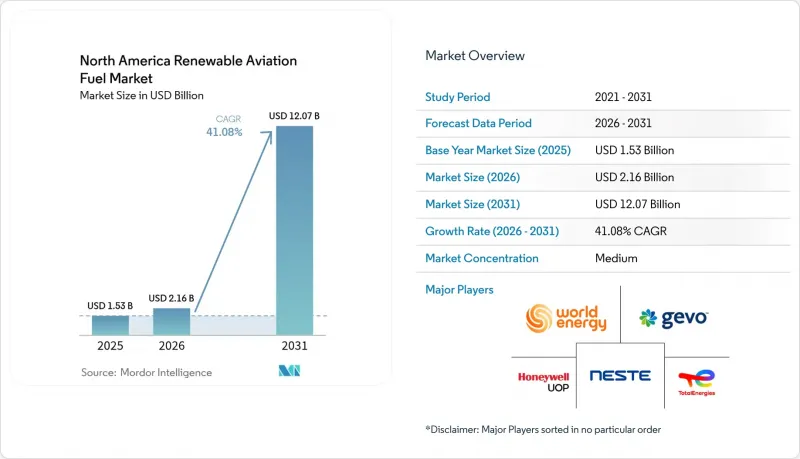
본 보고서는 기술별(피셔-트로프스 공정, 수소화 처리 에스테르 및 지방산, 알코올-투-제트, 합성 이소파라핀계, 촉매 수열 분해 제트, 수열 액화), 용도별(민간 여객 항공, 화물 항공, 군용 항공, 비즈니스·일반 항공), 지역별(미국, 캐나다, 멕시코)로 분류되어 있습니다.
북미의 재생 항공 연료 시장 동향 및 인사이트
미국 인플레이션 억제법에 따른 SAF 세액 공제
인플레이션 억제법에서는 수명 주기 내 온실가스 배출량을 최소 50% 감축하는 SAF에 대해 갤런당 최대 1.75달러의 세액 공제가 제공됩니다. 이 조치로 인해 화석 제트 연료와의 비용 격차가 축소되어 수억 갤런 규모의 프로젝트를 위한 경제적 기반이 마련됩니다. 라이프사이클 강도에 관한 규제로 인해, 더 대폭적인 탄소 감축을 달성할 수 있는 ATJ(항공용 바이오연료) 및 피셔-트로프스 공정의 설계에 우위가 생겨나면서, 북미 재생 항공 연료 시장 전체에서 기술의 다양화가 가속화되고 있습니다. 2025년에 섹션 45Z 세액 공제로 전환됨에 따라, 농업 원료 공급업체에 대한 새로운 인센티브가 추가되어 에탄올 투입 비용 곡선이 낮아질 가능성이 있습니다. 의무화된 탄소 회계 및 검증은 관리상의 복잡성을 증가시키지만, 이는 대규모 통합 생산자일수록 더 쉽게 극복할 수 있는 과제입니다. 그럼에도 불구하고 주목받는 세액 공제는 항공사 수요를 확실한 현금 흐름으로 전환하는 오프테이크 계약을 촉진하며, 예상되는 연평균 성장률(CAGR) 42.5%를 뒷받침하고 있습니다.
북미 항공사 운송 능력의 90% 이상이 넷제로 공약에 서명
여객 수송 능력의 90% 이상을 차지하는 항공사들은 2050년까지 넷제로를 달성하겠다고 공약하고 있으며, 2030년까지 SAF 사용률을 10-30%로 높이는 중간 목표를 제시하고 있습니다. 델타(Delta)만 해도 2억 갤런에 달하는 구매 계약을 체결했으며, 유나이티드(United)는 5년 이내에 SAF를 10% 혼합하는 것을 목표로 하고 있어, 이로 인해 장기적인 수요 곡선이 확고해지고 있습니다. 군의 관심이 높아지면서 수요를 더욱 뒷받침하고 있습니다. 록히드 마틴은 F-35, F-16, C-130 기종에 대한 합성 연료 사용을 승인함으로써 또 다른 대규모 시장 부문을 개척했습니다. 법적 구속력이 있는 약속은 협상력을 변화시켜, 항공사들이 향후 시설에 대해 조기에, 경우에 따라서는 주식 연동형 조건으로 협상하도록 촉진하고 있습니다. 그 결과, 수요의 확실성이 높아지고 대출 기관의 신뢰가 향상되어 북미 재생 항공 연료 시장 전반에서 프로젝트의 금융 마감(financial close)이 가속화되고 있습니다.
미국 중서부 지역의 원료 집약적 병목 현상
옥수수 유래 에탄올 공장은 ATJ에 가장 적합한 1억 갤런 규모의 전환 설비보다 작은 규모로 가동되고 있어, 물류 비용을 증가시키는 복잡한 집약 네트워크가 발생하고 있습니다. 에탄올은 이미 시장에서 가솔린과 경쟁하고 있기 때문에 SAF 프로젝트는 가격 경쟁을 피할 수 없으며, 이는 공급 계약에 변동성을 초래할 가능성이 있습니다. 이 지역의 저장 능력 및 파이프라인 용량은 여전히 제한적이어서, 연안 정유시설에는 추가 운송비가 발생하고 있습니다. SAFFiRE의 옥수수 짚에서 에탄올로의 전환과 LanzaJet의 기술을 결합한 콜로케이션 전략은 이 문제를 부분적으로 완화할 수 있지만, 자본 투자의 동기화가 필요합니다. 병목 현상이 해소될 때까지 북미의 재생 항공 연료 시장은 공급 측면의 마찰에 직면해 있으며, 이는 단기적인 성장을 저해하는 요인이 되고 있습니다.
부문 분석
HEFA(수소화 에스테르 및 지방산)는 2025년 북미 재생 항공 연료 시장 점유율의 83.20%를 차지한 것으로 평가되었으며, 이는 상업화의 성숙도, 기존 수소화 인프라, 확립된 물류 체인을 뒷받침합니다. 기존 시설의 디젤 수소화 처리 장치를 개조하여 활용하기 때문에 자본 요건은 여전히 적정 수준이며, 그린필드 설계보다 신속하게 투자 적격 상태를 달성할 수 있습니다. 그러나 원료 부족과 재생 가능 디젤 정제소와의 경쟁 심화로 인해 장기적인 확장성은 제약을 받고 있습니다.
알코올-투-제트(ATJ) 방식은 아직 발전 단계에 있지만, 2031년까지 연평균 성장률(CAGR) 45.89%를 나타낼 것으로 예측되며, 이는 관련 기술군 중 가장 빠른 성장률입니다. LanzaJet의 프리덤 파인즈 공장은 이 방식의 상업적 실현 가능성을 입증하고 있는 반면, CirculAir의 폐기물 유래 탄소를 이용한 발효 기술은 농업용 유지에 대한 의존을 극복하고 있습니다. 이러한 장점은 장기적으로 가치를 유지하는 자산을 찾는 투자자들에게 큰 매력으로 작용하고 있습니다. 탄소 배출량을 대폭 줄이는 연료에 대한 높은 세액 공제는 프로젝트의 내부수익률(IRR)을 끌어올려, 자본 배분을 ATJ(알코올-투-제트)로 더욱 전환시키고 있습니다. 피셔-트로프스 공법은 막대한 설비 투자가 필요하기 때문에 여전히 실증 단계에 머물러 있지만, 브리티시컬럼비아주와 같이 산림 자원이 풍부한 지역에서는 유망한 기술로 평가받고 있습니다. 촉매 수열 분해 제트(CHTJ) 및 수열 액화(HTL)는 여전히 시범 단계에 있지만, 생애주기 평가가 북미 재생 항공 연료 시장의 섹션 45Z 기준 상한선을 충족한다면 발전할 가능성이 있습니다.
기타 혜택 :
- 엑셀 형식 시장 예측(ME) 시트
- 3개월간의 애널리스트 지원
자주 묻는 질문
목차
제1장 서론
제2장 조사 방법
제3장 개요
제4장 시장 구도
제5장 시장 규모 및 성장 예측
제6장 경쟁 구도
제7장 시장 기회 및 향후 전망
AJY 26.09.01According to Mordor Intelligence, North America renewable aviation fuel market size in 2026 is estimated at USD 2.16 billion, growing from 2025 value of USD 1.53 billion with 2031 projections showing USD 12.07 billion, growing at 41.08% CAGR over 2026-2031.
This report is Segmented by Technology (Fischer-Tropsch, Hydroprocessed Esters and Fatty Acids, Alcohol-To-Jet, Synthesized Iso-Paraffinic, Catalytic Hydrothermolysis Jet, and Hydrothermal Liquefaction), Application (Commercial Passenger Airlines, Cargo Airlines, Military Aviation, and Business and General Aviation), and Geography (United States, Canada, and Mexico).
North America Renewable Aviation Fuel Market Trends and Insights
SAF Tax-Credits Under the U.S. Inflation Reduction Act
The Inflation Reduction Act offers up to USD 1.75 per gallon for SAF achieving at least 50% lifecycle greenhouse-gas savings, a step that compresses the cost delta with fossil jet fuel and sets an economic foundation for multi-hundred-million-gallon projects. Lifecycle intensity rules tilt the advantage toward ATJ and Fischer-Tropsch designs that can meet deeper carbon cuts, hastening technology diversification across the North America renewable aviation fuel market. The shift in 2025 to Section 45Z credits layers fresh incentives for agricultural feedstock suppliers, potentially lowering ethanol input cost curves. Obligatory carbon accounting and verification increase administrative complexity, a hurdle more readily cleared by large, integrated producers. Still, the headline tax credit catalyzes offtake deals that transform airline demand into bankable cash flows, supporting the forecast 42.5% CAGR.
Net-Zero Pledges Signed by Above 90% of North-American Airline Capacity
Airlines representing over 90% of passenger capacity have committed to achieving net-zero by 2050, with interim targets that call for 10-30% SAF usage by 2030. Delta alone has secured purchase agreements covering 200 million gallons, while United targets a 10% SAF blend within five years, thereby anchoring long-range demand curves. Military interest intensifies the pull: Lockheed Martin has cleared synthetic fuels for the F-35, F-16, and C-130 fleets, opening another sizable market segment. Binding pledges alter bargaining power, encouraging airlines to negotiate early, sometimes equity-linked, positions in upcoming facilities. The resulting demand certainty lifts lender confidence, accelerating project financial close across the North America renewable aviation fuel market.
Feedstock Aggregation Bottlenecks in the U.S. Midwest
Corn-ethanol plants operate at scales smaller than the 100-million-gallon conversion units optimal for ATJ, resulting in complex aggregation networks that increase logistics costs. Ethanol already competes with gasoline in the market, so SAF projects must compete on price, potentially introducing volatility into supply contracts. Storage and pipeline capacity in the region remain limited, resulting in additional freight expenses for coastal refineries. Co-location strategies, such as SAFFiRE's corn-stover-to-ethanol pairing with LanzaJet technology, partially mitigate the challenge but require synchronized capital deployment. Until bottlenecks ease, the North America renewable aviation fuel market faces supply-side friction that tempers near-term growth.
Other drivers and restraints analyzed in the detailed report include:
- Rising Corporate "Green Travel" Procurement Programs
- Emerging Carbon-Negative Alcohol-to-Jet Pathways
- HEFA Feedstock Price Volatility Linked to Renewable Diesel Build-Out
For complete list of drivers and restraints, kindly check the Table Of Contents.
Segment Analysis
HEFA commanded 83.20% of the North America renewable aviation fuel market share in 2025, a testament to its commercial readiness, existing hydroprocessing infrastructure, and established logistics chains. Capital requirements remain modest because facilities retrofit legacy diesel hydrotreaters, enabling projects to achieve investment-grade status faster than greenfield designs. However, feedstock scarcity and rising competition from renewable diesel refineries curb long-term scalability.
Alcohol-to-jet pathways, although nascent, are projected to post a 45.89% CAGR through 2031, the fastest in the technology stack. LanzaJet's Freedom Pines plant validates the route's commercial viability, while CirculAir's waste-carbon fermentation breaks the dependence on agricultural oils, an advantage that resonates with investors seeking long-lived assets. The high tax-credit uplift for deep-carbon-cut fuels amplifies project IRRs, further shifting capital allocation toward ATJ. Fischer-Tropsch routes remain in the demonstration phase due to high capital expenditures, yet they hold promise for forestry-rich regions like British Columbia. Catalytic Hydrothermolysis Jet and Hydrothermal Liquefaction remain in pilot stages but could advance if lifecycle scores meet the upper tiers of Section 45Z thresholds within the North American renewable aviation fuel market.
Complete Report Scope:
- By Technology
- Fischer-Tropsch (FT)
- Hydroprocessed Esters & Fatty Acids (HEFA)
- Alcohol-to-Jet (ATJ)
- Synthesized Iso-Paraffinic (SIP)
- Catalytic Hydrothermolysis Jet (CHJ)
- Hydrothermal Liquefaction (HTL)
- By Application
- Commercial Passenger Airlines
- Cargo Airlines
- Military Aviation
- Business & General Aviation
- By Country
- United States
- Canada
- Mexico
List of Companies Covered in this Report:
- Neste Oyj
- TotalEnergies SA
- World Energy LLC
- Honeywell UOP
- Gevo Inc.
- Fulcrum BioEnergy Inc.
- LanzaTech Global Inc.
- Alder Fuels
- Aemetis Inc.
- SG Preston Company
- Red Rock Biofuels LLC
- Velocys plc
- Marathon-Neste JV (Diamond Green Diesel)
- BP p.l.c.
- Shell plc (Shell Aviation)
- Praj Industries
- Virent Inc.
- SkyNRG Americas
- Boeing (SAF partnerships)
- Carbon Engineering Ltd.
Additional Benefits:
- The market estimate (ME) sheet in Excel format
- 3 months of analyst support
TABLE OF CONTENTS
1 Introduction
- 1.1 Study Assumptions & Market Definition
- 1.2 Scope of the Study
2 Research Methodology
3 Executive Summary
4 Market Landscape
- 4.1 Market Overview
- 4.2 Market Drivers
- 4.2.1 SAF tax-credits under the U.S. Inflation Reduction Act
- 4.2.2 Net-zero pledges signed by Above 90 % of North-American airline capacity
- 4.2.3 Rising corporate "green travel" procurement programs
- 4.2.4 Emerging carbon-negative alcohol-to-jet (ATJ) pathways
- 4.2.5 Regional airport consortia financing on-site SAF blenders
- 4.3 Market Restraints
- 4.3.1 Feedstock aggregation bottlenecks in the U.S. Midwest
- 4.3.2 HEFA feedstock price volatility linked to renewable diesel build-out
- 4.3.3 Lack of ASTM approval for 100 % drop-in SAF use
- 4.4 Supply-Chain Analysis
- 4.5 Regulatory Landscape
- 4.6 Technological Outlook
- 4.7 Porter's Five Forces
- 4.7.1 Bargaining Power of Suppliers
- 4.7.2 Bargaining Power of Buyers
- 4.7.3 Threat of New Entrants
- 4.7.4 Threat of Substitutes
- 4.7.5 Intensity of Rivalry
5 Market Size & Growth Forecasts
- 5.1 By Technology
- 5.1.1 Fischer-Tropsch (FT)
- 5.1.2 Hydroprocessed Esters & Fatty Acids (HEFA)
- 5.1.3 Alcohol-to-Jet (ATJ)
- 5.1.4 Synthesized Iso-Paraffinic (SIP)
- 5.1.5 Catalytic Hydrothermolysis Jet (CHJ)
- 5.1.6 Hydrothermal Liquefaction (HTL)
- 5.2 By Application
- 5.2.1 Commercial Passenger Airlines
- 5.2.2 Cargo Airlines
- 5.2.3 Military Aviation
- 5.2.4 Business & General Aviation
- 5.3 By Country
- 5.3.1 United States
- 5.3.2 Canada
- 5.3.3 Mexico
6 Competitive Landscape
- 6.1 Market Concentration
- 6.2 Strategic Moves (M&A, Partnerships, PPAs)
- 6.3 Market Share Analysis (Market Rank/Share for key companies)
- 6.4 Company Profiles (includes Global level Overview, Market level overview, Core Segments, Financials as available, Strategic Information, Products & Services, and Recent Developments)
- 6.4.1 Neste Oyj
- 6.4.2 TotalEnergies SA
- 6.4.3 World Energy LLC
- 6.4.4 Honeywell UOP
- 6.4.5 Gevo Inc.
- 6.4.6 Fulcrum BioEnergy Inc.
- 6.4.7 LanzaTech Global Inc.
- 6.4.8 Alder Fuels
- 6.4.9 Aemetis Inc.
- 6.4.10 SG Preston Company
- 6.4.11 Red Rock Biofuels LLC
- 6.4.12 Velocys plc
- 6.4.13 Marathon-Neste JV (Diamond Green Diesel)
- 6.4.14 BP p.l.c.
- 6.4.15 Shell plc (Shell Aviation)
- 6.4.16 Praj Industries
- 6.4.17 Virent Inc.
- 6.4.18 SkyNRG Americas
- 6.4.19 Boeing (SAF partnerships)
- 6.4.20 Carbon Engineering Ltd.
7 Market Opportunities & Future Outlook
- 7.1 White-space & Unmet-Need Assessment


