

|
시장보고서
상품코드
2115879
엽면 살포제 : 시장 점유율 분석, 업계 동향과 통계, 성장 예측(2026-2031년)Foliar Spray - Market Share Analysis, Industry Trends & Statistics, Growth Forecasts (2026 - 2031) |
||||||
 Mordor Intelligence
Mordor Intelligence에 따르면 2026년 엽면 살포제 시장 규모는 85억 1,000만 달러로 추정되며, 2025년 80억 8,000만 달러에서 확대되어 2031년에는 110억 1,000만 달러에 달할 것으로 예측됩니다.
2026년부터 2031년까지 연평균 성장률(CAGR) 5.30%로 성장할 것으로 전망됩니다.
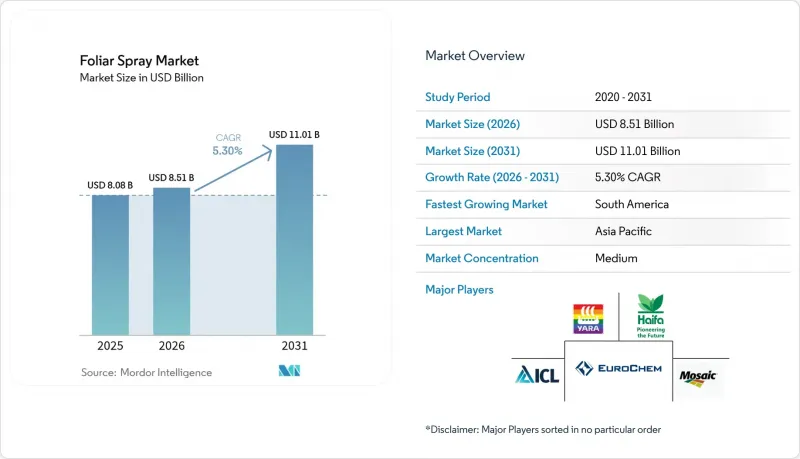
본 보고서에서는 업계를 화학제품별(인산계, 질소계, 칼륨계, 칼슘계 등), 제품 유형별(분말 및 액체), 원료별(합성 및 바이오 기반/유기), 용도(원예 작물, 농작물, 과수 작물 등), 및 지역(아시아태평양, 북미, 유럽, 남미, 중동 및 아프리카)별로 분류하고 있습니다. 시장 예측은 매출액(달러) 기준으로 제시되어 있습니다
세계 엽면 살포제 시장의 동향 및 인사이트
원예 작물에서의 수요 확대
원예 분야는 이미 엽면 살포제 소비량의 거의 절반을 차지하고 있으며, 생산자들이 특산 작물 재배 체계를 강화함에 따라 그 점유율은 계속 확대되고 있습니다. 유기농 딸기 생산에 관한 연구에 따르면, 생장 촉진제를 이용한 엽면 살포 처리 후 1포기당 262.42g의 수확량 증가가 확인되어, 상당한 경제적 이점이 있음을 입증하고 있습니다. 채소, 베리류, 화훼 생산자들도 개화나 착과와 같은 중요한 단계에서 엽면 살포 프로그램이 일시적인 영양 부족을 신속하게 해소한다는 점을 높이 평가하고 있습니다. 기술 기업들은 이미지 분석을 통해 유도되는 초미량 살포를 수행하는 드론을 통해 이러한 수요에 부응하고 있으며, 인체 노출을 줄이면서 수관 부위에 대한 살포 정확도를 높이고 있습니다. 그 결과, 엽면 살포 시장은 보호 재배, 온실 및 고밀도 노지 과수원에서 그 기반을 지속적으로 확대하고 있습니다.
미량영양소 결핍 대책의 급증
각국 정부와 NGO는 주곡 작물의 아연, 철, 요오드 결핍을 대상으로 한 프로그램을 확대하고 있으며, 엽면 살포를 공중 보건 수단으로 전환하고 있습니다. 아연 나노입자의 엽면 살포를 통해 렌즈콩 알갱이 내 아연 함량이 3배로 증가했으며, 이는 유전자 변형 없이 ‘숨은 기아’에 대처할 수 있는 살포 기술의 가능성을 보여주고 있습니다. 인도, 케냐, 브라질의 영양 강화 스프레이에 대한 보조금 제도 덕분에 소규모 농가들이 미리 혼합된 미량영양소 용액을 채택하도록 장려되어, 가격에 민감한 부문에서 엽면 살포 시장이 확대되고 있습니다. 이에 대응하여 공급업체들은 백팩식 분무기에 사용하도록 설계된 1회용 소포장을 제공함으로써, 살포 실수를 줄이고 포장 폐기물을 절감하고 있습니다.
세계 일부 지역에서 비료 관개 방식의 우위
점적 관개를 기반으로 한 비료 관개는 여전히 고부가가치 온실 채소 및 잔디에서 확고하게 자리 잡고 있으며, 생산자는 관개 라인을 통해 수용성 영양소를 지속적으로 공급할 수 있습니다. 정확한 투여량으로 인해 유출과 노동력을 줄일 수 있으므로, 비료 관개는 엽면 살포 프로그램의 직접적인 경쟁 상대가 되고 있습니다. 현대적인 인프라가 갖춰진 지역에서는 공급업체가 엽면 살포를 보완적인 수단으로 위치 짓고, 뿌리로는 신속하게 보충할 수 없는 결핍증을 해결하는 데 주력해야 합니다. 현재 스페인과 캘리포니아에서는 과실 착색기에 저용량의 엽면 칼륨을 시비하는 하이브리드 시비법이 도입되어 있으며, 이는 엽면 살포가 완전히 대체되는 것이 아니라 공존할 수 있는 길이 열리고 있음을 보여줍니다.
부문 분석
2025년 엽면 살포제 시장 규모에서, 질소계 제제는 영양 생장에서 폭넓은 역할을 수행한 덕분에 34.62%라는 최대 점유율을 차지했습니다. 그러나 미량영양소는 5.63%의 연평균 성장률(CAGR)로 이 화학제품 부문을 주도하고 있으며, 이는 품질 특성과 스트레스 내성에 미치는 지대한 영향을 반영하고 있습니다. 방글라데시와 르완다의 학교 급식 프로그램을 대상으로 한 공공 바이오포티피케이션 계획에서는 현재 고농도의 아연 및 철분 혼합제 사용이 의무화되어 있습니다. 엽면 살포제 시장에서는 킬레이트 아연과 아미노산을 결합한 신제품이 잇달아 출시되고 있으며, 잎으로의 흡수가 빠르고 토양과의 상호작용이 적다는 특징이 있습니다. 곡물 분야에서는 인산계 및 칼륨계 제품에 대한 수요가 견조한 추세를 보이는 한편, 새롭게 등장한 붕산칼슘 살포제는 세포벽을 강화하여 베리류의 저장 기간을 연장하고 있습니다. 해조류와 아미노산을 혼합한 특수 제품 라인은 뿌리의 분비를 촉진하는 생물활성 화합물을 제공하며, 합성 제품 기반을 훼손하지 않으면서 화학제품 포트폴리오의 다양화에 기여하고 있습니다.
액체 제제는 즉시 사용할 수 있고 기존의 붐식 분무기와 호환성이 있어 주류를 이루고 있으며, 2025년에는 엽면 살포제 시장의 74.35%를 차지할 것으로 전망됩니다. 흡수가 즉시 이루어지기 때문에 급격한 영양 스트레스가 발생했을 때도 유리합니다. 또한, 액체 제제는 저점도 약제를 필요로 하는 드론이나 로봇 살포기와도 호환성이 뛰어납니다. 각 공급업체는 pH 완충제나 항균제를 사용하여 보존 안정성을 향상시키고 있어, 냉장 보관 없이도 고온 기후 지역으로의 유통이 가능해졌습니다. 후르보산이 풍부하게 함유된 NPK 액체 비료에는 현재 미량의 셀레늄이 배합되어 있어, 양파 재배자들에게는 주요 영양소의 공급과 미량영양소를 통한 차별화라는 두 가지 이점을 모두 제공하고 있습니다.
한편, 분말 기술은 비용과 물류 측면에서 다시 탄력을 받고 있으며, 연평균 성장률(CAGR) 5.37%로 성장하고 있습니다. 산악 지대인 페루의 농가들은 부피가 큰 드럼통을 운반하는 번거로움을 피하기 위해 분말 형태를 선호하고 있습니다. 각 제조사는 미량영양소의 킬레이트제와 살포 직전에 용해시켜 덩어리짐을 방지하는 습윤제를 각각 1봉지씩 조합한 듀얼 팩을 제공하고 있습니다. 포장재가 생분해성 필름으로 전환됨에 따라 분말 제품이 액체 제품의 시장 점유율을 일부 빼앗을 가능성도 있지만, 엽면 살포 시장에서 각 형태가 서로 다른 사용 상황에 대응하고 있기 때문에 양자는 공존해 나갈 것으로 보입니다.
지역별 분석
아시아태평양은 2025년에도 매출의 38.84%를 계속 차지했습니다. 이는 결실 성수기에 엽면 살포용 아연 및 붕소에 의존하는 중국과 인도의 집약적인 온실 채소 생산 지역이 뒷받침하고 있습니다. 중국 연구진은 생장 촉진제와 카복시메틸셀룰로오스 살포액을 병용함으로써 사질 토양에서 사과 수확량을 향상시켰고, 북부 과수원에 이를 도입하는 데 박차를 가했습니다. 액적 직경을 조절할 수 있고 살포 폭이 10m인 드론 살포기는 노동력 필요성을 줄여주며, 엽면 살포 시장에서 ‘정밀 살포’라는 추세를 더욱 강화하고 있습니다.
브라질이 ‘국가 바이오 투입 자재 프로그램’을 공식적으로 도입함에 따라, 남미는 5.80%라는 지역별 최고 연평균 성장률(CAGR)을 기록하고 있습니다. 600종 이상의 생물 유래 제품이 등록되어 있으며, Stara사의 ‘Imperador 4000’과 같은 정밀 제초 살포 장치에는 AI 센서가 탑재되어 잎에 실시간으로 약제를 살포할 수 있게 되었습니다.
북미와 유럽은 고도의 정밀 농업 체계를 공유하고 있지만, 규제상의 압력으로 인해 제품 구성은 서로 다릅니다. 유럽 그린딜의 목표에 따라 제초제 사용량을 최대 90%까지 줄이는 초고정밀 스팟 살포기의 도입이 추진되고 있습니다. 중동 및 아프리카는 생산량 면에서는 뒤처져 있지만, 물 부족을 배경으로 엽면 살포의 저용량 사용이라는 특징이 정당화되기 때문에 상대적으로 강력한 성장을 보이고 있습니다. 아랍에미리트(UAE)의 대추야자 농장에서는 증발로 인한 손실을 줄이기 위해 야간에 붕소를 엽면 살포하고 있습니다.
기타 혜택:
- 엑셀 형식의 시장 예측(ME) 시트
- 3개월간의 애널리스트 지원
자주 묻는 질문
목차
제1장 소개
제2장 조사 방법
제3장 주요 요약
제4장 시장 구도
제5장 시장 규모와 성장 예측
제6장 경쟁 구도
제7장 시장 기회와 향후 전망
KSM 26.08.26According to Mordor Intelligence, foliar spray market size in 2026 is estimated at USD 8.51 billion, growing from 2025 value of USD 8.08 billion with 2031 projections showing USD 11.01 billion, growing at 5.30% CAGR over 2026-2031.
This report Segments the Industry by Chemical (Phosphatic, Nitrogenous, Potassic, Calcium, and More), Product Type (Powder and Liquid), Source (Synthetic and Bio-based/Organic), Application (Horticulture Crops, Agriculture Crops, Orchard Crops, and More), and Geography (Asia-Pacific, North America, Europe, South America, and Middle-East and Africa). The Market Forecasts are Provided in Terms of Volume (USD)
Global Foliar Spray Market Trends and Insights
Growing Demand from Horticulture Crops
Horticulture already contributes nearly half of foliar spray consumption and continues to gain share as growers intensify specialty crop systems. Studies on organic strawberry production show yield gains of 262.42 g per plant after biostimulant foliar treatment, confirming strong economic incentives. Vegetable, berry, and floriculture producers also value the rapid correction of transient nutrient deficiencies that foliar programs provide during critical flowering or fruit-set stages. Technology firms answer this demand with drones that apply ultra-low-volume sprays guided by imaging analytics, reducing human exposure while raising canopy coverage accuracy. The result is a foliar spray market that continues to broaden its base in protected cultivation, greenhouses, and high-density outdoor orchards.
Surge in Micronutrient Deficiency Mitigation Schemes
Governments and NGOs are scaling programs that target zinc, iron, and iodine deficiencies in staple crops, turning foliar feeding into a public-health tool. Foliar application of zinc nanoparticles tripled grain zinc in lentils, showing how spray technology can address "hidden hunger" without genetically modifying plants. Subsidies for fortified sprays in India, Kenya, and Brazil are encouraging smallholders to adopt premixed micronutrient solutions, enlarging the foliar spray market in price-sensitive segments. Suppliers respond with single-dose sachets designed for backpack sprayers, lowering application errors and packaging waste.
Fertigation Dominance in Certain Parts of the Globe
Drip-based fertigation remains entrenched in high-value greenhouse vegetables and turfgrass, where growers can deliver soluble nutrients continuously through irrigation lines. Precise dosing reduces leaching and labour, making fertigation a direct competitor to foliar programs. In regions with modern infrastructure, suppliers must position foliar sprays as complementary, targeting deficiencies that roots cannot correct quickly. Hybrid protocols in Spain and California now integrate low-dose foliar potassium during fruit colouring, indicating a path to coexistence rather than outright displacement.
Other drivers and restraints analyzed in the detailed report include:
- Growing Demand for Nutrient-Dense and Superior Quality Crops
- Increase in Agricultural Practices in Developing Countries
- Technical Complexity and Need for Expertise
For complete list of drivers and restraints, kindly check the Table Of Contents.
Segment Analysis
Nitrogenous formulas contributed the largest 34.62% share of the foliar spray market size in 2025, thanks to their broad role in vegetative growth. Yet micronutrients are pacing the chemical category with a 5.63% CAGR, reflecting their outsized influence on quality traits and stress resilience. High-zinc and iron blends are now mandatory in public biofortification schemes targeting school feeding programs in Bangladesh and Rwanda. The foliar spray market is witnessing product launches that combine chelated zinc with amino acids, delivering faster leaf absorption and lower soil interaction. Phosphatic and potassic options hold steady demand in cereals, while emerging calcium borate sprays extend shelf life in berries by firming cell walls. Specialty lines such as seaweed and amino acid blends offer bioactive compounds that stimulate root exudation, diversifying the chemical portfolio without eroding the synthetic base.
Liquid formulations dominate because they are ready-to-use and compatible with conventional boom sprayers, capturing 74.35% of foliar spray market share in 2025. Uptake is immediate, an advantage during abrupt nutrient stress events. Liquids also dovetail with drone and robot sprayers that need low-viscosity materials. Suppliers improve shelf stability through pH buffers and antimicrobial agents, allowing distribution into hot climates without cold storage. Fulvic acid-rich NPK liquids now include trace selenium, giving onion growers both macronutrient supply and micronutrient differentiation.
Powder technology, however, is regaining ground on cost and logistics, growing at a CAGR of 5.37%. Farmers in mountainous Peru prefer powders to avoid hauling bulky drums. Manufacturers offer dual packs: one pouch of micronutrient chelates and a second of wetting agents that dissolve just before application, minimising caking. As packaging moves to biodegradable films, powders could erode some liquid share, but co-existence is likely because each format serves distinct operational contexts in the foliar spray market.
Complete Report Scope:
- By Chemical
- Phosphatic
- Nitrogenous
- Potassic
- Calcium
- Micronutrients (Zn, B, Fe, Mn, Cu)
- Other Chemicals (Si, Amino-Acid, Seaweed-based)
- By Product Type
- Liquid
- Powder
- By Source
- Synthetic
- Bio-based / Organic
- By Application
- Horticulture Crops
- Agriculture Crops
- Orchard Crops
- Vegetables
- Turf
- Other Applications
- By Geography
- Asia-Pacific
- China
- India
- Japan
- South Korea
- Rest of Asia-Pacific
- North America
- United States
- Canada
- Mexico
- Europe
- Germany
- United Kingdom
- France
- Italy
- Rest of Europe
- South America
- Brazil
- Argentina
- Rest of South America
- Middle-East and Africa
- Saudi Arabia
- South Africa
- Rest of Middle-East and Africa
- Asia-Pacific
Geography Analysis
Asia-Pacific maintained a 38.84% revenue slice in 2025, anchored by intensive greenhouse vegetable clusters in China and India that rely on foliar zinc and boron during peak fruit-set. Chinese researchers improved apple yield on sandy soils by pairing biostimulants with carboxymethyl cellulose sprays, reinforcing adoption in northern orchards. Drone sprayers with adjustable droplet diameters and 10 m swath widths are lowering labour requirements and accentuating the precision narrative for the foliar spray market.
South America delivers the fastest regional CAGR at 5.80% as Brazil formalises its National Bio-inputs Program. More than 600 biological products are registered, and precision weed-spray rigs like Stara's Imperador 4000 integrate AI sensors to target foliage in real time.
North America and Europe share advanced precision frameworks, though regulatory pressure shapes product mixes differently. European Green Deal objectives push the adoption of ultra-precise spot sprayers that cut herbicide volumes by up to 90%. The Middle-East and Africa trail on volume but show strong relative growth as water scarcity legitimises foliar feeding's low-volume profile. Date palm plantations in the United Arab Emirates apply boron foliar sprays at night to curb evaporation losses.
List of Companies Covered in this Report:
- AgroLiquid
- Andaman Ag Corporation
- Aries Agro Limited
- Bayer AG
- Coromandel International Ltd.
- Corteva
- EuroChem Group
- Grupa Azoty S.A.
- Haifa Negev technologies LTD
- ICL
- Mosaic
- Nutrien
- Nutrient TECH
- Sichuan Shucan Chemical Co., Ltd.
- Syngenta
- WinField United
- Yara
Additional Benefits:
- The market estimate (ME) sheet in Excel format
- 3 months of analyst support
TABLE OF CONTENTS
1 Introduction
- 1.1 Study Assumptions and Market Definition
- 1.2 Scope of the Study
2 Research Methodology
3 Executive Summary
4 Market Landscape
- 4.1 Market Overview
- 4.2 Market Drivers
- 4.2.1 Growing Demand for Foliar Spray from Horticulture Crops
- 4.2.2 Surge in Micronutrient Deficiency Mitigation Schemes
- 4.2.3 Growing Demand for Nutrient Dense and Superior Quality Crops
- 4.2.4 Increase in Agricultural Practices in Developing Countries
- 4.2.5 Enhaced Nutrient Uptake Effiency Being Offered by Foliar Spray
- 4.3 Market Restraints
- 4.3.1 Fertigation Dominance in Certain Parts of the Globe
- 4.3.2 Technical Complexity and Need for Expertise
- 4.3.3 Limited Applicability to All Crop Types
- 4.4 Value Chain Analysis
- 4.5 Porter's Five Forces
- 4.5.1 Threat of New Entrants
- 4.5.2 Bargaining Power of Buyers
- 4.5.3 Bargaining Power of Suppliers
- 4.5.4 Threat of Substitute Products
- 4.5.5 Degree of Competition
5 Market Size and Growth Forecasts (Value)
- 5.1 By Chemical
- 5.1.1 Phosphatic
- 5.1.2 Nitrogenous
- 5.1.3 Potassic
- 5.1.4 Calcium
- 5.1.5 Micronutrients (Zn, B, Fe, Mn, Cu)
- 5.1.6 Other Chemicals (Si, Amino-Acid, Seaweed-based)
- 5.2 By Product Type
- 5.2.1 Liquid
- 5.2.2 Powder
- 5.3 By Source
- 5.3.1 Synthetic
- 5.3.2 Bio-based / Organic
- 5.4 By Application
- 5.4.1 Horticulture Crops
- 5.4.2 Agriculture Crops
- 5.4.3 Orchard Crops
- 5.4.4 Vegetables
- 5.4.5 Turf
- 5.4.6 Other Applications
- 5.5 By Geography
- 5.5.1 Asia-Pacific
- 5.5.1.1 China
- 5.5.1.2 India
- 5.5.1.3 Japan
- 5.5.1.4 South Korea
- 5.5.1.5 Rest of Asia-Pacific
- 5.5.2 North America
- 5.5.2.1 United States
- 5.5.2.2 Canada
- 5.5.2.3 Mexico
- 5.5.3 Europe
- 5.5.3.1 Germany
- 5.5.3.2 United Kingdom
- 5.5.3.3 France
- 5.5.3.4 Italy
- 5.5.3.5 Rest of Europe
- 5.5.4 South America
- 5.5.4.1 Brazil
- 5.5.4.2 Argentina
- 5.5.4.3 Rest of South America
- 5.5.5 Middle-East and Africa
- 5.5.5.1 Saudi Arabia
- 5.5.5.2 South Africa
- 5.5.5.3 Rest of Middle-East and Africa
- 5.5.1 Asia-Pacific
6 Competitive Landscape
- 6.1 Market Concentration
- 6.2 Strategic Moves
- 6.3 Market Share(%)/Ranking Analysis
- 6.4 Company Profiles (includes Global-level Overview, Market-level Overview, Core Segments, Financials as available, Strategic Information, Market Rank/Share, Products and Services, Recent Developments)
- 6.4.1 AgroLiquid
- 6.4.2 Andaman Ag Corporation
- 6.4.3 Aries Agro Limited
- 6.4.4 Bayer AG
- 6.4.5 Coromandel International Ltd.
- 6.4.6 Corteva
- 6.4.7 EuroChem Group
- 6.4.8 Grupa Azoty S.A.
- 6.4.9 Haifa Negev technologies LTD
- 6.4.10 ICL
- 6.4.11 Mosaic
- 6.4.12 Nutrien
- 6.4.13 Nutrient TECH
- 6.4.14 Sichuan Shucan Chemical Co., Ltd.
- 6.4.15 Syngenta
- 6.4.16 WinField United
- 6.4.17 Yara
7 Market Opportunities and Future Outlook
- 7.1 White-space and Unmet-Need Assessment
- 7.2 Growing Demand for Bio-Based Foliar Spray


