

|
시장보고서
상품코드
2115883
나일론 모노필라멘트 시장 : 시장 점유율 분석, 업계 동향 및 통계, 성장 예측(2026-2031년)Nylon Monofilament - Market Share Analysis, Industry Trends & Statistics, Growth Forecasts (2026 - 2031) |
||||||
 Mordor Intelligence
Mordor Intelligence에 의하면, 나일론 모노필라멘트 시장 규모는 2025년에 17억 3,000만 달러로 평가되었고, 2026년 18억 2,000만 달러에서 2031년까지 23억 1,000만 달러에 이를 것으로 예측되며, 예측 기간(2026-2031년) CAGR은 4.97%를 나타낼 전망입니다.
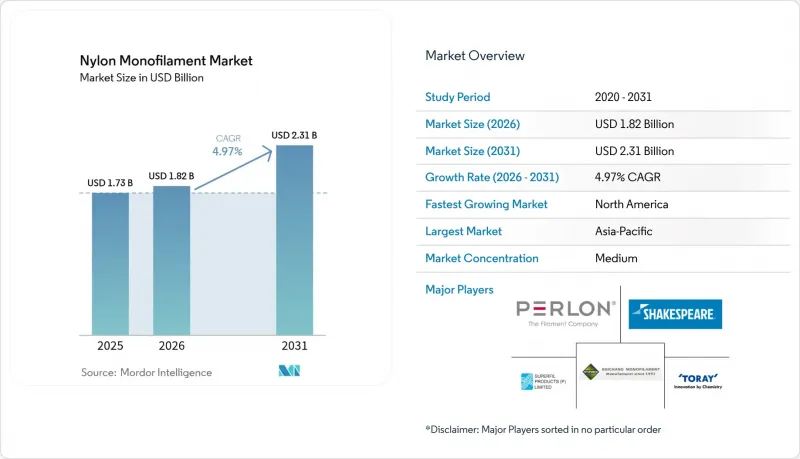
본 보고서는 공중합체 유형별(나일론 6, 나일론 66, 기타), 용도별(어망, 의료, 자동차용 직물, 소비재, 편조 로프, 기타), 지역별(아시아태평양, 북미, 유럽, 남미, 중동 및 아프리카)로 분류되어 있습니다. 시장 전망은 금액(달러) 기준으로 제시되어 있습니다.
세계의 나일론 모노필라멘트 시장 동향 및 인사이트
어망 및 양식 분야 수요 증가
세계 양식업의 확대는 사업자들이 어구의 내구성과 어획 효율을 우선시하고 있기 때문에 나일론 모노필라멘트 시장의 성장을 지속적으로 뒷받침하고 있습니다. 나일론은 어구용 폴리머의 76%를 차지하고 있으며, 모노필라멘트 그물은 장기간 바닷물에 노출되어도 인장 강도를 유지할 수 있어 멀티필라멘트 대체품보다 뛰어난 성능을 발휘합니다. 노르웨이에서는 생분해성 그물망의 시범 도입이 진행되고 있지만, 현장 데이터에 따르면 어획 효율이 40% 저하되고 비용도 상승하고 있어 단기적으로는 대체가 진행되지 않을 전망입니다. 또한, 양식장 소독에 사용되는 10% 과초산 용액에 그물을 담갔을 경우, 강도 저하는 고작 3-6%에 그칩니다는 사실이 현장 조사를 통해 밝혀졌으며, 이는 나일론의 내구성 우위를 입증해 줍니다. 동남아시아 시장의 규제 지연과 수명이 긴 어구로 인한 즉각적인 경제적 이익 덕분에, 유럽에서 환경 기준이 강화되고 있음에도 불구하고 판매량 증가는 유지되고 있습니다. 1년 이내에 92%의 해양 분해를 달성하는 신흥 생분해성 등급은 기계적 특성이 열악하기 때문에 여전히 상업적으로는 틈새 시장에 머물러 있습니다.
자동차용 경량 부품의 급증
자동차의 전동화로 인해 금속에서 엔지니어링 플라스틱으로의 대체가 가속화되고 있으며, 베어링 케이지, 케이블 타이, 기능성 트림 등의 나일론 모노필라멘트 제품은 현저한 경량화에 기여하고 있습니다. Domo가 제조하는 TECHNYL 4EARTH는 탄성률이나 내열성을 저하시키지 않으면서 제조 과정에서 발생하는 CO2 배출량을 최대 80%까지 줄입니다. Celanese는 금속을 직접 대체할 수 있으며, EV 플랫폼에 요구되는 피로 성능을 갖춘 유리섬유 강화 PA66 수지를 시장에 출시했습니다. 전 세계 OEM 기업들은 나일론공급망이 확립되어 있고 가격 메커니즘도 충분히 이해하고 있기 때문에 새로운 바이오 대안에 비해 전환 위험이 낮다는 이유로 나일론을 선호하고 있습니다. 높은 인증 비용, 엄격한 치수 공차, 규제상의 인증 요건으로 인해 진입 장벽은 여전히 높으며, 나일론 모노필라멘트 시장의 연평균 성장률(CAGR)에 1.2포인트라는 안정적인 기여율을 유지하고 있습니다.
정부의 규제 및 미세 플라스틱 규제
EU는 플라스틱 펠릿 배출량을 74% 감축하는 것을 목표로 하고 있으며, 연간 5톤 이상을 취급하는 가공업체에 대해 손실 방지 프로토콜 인증을 의무화하고 있습니다. 이 조치로 인해 EU 수출용 나일론 모노필라멘트 1kg당 추가적인 규정 준수 비용이 발생할 가능성이 있습니다. 세네갈에서는 1998년에 나일론 모노필라멘트로 만든 덫그물이 금지되었으나, 그 시행은 미흡한 편이지만 법적 불확실성이 어구 공급업체의 투자 계획을 얼마나 혼란스럽게 하는지 보여주고 있습니다. 미국에서는 연방조달청(GSA)이 연방 정부와의 계약에서 일회용 플라스틱을 사용하지 않는 포장을 의무화하고 있어, 향후 조달 과정에서 장벽이 될 것임을 시사하고 있습니다. 식용 어패류 분석 결과에서 나일론 섬유가 검출됨에 따라, 소비재 전반에 걸쳐 더 엄격한 규제를 요구하는 과학적 근거가 강화되었습니다. 업계의 대응으로 퇴비화 가능하거나 효소 분해 가능한 폴리아미드의 연구 개발(R&D)이 가속화되고 있으나, 비용 및 성능 면에서의 격차가 즉각적인 대규모 대체를 방해하고 있으며, 그 결과 나일론 모노필라멘트 시장의 연평균 성장률(CAGR)을 1.1포인트 순감소시키는 요인이 되고 있습니다.
부문 분석
나일론 6은 전환 비용을 낮게 억제하는 성숙한 세계 카프로락탐 생산 기반 덕분에 2025년에도 나일론 모노필라멘트 시장에서 64.62%의 점유율을 유지했습니다. 인도에 위치한 GSFC의 7만-8만 톤 규모의 생산 시설 등 플랜트는 규모의 경제를 구현하고 있으며, 그중 약 1만 7,000톤이 자사 내 모노필라멘트 제조 사업에 공급되고 있습니다. 어망에서 일용품의 브러시 모에 이르기까지의 주류 용도가 기초적인 수요를 뒷받침하고 있기 때문에 나일론 6의 나일론 모노필라멘트 시장 규모는 2031년까지 13억 9,000만 달러에 달할 것으로 예측됩니다. 대조적으로, 나일론 66은 EV 부품이나 산업용 벨트에 요구되는 뛰어난 내열성·내노화성 및 치수 안정성에 힘입어 연평균 성장률(CAGR) 5.28%라는 더 급격한 성장 궤도에 올라 있습니다. INVISTA가 상하이에서 추진하는 17억 5,000만 달러 규모의 확장 계획(PA66 생산 능력을 40만 톤으로 두 배로 늘리는 것)은 고온 환경에서 사용되는 제품 시장에 대한 이 회사의 자신감을 보여주는 것입니다.
장쇄 및 특수 등급(나일론 610, 612, MXD6)은 흡습성, 연료 차단성 또는 광학적 투명성이 중요한 분야에서 프리미엄 가격이 책정되고 있습니다. 나일론 MXD6는 포화 증기에 노출된 후에도 초기 강도의 60%를 유지하기 때문에 내화학성 모노필라멘트로 매력적입니다. 바이오 생산량은 급속히 확대되고 있습니다. LG화학과 CJ제일제당은 2028년까지 재생 가능 나일론 생산량을 140만 톤으로 늘리겠다는 목표를 세웠으며, 이는 전 세계 생산 능력 대비 연평균 29% 증가에 해당합니다. DSM의 완전 바이오 제품인 Stanyl(R) B-MB는 탄소 발자국을 50% 줄이고, 기계적 성능을 저하시키지 않으면서 OEM의 기후 목표를 충족합니다. 따라서 특수 용도 분야의 성장세는 나일론 6 시장 점유율을 소폭 잠식하는 한편, 나일론 모노필라멘트 시장 전체에서 프리미엄 가치의 풀을 확대시키고 있습니다.
지역별 분석
아시아태평양은 통합된 석유화학 단지와 비용 효율적인 노동력을 활용하여 2025년 나일론 모노필라멘트 시장 점유율의 32.88%를 차지했습니다. 중국 생산자들은 확립된 아시아 지역 내 네트워크를 통해 태국, 인도네시아, 인도로 산업용 원사를 수출하고 있습니다. 2025년까지 국내 합성섬유 소비량을 3,500억 달러, 수출액을 3,000억 달러로 늘리겠다는 인도의 로드맵은 산업용 섬유 분야에서 모노필라멘트의 판로 확대로 이어지고 있습니다. 일본의 초기 해외 투자(토레이는 1960년대에 태국과 인도네시아에 시설을 건설했습니다)는 현재도 기술적 파급 효과를 계속해서 가져오고 있습니다. 지역적 과제로는 미세 플라스틱 규제나 벤젠 관련 원료 가격 급등 등을 들 수 있지만, 확립된 규모의 경제 덕분에 아시아태평양은 기본 등급의 생산량에서 주도적인 위치를 유지하고 있습니다.
북미는 전기차(EV) 제조 의무화 및 첨단 의료기기 공급망에 힘입어 2026-2031년 연평균 성장률(CAGR) 5.55%로 가장 높은 성장세를 보일 것으로 예측됩니다. INVISTA는 온타리오주의 헥사메틸렌디아민 생산 설비를 재가동하는 한편, PA66 전구체를 확보하기 위해 새로운 아디포니트릴 생산 시설 건설을 계획하고 있습니다. BASF는 2024년 중반, 북미의 PA66 컴파운드 가격을 1파운드당 0.15달러 인상하며 수요 탄력성이 견고함을 보여주었습니다. 브라스켐(Bruskem)의 미국 필라멘트 사업 인수는 3D 프린팅의 보급을 촉진하고, 항공우주, 치과 및 소비자용 프로토타입을 위한 현지 나일론 생산 능력을 확충할 것입니다. 바이오 폴리아미드에 대한 FDA의 승인 절차는 OEM 업체들이 지속 가능한 등급을 지정하도록 더욱 촉진하여 프리미엄 부문 수요를 뒷받침하고 있습니다.
유럽은 규제 강화와 에너지 비용 상승이라는 역풍에 직면해 있지만, 순환 경제 이니셔티브에서는 주도적인 입지를 차지하고 있습니다. EU의 미세 플라스틱 협정에 따라 펠릿 취급 인증이 의무화되어 규정 준수 비용은 상승하겠지만, 이를 조기에 도입한 기업에게는 경쟁 우위가 될 것입니다. BASF의 DOMO에 의한 Alsachimie 지분 인수 및 프랑스 내 세계적 규모의 헥사메틸렌디아민 공장 가동은 유럽 나일론 화학 분야에 대한 장기적인 노력을 뒷받침합니다. 남미 및 중동 및 아프리카는 절대적인 생산량 면에서는 뒤처져 있지만, 수산 양식 및 인프라 분야에서 신규 진입의 기회를 내포하고 있습니다. 그러나 환율 리스크, 수입 의존도, 그리고 중합 설비의 부족이 단기적인 성장을 저해하고 있습니다.
기타 혜택 :
- 엑셀 형식 시장 예측(ME) 시트
- 3개월간의 애널리스트 지원
자주 묻는 질문
목차
제1장 서론
제2장 조사 방법
제3장 개요
제4장 시장 구도
제5장 시장 규모 및 성장 예측
제6장 경쟁 구도
제7장 시장 기회 및 향후 전망
AJY 26.09.01According to Mordor Intelligence, the nylon monofilament market size was valued at USD 1.73 billion in 2025 and estimated to grow from USD 1.82 billion in 2026 to reach USD 2.31 billion by 2031, at a CAGR of 4.97% during the forecast period (2026-2031).
This report is Segmented by Co-Polymer Type (Nylon 6, Nylon 66, Other Types), Application (Fishing Nets, Medical, Automotive Fabrics, Consumer Goods, Braided Ropes, Other Applications), and Geography (Asia-Pacific, North America, Europe, South America, Middle East and Africa). The Market Forecasts are Provided in Terms of Value (USD).
Global Nylon Monofilament Market Trends and Insights
Growing Demand in Fishing Nets & Aquaculture
Expansion of global aquaculture continues to underpin nylon monofilament market growth as operators prioritize gear durability and catch efficiency. Nylon constitutes 76% of fishing-equipment polymers, and monofilament nets outperform multifilament alternatives by maintaining tensile strength under prolonged saltwater exposure. Although Norway is trialing biodegradable gillnets, field data show a 40% drop in catch efficiency and elevated costs, limiting near-term displacement. Field studies further reveal only 3-6% strength loss when nets are immersed in 10% peracetic-acid baths used in fish-farm disinfection, reinforcing nylon's durability advantage. Regulatory latency in Southeast Asian markets and the immediate economic gains from longer-lasting gear sustain volume growth even as Europe tightens environmental standards. Emerging biodegradable grades that achieve 92% marine degradation within a year remain commercially niche due to inferior mechanical properties.
Surge in Automotive Lightweight Components
Vehicle electrification accelerates the substitution of metal with engineering plastics, and nylon monofilament products such as bearing cages, cable ties, and functional trim contribute measurable weight savings. TECHNYL 4EARTH, manufactured by Domo, delivers up to 80% CO2 reduction during production without sacrificing modulus or heat resistance. Celanese has introduced glass-fiber reinforced PA66 resins that enable direct metal replacement, offering the fatigue performance EV platforms require. Global OEMs favor nylon because its supply chain is entrenched and pricing mechanisms are well understood, reducing the switching risk relative to newer bio-based options. High qualification costs, tight dimensional tolerances, and regulatory certification needs keep entry barriers high and underpin a stable 1.2-point contribution to the nylon monofilament market CAGR.
Government Restrictions & Microplastic Regulations
The EU aims to cut plastic-pellet emissions by 74%, obliging processors handling over 5 tonnes annually to certify loss-prevention protocols-measures that could add compliance costs to every EU-bound kilogram of nylon monofilament. Senegal's 1998 ban on nylon monofilament gillnets, although weakly enforced, illustrates how legal uncertainty can disrupt investment plans for fish-gear suppliers. In the United States, the General Services Administration now mandates single-use-plastic-free packaging on federal contracts, signaling future procurement barriers. Laboratory assessments of edible seafood detected nylon fibers, strengthening the scientific case for tighter controls across consumer goods. Industry responses include accelerated R&D in compostable or enzyme-cleavable polyamides, yet cost and performance gaps hinder immediate large-scale substitution, resulting in a net 1.1-point drag on the nylon monofilament market CAGR.
Other drivers and restraints analyzed in the detailed report include:
- Expansion in Healthcare & Surgical Sutures
- Growth in Consumer Goods & 3D Printing Adoption
- Volatility in Raw-Material (Caprolactam) Prices
For complete list of drivers and restraints, kindly check the Table Of Contents.
Segment Analysis
Nylon 6 retained 64.62% nylon monofilament market share in 2025 thanks to a mature global caprolactam production base that keeps conversion costs low. Plants such as GSFC's 70,000-80,000 tonne facility in India illustrate economies of scale, and roughly 17,000 tonnes feed captive monofilament operations. The nylon monofilament market size for Nylon 6 is projected to reach USD 1.39 billion by 2031 as mainstream applications from fishing nets to consumer bristles uphold baseline demand. In contrast, Nylon 66 is on a steeper 5.28% CAGR trajectory, driven by superior heat-aging and dimensional stability required for EV components and industrial belts. INVISTA's USD 1.75 billion expansion in Shanghai, doubling PA66 output to 400,000 tonnes, signals confidence in high-temperature markets.
Longer-chain and specialty grades-Nylon 610, 612, MXD6-command premium prices where water absorption, fuel-barrier, or optical-clarity performance matters. Nylon-MXD6 retains 60% of initial strength after saturated-steam exposure, making it attractive for chemical-resistant monofilaments. Bio-based output is scaling quickly: LG Chem and CJ CheilJedang target 1.4 million tonnes of renewable nylon by 2028, a 29% annual addition to global capacity. DSM's fully bio-based Stanyl(R) B-MB delivers a 50% smaller carbon footprint, satisfying OEM climate targets without mechanical compromise. Specialty momentum therefore erodes Nylon 6's share at the margin but expands overall premium value pools in the nylon monofilament market.
Complete Report Scope:
- By Co-polymer Type
- Nylon 6
- Nylon 66
- Other Types (Nylon 610, 612, MXD6, Bio-based)
- By Application
- Fishing Nets
- Medical (sutures, catheters)
- Automotive Fabrics
- Consumer Goods (toothbrush, racket strings)
- Braided Ropes
- Other Applications (Food Packaging, Sports Wear, etc.)
- Geography
- Asia-Pacific
- China
- India
- Japan
- South Korea
- Rest of Asia-Pacific
- North America
- United States
- Canada
- Mexico
- Europe
- Germany
- United Kingdom
- France
- Italy
- Rest of Europe
- South America
- Brazil
- Argentina
- Rest of South America
- Middle East and Africa
- Saudi Arabia
- South Africa
- Rest of Middle East and Africa
- Asia-Pacific
Geography Analysis
Asia-Pacific accounted for 32.88% of nylon monofilament market share in 2025, leveraging integrated petrochemical complexes and cost-effective labor. Chinese producers export industrial yarn to Thailand, Indonesia, and India under a well-established intra-Asian network. India's roadmap targeting USD 350 billion in domestic man-made fiber consumption and USD 300 billion in exports by 2025 provides a growing outlet for monofilament in technical textiles. Japan's early overseas investment-Toray built facilities in Thailand and Indonesia in the 1960s-continues to yield technological spillovers. Regional challenges include microplastic regulations and benzene-linked feedstock spikes, yet entrenched scale advantages preserve Asia-Pacific leadership in base-grade volumes.
North America is projected to post the fastest 5.55% CAGR over 2026-2031, propelled by EV manufacturing mandates and an advanced medical-device supply chain. INVISTA is recommissioning hexamethylene-diamine assets in Ontario and planning a new adiponitrile unit to secure PA66 precursors. BASF lifted North-American PA66 compound prices by USD 0.15 per lb in mid-2024, indicating healthy demand elasticity. Braskem's U.S. filament acquisition supports 3D-printing uptake, adding localized nylon capacity for aerospace, dental, and consumer prototypes. FDA pathways for bio-based polyamides further entice OEMs to specify sustainable grades, reinforcing premium-segment pull.
Europe is navigating tighter regulation and energy-cost headwinds yet leads in circular-economy initiatives. The EU microplastic accord forces pellet-handling certification, raising compliance costs but providing a moat for early adopters. BASF's acquisition of DOMO's Alsachimie stake and the startup of a world-scale hexamethylene-diamine plant in France affirm long-term commitment to European nylon chemistry. South America and the Middle East & Africa trail in absolute volume yet present green-field opportunities in aquaculture and infrastructure; however, currency risk, import dependency, and limited polymerization assets temper near-term growth.
- ABC Polymer Industries, LLC
- AstenJohnson
- Atkins & Pearce
- BASF SE
- Celanese Corporation
- ICF Mercantile LLC
- INVISTA
- Nanjing Forever Textile Co.,LTD
- Perlon GmbH
- Radici Partecipazioni SpA
- Ruichang Monofilament
- Shakespeare Company LLC
- Shinkey Monofilament Enterprise Co., LTD
- Superfil
- The Filament Company
- Toray Industries Inc.
Additional Benefits:
- The market estimate (ME) sheet in Excel format
- 3 months of analyst support
TABLE OF CONTENTS
1 Introduction
- 1.1 Study Assumptions & Market Definition
- 1.2 Scope of the Study
2 Research Methodology
3 Executive Summary
4 Market Landscape
- 4.1 Market Overview
- 4.2 Market Drivers
- 4.2.1 Growing demand in fishing nets & aquaculture
- 4.2.2 Surge in automotive lightweight components
- 4.2.3 Expansion in healthcare & surgical sutures
- 4.2.4 Growth in consumer goods (toothbrush bristles)
- 4.2.5 3-D printing & additive manufacturing adoption
- 4.3 Market Restraints
- 4.3.1 Government restrictions on nylon fishing lines
- 4.3.2 Volatility in raw-material (caprolactam) prices
- 4.3.3 Micro-plastic shedding regulations
- 4.4 Value Chain Analysis
- 4.5 Porter's Five Forces
- 4.5.1 Bargaining Power of Suppliers
- 4.5.2 Bargaining Power of Buyers
- 4.5.3 Threat of New Entrants
- 4.5.4 Threat of Substitutes
- 4.5.5 Degree of Competition
5 Market Size & Growth Forecasts (Value)
- 5.1 By Co-polymer Type
- 5.1.1 Nylon 6
- 5.1.2 Nylon 66
- 5.1.3 Other Types (Nylon 610, 612, MXD6, Bio-based)
- 5.2 By Application
- 5.2.1 Fishing Nets
- 5.2.2 Medical (sutures, catheters)
- 5.2.3 Automotive Fabrics
- 5.2.4 Consumer Goods (toothbrush, racket strings)
- 5.2.5 Braided Ropes
- 5.2.6 Other Applications (Food Packaging, Sports Wear, etc.)
- 5.3 Geography
- 5.3.1 Asia-Pacific
- 5.3.1.1 China
- 5.3.1.2 India
- 5.3.1.3 Japan
- 5.3.1.4 South Korea
- 5.3.1.5 Rest of Asia-Pacific
- 5.3.2 North America
- 5.3.2.1 United States
- 5.3.2.2 Canada
- 5.3.2.3 Mexico
- 5.3.3 Europe
- 5.3.3.1 Germany
- 5.3.3.2 United Kingdom
- 5.3.3.3 France
- 5.3.3.4 Italy
- 5.3.3.5 Rest of Europe
- 5.3.4 South America
- 5.3.4.1 Brazil
- 5.3.4.2 Argentina
- 5.3.4.3 Rest of South America
- 5.3.5 Middle East and Africa
- 5.3.5.1 Saudi Arabia
- 5.3.5.2 South Africa
- 5.3.5.3 Rest of Middle East and Africa
- 5.3.1 Asia-Pacific
6 Competitive Landscape
- 6.1 Market Concentration
- 6.2 Strategic Moves
- 6.3 Market Share (%)**/Ranking Analysis
- 6.4 Company Profiles (includes Global level Overview, Market level overview, Core Segments, Financials as available, Strategic Information, Market Rank/Share, Products & Services, Recent Developments)
- 6.4.1 ABC Polymer Industries, LLC
- 6.4.2 AstenJohnson
- 6.4.3 Atkins & Pearce
- 6.4.4 BASF SE
- 6.4.5 Celanese Corporation
- 6.4.6 ICF Mercantile LLC
- 6.4.7 INVISTA
- 6.4.8 Nanjing Forever Textile Co.,LTD
- 6.4.9 Perlon GmbH
- 6.4.10 Radici Partecipazioni SpA
- 6.4.11 Ruichang Monofilament
- 6.4.12 Shakespeare Company LLC
- 6.4.13 Shinkey Monofilament Enterprise Co., LTD
- 6.4.14 Superfil
- 6.4.15 The Filament Company
- 6.4.16 Toray Industries Inc.
7 Market Opportunities & Future Outlook
- 7.1 White-space & Unmet-need Assessment


