

|
시장보고서
상품코드
2115887
화염 방지기 : 시장 점유율 분석, 산업 동향 및 통계 데이터, 성장 예측(2026-2031년)Flame Arrestor - Market Share Analysis, Industry Trends & Statistics, Growth Forecasts (2026 - 2031) |
||||||
 Mordor Intelligence
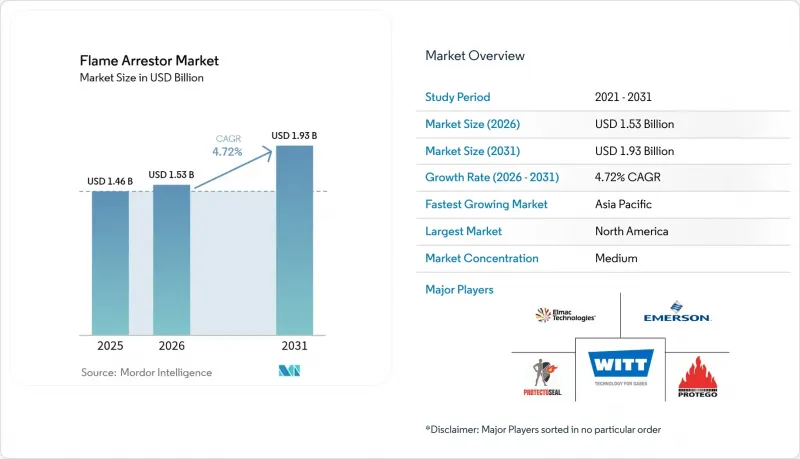
에 의하면, 화염 방지기 시장 규모는 2025년 14억 6,000만 달러로 평가되었습니다. 2026년에는 15억 3,000만 달러로 확대되어 2026년부터 2031년에 걸쳐 CAGR 4.72%로 성장을 지속하여, 2031년에는 19억 3,000만 달러에 이를 것으로 예측됩니다.
본 보고서는 유형별(인라인식 어레스터, 엔드 오브 라인식 어레스터, 복합형/스파크 어레스터), 소재별(스테인리스 스틸, 탄소강, 알루미늄, 니켈·특수합금), 최종 사용자(석유 및 가스,화학제품 및 석유화학제품, 제약·바이오기술, 광업 및 금속, 식품 및 음료 등), 지역(북미, 유럽, 아시아태평양, 남미 등)별로 분류되어 있습니다.
세계의 화염 방지기 시장 동향 및 인사이트
수소 미드스트림 인프라의 방폭 규정
현재 미국, 유럽, 아시아의 수소 안전 체계에서는 저장 탱크, 벤트 헤더 및 이동식 충전 장치에 화염 방지기 설치를 의무화하고 있으며, 이것이 화염 방지기 시장의 다음 투자 붐을 주도하고 있습니다. FMVSS 307 및 308과 같은 기술 지침에 따라, 차량용 탱크 공급업체는 충돌 시 화염의 역류를 방지하기 위해 화염 방지기가 내장된 열작동식 장치를 장착해야 합니다. 유엔 세계 기술 규정 제13호도 이러한 규정을 따르고 있으며, 소화 거리, 최대 실험 안전 간격 및 압력 펄스 내성에 관한 시험 프로토콜을 통일하고 있습니다. 이러한 규정의 조화가 진행됨에 따라, 사업자들은 기존의 벤트 스크린을 훨씬 더 엄격한 공차로 가공된 인증된 내폭성 모델로 교체하도록 권장받고 있습니다. 700 bar를 초과하는 수소 압력 하에서 성능을 검증할 수 있는 공급업체는 중기적으로 플레임 어레스터 시장을 뒷받침할 초기 프레임워크 계약을 확실히 확보하고 있습니다.
아시아태평양(APAC) 및 중동·북아프리카(MENA) 지역의 정유시설 개조 증가
중국, 인도, 사우디아라비아, 아랍에미리트(UAE)의 정유시설 소유주들은 황 및 벤젠 배출 상한 기준을 충족하기 위해 증기 제어 라인의 업그레이드를 추진하고 있으며, 이는 인라인형 폭발 방지 장치 및 라인 말단의 탱크 벤트에 대한 대규모 발주로 직결되고 있습니다. 사업자들은 기본 설계 단계에서 ISO 16852 시험을 완료한 장비를 지정하고 있으므로, 신규 진공 가스오일 수소화 처리 설비 및 지연 코크스 설비 모두에 다점식 화염 방지 장치가 예산에 반영되어 있습니다. 저장성 및 주바이르의 원유에서 화학제품에 이르는 복합 시설에 걸친 장기 자본 투자 계획에 따라 2020년대 후반까지 수요가 전망되는 상황이며, 화염 방지기 시장을 목표로 하는 공급업체에게는 견실한 수주 잔고가 유지되고 있습니다.
사워 가스 사용 환경에서 발생하는 막힘 및 압력 손실로 인한 고장
황화수소 흐름은 화염 방지 장치의 유로 내부에서 피칭 및 유황 침적을 가속화하여 압력 손실의 급격한 변화를 유발하고, 유량 확보 및 안전 여유를 저해하는 원인이 됩니다. NACE MR0175 규격 준수가 요구되는 사업자는 종종 니켈 합금 재질의 내부 구조를 채택하지만, 이로 인해 자본 비용이 80-120% 증가하기 때문에 수익성이 낮은 유전에서의 도입이 억제되고 있습니다. 또한, 파울링 증가로 인해 세척 주기가 분기마다 단축되며, 그 결과 가동 중단 시간 증가와 예비 부품 재고 증가로 이어집니다. 그 결과, 일부 E&P 기업들은 업그레이드를 연기하고 있으며, 이는 화염 방지기 시장의 단기적인 판매량 증가세를 둔화시키고 있습니다.
부문별 분석
공정 배관 내에 직접 설치되는 인라인형은 양방향 보호 기능으로 인해 유동 상태를 방해하지 않고 지속적인 처리 능력을 유지할 수 있기 때문에 2025년에는 매출의 57.30%를 차지했습니다. 이 점유율은 엄격한 연소 격리 규정이 적용되는 원유 증류 설비, 압축기 스테이션, 수소 충전소 등에서 확고하게 정착된 도입 현황을 반영하고 있습니다. 인라인형 화염 방지기 시장 규모는 브라운필드(기존 시설) 개보수의 상당 부분이 여전히 동급 제품으로의 교체를 기본으로 하고 있기 때문에 시장 전체의 연평균 성장률(CAGR) 4.72%에 따라 크게 확대될 것으로 예측됩니다.
복합형/스파크형 어레스터는 연평균 성장률(CAGR) 7.2%가 예상되며, 이는 다른 모든 유형을 능가하는 속도입니다. 이는 사업자들이 압력 및 진공 배출 기능과 소화 기능을 단일 노즐에 통합한 하드웨어를 중시하기 때문입니다. 선박용 벙커 매니폴드 및 용제 회수 드라이어는 설치 면적, 중량 및 유지보수 접근성이 제한되는 이용 사례의 대표적인 예입니다. 선박용 LNG 연료 공급이 주류를 이루게 됨에 따라, 이러한 소형 어셈블리는 특히 공급업체가 극저온 열 사이클에 대한 가혹한 사용 환경에서의 내구성을 인증할 수 있는 경우, 프레임 아레스터 시장에서 점유율을 더욱 확대할 것으로 전망됩니다.
지역별 분석
북미는 NFPA(미국 화재방지협회) 규격의 채택, 미국의 정유시설 수명 연장 프로젝트, 그리고 멕시코만 연안의 LNG 수출 터미널 건설 확대에 힘입어 2025년 매출의 34.60%를 차지했습니다. 보험사가 보험료를 문서화된 검증 프로토콜에 연동하고 있기 때문에 이 지역은 SIL(안전 수준) 인증 업그레이드에 있어 주요 애프터마켓으로 남아 있습니다.
아시아태평양은 중국이 하루 120만 배럴을 초과하는 신규 원유-화학제품 복합 시설을 가동하고, 인도가 ‘바랏 스테이지 VI’ 연료로의 업그레이드를 추진함에 따라 6.55%라는 가장 높은 연평균 성장률(CAGR)을 나타낼 전망입니다. 이러한 확장 프로젝트에서는 부지 계획 단계부터 화염 방지 대책이 반영되어 있으며, 시설당 설치 대수가 증가하고 평균 판매 가격도 상승하고 있어, 이 지역은 화염 방지기 시장 전망 수요를 견인할 것으로 전망됩니다.
유럽에서는 북해 및 발트해 전역의 LNG 선박 연료 공급 허브를 통해 꾸준한 성장이 지속되고 있으며, 러시아에서는 지정학적 역풍이 있음에도 불구하고 기존 정유시설의 유지보수 수요가 폭발 방지 관련 틈새 개조 수요를 뒷받침하고 있습니다. 라틴아메리카와 아프리카에서는 브라질의 석유화학 산업, 아르헨티나의 셰일 가스, 사우디아라비아의 콘덴세이트 분리 장치, 그리고 남아프리카공화국의 광업 분야 메탄 감축 프로젝트에 힘입어 완만한 성장세를 보이고 있으며, 이 모든 요인이 종합적으로 프레임 아레스터 시장 세계 시장 범위를 확대되고 있습니다.
기타 혜택 :
- 엑셀 형식 시장 예측(ME) 시트
- 3개월간의 애널리스트 지원
자주 묻는 질문
목차
제1장 서론
제2장 분석 방법
제3장 개요
제4장 시장 구도
제5장 시장 규모 및 성장률 예측
제6장 경쟁 구도
제7장 시장 기회 및 향후 전망
KTH 26.08.31According to Mordor Intelligence, the flame arrestor market size is expected to grow from USD 1.46 billion in 2025 to USD 1.53 billion in 2026 and is forecast to reach USD 1.93 billion by 2031 at 4.72% CAGR over 2026-2031.
This report is Segmented by Type (In-Line Arrestor, End-Of-Line Arrestor, Combination/Spark Arrestor), Material (Stainless Steel, Carbon Steel, Aluminum, and Nickel and Exotic Alloys), End User (Oil and Gas, Chemicals and Petrochemicals, Pharmaceutical and Biotechnology, Mining and Metals, Food and Beverage, and More), and Geography (North America, Europe, Asia-Pacific, South America, and More).
Global Flame Arrestor Market Trends and Insights
Explosion-Proof Mandates in Hydrogen Mid-Stream Infrastructure
Hydrogen safety frameworks across the United States, Europe, and Asia now specify the installation of flame arrestors in storage vessels, vent headers, and mobile refuelers, driving the next wave of spending in the flame arrestor market. Technical guidance, such as FMVSS 307 and 308, obliges vehicle tank suppliers to embed thermally activated devices with integrated arrestors to stop flame front regression in crash scenarios. The UN Global Technical Regulation 13 echoes these provisions, harmonizing testing protocols on quenching distance, maximum experimental safe gap, and pressure-pulse survivability. These converging rulesets are nudging operators to replace legacy vent screens with certified detonation-proof models machined to far tighter tolerances. Vendors able to validate performance in hydrogen at pressures above 700 bar are securing early framework contracts that underpin the flame arrestors market for the medium term.
Rising Refinery Upgrades in APAC & MENA
Refinery owners in China, India, Saudi Arabia, and the United Arab Emirates are upgrading their vapor control trains to meet sulfur and benzene emission caps, which translates directly into larger purchase orders for in-line detonation arrestors and end-of-line tank vents. Operators are specifying ISO 16852-tested units during basic engineering phases, so every new vacuum gas-oil hydrotreater or delayed coker is budgeted with multi-point flame protection. Long-cycle capital programs spanning crude-to-chemicals complexes in Zhejiang and Jubail are securing demand visibility into the late 2020s, sustaining a robust backlog for suppliers targeting the flame arrestor market.
Clogging & Pressure-Drop Failures in Sour-Gas Service
Hydrogen sulfide streams accelerate pitting and sulfur deposition inside arrestor passages, causing step-changes in pressure drop that undermine flow assurance and safety margins. Operators meeting NACE MR0175 compliance often resort to nickel-alloy internals, which increase capital costs by 80-120%, thereby restraining adoption among marginal fields. Elevated fouling also shortens cleaning cycles to quarterly intervals, resulting in increased downtime and higher spares inventory. Consequently, some E&P firms postpone upgrades, denting short-term volume growth in the flame arrestors market.
Other drivers and restraints analyzed in the detailed report include:
- Electrification-Driven Solvent Recovery in Battery Gigafactories
- Accelerated LNG Bunkering Adoption in Marine Sector
- Scarcity of Detonable-Grade Test Labs Outside OECD
For complete list of drivers and restraints, kindly check the Table Of Contents.
Segment Analysis
In-line designs, positioned directly within process piping, secured 57.30% revenue in 2025 as their bidirectional protection supports continuous throughput without disrupting flow regimes. This share reflects entrenched deployment across crude distillation units, compressor stations, and hydrogen dispensers, each governed by rigorous deflagration-isolation rules. The flame arrestors market size for in-line units is projected to expand significantly, in line with the overall 4.72% CAGR, as most brownfield upgrades still default to like-for-like replacement.
Combination or spark-integrated arrestors are slated for a 7.2% CAGR, outpacing all other formats as operators value consolidated hardware that merges pressure-vacuum relief with flame quenching in a single nozzle. Marine bunkering manifolds and solvent-recovery dryers illustrate use cases where footprint, weight, and maintenance access are constrained. As maritime LNG fueling becomes mainstream, these compact assemblies are poised to capture an incremental share of the flame arrestors market, especially when vendors can certify severe-duty endurance against cryogenic thermal cycles.
Complete Report Scope:
- By Type
- In-line Arrestor
- Deflagration In-line Arrestor
- Detonation In-line Arrestor
- End-of-line Arrestor
- Vent-stack Arrestor
- Tank-breather Arrestor
- Combination/Spark Arrestor
- In-line Arrestor
- By Material
- Stainless Steel
- Carbon Steel
- Aluminum
- Nickel and Exotic Alloys
- By End User
- Oil and Gas
- Chemicals and Petrochemicals
- Pharmaceutical and Biotechnology
- Mining and Metals
- Power Generation
- Water and Waste-water
- Food and Beverage
- Others (Marine, Aerospace and Defense)
- By Geography
- North America
- United States
- Canada
- Mexico
- Europe
- Germany
- United Kingdom
- France
- Russia
- Rest of Europe
- Asia Pacific
- China
- India
- Japan
- South Korea
- ASEAN Countries
- Rest of Asia Pacific
- South America
- Brazil
- Argentina
- Rest of South America
- Middle East and Africa
- Saudi Arabia
- United Arab Emirates
- South Africa
- Rest of Middle East and Africa
- North America
Geography Analysis
North America generated 34.60% of 2025 revenue, driven by NFPA adoption, refinery life-extension projects in the United States, and LNG export terminal buildouts on the Gulf Coast. The region remains the principal aftermarket for SIL-rated upgrades because insurers tie premiums to documented validation protocols.
Asia-Pacific is forecast to generate the fastest 6.55% CAGR as China commissions new crude-to-chemicals complexes exceeding 1.2 million barrels per day and India upgrades Bharat Stage VI fuels. These expansions embed flame protection from the plot plan phase, boosting unit counts per facility and raising average selling prices, positioning the region as the future demand engine for the flame arrestors market.
Europe sustains steady growth through LNG marine bunkering hubs across the North Sea and Baltic, while Russia's brownfield refinery maintenance supports niche detonation-rated retrofits despite geopolitical headwinds. Latin America and Africa post modest gains, driven by Brazilian petrochemicals, Argentine shale gas, Saudi condensate splitters, and South African methane-abatement projects in mining, collectively broadening the global footprint of the flame arrestors market.
- Emerson Electric (Enardo)
- Elmac Technologies
- PROTEGO Braunschweiger Flammenfilter
- Protectoseal
- WITT-Gasetechnik
- Cashco
- Paradox IP
- Groth Corporation
- L&J Technologies
- Parker Hannifin (Veriflo)
- BS&B Safety Systems
- Kimray
- D-KTC Fluid Control
- Flammer GmbH
- Sunflow Technologies
- Sureseal
- Dresser Natural Gas Solutions
- Paladon Systems
- Essex Industries
- Detronics
Additional Benefits:
- The market estimate (ME) sheet in Excel format
- 3 months of analyst support
TABLE OF CONTENTS
1 Introduction
- 1.1 Study Assumptions & Market Definition
- 1.2 Scope of the Study
2 Research Methodology
3 Executive Summary
4 Market Landscape
- 4.1 Market Overview
- 4.2 Market Drivers
- 4.2.1 Explosion-proof mandates in hydrogen mid-stream infrastructure
- 4.2.2 Rising refinery upgrades in APAC & MENA
- 4.2.3 Electrification-driven solvent recovery in battery gigafactories
- 4.2.4 Accelerated LNG bunkering adoption in marine sector
- 4.2.5 Tightening NFPA 69 testing intervals (North America)
- 4.2.6 Insurance-premium discounts linked to SIL-rated arrestors
- 4.3 Market Restraints
- 4.3.1 Clogging & pressure-drop failures in sour-gas service
- 4.3.2 Scarcity of detonable-grade test labs outside OECD
- 4.3.3 Shift to intrinsic-safe sensors replacing small arrestors in VOC vents
- 4.3.4 High NACE-compliant alloy costs
- 4.4 Supply-Chain Analysis
- 4.5 Regulatory Landscape
- 4.6 Technological Outlook
- 4.7 Porter's Five Forces
- 4.7.1 Bargaining Power of Suppliers
- 4.7.2 Bargaining Power of Buyers
- 4.7.3 Threat of New Entrants
- 4.7.4 Threat of Substitutes
- 4.7.5 Intensity of Competitive Rivalry
5 Market Size & Growth Forecasts
- 5.1 By Type
- 5.1.1 In-line Arrestor
- 5.1.1.1 Deflagration In-line Arrestor
- 5.1.1.2 Detonation In-line Arrestor
- 5.1.2 End-of-line Arrestor
- 5.1.2.1 Vent-stack Arrestor
- 5.1.2.2 Tank-breather Arrestor
- 5.1.3 Combination/Spark Arrestor
- 5.1.1 In-line Arrestor
- 5.2 By Material
- 5.2.1 Stainless Steel
- 5.2.2 Carbon Steel
- 5.2.3 Aluminum
- 5.2.4 Nickel and Exotic Alloys
- 5.3 By End User
- 5.3.1 Oil and Gas
- 5.3.2 Chemicals and Petrochemicals
- 5.3.3 Pharmaceutical and Biotechnology
- 5.3.4 Mining and Metals
- 5.3.5 Power Generation
- 5.3.6 Water and Waste-water
- 5.3.7 Food and Beverage
- 5.3.8 Others (Marine, Aerospace and Defense)
- 5.4 By Geography
- 5.4.1 North America
- 5.4.1.1 United States
- 5.4.1.2 Canada
- 5.4.1.3 Mexico
- 5.4.2 Europe
- 5.4.2.1 Germany
- 5.4.2.2 United Kingdom
- 5.4.2.3 France
- 5.4.2.4 Russia
- 5.4.2.5 Rest of Europe
- 5.4.3 Asia Pacific
- 5.4.3.1 China
- 5.4.3.2 India
- 5.4.3.3 Japan
- 5.4.3.4 South Korea
- 5.4.3.5 ASEAN Countries
- 5.4.3.6 Rest of Asia Pacific
- 5.4.4 South America
- 5.4.4.1 Brazil
- 5.4.4.2 Argentina
- 5.4.4.3 Rest of South America
- 5.4.5 Middle East and Africa
- 5.4.5.1 Saudi Arabia
- 5.4.5.2 United Arab Emirates
- 5.4.5.3 South Africa
- 5.4.5.4 Rest of Middle East and Africa
- 5.4.1 North America
6 Competitive Landscape
- 6.1 Market Concentration
- 6.2 Strategic Moves (M&A, Partnerships, PPAs)
- 6.3 Market Share Analysis (Market Rank/Share for key companies)
- 6.4 Company Profiles (includes Global level Overview, Market level overview, Core Segments, Financials as available, Strategic Information, Products & Services, and Recent Developments)
- 6.4.1 Emerson Electric (Enardo)
- 6.4.2 Elmac Technologies
- 6.4.3 PROTEGO Braunschweiger Flammenfilter
- 6.4.4 Protectoseal
- 6.4.5 WITT-Gasetechnik
- 6.4.6 Cashco
- 6.4.7 Paradox IP
- 6.4.8 Groth Corporation
- 6.4.9 L&J Technologies
- 6.4.10 Parker Hannifin (Veriflo)
- 6.4.11 BS&B Safety Systems
- 6.4.12 Kimray
- 6.4.13 D-KTC Fluid Control
- 6.4.14 Flammer GmbH
- 6.4.15 Sunflow Technologies
- 6.4.16 Sureseal
- 6.4.17 Dresser Natural Gas Solutions
- 6.4.18 Paladon Systems
- 6.4.19 Essex Industries
- 6.4.20 Detronics
7 Market Opportunities & Future Outlook
- 7.1 White-space & Unmet-need Assessment


