

|
시장보고서
상품코드
2116004
싱가포르의 항공우주 및 방위 : 시장 점유율 분석, 업계 동향 및 통계, 성장 예측(2026-2031년)Singapore Aerospace And Defense - Market Share Analysis, Industry Trends & Statistics, Growth Forecasts (2026 - 2031) |
||||||
 Mordor Intelligence
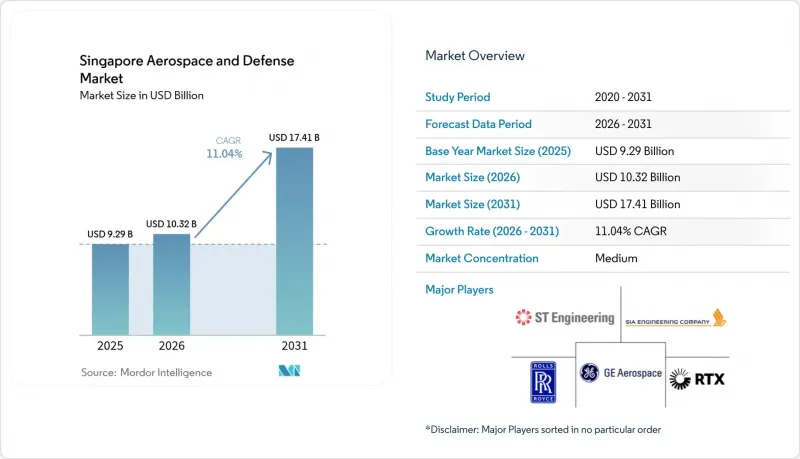
싱가포르의 항공우주 및 방위 시장 규모는 2025년 92억 9,000만 달러로 평가되었습니다. 2026년에는 103억 2,000만 달러로 확대되어 2026년부터 2031년에 걸쳐 CAGR 11.04%로 성장을 지속하여, 2031년에는 174억 1,000만 달러에 이를 것으로 예측됩니다.
본 보고서는 업종별(제조, 설계·엔지니어링 등), 유형별(항공우주 및 방위), 최종 사용자별(민간, 군사 등), 플랫폼별(고정익기, 회전익기, 무인항공기(UAV), 지상 시스템, 해군 시스템 등)로 분류되어 있습니다. 시장 예측은 금액(미 달러) 기준으로 제시되어 있습니다.
싱가포르의 항공우주 및 방위 시장 동향 및 인사이트
2030년까지의 견조한 국방 예산 증가
국내총생산(GDP)의 약 3%에 해당하는 연간 예산이 기체 군의 갱신, 스마트 훈련 시설 및 기지 인프라에 대해 예측 가능한 장기적인 자금 지원을 제공합니다. 2025 회계연도의 234억 싱가포르 달러(180억 9,000만 달러) 예산 항목 중 193억 4,000만 싱가포르 달러(151억 9,000만 달러)가 운용 및 유지보수에 배정되어, 이를 통해현지 항공우주 부품 수리 업체에 안정적인 업무량이 보장되고 있습니다. 2022년 대비 43% 증가한 별도의 개발 예산은 격납고 자동화 및 디지털 사격장 계측 장비에 투입되어, 첨단 제조 업체들의 수주 전망에 대한 확실성을 높이고 있습니다.
싱가포르 세계 허브 MRO 사업의 회복
창이 공항의 여객 수가 정상화됨에 따라 정비 공장으로 입고되는 항공기 대수는 팬데믹 이전의 최고 수준으로 회복되었습니다. SIA 엔지니어링이 주요 항공사와 체결한 장기 서비스 계약은 거래 기반의 MRO 수익 안정성을 보여주고 있으며, 또한 직원 수가 2019년 당시의 95% 이상으로 회복된 것이 처리 능력 회복을 뒷받침하고 있습니다. 싱가포르 에어로 엔진 서비스(SAES)의 최신 확장 계획에 따라 500명의 숙련된 기술자 직위가 추가되고, 차세대 엔진 모듈의 기술력이 국내에 도입됨에 따라 이 도시 국가가 전 세계 MRO 매출에서 차지하는 두 자릿수 점유율이 유지될 것입니다.
토지 부족과 기술자 고령화
2030년까지 파야 레바르 공군 기지가 폐쇄됨에 따라 800헥타르의 부지가 도시 재개발에 활용될 예정이지만, 그와 동시에 항공우주 관련 사업은 창이 및 텐가 지역에 집중될 것입니다. 새로운 다층 격납고와 자동 공구 크레인은 공간 부족을 일부 해소하는 한편, 자본 집약도를 높이고 있습니다. 한편, 인구 동향의 변화로 인해 항공우주 분야 졸업생은 연간 1,700명만이 노동 시장에 진입하고 있는 반면, 수요는 2,500명에 달하고 있습니다. 이에 따라 싱가포르의 항공우주산업협회(Association of Aerospace Industries Singapore)가 후원하는신입사원 대상 채용 활동과 경력직 대상 재교육 프로그램이 실시되고 있습니다.
부문별 분석
2025년, 정비·수리·정비(MRO) 부문은 싱가포르의 항공우주 및 방위 시장의 62.03%를 차지했습니다. 이는 30년에 걸쳐 축적된 노하우와 130개 이상의 서비스 제공업체로 구성된 생태계를 반영한 것입니다. 이러한 견고한 기반을 바탕으로, 8개국 34개 공항을 아우르는 엔진 모듈, 착륙 장치, 항공전자기기 관련 계약이 꾸준히 유지되고 있습니다. 이 부문의 수익은 현재 GE에서 세계 최대의 부품 수리 거점이 된 GE 에어로스페이스의 ‘스마트 팩토리’와, 복합재 팬 블레이드 수리 능력을 도입하는 싱가포르 에어로 엔진 서비스(Singapore Aero Engine Services)의 1억 8,000만 달러 규모 시설 확장에 의해 뒷받침되고 있습니다.
제조, 설계, 엔지니어링 분야는 롤스로이스가 모든 와이드코드 팬 블레이드를 영국 외 지역인 싱가포르에서 제조하기로 결정한 것과, 프랫 앤 휘트니가 기어드 터보팬 부품의 생산 능력을 확대하고 있는 데 힘입어 2031년까지 연평균 성장률(CAGR) 14.41%로 성장하고 있습니다. 또한, 봄바르디아의 29만 제곱피트 규모 서비스 센터 확장은 고부가가치 OEM 브랜드의 지원 솔루션으로의 전환을 뒷받침하는 호재로 작용하고 있습니다. 연구개발(R&D) 테스트베드와 생산 라인이 긴밀하게 연계되어 있기 때문에 A*STAR 공동 연구소에서 검증된 적층 가공 부품은 대부분의 경우 그대로 생산 단계로 넘어가, 혁신에서 시장 출시까지의 주기를 단축하고 있습니다.
항공우주 부문은 창이 공항이 대륙 간 환승 허브 역할을 수행하고 있으며, 셀레타 항공우주 공원에 70개 이상의 OEM 및 Tier 1 기업이 집적되어 있다는 점을 배경으로 2025년 매출의 71.62%를 차지했습니다. 2022년 이후 2억 1,000만 싱가포르 달러(1억 6,494만 달러)에 달하는 정부 보조금이 소형 위성의 페이로드, 지상국 분석, 우주 상황 인식 서비스를 지원하며, 기존의 민간 항공 분야를 넘어선 사업 다각화에 기여하고 있습니다.
싱가포르 공군이 20대의 F-35 파생형을 도입하고, 해군이 ‘인빈시블’급 잠수함을 6척까지 증강함에 따라, 방위 분야의 매출액은 2031년까지 연평균 성장률(CAGR) 12.18%로 확대되고 있습니다. 이러한 프로젝트를 통해 복합재 항공 구조물의 수리, 스텔스 코팅 유지보수, 수중 음향 시스템에 대한 수요가 증가하고 있으며, MRO 전문가들은 기존 민간 분야에서 축적한 노하우를 활용하여 새로운 군사 분야의 업무에 대응할 수 있게 될 것입니다.
기타 혜택 :
- 엑셀 형식 시장 예측(ME) 시트
- 3개월간의 애널리스트 지원
자주 묻는 질문
목차
제1장 서론
제2장 조사 방법
제3장 개요
제4장 시장 구도
제5장 시장 규모 및 성장 예측
제6장 경쟁 구도
제7장 시장 기회 및 향후 전망
KTH 26.08.31According to Mordor Intelligence, the Singapore aerospace and defense market size is expected to grow from USD 9.29 billion in 2025 to USD 10.32 billion in 2026 and is forecast to reach USD 17.41 billion by 2031 at 11.04% CAGR over 2026-2031.
This report is Segmented by Industry (Manufacturing, Design, and Engineering, and More), Type (Aerospace and Defense), End User (Commercial, Military, and More), Platform (Fixed-Wing Aircraft, Rotary-Wing Aircraft, Unmanned Aerial Vehicles (UAVs), Land Systems, Naval Systems, and More). The Market Forecasts are Provided in Terms of Value (USD).
Singapore Aerospace And Defense Market Trends and Insights
Robust Defense-Budget Growth Through 2030
Annual appropriations of roughly 3% of gross domestic product provide predictable long-cycle funding for fleet upgrades, smart training facilities, and base infrastructure. FY2025's SGD 23.4 billion (USD 18.09 billion) line-item channels SGD 19.34 billion (USD 15.19 billion) into operations and maintenance, guaranteeing steady workloads for local aerospace-component repair shops. A separate development vote, up 43% since 2022, finances hangar automation and digital range instrumentation, reinforcing order visibility for advanced-manufacturing vendors.
Rebound of Singapore's Global-Hub MRO Business
Shop-visit volumes have returned to pre-pandemic peaks as Changi Airport passenger flows normalise. SIA Engineering's long-term services agreements with major carriers illustrate the stability of transaction-based MRO revenues, while workforce restoration to more than 95% of 2019 staffing underpins throughput recovery. Singapore Aero Engine Services' latest expansion will add 500 skilled positions and bring next-generation engine-module competencies onshore, preserving the city-state's double-digit share of worldwide MRO billings.
Land Scarcity and Ageing Technician Base
The closure of Paya Lebar Air Base by 2030 will release 800 hectares for urban redevelopment but compress aerospace operations into Changi and Tengah zones. New multi-story hangars and automated tool cranes partly offset the spatial squeeze yet raise capital intensity. Meanwhile, demographic shifts mean only 1,700 aerospace graduates enter the workforce yearly against demand for 2,500, prompting early-career outreach and mid-career conversion programmes sponsored by the Association of Aerospace Industries Singapore.
Other drivers and restraints analyzed in the detailed report include:
- Dual-Use R&D Incentives Under "Manufacturing 2030"
- Engine-OEM Capacity Expansions Deepening the Supply Chain
- Export-Control Pressures on Avionics and Chips
For complete list of drivers and restraints, kindly check the Table Of Contents.
Segment Analysis
The maintenance, repair, and overhaul (MRO) segment controlled 62.03% of the Singapore aerospace and defense market in 2025, reflecting three decades of accumulated know-how and an ecosystem of more than 130 service providers. That heft translates into a resilient baseline of engine-module, landing-gear, and avionics contracts covering 34 airports across eight countries. Segment revenue is reinforced by GE Aerospace's Smart Factory, now the single-largest GE component-repair site worldwide, and by Singapore Aero Engine Services' USD 180 million footprint enlargement that inaugurates composite fan-blade restoration capabilities.
Manufacturing, design, and engineering are growing at a 14.41% CAGR through 2031, propelled by Rolls-Royce's decision to build every wide-chord fan blade outside Britain in Singapore and Pratt & Whitney lifting geared-turbofan component capacity. Additional lift comes from Bombardier's 290,000-sq-ft service centre upgrade, underscoring the move toward high-value, OEM-branded support solutions. Close coupling between R&D testbeds and industrial lines means additive-manufactured parts validated in A*STAR's joint labs often transition straight into production, compressing the innovation-to-market cycle.
The aerospace segment contributed 71.62% of 2025 revenue, underpinned by Changi's role as an intercontinental transfer hub and by Seletar Aerospace Park's cluster of more than 70 OEM and tier-one tenants. Government grants worth SGD 210 million (USD 164.94 million) since 2022 support small-satellite payloads, ground-station analytics, and space-situational-awareness services, helping diversify beyond traditional civil aviation.
Defense revenues are expanding at a 12.18% CAGR through 2031 as the Republic of Singapore Air Force inducts 20 F-35 variants and the Navy grows to six Invincible-class submarines. These projects push requirements for composite-aerostructure repair, stealth-coating maintenance, and underwater acoustic systems, allowing MRO specialists to leverage existing civil capabilities for new military workloads.
Complete Report Scope:
- By Industry
- Manufacturing, Design, and Engineering
- Maintenance, Repair, and Overhaul (MRO)
- By Type
- Aerospace
- Aviation
- Space
- Defense
- Aerospace
- By End User
- Commercial
- Military
- Government (Non-military)
- Private and Business Aviation
- By Platform
- Fixed-Wing Aircraft
- Rotary-Wing Aircraft
- Unmanned Aerial Vehicles (UAVs)
- Land Systems
- Naval Systems
- Missiles and Precision Munitions
- Space Platforms and Launchers
List of Companies Covered in this Report:
- Singapore Technologies Engineering Ltd.
- SIA Engineering Company Limited
- Airbus SE
- The Boeing Company
- Rolls-Royce plc
- RTX Corporation
- General Electric Company
- Lockheed Martin Corporation
- Bombardier Inc.
- L3Harris Technologies, Inc.
- Textron Aviation Inc.
- Curtiss-Wright Corporation
- Moog Inc.
- Safran SA
- Thales Group
- Leonardo S.p.A.
- Elbit Systems Ltd.
- Israel Aerospace Industries Ltd.
- Wemark Techno Engineering Pte Ltd.
- Strategic Marine (S) Pte Ltd.
Additional Benefits:
- The market estimate (ME) sheet in Excel format
- 3 months of analyst support
TABLE OF CONTENTS
1 INTRODUCTION
- 1.1 Study Assumptions and Market Definition
- 1.2 Scope of the Study
2 RESEARCH METHODOLOGY
3 EXECUTIVE SUMMARY
4 MARKET LANDSCAPE
- 4.1 Market Overview
- 4.2 Market Drivers
- 4.2.1 Robust defense-budget growth through 2030
- 4.2.2 Rebound of Singapore's global-hub MRO business
- 4.2.3 Dual-use R&D incentives under "Manufacturing 2030"
- 4.2.4 Engine-OEM capacity expansions deepening supply chain
- 4.2.5 Government-funded small-satellite and space-tech testbeds
- 4.2.6 SAF "Island-in-a-Box" autonomous training ranges
- 4.3 Market Restraints
- 4.3.1 Land-scarcity and ageing technician base
- 4.3.2 US-China export-control pressures on avionics and chips
- 4.3.3 High operating costs versus emerging SE-Asian hubs
- 4.3.4 Volatile regional tensions altering procurement timing
- 4.4 Value Chain Analysis
- 4.5 Regulatory Landscape
- 4.6 Technological Outlook
- 4.7 Porter's Five Forces Analysis
- 4.7.1 Threat of New Entrants
- 4.7.2 Bargaining Power of Buyers
- 4.7.3 Bargaining Power of Suppliers
- 4.7.4 Threat of Substitutes
- 4.7.5 Intensity of Competitive Rivalry
5 MARKET SIZE AND GROWTH FORECASTS (VALUE)
- 5.1 By Industry
- 5.1.1 Manufacturing, Design, and Engineering
- 5.1.2 Maintenance, Repair, and Overhaul (MRO)
- 5.2 By Type
- 5.2.1 Aerospace
- 5.2.1.1 Aviation
- 5.2.1.2 Space
- 5.2.2 Defense
- 5.2.1 Aerospace
- 5.3 By End User
- 5.3.1 Commercial
- 5.3.2 Military
- 5.3.3 Government (Non-military)
- 5.3.4 Private and Business Aviation
- 5.4 By Platform
- 5.4.1 Fixed-Wing Aircraft
- 5.4.2 Rotary-Wing Aircraft
- 5.4.3 Unmanned Aerial Vehicles (UAVs)
- 5.4.4 Land Systems
- 5.4.5 Naval Systems
- 5.4.6 Missiles and Precision Munitions
- 5.4.7 Space Platforms and Launchers
6 COMPETITIVE LANDSCAPE
- 6.1 Market Concentration
- 6.2 Strategic Moves
- 6.3 Market Share Analysis
- 6.4 Company Profiles (includes global-level overview, core segments, financials, strategic info, products and services, recent developments)
- 6.4.1 Singapore Technologies Engineering Ltd.
- 6.4.2 SIA Engineering Company Limited
- 6.4.3 Airbus SE
- 6.4.4 The Boeing Company
- 6.4.5 Rolls-Royce plc
- 6.4.6 RTX Corporation
- 6.4.7 General Electric Company
- 6.4.8 Lockheed Martin Corporation
- 6.4.9 Bombardier Inc.
- 6.4.10 L3Harris Technologies, Inc.
- 6.4.11 Textron Aviation Inc.
- 6.4.12 Curtiss-Wright Corporation
- 6.4.13 Moog Inc.
- 6.4.14 Safran SA
- 6.4.15 Thales Group
- 6.4.16 Leonardo S.p.A.
- 6.4.17 Elbit Systems Ltd.
- 6.4.18 Israel Aerospace Industries Ltd.
- 6.4.19 Wemark Techno Engineering Pte Ltd.
- 6.4.20 Strategic Marine (S) Pte Ltd.
7 MARKET OPPORTUNITIES AND FUTURE OUTLOOK
- 7.1 White-space and Unmet-Need Assessment


