

|
시장보고서
상품코드
2116029
광섬유 부품 : 시장 점유율 분석, 업계 동향 및 통계, 성장 예측(2026-2031년)Fiber Optic Component - Market Share Analysis, Industry Trends & Statistics, Growth Forecasts (2026 - 2031) |
||||||
 Mordor Intelligence
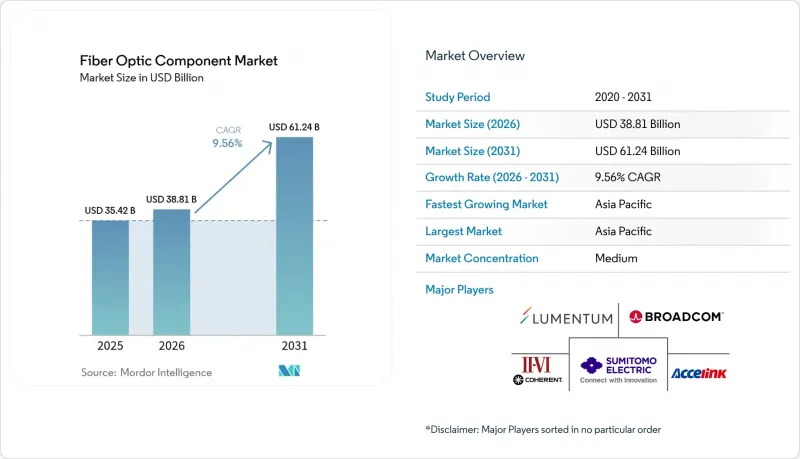
Mordor Intelligence에 의하면, 광섬유 부품 시장 규모는 2026년에 388억 1,000만 달러로 추정되고 2025년 354억 2,000만 달러에서 확대해, 2031년에는 612억 4,000만 달러에 이를 것으로 예측됩니다.
2026년부터 2031년까지 연평균 성장률(CAGR) 9.56%로 성장할 것으로 전망됩니다.
본 보고서는 유형별(케이블, 증폭기, 스플리터,액티브 광케이블, 커넥터, 트랜시버, 기타), 용도(분산 센싱, 통신, 분석·의료기기, 조명), 최종 사용자(통신 사업자, 하이퍼스케일 및 엔터프라이즈 데이터센터, 산업 및 에너지, 헬스케어 및 생명과학, 국방·항공우주), 그리고 지역별로 분류되어 있습니다.
세계의 광섬유 부품 시장 동향 및 인사이트
하이퍼스케일 데이터센터의 광섬유 교체 물결
급증하는 생성형 AI 훈련 클러스터에는 기존 클라우드 노드보다 훨씬 더 고밀도인 광 인터커넥트가 요구되고 있습니다. 코닝(Corning)은 2025년 1분기 광통신 부문 매출이 전년 동기 대비 46% 증가한 13억 6,000만 달러에 달했다고 보고했습니다. 이는 단일 데이터센터 사업자에게 코닝사의 전 세계 광섬유 생산량의 10%를 공급하는 다년간공급 계약에 힘입은 결과입니다. 2024년 2분기 광트랜시버 출하액은 30억 달러를 넘어, 2019년 이후 가장 높은 전분기 대비 매출 실적을 기록했습니다. 각 벤더들은 800G 및 1.6T 광 모듈을 중심으로 리프 앤 스파인 아키텍처의 재설계를 진행하고 있으며, 이를 위해서는 케이블 트레이 내에 더 높은 품질의 굽힘 내성 광섬유가 필요합니다. 이러한 변화로 인해 저손실 광섬유에 대한 수요가 증가하면서 코패키지드 옵틱스의 수주가 확대되고 있습니다. 이 광범위한 리프레시 사이클 덕분에 부품 공급업체들의 향후 몇 년간 전망이 더욱 명확해지고 있습니다.
5G 프론트홀 및 백홀의 고밀도화
대규모 독립형 5G의 전개로 인해 무선 헤드에서 베이스밴드 유닛에 이르는 광섬유 수가 두 배로 증가하고 있습니다. 태국의 ‘빌리지 브로드밴드 인터넷’ 이니셔티브에서는 2025년 3월까지 2만 4,700개의 외딴 지역 커뮤니티에 광섬유를 확장했습니다. 말레이시아의 국가 광대역 프로젝트(총액 210억 링깃(44억 달러))에서는 2024년 12월 기준으로 대상 시설의 60%가 광섬유로 업그레이드되었습니다. 스미토모 전기공업의 0.07밀리초 컨버터는 프론트홀 연동에 필요한 시간 동기화의 정밀도를 향상시킵니다. 프리즈미안의 최신형 초고밀도 리본 케이블은 통신 사업자가 제한된 덕트 내에 더 많은 광섬유를 수용할 수 있게 해줍니다(프리즈미안 그룹). 이러한 전개에 따라 네트워크 토폴로지는 분산형 아키텍처로 변모하고 있으며, 커넥터, 클로저 및 저지연 케이블에 대한 수요가 증가하고 있습니다.
인듐 인화물 및 갈륨 비소 화합물의 에피택셜 용량 부족
2023년 중국이 갈륨 및 게르마늄 수출 규제를 시행한 결과, 현물 가격은 각각 250%, 75% 상승했습니다. 미국 지질조사국(USGS)의 추산에 따르면, 규제가 완전히 시행될 경우 GDP에 34억 달러의 타격이 가해질 가능성이 있습니다. 텍사스주에 위치한 코히런트(Coherent)사의 새로운 6인치 인듐 인화물 웨이퍼 생산 라인은 풀 가동 시 비용을 60% 절감하고 웨이퍼 1장당 다이 생산량을 4배로 늘릴 것으로 기대됩니다. 프라운호퍼 ISE의 InP-on-GaAs 기판은 웨이퍼 비용을 80% 절감하고 8인치 파일럿 생산을 가능하게 합니다. 그러나 설비 도입 주기가 단기적인 공급 완화를 제한하고 있기 때문에 수탁 제조업체들은 수익성이 높은 트랜시버 고객을 우선시할 수밖에 없어 저속 부품의 납기일을 연장해야 하는 상황입니다.
부문별 분석
광케이블은 메트로 및 장거리 백본에서의 확고한 도입에 힘입어 2025년 광섬유 부품 시장에서 40.62%의 점유율을 유지했습니다. 이 부문의 광섬유 부품 시장 규모는 143억 9,000만 달러에 달하며, 대규모 정부 자금 지원에 따른 구축에서 수동형 케이블에 대한 지출이 지배적임을 반영합니다. 그러나 하이퍼스케일 사업자들이 서버 랙 내의 완전 통합형 및 플러그인 가능한 링크로 전환함에 따라, 능동형 광케이블은 2031년까지 연평균 성장률(CAGR) 10.97%를 나타낼 것으로 전망됩니다. 증폭기 및 스플리터에 대한 수요는 기존 회선의 지점 간 업그레이드에 계속 의존하고 있으며, 특히 정부가 자금을 지원하는 지방의 네트워크 확장 프로젝트에서 두드러집니다.
코패키지드 옵틱스의 채택으로 인해 액티브 케이블은 대역폭 확장을 위한 단거리 엔진으로 변모하고 있습니다. 코닝(Corning)은 102.4T 스위치 인클로저를 대상으로 전력 최적화 커넥터를 통합한 Gen-AI 파이버 어셈블리를 발표했습니다. 트랜시버 제조업체들은 디지털 신호 프로세서와 포토닉 다이를 통합함으로써 실적를 축소하는 동시에 에너지 효율을 높이고 있습니다. 이에 따라 액티브 부문은 100미터 미만의 데이터 통신 거리에서 기존의 트렁크 회선을 대체함으로써 점차 시장 점유율을 확대되고 있습니다. 유리 인발에 대한 전문 지식과 모듈 통합 기술을 모두 갖춘 공급업체는 향후 설계 수주를 확보할 수 있을 것으로 전망됩니다.
지역별 분석
아시아태평양은 2025년에 광섬유 부품 시장의 38.74%를 차지하며 연평균 성장률(CAGR) 10.44%로 성장하고 있습니다. 중국의 50G 패시브 광 네트워크 구축과 10기가비트 도시 프로그램으로 인해 광 회선 종단 장치의 용량이 비약적으로 증가하고 있습니다. 일본 정보통신연구기구(NICT)는 1,808km에 걸친 1.02 Pbit/s 전송 실험에 성공하여, 기존의 지상 광섬유가 장거리 AI 트래픽을 처리할 수 있음을 입증했습니다. 정부의 보조금 덕분에 인도와 필리핀 등 신흥국에서는 라스트 마일 광섬유 구축 자금이 확보되어, 거시경제가 둔화되는 시기에도 기초적인 수요가 유지되고 있습니다.
북미는 버지니아주의 데이터센터 코리도 및 오리건주의 재생에너지를 활용한 서버 팜 내 하이퍼스케일 캠퍼스 확장에 힘입어, 지역별로는 두 번째로 큰 기여도를 보이고 있습니다. 미국의 ‘광대역 형평성, 접근성 및 구축(BEAD)’ 프로그램은 서비스가 제공되지 않는 지역에 424억 5,000만 달러를 배정하고, 실현 가능한 지역에서는 광섬유 설치를 의무화하고 있습니다. 보스턴과 시카고의 양자 네트워크 테스트베드에서는 이미 설치된 다크 파이버를 활용한 초안전한 키 배포 실증이 진행되고 있으며, 이는 초저손실 케이블이라는 새로운 카테고리의 보급을 촉진하고 있습니다.
유럽에서는 산업 자동화와 양자 보안 조치가 적용된 정부 간 통신이 중시되고 있습니다. 독일에서는 리피터를 사용하지 않고, 기존 도이치 텔레콤의 광섬유 회선(총 길이 76킬로미터)을 통해 양자 통신 실증에 성공했습니다. 영국의 태스크포스는 2025년 4월, 410킬로미터에 달하는 양자 보안 조치가 적용된 영상 전송을 실현했습니다. 남유럽의 유틸리티 회사는 광섬유 기반 SCADA(감시 제어 시스템) 업그레이드에 투자하고 있는 반면, 북유럽 국가들은 풍부한 수력발전을 활용하여 AI 클러스터를 유치함으로써 코패키지형 광모듈 수요를 창출하고 있습니다. 라틴아메리카, 중동 및 아프리카는 현재 규모는 작지만, 해저 케이블 상륙 및 데이터센터에 대한 우대 조치가 확대됨에 따라 두 자릿수 성장을 기록하고 있습니다.
기타 혜택 :
- 엑셀 형식 시장 예측(ME) 시트
- 3개월간의 애널리스트 지원
자주 묻는 질문
목차
제1장 서론
제2장 조사 방법
제3장 개요
제4장 시장 구도
제5장 시장 규모 및 성장 예측
제6장 경쟁 구도
제7장 시장 기회 및 향후 전망
KTH 26.08.31According to Mordor Intelligence, fiber optic component market size in 2026 is estimated at USD 38.81 billion, growing from 2025 value of USD 35.42 billion with 2031 projections showing USD 61.24 billion, growing at 9.56% CAGR over 2026-2031.
This report is Segmented by Type (Cables, Amplifiers, Splitters, Active Optical Cables, Splitters, Connectors, Transceivers, and Others), Application (Distributed Sensing, Communications, Analytical and Medical Equipment, and Lighting), End-User (Telecom Operators, Hyperscale and Enterprise Data Centers, Industrial and Energy, Healthcare and Life-Sciences, and Defense and Aerospace), and Geography.
Global Fiber Optic Component Market Trends and Insights
Hyperscale-data-center fiber refresh wave
Surging generative-AI training clusters require far denser optical interconnects than legacy cloud nodes. Corning reported a 46% year-over-year jump in optical-communications revenue to USD 1.36 billion during Q1 2025, underpinned by a multi-year supply agreement that reserves 10% of its global fiber output for a single data-center operator. Optical transceiver shipments exceeded USD 3 billion in Q2 2024, marking the strongest sequential revenue performance since 2019. Equipment vendors are redesigning leaf-and-spine architectures around 800 G and 1.6 T optics, which requires higher-grade bend-insensitive fiber inside cable trays. These shifts elevate demand for low-loss fiber types and advance orders for co-packaged optics. The broad refresh cycle increases visibility for component suppliers over a multi-year horizon.
5G fronthaul and backhaul densification
Wide-scale standalone 5G rollouts multiply fiber counts from radio head to baseband unit. Thailand's Village Broadband Internet initiative extended fiber to 24,700 remote communities by March 2025. Malaysia's national broadband project, valued at MYR 21 billion (USD 4.4 billion), upgraded 60% of premises to fiber as of December 2024. Sumitomo Electric's 0.07-millisecond converter improves the time-synchronization precision needed for fronthaul coordination. Prysmian's latest ultra-high-density ribbon cables help operators push more fibers into constrained ducts Prysmian Group. These deployments transform network topologies toward distributed architectures, lifting demand for connectors, closures, and low-latency cables.
Shortage of indium-phosphide and gallium-arsenide epi-capacity
China's export restriction on gallium and germanium in 2023 lifted spot prices by 250% and 75%, respectively. The U.S. Geological Survey calculated a potential USD 3.4 billion GDP hit if bans become absolute. Coherent's new six-inch indium-phosphide wafer line in Texas promises 60% cost reduction once fully ramped, quadrupling die output per wafer. Fraunhofer ISE's InP-on-GaAs substrates lower wafer costs by 80% and enable eight-inch pilot runs. Even so, tooling cycles limit near-term relief, forcing contract manufacturers to prioritize high-margin transceiver customers and extend delivery windows on lower-speed parts.
Other drivers and restraints analyzed in the detailed report include:
- AI/ML optics accelerating PAM4 and co-packaged integration
- Rapid FTTH expansion in emerging markets
- Geopolitical export controls are fragmenting global supply chains
For complete list of drivers and restraints, kindly check the Table Of Contents.
Segment Analysis
Optical cables retained a 40.62% share of the fiber optic component market in 2025, driven by entrenched deployments in metro and long-haul backbones. The fiber optic component market size for this segment reached USD 14.39 billion, reflecting the dominance of passive cable spending in large state-funded rollouts. However, active optical cables post an 10.97% CAGR to 2031 as hyperscale operators migrate to fully integrated, pluggable links inside server racks. Demand for amplifiers and splitters remains tied to point-to-point upgrades on existing routes, particularly where governments finance rural reach projects.
Adoption of co-packaged optics turns active cables into short-reach engines of bandwidth scaling. Corning introduced Gen-AI fiber assemblies with integrated power-optimized connectors aimed at 102.4 T switch enclosures. Transceiver makers bundle digital signal processors with photonic dies, shrinking footprint while lifting energy efficiency. The active segment thereby captures incremental share by substituting traditional trunks at datacom distances below 100 meters. Suppliers that couple glass-drawing expertise with module integration stand to gain follow-on design wins.
Complete Report Scope:
- By Type
- Cables
- Amplifiers
- Active Optical Cables
- Splitters
- Connectors
- Transceivers
- Others
- By Application
- Distributed Sensing
- Communications
- Analytical and Medical Equipment
- Lighting
- By End-user
- Telecom Operators
- Hyperscale and Enterprise Data Centers
- Industrial and Energy
- Healthcare and Life-Sciences
- Defense and Aerospace
- By Geography
- North America
- United States
- Canada
- Mexico
- South America
- Brazil
- Argentina
- Rest of South America
- Europe
- Germany
- United Kingdom
- France
- Russia
- Rest of Europe
- Asia-Pacific
- China
- Japan
- India
- South Korea
- Rest of Asia-Pacific
- Middle East and Africa
- United Arab Emirated
- Saudi Arabia
- South Africa
- Nigeria
- Rest of Middle East and Africa
- North America
Geography Analysis
Asia Pacific held 38.74% of the fiber optic component market in 2025 and is growing at 10.44% CAGR. China's 50 G passive optical network rollout and 10-gigabit city program create step-function increases in optical-line-terminal capacity. Japan's National Institute of Information and Communications Technology demonstrated 1.02 Pbit/s transmission across 1,808 kilometers, proving that existing terrestrial fiber can meet long-haul AI traffic. Government subsidies ensure that emerging economies such as India and the Philippines fund last-mile fiber, sustaining baseline demand even during macro-slowdowns.
North America is the second-largest regional contributor, buoyed by hyperscale campus expansions in Virginia's data-center corridor and Oregon's renewable-powered server farms. The U.S. Broadband Equity, Access, and Deployment (BEAD) program allocates USD 42.45 billion for unserved areas, mandating fiber where feasible. Quantum-network testbeds in Boston and Chicago validate ultra-secure key distribution over installed dark fiber, catalysing new categories of ultra-low-loss cabling.
Europe emphasizes industrial automation and quantum-safe government links. Germany recorded quantum communications over existing Deutsche Telekom fiber spanning 76 kilometers without repeaters. The UK taskforce achieved 410-kilometer quantum-secure video transmission in April 2025. Southern European utility firms invest in fiber-based SCADA upgrades, while the Nordics leverage abundant hydropower to attract AI clusters, thereby drawing co-packaged optics demand. Latin America and the Middle East & Africa remain smaller today but log double-digit growth as undersea cable landings and data-center incentives proliferate.
- Lumentum Holdings Inc.
- Broadcom Inc.
- Coherent Corp. (II-VI)
- Sumitomo Electric Industries Ltd.
- Accelink Technologies
- Fujitsu Optical Components
- Source Photonics
- NeoPhotonics (Cisco)
- O-Net Technologies
- Corning Incorporated
- Prysmian Group
- Sterlite Technologies
- Hisense Broadband
- Innolight Technology
- EMCORE Corporation
- Reflex Photonics
- FiberHome Telecommunication
- Huawei Technologies
- Mwtechnologies LDA
- OptiEnz Sensors
Additional Benefits:
- The market estimate (ME) sheet in Excel format
- 3 months of analyst support
TABLE OF CONTENTS
1 INTRODUCTION
- 1.1 Study Assumptions and Market Definition
- 1.2 Scope of the Study
2 RESEARCH METHODOLOGY
3 EXECUTIVE SUMMARY
4 MARKET LANDSCAPE
- 4.1 Market Overview
- 4.2 Market Drivers
- 4.2.1 Hyperscale-data-center fibre refresh wave
- 4.2.2 5G fronthaul/backhaul densification
- 4.2.3 AI/ML optics Greater than 800 Gb accelerating PAM4/Co-Packaged Optics
- 4.2.4 Rapid FTTH rollout in emerging APAC and Africa
- 4.2.5 Government-funded rural broadband programs (US, EU)
- 4.2.6 Quantum-safe network pilots demanding ultra-low-loss fibre
- 4.3 Market Restraints
- 4.3.1 Shortage of indium-phosphide and gallium-arsenide epi-capacity
- 4.3.2 Geopolitical export controls on advanced photonics to China
- 4.3.3 Cyber-physical vandalism risk on long-haul fibre routes
- 4.3.4 Growing adoption of hollow-core fibre as substitute
- 4.4 Value/Supply-Chain Analysis
- 4.5 Regulatory Landscape
- 4.6 Technological Outlook
- 4.7 Porter's Five Forces Analysis
- 4.7.1 Bargaining Power of Suppliers
- 4.7.2 Bargaining Power of Buyers
- 4.7.3 Threat of New Entrants
- 4.7.4 Threat of Substitutes
- 4.7.5 Intensity of Competitive Rivalry
5 MARKET SIZE AND GROWTH FORECASTS (VALUE)
- 5.1 By Type
- 5.1.1 Cables
- 5.1.2 Amplifiers
- 5.1.3 Active Optical Cables
- 5.1.4 Splitters
- 5.1.5 Connectors
- 5.1.6 Transceivers
- 5.1.7 Others
- 5.2 By Application
- 5.2.1 Distributed Sensing
- 5.2.2 Communications
- 5.2.3 Analytical and Medical Equipment
- 5.2.4 Lighting
- 5.3 By End-user
- 5.3.1 Telecom Operators
- 5.3.2 Hyperscale and Enterprise Data Centers
- 5.3.3 Industrial and Energy
- 5.3.4 Healthcare and Life-Sciences
- 5.3.5 Defense and Aerospace
- 5.4 By Geography
- 5.4.1 North America
- 5.4.1.1 United States
- 5.4.1.2 Canada
- 5.4.1.3 Mexico
- 5.4.2 South America
- 5.4.2.1 Brazil
- 5.4.2.2 Argentina
- 5.4.2.3 Rest of South America
- 5.4.3 Europe
- 5.4.3.1 Germany
- 5.4.3.2 United Kingdom
- 5.4.3.3 France
- 5.4.3.4 Russia
- 5.4.3.5 Rest of Europe
- 5.4.4 Asia-Pacific
- 5.4.4.1 China
- 5.4.4.2 Japan
- 5.4.4.3 India
- 5.4.4.4 South Korea
- 5.4.4.5 Rest of Asia-Pacific
- 5.4.5 Middle East and Africa
- 5.4.5.1 United Arab Emirated
- 5.4.5.2 Saudi Arabia
- 5.4.5.3 South Africa
- 5.4.5.4 Nigeria
- 5.4.5.5 Rest of Middle East and Africa
- 5.4.1 North America
6 COMPETITIVE LANDSCAPE
- 6.1 Market Concentration
- 6.2 Strategic Moves
- 6.3 Market Share Analysis
- 6.4 Company Profiles (includes Global level Overview, Market level overview, Core Segments, Financials as available, Strategic Information, Market Rank/Share for key companies, Products and Services, and Recent Developments)
- 6.4.1 Lumentum Holdings Inc.
- 6.4.2 Broadcom Inc.
- 6.4.3 Coherent Corp. (II-VI)
- 6.4.4 Sumitomo Electric Industries Ltd.
- 6.4.5 Accelink Technologies
- 6.4.6 Fujitsu Optical Components
- 6.4.7 Source Photonics
- 6.4.8 NeoPhotonics (Cisco)
- 6.4.9 O-Net Technologies
- 6.4.10 Corning Incorporated
- 6.4.11 Prysmian Group
- 6.4.12 Sterlite Technologies
- 6.4.13 Hisense Broadband
- 6.4.14 Innolight Technology
- 6.4.15 EMCORE Corporation
- 6.4.16 Reflex Photonics
- 6.4.17 FiberHome Telecommunication
- 6.4.18 Huawei Technologies
- 6.4.19 Mwtechnologies LDA
- 6.4.20 OptiEnz Sensors
7 MARKET OPPORTUNITIES AND FUTURE OUTLOOK
- 7.1 White-space and Unmet-need Assessment


