

|
시장보고서
상품코드
2116052
전력 관리 시스템 시장 : 시장 점유율 분석, 업계 동향 및 통계, 성장 예측(2026-2031년)Power Management System - Market Share Analysis, Industry Trends & Statistics, Growth Forecasts (2026 - 2031) |
||||||
 Mordor Intelligence
Mordor Intelligence에 의하면, 전력 관리 시스템(PMS) 시장 규모는 2025년 71억 2,000만 달러로 평가되었고, 2026년에는 76억 1,000만 달러로 추정되고, 2026-2031년 CAGR 6.89%로 성장을 지속할 전망이며, 2031년에는 106억 2,000만 달러에 이를 것으로 예측됩니다.
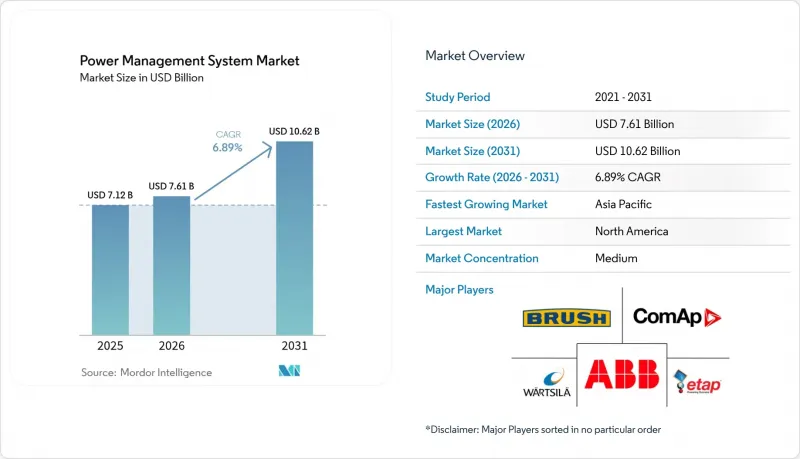
본 보고서는 구성 요소별(전력 모니터링·제어, 부하 차단·관리, 데이터 히스토리언/고급 분석 등), 전력 아키텍처별(집중형 PMS, 분산형 PMS, 모듈형/하이브리드형 PMS), 최종 사용자 산업별(유틸리티, 데이터센터, 석유 및 가스, 선박·오프쇼어, 기타), 그리고 지역별(북미, 유럽, 아시아태평양, 남미, 기타)로 분류되어 있습니다.
세계의 전력 관리 시스템 시장 동향 및 인사이트
산업 규모의 에너지 효율화 프로그램에 대한 규제 압력
현재 미국에서는 상업용 보일러에 최소 성능 기준이 적용되고 있으며, 가스 연소 설비에는 80%, 석유 연소 시스템에는 81%의 열효율이 요구되고 있습니다. 일본의 ‘에너지 효율화법’에서는 지정 공장에 대해 인증 에너지 매니저의 임명과 연례 실적 보고서 제출을 의무화하고 있으며, 이를 통해 체계적인 에너지 절약이 촉진되어 초기 도입 단계에서 26%의 에너지 절약 효과를 달성하고 있습니다. EU 전역에 유사한 규제가 도입됨에 따라 디지털을 활용한 개조가 가속화되고, 각 공장이 실시간 에너지 성능을 기록하기 위해 경쟁하는 가운데 전력 관리 시스템 시장이 강화되고 있습니다.
재생에너지의 급속한 계통 연계가 계통 안정화 솔루션을 촉진
2050년까지 간헐적인 태양광 및 풍력 발전이 전 세계 서비스 부하 전력의 57%를 공급할 것으로 예측되어, 기존의 주파수 제어 패러다임에 과제를 안겨주고 있습니다. 하이브리드 에너지 저장 시스템과 결합된 유연한 교류 송전 시스템은 기존 설계에 비해 안정성을 30% 향상시키고, 총 고조파 왜곡을 2% 미만으로 낮춥니다. 이러한 기술적 진보로 인해 마이크로그리드 전체에서 변동하는 수급 균형을 조정하는 첨단 오케스트레이션 소프트웨어의 도입이 촉진되어 전력 관리 시스템 시장을 견인하고 있습니다.
높은 초기 도입 비용 및 개조 비용
예산 제약으로 인해, 자본 회수 기간이 이사회의 일반적인 기대를 초과하는 가격에 민감한 경제권에서는 도입 속도가 둔화되고 있습니다. 중규모 발전소의 경우, 설비 및 통합에 드는 비용이 100만 달러를 초과하기도 하여, CFO는 디지털 개조를 연기할 수밖에 없는 상황에 몰리고 있습니다. 정부의 인센티브로 인해 부담의 일부는 경감되고 있지만, 자금 조달 격차는 여전히 존재하여 전력 관리 시스템 시장의 확장을 일시적으로 둔화시키고 있습니다.
부문 분석
전력 모니터링 및 제어 분야는 2025년에 23억 6,000만 달러 시장 규모를 기록하며, 전체 전력 관리 시스템 시장의 33.10%를 차지했습니다. 브레이커 상태 모니터링 및 피더 계측에는 기존 SCADA 플랫폼이 여전히 필수적이지만, 사업자들의 히스토리안 데이터베이스 도입이 확대되면서 거점 간 벤치마킹이 가능해졌습니다. ‘데이터 히스토리안/고급 분석’ 부문은 AI 기반 예측 모델을 통해 계획되지 않은 가동 중단 시간을 줄이고 에너지 낭비를 억제함으로써 연평균 성장률(CAGR) 10.62%로 가장 빠른 성장 궤도를 그리며, 2031년까지 26억 6,000만 달러에 달할 것으로 예측됩니다. 부하 차단 및 관리 도구는 규칙 기반 로직에 비해 과도한 부하 감축을 30% 줄여주는 최적화 알고리즘을 활용하여 산업의 회복탄력성을 향상시키고 있습니다. 발전기 제어는 마이크로그리드 도입에서 중요성이 커지고 있으며, GE의 ‘PowerNode’는 IEC 61850 GOOSE 메시징을 통해 사이버 경계를 보호하면서 15밀리초 이내에 보호적 부하 차단 조치를 시작합니다.
통합 제품군은 현재 모니터링, 히스토리안, 최적화 모듈을 클라우드 지원 대시보드에 통합하여 전력 관리 시스템 시장을 플랫폼 경제로 이끌고 있습니다. 벤더는 보안 API를 통합하여 타사 개발자가 핵심 데이터 서비스 위에 용도를 구축할 수 있도록 하고 있습니다. ABB의 SACE Emax 3 차단기는 전력 품질 지표를 히스토리안 파이프라인에 직접 가져옴으로써 이러한 변화를 구현하고 있습니다. 탈탄소화 규제가 강화되는 가운데, 분석 모듈은 배출 감축량을 정량화하고 수요 반응 크레딧을 금전적 가치로 환산함으로써 신규 건설 사양에서의 채택률을 높이고 있습니다.
지역별 분석
북미는 2025년 매출의 32.40%를 차지한 것으로 평가되었으며, 그 배경에는 ‘인플레이션 억제법’과 30GW를 초과하는 신규 데이터센터 전력 계약 파이프라인이 있습니다. 연방 정부의 인센티브에 힘입어 슈나이더 일렉트릭은 미국 내 제조 거점 확장을 위해 7억 달러를 투자하여 국내 공급 탄력성을 강화하고 있습니다. 캐나다의 ‘에너지 효율 산업 파트너십’은 ISO 50001 도입 보조금을 지원하고 있으며, 한편 멕시코의 변압기 투자는 지역적 병목 현상 완화에 기여하고 있습니다.
유럽에서는 기업의 지속가능성 보고를 의무화하고 에코디자인 규정을 엄격화하는 까다로운 규제 환경이 유지되고 있으며, 독일, 프랑스, 영국 전역에서 안정적인 수요가 지속되고 있습니다. 독일의 산업 자동화 업그레이드에서는 히스토리안 기반 OEE 대시보드가 도입되고 있는 반면, 영국에서는 Ofgem의 혁신 프로그램을 통해 자금을 지원받은 스마트 그리드 시범 사업이 추진되고 있습니다. ‘기업 지속가능성 보고 지침(CSRD)’에 따라 기업들은 상세한 에너지 데이터를 ESG 워크플로우에 통합해야 하며, 이로 인해 전력 관리 시스템 시장 전반에 걸쳐 분석 기술 도입이 촉진되고 있습니다.
아시아태평양은 연평균 성장률(CAGR) 8.98%를 나타낼 것으로 전망됩니다. 중국의 전국 전력 시장에서는 2025년 초 녹색 전력 거래량이 220 TWh를 넘어설 것으로 예상되며, 이에 따라 전력 사업자들은 AI를 활용한 발전 계획 도입을 가속화하고 있습니다. 인도는 ‘Perform, Achieve, and Trade(PAT)’ 제도 하에서 산업용 에너지 효율 향상을 추진하고 있으며, 일본과의 ‘탑러너(Top Runner)’ 협정을 통해 2027년까지 변압기 효율을 11.4% 향상시키는 것을 목표로 하고 있습니다. 일본의 화학 산업 클러스터에서는 공장 전반에 걸친 IIoT 도입이 진행되고 있는 반면, 호주에서는 외딴 지역의 광산 운영을 지원하기 위해 통합형 마이크로그리드의 시범 운영이 이루어지고 있습니다.
기타 혜택 :
- 엑셀 형식 시장 예측(ME) 시트
- 3개월간 애널리스트 지원
자주 묻는 질문
목차
제1장 서론
제2장 조사 방법
제3장 개요
제4장 시장 구도
제5장 시장 규모 및 성장 예측
제6장 경쟁 구도
제7장 시장 기회 및 향후 전망
AJY 26.09.01According to Mordor Intelligence, the power management system market size is expected to grow from USD 7.12 billion in 2025 to USD 7.61 billion in 2026 and is forecast to reach USD 10.62 billion by 2031 at 6.89% CAGR over 2026-2031.
This report is Segmented by Component (Power Monitoring and Control, Load Shedding and Management, Data Historian/Advanced Analytics, and More), Power-Architecture (Centralised PMS, Distributed PMS, and Modular/Hybrid PMS), End-User Industry (Utilities, Data Centres, Oil and Gas, Marine and Offshore, and More), and Geography (North America, Europe, Asia Pacific, South America, and More).
Global Power Management System Market Trends and Insights
Regulatory Pressure for Industrial-Scale Energy Efficiency Programs
Minimum performance standards now apply to commercial furnaces in the United States, requiring 80% thermal efficiency for gas-fired units and 81% for oil-fired systems. Japan's Energy Efficiency Act obliges designated factories to appoint certified energy managers and submit annual performance reports, fostering systematic energy savings that have reached 26% in early deployments.Similar mandates across the EU accelerate digital retrofits and strengthen the power management system market as plants race to document real-time energy performance.
Rapid Renewable-Grid Integration Driving Grid-Stability Solutions
Intermittent solar and wind are forecast to supply 57% of global service-load electricity by 2050, challenging conventional frequency-control paradigms. Flexible AC transmission systems paired with hybrid storage deliver 30% stability improvements and cut total harmonic distortion below 2% compared with legacy designs. These technical gains stimulate procurement of advanced orchestration software that balances variable supply and demand across microgrids, bolstering the power management system market.
High Upfront System & Retrofit Costs
Budget constraints slow adoption in price-sensitive economies where capital recovery timelines exceed typical board expectations. Equipment plus integration outlays can exceed USD 1 million for a mid-sized plant, pressuring CFOs to delay digital retrofits. Government incentives mitigate some burden, yet financing gaps persist, temporarily tempering the expansion of the power management system market.
Other drivers and restraints analyzed in the detailed report include:
- Exponential Rise of Hyperscale & AI Data-Center Power Demand
- Wide-Bandgap (SiC/GaN) Semiconductors Slash Switching Losses
- Escalating Cyber-Security & Data-Sovereignty Risks
For complete list of drivers and restraints, kindly check the Table Of Contents.
Segment Analysis
Power Monitoring & Control booked USD 2.36 billion in 2025, equivalent to 33.10% of the power management system market size. Legacy SCADA platforms remain indispensable for breaker status and feeder metering; however, operators are increasingly overlaying historian databases that unlock cross-site benchmarking. Data Historian/Advanced Analytics is projected to have the quickest trajectory, with a 10.62% CAGR, reaching USD 2.66 billion by 2031, as AI-driven predictive models reduce unplanned downtime and cut energy waste. Load Shedding and Management tools leverage optimisation algorithms that trim load overcut by 30% compared to rule-based logic, sharpening industrial resiliency. Generator Controls gain relevance in microgrid deployments, with GE's PowerNode initiating protective load-sheds within 15 milliseconds while safeguarding cyber-perimeters through IEC 61850 GOOSE messaging.
Integrated suites now converge monitoring, historian, and optimisation modules into cloud-ready dashboards, steering the power management system market toward platform economics. Vendors embed secure APIs, allowing third-party developers to build applications on top of core data services. ABB's SACE Emax 3 breaker showcases this shift by exposing energy-quality metrics directly into historian pipelines. As decarbonisation mandates tighten, analytics modules quantify avoided emissions and monetise demand-response credits, elevating their share of new-build specifications.
Complete Report Scope:
- By Component
- Power Monitoring and Control
- Load Shedding and Management
- Energy Cost Accounting and Optimisation
- Switching and Safety Management
- Generator Controls
- Data Historian/Advanced Analytics
- By Power-Architecture
- Centralised PMS
- Distributed PMS
- Modular / Hybrid PMS
- By End-User Industry
- Utilities
- Data Centres
- Oil and Gas
- Marine and Offshore
- Metals and Mining
- Chemicals and Pharmaceuticals
- Others (Manufacturing, Healthcare, Telecom)
- By Geography
- North America
- United States
- Canada
- Mexico
- Europe
- Germany
- United Kingdom
- France
- Italy
- Spain
- NORDIC Countries
- Russia
- Rest of Europe
- Asia Pacific
- China
- India
- Japan
- South Korea
- ASEAN Countries
- Rest of Asia Pacific
- South America
- Brazil
- Argentina
- Chile
- Rest of South America
- Middle East and Africa
- Saudi Arabia
- United Arab Emirates
- South Africa
- Nigeria
- Egypt
- Rest of Middle East and Africa
- North America
Geography Analysis
North America contributed 32.40% of 2025 revenue, underpinned by the Inflation Reduction Act and a pipeline of more than 30 GW in new data-center power agreements. Federal incentives have encouraged Schneider Electric to commit USD 700 million toward U.S. manufacturing expansion, enhancing domestic supply resilience. Canada's Industry Partnership for Energy Conservation sponsors ISO 50001 adoption grants, while Mexican transformer investments mitigate regional bottlenecks.
Europe maintains a stringent regulatory environment that mandates corporate sustainability reporting and tightens eco-design rules, sustaining steady demand across Germany, France, and the United Kingdom. Industrial automation upgrades in Germany deploy historian-driven OEE dashboards, whereas the U.K. pushes smart-grid pilots funded by Ofgem innovation programs. The Corporate Sustainability Reporting Directive drives enterprises to integrate granular energy data into ESG workflows, thereby strengthening the uptake of analytics throughout the power management system market.
Asia-Pacific region is poised for a 8.98% CAGR. China's national power market saw green-electricity trading exceed 220 TWh in early 2025, spurring utilities to adopt AI-enabled dispatch planning. India advances industrial energy efficiency under the Perform, Achieve, and Trade scheme and commits to achieving 11.4% transformer efficiency gains by 2027 through Japan's Top Runner collaboration. Japan's chemical clusters embrace factory-wide IIoT overlays, while Australia pilots integrated microgrids to support remote mining operations.
- ABB Ltd
- Siemens Energy
- Schneider Electric SE
- General Electric Vernova
- Mitsubishi Electric Corporation
- Eaton Corporation plc
- Emerson Electric Co.
- Wartsila Oyj Abp
- ComAp AS
- ETAP / Operation Technology Inc.
- Rockwell Automation
- Honeywell International Inc.
- Yokogawa Electric Corporation
- SEL Schweitzer Engineering Labs
- Kongsberg Gruppen ASA
- RH Marine Netherlands BV
- INTECH Process Automation Inc.
- Marine Control Services
- Delta Electronics Inc.
- Texas Instruments (PMIC business)
Additional Benefits:
- The market estimate (ME) sheet in Excel format
- 3 months of analyst support
TABLE OF CONTENTS
1 Introduction
- 1.1 Study Assumptions & Market Definition
- 1.2 Scope of the Study
2 Research Methodology
3 Executive Summary
4 Market Landscape
- 4.1 Market Overview
- 4.2 Market Drivers
- 4.2.1 Regulatory pressure for industrial?scale energy efficiency programs
- 4.2.2 Rapid renewable?grid integration driving grid-stability solutions
- 4.2.3 Exponential rise of hyperscale & AI data-center power demand
- 4.2.4 Digitalisation/IIoT enabling real-time optimisation & analytics
- 4.2.5 Wide-bandgap (SiC/GaN) semiconductors slash switching losses
- 4.2.6 Corporate PPAs create micro-grid complexity needing PMS orchestration
- 4.3 Market Restraints
- 4.3.1 High upfront system & retrofit costs
- 4.3.2 Escalating cyber-security & data-sovereignty risks
- 4.3.3 Transformer & switchgear supply-chain bottlenecks
- 4.3.4 Legacy OT/IT interoperability barriers
- 4.4 Supply-Chain Analysis
- 4.5 Regulatory Landscape
- 4.6 Technological Outlook
- 4.7 Porter's Five Forces
- 4.7.1 Bargaining Power of Suppliers
- 4.7.2 Bargaining Power of Buyers
- 4.7.3 Threat of New Entrants
- 4.7.4 Threat of Substitutes
- 4.7.5 Intensity of Competitive Rivalry
5 Market Size & Growth Forecasts
- 5.1 By Component
- 5.1.1 Power Monitoring and Control
- 5.1.2 Load Shedding and Management
- 5.1.3 Energy Cost Accounting and Optimisation
- 5.1.4 Switching and Safety Management
- 5.1.5 Generator Controls
- 5.1.6 Data Historian/Advanced Analytics
- 5.2 By Power-Architecture
- 5.2.1 Centralised PMS
- 5.2.2 Distributed PMS
- 5.2.3 Modular / Hybrid PMS
- 5.3 By End-User Industry
- 5.3.1 Utilities
- 5.3.2 Data Centres
- 5.3.3 Oil and Gas
- 5.3.4 Marine and Offshore
- 5.3.5 Metals and Mining
- 5.3.6 Chemicals and Pharmaceuticals
- 5.3.7 Others (Manufacturing, Healthcare, Telecom)
- 5.4 By Geography
- 5.4.1 North America
- 5.4.1.1 United States
- 5.4.1.2 Canada
- 5.4.1.3 Mexico
- 5.4.2 Europe
- 5.4.2.1 Germany
- 5.4.2.2 United Kingdom
- 5.4.2.3 France
- 5.4.2.4 Italy
- 5.4.2.5 Spain
- 5.4.2.6 NORDIC Countries
- 5.4.2.7 Russia
- 5.4.2.8 Rest of Europe
- 5.4.3 Asia Pacific
- 5.4.3.1 China
- 5.4.3.2 India
- 5.4.3.3 Japan
- 5.4.3.4 South Korea
- 5.4.3.5 ASEAN Countries
- 5.4.3.6 Rest of Asia Pacific
- 5.4.4 South America
- 5.4.4.1 Brazil
- 5.4.4.2 Argentina
- 5.4.4.3 Chile
- 5.4.4.4 Rest of South America
- 5.4.5 Middle East and Africa
- 5.4.5.1 Saudi Arabia
- 5.4.5.2 United Arab Emirates
- 5.4.5.3 South Africa
- 5.4.5.4 Nigeria
- 5.4.5.5 Egypt
- 5.4.5.6 Rest of Middle East and Africa
- 5.4.1 North America
6 Competitive Landscape
- 6.1 Market Concentration
- 6.2 Strategic Moves (M&A, Partnerships, PPAs)
- 6.3 Market Share Analysis (Market Rank/Share for key companies)
- 6.4 Company Profiles (includes Global level Overview, Market level overview, Core Segments, Financials as available, Strategic Information, Products & Services, and Recent Developments)
- 6.4.1 ABB Ltd
- 6.4.2 Siemens Energy
- 6.4.3 Schneider Electric SE
- 6.4.4 General Electric Vernova
- 6.4.5 Mitsubishi Electric Corporation
- 6.4.6 Eaton Corporation plc
- 6.4.7 Emerson Electric Co.
- 6.4.8 Wartsila Oyj Abp
- 6.4.9 ComAp AS
- 6.4.10 ETAP / Operation Technology Inc.
- 6.4.11 Rockwell Automation
- 6.4.12 Honeywell International Inc.
- 6.4.13 Yokogawa Electric Corporation
- 6.4.14 SEL Schweitzer Engineering Labs
- 6.4.15 Kongsberg Gruppen ASA
- 6.4.16 RH Marine Netherlands BV
- 6.4.17 INTECH Process Automation Inc.
- 6.4.18 Marine Control Services
- 6.4.19 Delta Electronics Inc.
- 6.4.20 Texas Instruments (PMIC business)
7 Market Opportunities & Future Outlook
- 7.1 White-space & Unmet-Need Assessment


